Category: Records

  • Are Vinyl Records Recyclable? Let’s Find Out!

    Are Vinyl Records Recyclable? Let’s Find Out!

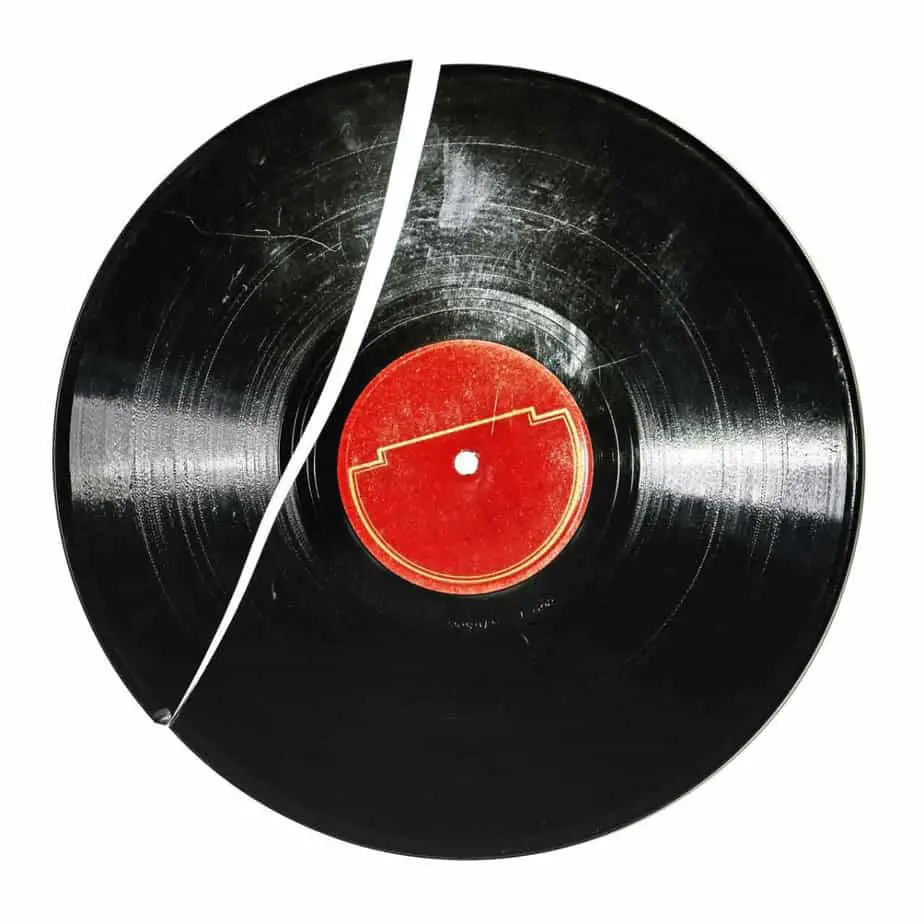
    PVC (polyvinyl chloride, popularly known as vinyl) is the most versatile plastic on Earth and was used extensively by the record industry. While most people have switched to digital music, many of us continue to store our vinyl records at home, unsure what to do with them.

    Vinyl records are non-recyclable. This is because the materials they are made of are toxic and harmful to handlers, and most recyclers are either unequipped or unwilling to handle this material. 

    So to many who were wondering, ‘Are vinyl records recyclable?’ they aren’t. In this article, I’ll explore why recycling vinyl records isn’t a viable option and look at what you can do with your old records instead.

    Why You Can’t Recycle Vinyl

    As mentioned, to properly recycle vinyl records, you’ll need to find a recycling facility that is specifically designed to handle it – and doing so can be challenging.

    Most companies accept PVC in the form of banners, gift cards, and old construction material. These forms of PVC are easier to break down and repurpose, and finding a company to handle them isn’t much of an issue. 

    However, vinyl records are made from thicker layers of PVC and emit a lot more toxic fumes when melted. The poisonous gases and heavy metals they give off will need to be contained because recycling can release these toxins into the air or underground. Finding a facility that is adequately prepared to handle this complex recycling process can be almost impossible.

    This is why vinyl records need to be kept out of the waste stream – doing so helps avoid further pollution.

    Alternatives to Recycling Vinyl Records

    As we’ve established, vinyl records can’t be easily recycled, and they can be harmful if left unattended. Luckily, there are a few alternatives to recycling records.
    Reselling

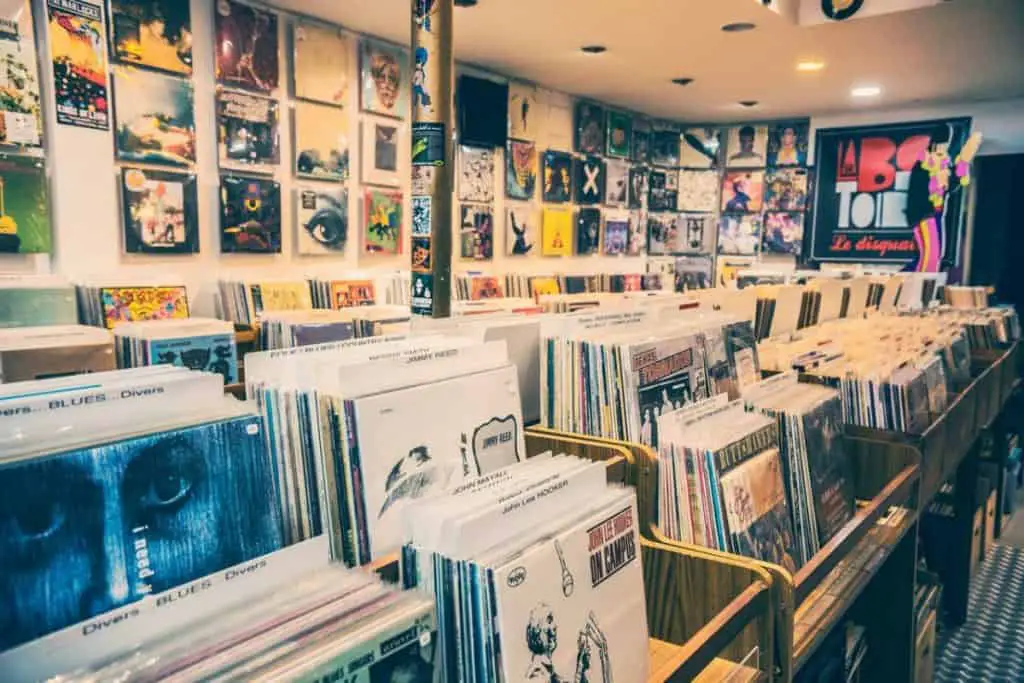
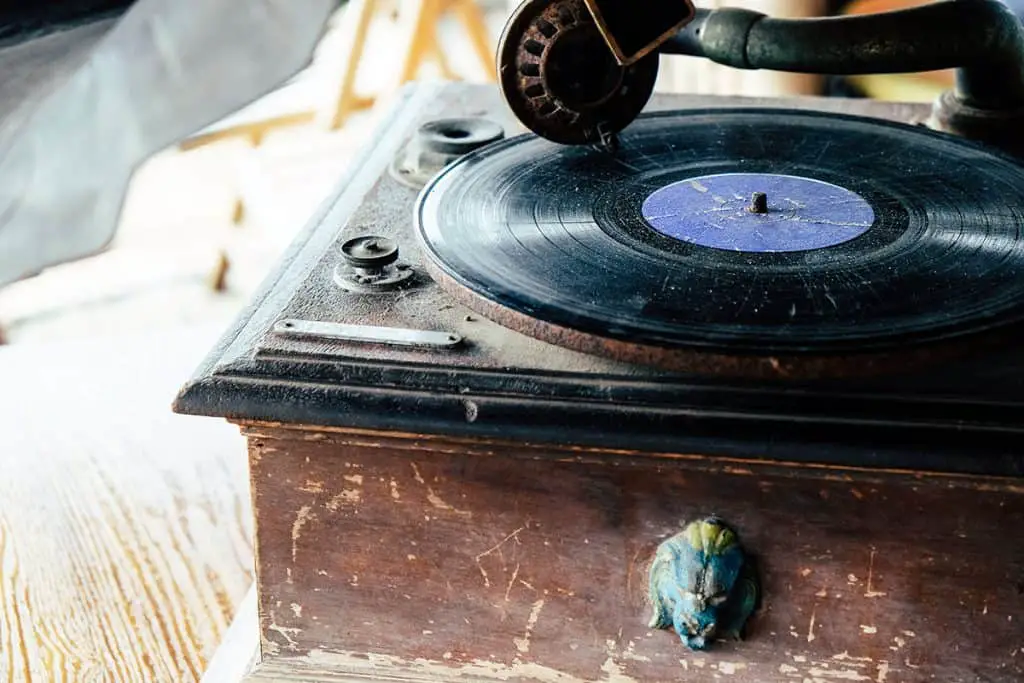
    Selling your old records is an effective way to ensure they’re put to good use. While it may seem like vinyl records have gone out of vogue, many of today’s artists are producing music on LPs thanks to the superior sound quality.

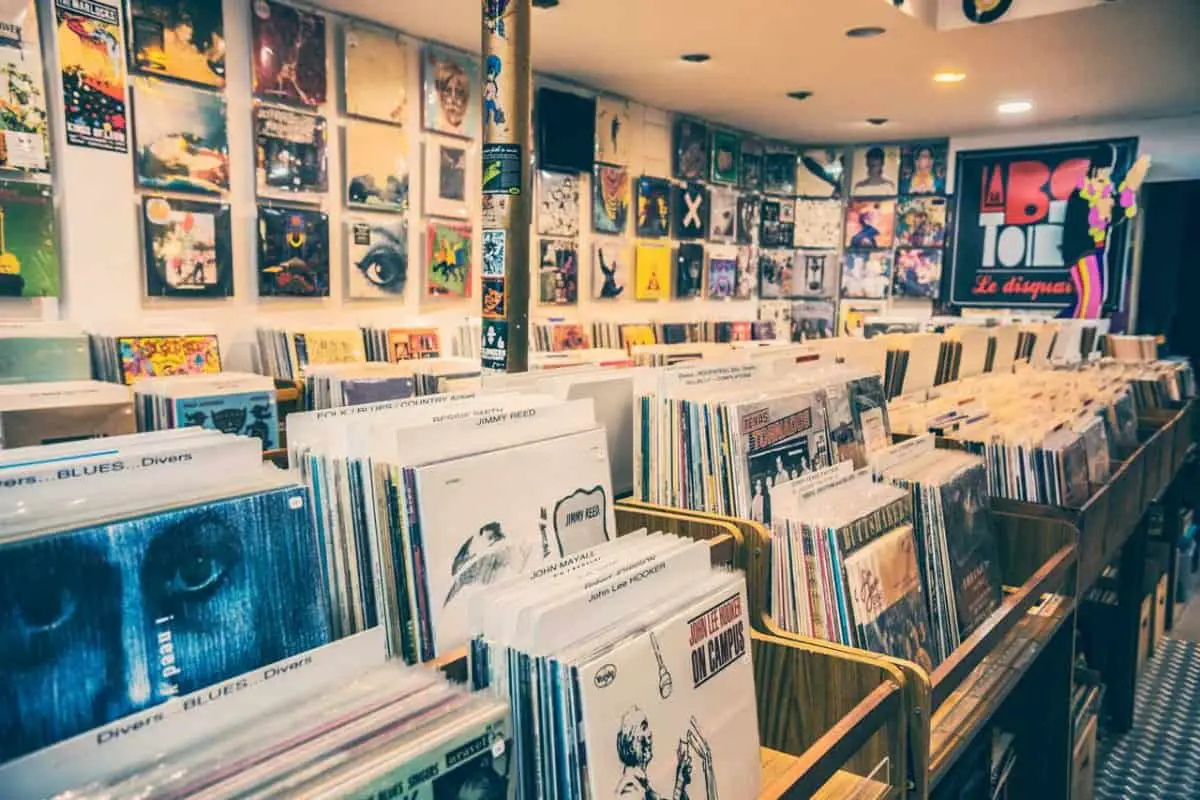
    You’ll likely be able to find plenty of record stores looking to buy older vinyl records to add to their collection. 

    The challenge with selling your records is finding a fair price, as the cost will differ based on the value of the vinyl and the buyer’s need for the said record. However, reselling is a viable option, and you won’t have to worry about dumping your records in a landfill.

    If you’re thinking of reselling, here are a few options you should consider:

    Record Stores

    The most obvious buyer would be your local record store, and you’re sure to find buyers willing to pay a fair amount for your collection. Snoop around a little, find out what kind of music the store is looking to stock up on, and see if you can provide them with suitable records.

    Online Stores

    The internet comprises a vast landscape of potential record-buyers – you just need to find them. For example, Hard to Find Records is a website that offers cash in exchange for your records. They even have a wanted list to let sellers know which specific LPs they’re willing to pay top dollar for.

    Discogs is another website where you’ll be able to sell certain records, depending on what they’re looking for.

    eBay

    While it may not seem like the right marketplace, you never know who’s looking for a specific record on eBay. Consider posting your records on eBay, especially if you’ve got some older LPs that aren’t too popular with record stores. 

    You may get lucky and find a buyer looking to buy the record you’re selling. 

    While it may seem like selling isn’t so profitable, you will, at the very least, ensure that your records end up in a store and not the dumpster. 

    If your records have no resale value, consider donating them to local thrift stores that deal with old LPs. Either way, your music will end up on a shelf where it may be of use to someone else.

    Upcycling

    Upcycling is the creative alternative to selling your old LPs, and there’s a lot you can do with used vinyl records. Here are a few ideas to get you started:

    Book Holder

    You can use two vinyl records to make a nifty and easy-to-dismantle book holder. You’ll need the following:

    • Boiling water
    • 2 vinyl records
    • Block of wood 

    Here are the steps to make a book holder:

    1. Immerse one-third of the vinyl record in boiling water for a few minutes. The portion immersed in water will be malleable when you take it out. 
    2. Fold the record at this portion and use the wooden block to press down hard to even the surface.
    3. Do this with both records and place them parallel, with the folded portion facing inward. 
    4. Stack a few books between them. 
    5. The straightened parts of the records will keep your books in place.

    Clock

    Clocks made from old vinyl records look classy and neat and are pretty straightforward to assemble. You’ll need a bit of drilling knowledge for this one, but this idea shouldn’t take much time if you’ve got the proper equipment. 

    Watch this YouTube tutorial on how to go about building a vinyl record clock:

    Vinyl Bowls

    Vinyl record bowls are another straightforward DIY idea that takes little effort but turns an old record into a slick everyday household item. 

    Heat is the crucial element in morphing vinyl into different shapes and sizes. Here, you’ll use an oven to heat the vinyl before changing its shape.

    Watch this YouTube video to know more:

    Here are the steps on how to make bowls using vinyl:

    1. Select a bowl with the shape and size that you want your vinyl record to replicate. 
    2. Place the bowl upside down on cookie paper and the vinyl on top of the bowl. 
    3. Put this arrangement in the oven for about ten minutes.
    4. Ensure to put on gloves before you handle the hot record. 
    5. Take the bowl out, turn it over, and place the vinyl inside, using the pressure of your hands to mold the record into a desirable shape. 
    6. This bowl works best as a fruit or candy holder, thanks to the hole at the bottom.

    Coasters

    Vinyl records make for neat little coasters, and the best part is you’ll have an assortment of different ones you can use while serving drinks.

    Here, again, the critical element is heat. The process is similar to making a bowl, and you will start by placing the record on the bowl before putting it in the oven. That said, making coasters is a bit more nuanced than making a bowl, as you’ll have to be careful to avoid melting the center of the record.

    Here is how you can make coasters using vinyl records:

    1. Once the outer edges of the record have melted, you can cut it out using scissors or a knife. Carve the exteriors carefully, so you’re left with the circular middle. 
    2. You can use sandpaper to smooth out the edges and give your coasters a neat finish.
    3. If the middle starts to warp, you can straighten it out by placing it between two books or weighted blocks of wood till it reverts to its original smoothness.

    Photo Frames

    Using a vinyl record as a photo frame is perhaps the least-involved yet satisfying DIY idea. All you have to do is cut out the edges of your photos and try making them circular. Now, stick this photo in the middle of your record, and you’ve got a neat new photo frame. 
    You can hang this up on your wall or melt one side and bend it away from the photo side to create a stand.

    Final Thoughts

    While vinyl records aren’t recyclable, there are various ways to repurpose them and ensure they don’t pollute the Earth by ending up in a landfill.

    All it takes is a bit of creativity, and with a bit of effort, you can find ways to prolong the use of these records. 
  • How To Tell If A Record Is Warped

    How To Tell If A Record Is Warped

    How to tell if a record is warped — if you are new to collecting vinyl records, this is important for you to know. Vinyl records are delicate items, so proper care is essential. But before you can do that, you need to know how to check if there is warping on your record.

    The simplest way to know if warping on a record is to hold it flat at eye level. This way, you will see even the smallest warping on the vinyl. Sound distortion when you play the vinyl will also be present if there is enough warping on it. (source)

    Vinyl records are sensitive, so you need to know what factors can cause them to warp and get damaged. Apart from that, you also need to understand how to care for them to keep them in good condition.

    Vinyl 101: How To Tell If A Record Is Warped

    Regardless of the modern advancements that happened to the music industry, there is no denying that vinyl is here to stay. The reason is that there is no replacement for the warm, high-quality sound that a vinyl record can provide.

    Unfortunately, audiophiles who are new to vinyl may accidentally purchase a warped record, preventing them from enjoying the crispness of the vinyl experience. Some of the vinyl problems caused by warps are:

    • changes in tracking force
    • mistracking
    • harmonic and pitch fluctuation
    • vertical tracking angle

    That said, you need to learn how to tell if a record is warped.

    The easiest way to see warping on your record is by holding it flat at eye level. A perfect vinyl record will look utterly flat on your vision. But if it is not, you will see even the slightest apparent warping.

    Variations in the wow and flutter are also indicators of warping.

    On the other hand, you can also play the vinyl record to inspect if it is warped. A warped vinyl will have a distortion of the audio and a skipping sound.

    Fortunately, most vinyl record sellers will check their items for damage before selling them to the public. If you want to avoid buying a warped record, choose a shop that has a good reputation or reviews from other buyers. (source)

    The Causes of Vinyl Warping

    In most cases, the cause of warping on vinyl records is improper storage. Considering how sensitive vinyl records are, warping can be a cause of various factors.

    That said, it is not enough that you know how to tell if a record is warped. Instead, you also need to know the possible causes of warping so that you can avoid them.

    Improper storage

    Not knowing how to store vinyl records properly can cause warping. For instance, stacking your records on top of each other can cause pressure, negatively affecting their shape.

    You might think that horizontally laying your records will keep them flat. But in reality, this method of storing can lead to warping and damage.

    For this reason, it is essential to store your records vertically. You should also not cram too many vinyl records together in storage space as it will also expose them to pressure.

    If you are keeping your records in a box, do not pack them too tightly. The container needs to be a perfect fit for your records as too big boxes will cause the records to move too much.

    Exposure to extreme temperatures

    Vinyl records become soft when you expose them to high temperatures. Since they are already soft, any amount of pressure will cause them to warp.

    A vinyl record starts warping at approximately 140 degrees Fahrenheit. Then, it will begin to melt at 212 degrees Fahrenheit. For this reason, it is ideal to get a wooden shelf for your records.

    Wood does not heat up quickly, so it is the safest material for you to store your record. Plastic storage materials trap heat, so it is not ideal for vinyl records. On the other hand, metal storage moistens when the temperature changes, so it can also damage your records.

    Moreover, do not place your vinyl records near a place where it has direct contact with sunlight, such as windows.

    If you know how to tell if a record is warped and you know are aware of the causes of warping, you will be able to take better care of your vinyl record. (source)

    How To Fix A Warped Vinyl Record

    Record warping is one of the most dreaded problems of vinyl collectors. Unfortunately, there may come the point where you have to face this problem, so it is a good thing that you know how to fix a warped vinyl record.

    However, it is essential to note that the remedies to warping will not fix your record perfectly. TO simply put it, a vinyl record will rarely become perfect again after it is warped.

    Still, it is a good thing that you know how to fix them.

    Sandwich the vinyl record between two heavy objects

    Get two objects that are heavy enough to apply pressure to the record without causing it to break. The objects need to be wide enough to cover the entire record. If you have two large books, they will work perfectly for this process.

    Before starting with the process, make sure that everything you will use is clean.

    Place the first object on a flat surface where there will be no disturbance. Before placing the record, it is ideal to cover it with a soft cloth on both sides to prevent scratching.

    Next, place the vinyl record on top of the first object and cover it with the second heavy object. This method will not show immediate results. It may take up to work, so make sure that you place it somewhere undisturbed.

    While this method can be time-consuming, it is also the easiest and most effective one. Still, it is essential to note that it will not always work.

    Apply heat and pressure

    After knowing how to tell if a record is warped, the next thing you need to know is all the possible methods to fix it. On

    This process requires you to have:

    • two glass panes.
    • your warped vinyl record
    • an oven
    • hot pads or oven mitts

    Preheat your oven to approximately 175 degrees Fahrenheit. The preheating time can take about 5 to 10 minutes, depending on your oven.

    While the oven is preheating, place the record between the glass panels, ensuring it is in the center. Take note that those two panes need to cover the entire vinyl record. Once the oven reaches the right temperature, you can place the vinyl record and glass panes stack onto the oven rack.

    Make sure that you are not pushing the record and glass pane combination too far to be easy to remove later on. The record should sit in the oven for less than three minutes.

    You need to keep your eyes on the oven while doing this method. If you smell anything or hear noise from it, take the vinyl record out immediately.

    After less than three minutes, get a hot pad or oven mitts and remove the vinyl and glass panes from the oven. Put them on a table or any flat surface, and place a heavy object above it until the glass cools. After that, you can remove the vinyl record from the glass panes to see if the warping is gone.

    You already know how to tell if a record is warped. So, you can repeat this process if you cannot fix the warping on the first try. (source)

    Call for a professional’s help.

    If you are unsure if you can do the two methods mentioned above correctly, hiring a professional to help you can be your last resort. Calling a professional is always the most excellent option. Not only do they know how to tell if a record is warped, but they also know what they should do to fix your warped vinyl record.

    Many record shops have a heat and press machine that will bring your record back to its flat shape.

    How To Take Care Of A Vinyl Record To Avoid Warping

    A vinyl record requires more care than CDs and digital music files. And if you know how to tell if a vinyl record is warped, you should also know how to take care of it properly. This way, you will be able to avoid problems in the long run.

    In addition, taking care of your vinyl will help you make it last a lifetime.

    Dry clean your vinyl record

    When dry cleaning a vinyl record, a carbon fiber anti-static brush is the best tool, such a brush allows you to get into the grooves of your record and remove dust and dirt without scratching it. In addition, an anti-static brush will help you clean your record without ruining its audio quality.

    To clean the record correctly, spin it on a turntable and rest the brush lightly on top. After spinning the record for a few seconds, slowly and carefully drag the brush off of the record.

    Be careful with wet cleaning.

    You will need a mild cleaning agent when wet cleaning your vinyl record. Make sure that the cleaner you will use does not have any harsh chemicals that can damage the surface of your record. If you damage your record surface, it will not be enough that you know how to tell if a record is warped. Instead, you will also need to find out how to fix a scratched record.

    You will also need a microfiber cloth to help you remove any dirt, dust, and fingerprint from your vinyl record. The cloth will also give your record a more thorough cleaning.

    For this method, simply spray your cleaning solution directly on the record and let it sit for a few seconds so it can seep into the grooves. Next, wipe the record with a microfiber cloth, following the grooves around.

    Keep your vinyl record in a cool and dry place.

    Vinyl is a type of plastic. For this reason, heat can quickly soften it and cause it to be out of shape. Such is the reason why you need to know how to tell if a record is warped. But apart from that, you need to know the factors that can warp your record so that you can avoid them.

    In addition, keeping your record cool and dry will help you preserve it for a long time. The reason is that storing your record in an area that is too hot or humid will make it prone to bending, warping, and surface damage.

    Avoid touching the surface of your record.

    All the musical information in a vinyl record is stored in the grooves. So, anything that touches the surface of your record can ruin its audio quality. Meaning even your hands can affect the sound quality of a vinyl record.

    If you want your vinyl record to have the best possible audio quality, the right way of handling your record is by touching only the inner label and outside edges.

    Place the vinyl record inside the record jacket right after using it

    Every vinyl record has a jacket where you need to place it after using it. Leaving your record out of its cover for a long time will allow dust, dirt, and other particles to stick into its surface. These buildups can damage the surface of your vinyl record as well as its grooves in the long run.

    If that happens, the audio quality of your record will decrease significantly. (source)

    Avoid Warping: The Do’s And Don’ts Of Vinyl Records

    New vinyl record collectors might not know what they should and should not do with their vinyl records. They may think that learning how to tell if a record is warped is enough to keep vinyl in an excellent state. However, that is not the case.

    As mentioned, vinyl records are sensitive. For this reason, there are a lot of things that you need to avoid doing if you want your collection to last a lifetime. Similarly, there are things that you can do to keep them in good shape.

    Do clean your records before playing them.

    If you know how to tell if a record is warped, you will be able to fix your vinyl records when they acquire damage. However, preventing the records from getting damaged is always better than fixing them. That said, knowing when to clean your records is one of the best ways to keep them in good shape.

    You need to clean your record before using it. While it may sound a little pedantic, cleaning your vinyl record is essential. Such can be as simple as wiping the surface of the record before putting it on a turntable.

    Don’t let the damaged stylus touch the record grooves

    Your stylus will acquire damage in the long run. If you have poor upkeep of your stylus and play your record on the turntable, the record will obtain scratches, which is irreversible damage.

    For that reason, it is not enough that you know how to tell if a record is warped. It is also vital that you take care of your record player and change the stylus once it gets damaged.

    One method to keep your stylus in excellent condition is to reduce the static charge of the records before playing them. Vinyl records consist of PVC, which is prone to static electricity buildup. So, using an anti-static brush will help you prevent any damage to the stylus.

    Don’t lift the vinyl record from the turntable before it stops.

    It is essential to wait for your turntable to stop completely before taking off the record. If you remove the record while the turntable is still spinning, you will scratch its underside and ruin the grooves. Scratches are far different from warping, so you will not be able to use your knowledge about how to tell if a record is warped once your vinyl record obtains scratches.

    Don’t wipe your record using a towel or a shirt.

    Never use a towel or a shirt as a record cleaner regardless of how soft or clean it is. These materials can easily scratch the surface and damage its ridges if you put too much pressure on it.

    If you want to dry clean your vinyl record, you should instead use an anti-static brush and microfiber cloth.

    Don’t use shaky hands when cueing up a record.

    When skipping a song from the record, make sure that you are not using shaky hands. Your hands should be as stable as possible when you cue up the lever and lower the needle to your record. The reason is that cueing the lever with shaky hands and abruptly picking up the needle will cause your vinyl to make popping and ticking sounds in the future.

    If your record player does not have a cueing lever, make sure that you are resting the base of your hand on a steady surface. Next, use two of your fingers to carefully lift the tonearm without gouging the grooves of your record.

    Make sure that you are carefully cueing your tonearm as your knowledge about how to tell if a record is warped will not help you once you scratched it. (source)

  • Are Scratched Records Able To Play? (We Find Out)

    Are Scratched Records Able To Play? (We Find Out)

    Are your vinyl records damaged goods, or are scratched records able to play? A scrape on your thousand-dollar phone, a scuff on your brand new car, an abrasion on your prescription glasses, scratches mean damage, and no one wants damaged goods. It may be tempting to think about the scratches on your vinyl records, and for that, I do not blame you. 

    Just like how a minor groove on your phone screen does not render your phone useless, a small scratch should not be a problem, therefore a scratched record should be able to play.  However, it is crucial to know that the damage will determine if your vinyl is playable or not.

    Is my scratched vinyl record playable or not, or can I at least mitigate the damage? In this article, we will answer these questions through and through, so sit back and relax.

    The Scratches And Vinyl

    Are scratched records able to play? Before we directly tackle that query, we must first understand the role of “scratches” in vinyl records.

    It is simply incomprehensible how we can manage to bring albums and more albums of songs within the palm of our very hands. And to think how we do not even ponder about this fantastic technology and take it for granted! However, there was a time when we needed to carry compact disks, clunky cassettes, or even vinyl to play quality music.

    Even with cassette tapes and most compact disks going obsolete, vinyl records are still alive and well! Who would have known that such a “relic” is still one of the best ways to listen to music to date! However, boy, are they susceptible to physical damage!

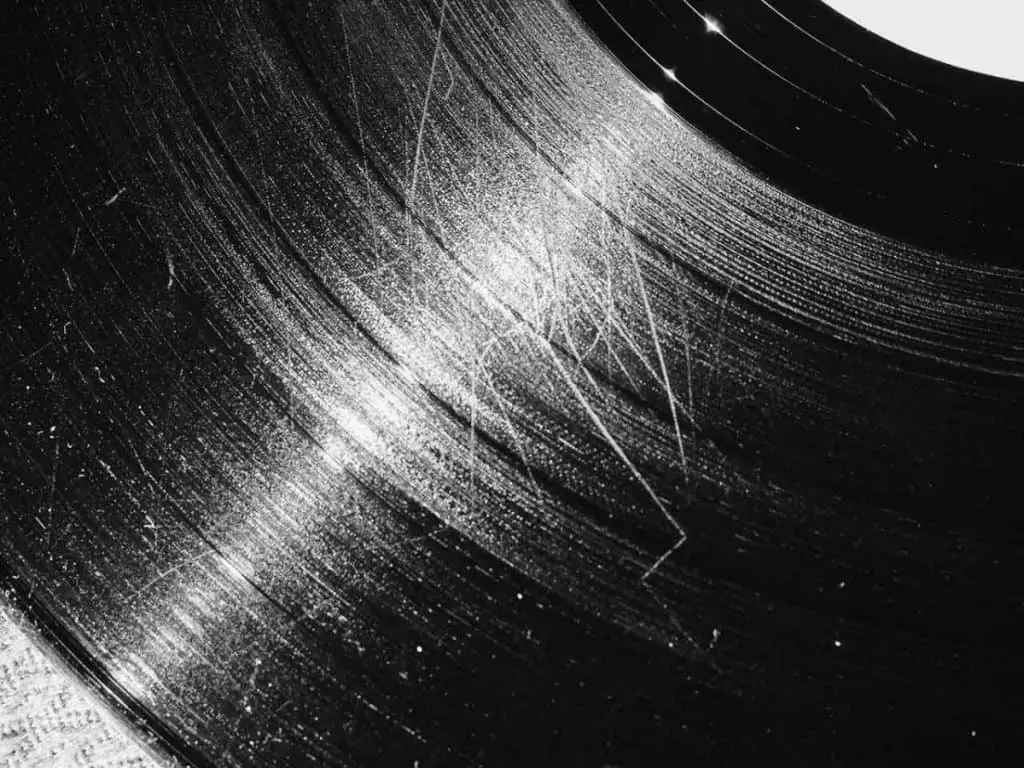
    Vinyl records have a “love and hate” relationship with scratches. First of all, the very existence of vinyl records comes from its precise architecture of scratches, known as its grooves. 

    These grooves form an intricate pattern that collectively is read as sound signals by the needle of your vinyl record player and converted into the music that you hear. Quite the beautiful journey, isn’t it? (1)

    From the humble origins of being a boring groove to its stunning end as an Obra Maestra musical piece, it is quite a wonder. However, despite the scratches known as “grooves” creating such beauty, scratches themselves can also ruin it. Improper handling, falling, improper storage, and more situations can result in vinyl scratching.

    Some would say, “Who cares? Aren’t vinyl records made out of grooves in the first place? Do scratches even matter?” Well, yes, it does matter.

    Because vinyl records are so reliant on the specific structure of the grooves, they are highly susceptible to mutilation due to even slight changes in the physical form of the grooves. These “physical changes” can manifest as bending, but it often presents itself in the form of scratches.

    Are Scratched Records Able To Play?

    As we have established already, vinyl records are vulnerable to scratches or even just minor changes to their physical structure. However, does a simple scratch spell death, or do they inhibit unnoticeable audio artifacts? Are scratched records able to play?

    Scratches Are A Big Deal

    We will use the compact disk as a potential viewpoint to answer this question in a more relatable light. Despite the two’s vast differences, the compact disk and vinyl records hold many similarities. For example, both are in the shape of a disk, save data, and were also used as mediums to store audible information.

    We all know too well that compact disks scratch very quickly, even swifter than a vinyl record. It is not too common to see a used, unscratched compact disk. However, they still retain their data and are still very usable.

    Just like that, a vinyl record can still hold its integrity even when scratched. Especially when the scratches are minor scuffs, vinyl records will mostly retain their listenability. However, like how a scratched compact disk will have odd skips and pauses, a vinyl record will undoubtedly have audible artifacts.

    Since vinyl records are analog technologies and not like the compact disk, the scratch will not only manifest itself as minor skips and pauses, but it can even cause your vinyl record to jump and skip whole tracks! Even with the most minute of scratches, do not expect uninterrupted listening. (2)

    Are scratched records able to play? Perhaps, that may be the case—however, any scratch, big or small, will have impacts on your vinyl record. The only thing you can do is hope.

    After all, a big scratch aligning with the grooves will not have as much damage compared to a scratch running directly across multiple rows of the vinyl record’s tracks. Like a train with a broken rail, it would not be playing smoothly.

    Some Will Still Play; However, There May Be Skipping Involved

    Alright, you have dropped your vinyl record, succumbing the record to scratches. “Certainly, there will be no audible damages, right?” You said to yourself wistfully.

    You pop your vinyl record player open, hope for the best, and find track one playing well. Track two, track three, and track five seem to be playing well also. However, where did track four go?

    Your worst nightmares are confirmed, and it looks like there are damages to your vinyl record. Why is this a thing, and how does this happen? Well, let us talk about that, shall we?

    I know you are tired of hearing this concept. Still, I must repeatedly assert that the physical architecture and structure of the vinyl record will heavily impact its integrity. Having unnecessary scratches or scuffs will result in audible damage. 

    Are scratched records able to play? Well, it depends on the severity of the scratch. However, as said earlier, mutilations and distortions are expected even with the slightest and shallowest scratches.

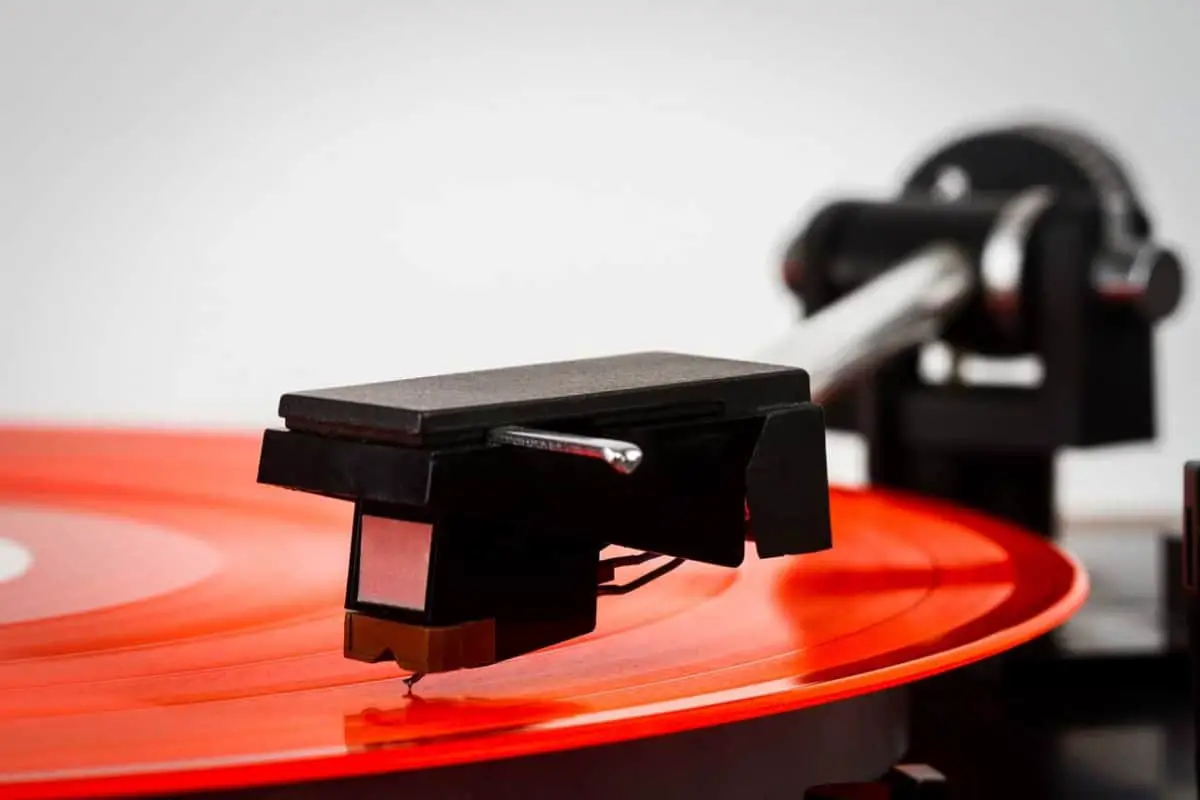
    The needle on your vinyl record player’s cartridge follows the structures, i.e., the grooves on your vinyl records. When there are scratches on your vinyl record, instead of following the predetermined path that will play each section of the record in an orderly manner, the scratch will create an additional pathway for the needle to go through. 

    When this happens, instead of transitioning from track three to track four, the tonearm’s needle passes through a shortcut and skips to track five directly. 

    Scratches Do Not Mean Bad Blood With Your Needle

    Certain things may make your heart burst into action: your smartphone dropping,- or that loud popping you hear when your needle hits a scratch. We all know that needles are very expensive and that popping sound from the vinyl record’s scratch may be the end of it. 

    Hold your horses first, amigo, as that is certainly not the story. If you do not know, most needles placed on your turntables contain diamond or sapphire, both very durable metals that do not break with just a scratch. Vinyl is a much less durable material than diamond or sapphire, so you shouldn’t be worrying too much about that. (3)

    However, it would be best not to forget that even diamonds and sapphires suffer from casual wear and tear. Keep them safe and handled well!

    Frequently Asked Questions

    How Do Vinyl Records Get Scratches?

    Vinyl records get scratched due to mishandling, stacking, dropping, improper storage, and even dust and sand. 

    How Do I Keep My Vinyl Records Pristine And Scratch-Free?

    To keep your vinyl records scratch-free, make sure always to have a clean, well-maintained, designated storage area for them. Additionally, do not touch the grooves. It may be tempting, but handling them with your bare hands may cause scratches.

    Are Scratches Permanent?

    Scratches are permanent, and there are no foolproof ways to repair them. Make sure to handle them properly always.

    Sources

    1. https://www.vinylrecordlife.com/how-vinyl-records-get-scratched-and-how-to-avoid-it/
    2. https://retroonly.com/do-scratched-records-still-play/
    3. https://toprecordplayers.com/does-playing-scratched-records-damage-the-needle/
  • Can A Record Be Paused? We’ve Got The Answer

    Can A Record Be Paused? We’ve Got The Answer

    In a world where Spotify, iPods, and compact disks exist, sometimes, we take for granted even the smallest of features: mainly pausing. While digital media can “play” and “pause” with the push of a button, this process is not precisely very straightforward on analog mediums. That is why today, we asked ourselves: “Can a record be paused?”

    Despite the technical limitations, analog music formats such as vinyl records can be paused. However, the process isn’t so straightforward. It will require you to raise the cue physically.

    In this article, let us talk about how to pause the record safely and consider what you should consider before hitting the play button.

     Can A Record Be Paused?

    Although not conventional, you can pause a vinyl record. However, in my opinion, I would not consider the process “pausing” rather than calling the method as stopping the record altogether. Why do I say this exactly? Let us find out.

    1. Pausing The Old School Way

    Vinyl records and turntables make themselves stand out as they are one of the last remaining analog mediums of playing recorded music that is still widely used. Despite its weight, exorbitant prices, cumbersome form factor, and fragility, vinyl records are considered the prime way of listening to music. They are uncompressed and have the nostalgia and experience factor added in. However, they are not considered to be the most convenient method of listening to music.

    Why do I say this? Well, because of many factors. First, vinyl records are not precisely beginner-friendly, and they are certainly more prone to damage; moreover, the act of pausing isn’t precisely as straightforward as an MP3 player.

    The pausing process goes like this: first, you will need to lift the cue to raise the tonearm. When you do this process, you will notice that the music has already stopped. However, this does not mean that it is paused, unfortunately.

    If you are using the modern vinyl players (which you are probably using one), you will probably notice the lift arm button. Instead of manually lifting the cue with this button, you can lift it with the push of a button! It will make the process a lot easier and less cumbersome.

    If you take a second look at your turntable, you will notice that vinyl is still rotating, which implies that it technically hasn’t stopped yet, only that there is no audio leaving the speakers anymore. In this step, you will need to “stop” the rotation by pressing the stop button on your turntable. (1)

    So technically, you haven’t “paused” your vinyl record. You merely “stopped” the turning. However, it functions more or less the same as the pause button on your MP3 player, albeit less convenient, and is not very precise as well.

    The next time you ask if a record can be paused, remember that you can pause it– but not in the same manner as you know it to be.

    1. Why The Order Matters

    If you read the process stated above, you may have noticed that instead of directly stopping the vinyl record’s rotation, we have lifted the cue and the tonearm first before proceeding with the stopping action. Why is this exactly?

    It is not a “must-do,” but it is a recommended process. If you didn’t know, the needle of your record player’s tonearm is actually made out of the diamond. Earlier, we have discussed that vinyl records and record players are very fragile; let’s talk about that.

    The diamond needle is not only very expensive (obviously) but is also pretty tough, especially the diamond tip. Using the Mohs scale of mineral hardness, we will notice that the diamond is the most challenging material globally, making the vinyl pale in comparison. Indeed, you wouldn’t want the ever-so-hard diamond needle dragging over on your delicate vinyl, wouldn’t you? (2)

    1. It’s Not Exactly The Same. In Fact, It Is Quite Complicated.

    Pausing a vinyl record player is not necessarily the same as the pausing option you have with your MP3 player. We have established that well enough already. However, can it get more different as well?

    First of all, we have already discussed a specific “ritual” or order when pausing a vinyl record. Lift the cue, then stop the vinyl record. However, this is not the only way a vinyl record’s pause differs from the standard pause we have on our gadgets.

    If you must know, there is a particular behavior of pausing that is exclusive to vinyl record players. Unlike MP3s, iPods, and the like, vinyl record players, when “paused,” do not resume the music or audio at the spot where you stopped it. Instead, it may skip through a few seconds of the track, especially if the whole process was manual and does not incorporate automatic cue levers.

    So can a record be paused? Yes, but the process is not the same as how a DVD player would pause a compact disk.

    Playing A Vinyl Record Player Is Not So Simple Either

    We have discussed earlier how the pausing process is quite convoluted. However, the same can be said to the “playing” process as well. In the instance where you will need to resume your audio after pausing or when you are just initially starting to play your vinyl record, you do not just press play, as it always has been with vinyl record players; it is more complicated than that. (3)

    1. Speed And Size

    First, you must know all about the vinyl record’s speeds. Vinyl records are unique on their own as they have different sizes that can affect their rotation speed. When you play a vinyl record too fast or slow, you may not like the overall music output.

    Second, you must know about the sizes. As of writing, there are still three relatively standard sizes, the seven-inch vinyl, the ten-inch one, and the twelve-inch one. (4)

    The seven-inch and twelve-inch vinyl are generally used for singles and can hold up to two songs, one song on each side of the vinyl record. On the other hand, the twelve-inch vinyl is reserved for extended plays and can include multiple songs per side. These sizes handle different rotation speeds.

    The 7-inch and 10-inch records play at 45 RPM, while the 12-inch records play slower at 33 1/3 RPM. So before you press play, make sure you are using the correct rotation speed first. Most modern vinyl players can operate under multiple rotations per minute options, so compatibility problems should not be too familiar.

    1. Pressing Play

    So how exactly does the process of pressing play go? Now that we have understood the speed and the vinyl sizes, I would like you to identify the speed needed for the vinyl record at hand. There are usually printed labels indicating the speed requirement of a vinyl record on the record itself.

    Now, set up your vinyl record player at the appropriate speed. Wait for the vinyl record player to rotate that fast and then press play.

    When using automatic record players, the cueing lever will rise and hover over the record. When using a manual record player, you may need to press on the tonearm’s cueing lever to lower it. (3)

    Can a record be paused? Can a record be played? Of course, it can, and all it requires is wit and preciseness.

    The Questions They Asked: Frequently Asked Questions

    1. Will I damage the record if I leave the needle resting on it?

    If you followed the steps earlier, you would notice that we recommend you raise the needle before you stop the record. We still want you to do the same.

    1.  Are there thicker types of vinyl?

    Yes, there are. Although not necessarily affecting sound quality, it does improve durability by lowering the risk of vinyl warping, a phenomenon common in hot climates.

    1. Does tonearm matter?

    Yes. Some tonearms are much more suited to a specific sound than others.

    Sources

    1. https://forums.stevehoffman.tv/threads/how-do-you-properly-stop-a-record.178926
    2. https://forum.dvdtalk.com/other-talk/638008-do-record-players-have-pause.html
    3. https://toprecordplayers.com/how-to-use-a-record-player/
    4. https://victrola.com/blogs/articles/a-guide-to-vinyl-record-sizes

  • What Temperature Can Vinyl Records Withstand? We Have The Answer.

    What Temperature Can Vinyl Records Withstand? We Have The Answer.

    It only happened recently when a heatwave struck the United Kingdom, but one of the oddest questions popped out of nowhere due to the event: what temperatures can vinyl records withstand? It all started with the media giant Tiktok, and when a vinyl record lover, Matt, discovered the heatwave left, his records warped. With the video gaining traction, many people have turned to ask the same question as you did. (source)

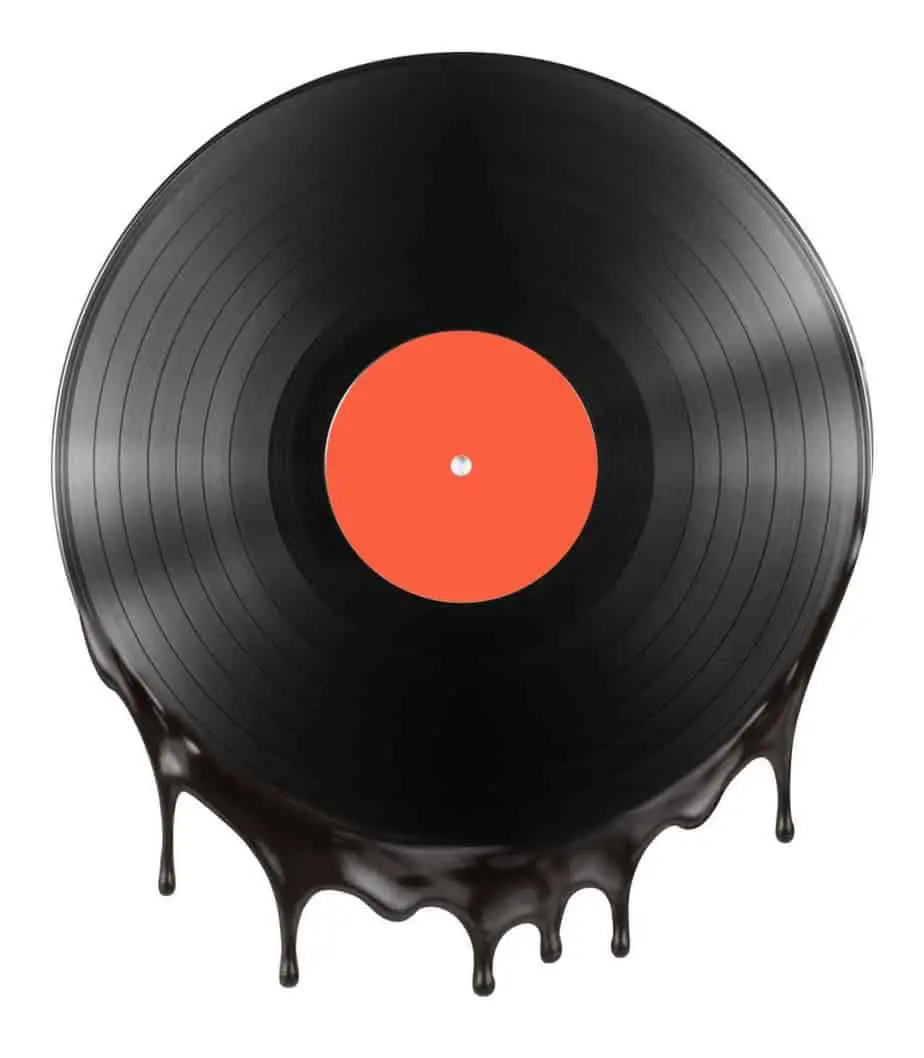
    Typical vinyl records start to melt at around a hundred degrees Celsius, or approximately 212 degrees Fahrenheit. Despite indoor and outdoor temperatures not being that hot, the material can absorb heat which will help reach those dangerously high levels. 

    In this article, we take it upon ourselves to solve the phenomena of the melting vinyl records and finally answer the question, “What temperatures can vinyl records withstand?”

    The Phenomenon That Sparked Curiosity: The Heat Wave And The Vinyl

    Before we get started with all the “vinyl record warping science,” let us first investigate the very phenomenon that sparked the curiosity in everyone’s heads: the Tiktok video and the excruciatingly hot United Kingdom heatwave. 

    On a fateful week of July, the United Kingdom and Northern Ireland reported and recorded their hottest day yet– prompting The Met Office (The United Kingdom’s national meteorological service) to issue their first-ever extreme heat warning. Yes, you heard that right, they published their first-ever notice of such sort! (source)

    Of course, many people tried to avoid experiencing the hot weather, wearing loose clothes, and staying indoors; the people of the United Kingdom sure did their very best to keep cool. However, some did get a little bit creative. 

    While a significant portion went out to enjoy the heat and play sports or went to get a tan, Tiktok user and vinyl lover “Matt” tried to be more creative.

    Instead of going to Google and searching up “What temperature can vinyl records withstand?”, he instead tried to take it to the great outdoors to solve the question. 

    With the help of his trusty phone to help film the process, he used a Demi Lovato vinyl record (broken, of course) and went out to do some initiatives and left it amid the burning sun.

    An hour into the experiment, the vinyl was starting to get a bit of a wobble. And by the three-hour mark, the record was beyond any hope for reviving (although the record was never functional anyway).

    Despite the process not being exactly the most accurate way, nor is the most scientific way of doing experiments, they did (to some extent) find the answers to their inquiries. At least, he could infer that the high sun and the heatwave would bend their vinyl records.

    Even though “Matt” did this experiment all in the name of fun, they were still able to give us a lesson that we should never, ever forget. We don’t need to know what temperature vinyl records can withstand to infer this. All we need to do is never expose our vinyl records to the hot sun!

    What Temperature Can Vinyl Records Withstand?

    Vinyl records are complex inventions that need precision to work. This intricacy signifies that to ensure the vinyl record’s integrity is to ensure that the records must not be scratched, nor be at any point be dropped or warped. So what exactly makes a vinyl record distorted and warped?

    There are many reasons why vinyl records incur such damages, but we must never forget that vinyl records’ number one enemy will always be heat and mishandling. 

    For the sake of simplicity and to stay unto the subject matter at hand, we will only be tackling with heat. What is heat, and what temperatures can vinyl records withstand?

    Keeping It Below Boiling Point

    Let us get this straight: humans can only survive at a heat of a little bit more than 40 degrees Celsius or 110 degrees Fahrenheit at ten percent humidity. Yes, it only takes that amount for us to be “too hot” and experience hyperthermia and even death. Imagine that but double that number, and do that to your vinyl record. (source)

    While not known as a very heat-resistant material, vinyl can absorb way better temperatures than us at around a hundred degrees Celsius or a little more than 210 degrees Fahrenheit. However, this does not mean that we should always expose them to such conditions.

    Think of it in this way: while eating a little bit over our calorie budget will not harm us extensively in the short term, it will pose a significant threat in the long run. 

    As such, we should apply the same mentality to our vinyl records as well. We should not constantly expose them to temperatures even above 50 degrees Celsius, even more so in more extended periods.

    If you love your vinyl records, you should not wait until a burst of heat to reconsider your vinyl handling practices. That’s because even a spark of a cigarette can start a wildfire. Let’s not wait until we see a wildfire of damage to vinyl and start disposing of our cigarette butts responsively and store our vinyl appropriately.

    Cars Are A Different Story

    It is not a secret that cars, especially when left under the heat of the midday sun, can get plenty hot. Many people, especially those living in the Southern United States, can even attest to this and have done their fair share of experiments as well. In the video linked below, we can see a person using a frying pan and an egg and placing it on the hood of his car only to successfully fry it. (source)

    So let us go back to the topic at hand, shall we? So, what temperatures can vinyl records withstand? To give you a more physical example, I can confidently say that your car’s temperature is probably too hot for the vinyl.

    As said earlier, vinyl records can begin to melt at boiling point or 212 degrees Fahrenheit or a hundred degrees Celsius. Of course, the temperatures within our cars do not reach that zenith of heat. However, by themselves, when left outside, they can reach temperatures of 43 degrees Celsius or 110 degrees Fahrenheit within an hour of exposure. (source)

    Of course, 43 degrees Celsius is a far cry from the 100 degrees Celsius boiling point. However, we must note that a hundred degrees Celsius is the temperature where vinyl records melt. Therefore, we can imply that vinyl records warp at much cooler temperatures.

    As to such, we have researched specific values as to what temperatures constitute “warping levels” for your vinyl records. With that in mind, we have found out that the answer to the question “What temperature can vinyl records withstand” is much lower than a hundred degrees celsius.

    The actual number is that vinyl records themselves can withstand temperatures up to 60 degrees Celsius or 140 degrees Fahrenheit without warping. This lower limit of temperatures implies that the outside temperature must not be warmer than 97 degrees Fahrenheit or 37 degrees Celsius to assure a “no warping safe zone” for your vinyl. (source)

    Direct Sunlight Is Much Worse

    There are many variables as to why your vinyl records may warp due to heat. Of course, the temperatures are the main issue, but the context or the environment themselves play a significant role.

    Although we have mentioned the magic numbers for vinyl records: 37 degrees Celsius and the boiling point, there is still a consideration. After all, your vinyl record can still warp even without reaching those peak numbers. 

    You may ask what can expedite the process, and the answer is direct sunlight. At this point, the question is more than just what temperatures vinyl records can withstand but more of how long can your vinyl records stay in direct sunlight.

    The time it takes for your vinyl records to warp can vary greatly. You may be surprised how a vinyl in direct sunlight with temperatures of 38 degrees Celsius (100 degrees Fahrenheit) can warp your vinyl faster than exposure to 50 degrees Celsius temperatures (120 degrees Fahrenheit) inside shaded areas.

    Just because the temperatures outside are not the hottest does not mean that you can leave your vinyl records outside. Remember that direct sunlight may damage your vinyl records way faster than constant room temperature, and cooler temperatures do not necessarily mean a warp-free environment.

    Time Is Of The Matter

    As said earlier, the warping of your vinyl records may not only result from a simple temperature rise. After all, it would take scorching temperatures to scathe your vinyl records. However, with the presence of environmental and uncontrollable factors, you may be surprised how fast your vinyl records can warp even without reaching maximum temperature. One of those so-called “factors” is time and duration of exposure.

    I was hoping you could think of the situation this way: exposure to a hundred degrees Celsius of heat for five seconds will deal minor damage compared to 40 degrees Celsius of heat for thirty minutes. In this world (and yes, including vinyl records), the number one cause of corrosion is time.

    This corrosion has reminded me of the quote by Veronica Roth, “I give you this to take with you: Nothing remains as it was. If you know this, you can begin again, with pure joy in the uprooting.” (source)

    Leaving your vinyl records in the heat for extended durations of time will make sure that it will not remain as pristine as it was, as, after all, time and heat are a vinyl record’s main components for “corrosion.” 

    Keeping all the imagery aside, here, we have a list for easily giving you a timeframe of how fast it takes for heat to warp your vinyl records

    Time It Takes For Vinyl Records To Warp:

    1. Inside the car, a vinyl record will take only a little more than an hour to warp when outside temperatures reach above a hundred degrees Fahrenheit or 37 degrees Celsius. (source)
    2. Leaving vinyl records outside in direct sunlight under temperatures of 35 degrees Celsius or 95 degrees Fahrenheit will start to warp your vinyl records in under an hour. (source)
    3. Leaving your records under “normal” or below 35 degrees Celsius of heat in cars for less than an hour will not warp your records. (source)

    Key Takeaways

    To summarize our findings and compress them into digestible bits, we will put them into a list and label them as “Key Takeaways.” So to hasten this process, here is the list of answers to the question: “What temperature can vinyl records withstand?”

    What temperature can vinyl records withstand:

    1. Vinyl records will melt at the water’s boiling point or a hundred degrees Celsius (210 degrees Fahrenheit).
    2. In most situations, keeping Vinyl records in hot conditions with temperatures more than 35 degrees Celsius (95 degrees Fahrenheit) in more than an hour will most certainly wrap them.
    3. Cars are a vinyl record’s enemy, and leaving them there in more than 40-degree weather will warp them.
    4. Direct sunlight, even at cooler temperatures, will be able to warp your vinyl records.

    The Warping Situation: What Are The Reasons As To Why My Vinyl Records Will Warp?

    Vinyl records, although quickly produced, are not made out of the most durable materials. Because vinyl records need to be light, malleable under processing, and cheap, they are composed of plastic vinyl (as stated in its name). 

    Despite the modern standards of vinyl records being considerably more durable than their older iterations, they are still pretty fragile. Even with slight scratches, warping, and dust, their performance will be disturbed, and the vinyl records will not achieve optimal sound.

    Because it is so, it is always essential to make sure that your vinyl records are free from possibly damaging agents. 

    Aside from trying to answer the question, “What temperature can vinyl records withstand” we will also try to answer what other factors can warp your vinyl records?

    Heat Is An Obvious Answer

    Of course, making sure that your vinyl record is not subject to extreme temperatures is one crucial variable that will help avoid warping. Since we have discussed this point thoroughly already we shall proceed to the next issue.

    The Method of Storing Vinyl Records Is Integral

    When the space race first started, we did not know the implications of such an aggressive and lifeless environment to our human bodies. However, once we began to send out astronauts and cosmonauts into space, we noticed something. The people we sent to space when returning to Earth grew taller.

    According to NASA, such a phenomenon exists due to the lack of gravity in space. As such, cosmonauts and astronauts grew a tad bit taller. Fascinating how much gravity has affected the shape and form of the human body! (source)

    Of course, not only the human body is affected by the gravity of the Earth. Your vinyl records are also affected by gravity. It seems like the temperature vinyl records can withstand is the most crucial variable, but with gravitational force as well! 

    Of course, we do not bring our vinyl records to space, so that should not be too much concern. However, one thing we should take note of is the force exerted by other items placed on top of your vinyl records, which will exert pressure upon your vinyl.

    There are many ways to achieve this: putting heavy objects on top of your vinyl is one, but a common mistake is stacking your vinyl records together. 

    Of course, vinyl records are not the heaviest, but when stacked, they can exert enough pressure to warp your vinyl records!

    So aside from finding what temperature can vinyl records withstand, we should also consider what amount of pressure you should put on your vinyl records. And to that, I say, do not stack your vinyl records on top of each other! Store them vertically (upright) or at least stack them in the manner that they do not succumb to external horizontal pressure. 

    Frequently Asked Questions

    1. How Can I Keep My Vinyl Records Safe?

    To keep your vinyl records safe, keep them stored in a cool, dry place. Also, make sure to allot some budget into your vinyl storage system.

    One of the main reasons why vinyl records succumb to damage is due to improper handling. We always recommend never to touch the surface of your vinyl records.

    1. How Can I Save My Vinyl Records In A Heat Wave?

    To keep your vinyl records safe in a heatwave, make sure to store them in a shaded area and keep them within their sleeves. As much as possible, use an air conditioner to cool off your records. Keeping them as cool as possible is serious business!

    1. Are Vinyl Records Flammable?

    Although they are prone to warping and melting under high temperatures, most of the time, they do not ignite.

  • How To Define A Pressing Of A Record

    How To Define A Pressing Of A Record

    If you have ever seen or, better yet, held a vinyl record before, you will likely notice the texture on its surface, with grooves so defined you can feel them at every caress. Just like any curious mind, you might want to ask how these patterns are implemented into the vinyl record. We also had the same question as we had to ask ourselves: how do they define the pressing of a record?

    There is an intricate process dedicated to defining the pressing of a record. The pressing of a record involves many smaller, intrinsic processes, and it requires heat and a master disc. (1)

    What is a master disc, and how exactly are vinyl records made? We will talk more about that in this article and the importance of the “first press.”

    How To Define A Pressing Of A Record

    You may be thinking of doing a homemade vinyl pressing service, or you are probably just curious. Either way, the fact remains that pressing a record is a complicated, intricate process involving a lot of technical knowledge, especially if one desires to mass-produce a record.

    First, we may want to talk about why we need to define our records before asking how to define a record’s pressing. I mean, we could observe how compact discs work without grooves. Why do vinyl records need defined patterns, unlike compact discs?

    One significant difference between a vinyl record and a compact disk is that a compact disk is a digital format, meaning that it relies on data stored as ones and zeroes to replicate music. For the case of a vinyl record, however, they utilize the patterns within the disc. The reason behind this is that vinyl records need the pattern to transcribe the stored data into audio.

    At this juncture, let us talk about the main point, which is”how to define a pressing of a record” once again. Undoubtedly, the manufacturers don’t use needles by hand and start scratching the vinyl surface, do they?

    In this article, we will talk about the process of defining the pressing of a record. We have formulated a step-by-step list to help you understand the process thoroughly.

    1. The Audio

    Before we get to the part where we define the pressing of a record, we should first settle the audio. After all, no one can create good vinyl records without good audio. Because of this, specialized audio engineers collaborate to create a perfect blend of music, specifically mastered to fit with the vinyl record’s standards.

    There must also be precision and passion other than the instruments or the vocalists used in the audio. Moreover, a constant mindset of attention to detail is needed while working with vinyl records. While the vocalists and instruments need to be pitch-perfect for their job, the audio engineers must also be very meticulous to avoid errors, distortions, and audio skips. (1)

    2. The Formation Of Master Discs

    Next, we look at the master discs. Master discs, or lacquer, are like molds that enable vinyl records to be mass-produced. It would imply that no, vinyl records do not get scratched by hand at a recording studio.

    What happens first is a master disc must be produced to quickly replicate vinyl records, ensuring that each one that goes out of the recording company is up to standard and are up to par with industry standards. (2)

    Before producing the final master disc, it goes through multiple test cuts to ensure no problems arise, creating a domino effect on the production chain. Fun fact: instead of grooves, master discs have creases instead.

    During the cutting process, problems may arise, especially when it comes to the range of the audio on hand. For example, powerful basses and trebles may create technical issues. Moreover, powerful basses can heavily hamper the recording time and reduce it significantly, as basses require deeper grooves. (1)

    However, if you think that that is all with the process, the truth is that we are far from it. At this stage, the master disc is too vulnerable to damage and is, therefore, reinforced with strengthening materials.

    Going back to the process of pressing a record: now you know that to define a record, you must first use a master disc.

    3. The Pressing Stage

    Now we are in the most awaited part: the pressing stage. However, before we proceed, engineers must first test out the master disc to mitigate possible errors. If the errors fail detection, then errors after mass production will incur heavy losses to the record companies.

    After the testing phase, the pressing and the manufacturing stage follow. Liquefied pellets help to produce the vinyl, creating a patty-like form.

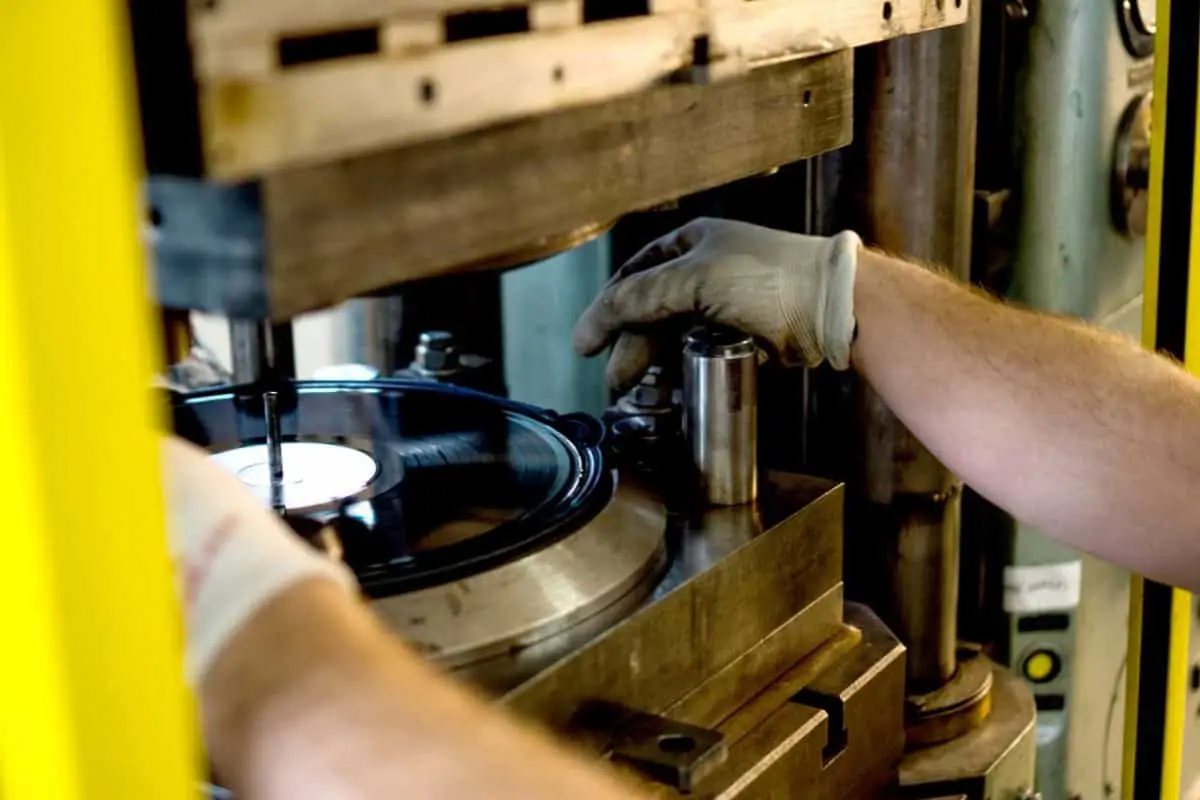
    After this stage, the master disc is ready to be put to good use. Using stampers from the top and the bottom, they stamp the creases from the master disc and reinforce them to create grooves in the vinyl records. They may use pressure that can rise to more than a hundred tons and heat the presses at temperatures higher than 200 degrees Celsius. (1)

    4. Labels And Packaging 

    Label and packaging are one of the most manageable parts of the process as they are not as volatile compared to, say, the vinyl records themselves.

    First, they will need to contact artists that may do the label’s artwork or a graphic designer that will incorporate designs together to create a coherent piece. More often than not, this process will happen way earlier compared to the whole “pressing” process.

    After the design, labels and packaging are printed, cut, folded, glued, and sealed to be ready for shipment. Despite not being a relevant answer to: “How to define pressing a record,” it is still a very integral part of the vinyl record experience.

    What Is The First Press And Does It Matter?

    So what is the first press exactly? The first press refers to a set of vinyl records produced using the first pressing of a master disc. The definitions of the first press vary heavily and are a cause of debate within the vinyl community.

    Some may refer to the first press as the “first pressing,” while some may refer to it as the “first issues.” However, one thing that stands clear is a point of agreement between these parties, and that is that the first presses “sound way better” than the latter presses.

    Another reason collectors and audiophiles prefer first pressings can boil down to another variable: the materials. These determined collectors have noticed that the materials used for first pressing vinyl records are significantly more durable than later pressings. They have justified this as they have pointed out that first pressings contain more material than later pressings. 

    The Frequently Asked Questions On Defining The Pressing Of A Record

    How Do You Define The First Pressing Of A Record?

    Some savvy audiophiles are very determined to find out whether a specific vinyl record is the first pressing or not. They have many ways of doing so. One of the key takeaways that will tell us whether something is first pressing or not is the labels.

    Since each manufacturer uses a different labeling format, we cannot give you a magical guide for first presses. It means that if you are determined, you might need to do a lot of heavy research regarding the origins of your vinyl records, together with their manufacturers.

    How Many Vinyl Records Can Be Made Within A Day?

    A company in New York named Brooklynphono has claimed to have made 300 records per hour. However, the numbers will heavily vary per company’s resources. (2)

    Can Vinyl Records Be Stereo, Despite Being Analog?

    Yes, vinyl records can both be mono or stereo. Analog signals can be split into dual channels, or a stereo signal in other words.

  • Do Record Changers Damage Vinyl Records? We Find Out

    Do Record Changers Damage Vinyl Records? We Find Out

    A record changer is a device that automatically changes your vinyl records so you can play various phonographs without user intervention. They first came out during the late 1920s but were only common until the 1980s. They gradually became rarer because they believed that using these devices can wear, tear, and warp vinyl records. 

    Automatic record changers can really damage your record. The reason is that these changers drop the vinyl record a little carelessly when it is time to replace the record. The stacked vinyl records can also grind against each other, damaging their surfaces.

    To know how record changers damage your vinyl records, you also need to understand how they work.

    How Do Record Changers Ruin Your Vinyl Records?

    Most of the time, the mechanisms of record changers are complicated. They hold a stack of vinyl records placed on an extended central spindle. An arm then supports the spindle.

    In addition, some units have feelers responsible for detecting the sizes of the records stacked on them.

    Once the turntable finished playing a vinyl record, the arm moves out to clear the way, and then the next vinyl record will drop. While using this mechanism can be convenient, the way it drops the records can cause warping in the long run.

    Also, since the vinyl records are stacked on top of each other, their surfaces can acquire scratches. These damages on your vinyl records can damage and render them useless.

    Audiophiles spurned record changers because they noticed a compromise in reliability in these machines. The reason is that the tonearm changes its angle depending on the height of the stack. Vinyl collectors were also concerned about the rough treatment of record changers on discs.

    Apart from scratches and warping, the change in the angle of the tonearm results in collective damage to the records’ spindle holes. Still, this damage results from dropping the vinyl from a height of a few inches going to the stack or record below the turntable platter.

    How Do Vinyl Records Work In An Automatic Record Changer?

    As mentioned, automatic record changers drop your vinyl record into the platter. For the records to play in the correct sequence, the numbering of the front and back is different. For instance, if you have four vinyl records, the sides are numbered 1 and 8, 2 and 7, 3 and 6, and 4 and 5, respectively.

    This sequencing method is popular as “automatic sequencing,” “auto-coupling,” or “changer sequencing.” Vinyl manufacturers record using this format during the pre-LP days, concertos, original cast albums, and classical symphonies.

    In addition, manufacturers designed this drop automatic sequence for record changers. This way, the machine simply dropped records instead of reversing the stack for it to play in sequence.

    On the other hand, there are also record changers that are capable of reversing the record stack automatically. That includes the record changers manufactured by RCA and GE in the 1930s.

    These units kept the vinyl records stacked on top of each other. Once the turntable finished playing a record, the changer slid it to the other side of the stack. This mechanism became famous as the “slide-automatic sequence.”

    Dust, Scratching, And Dropping: How They Damage Your Record

    Stacking vinyl records on a record changer exposed them to dust. The reason is that when people could play multiple records one after another, they tend to leave the records out of the sleeves for an extended period. As a result, the records accumulated dust.

    The more dust that came in contact between the vinyl records and the stylus, the more it produced surface noise. More than that, playing a dusty record could prematurely wear it down and damage the grooves. In time, the vinyl record was destroyed and rendered useless.

    Additionally, scratches can ruin your vinyl record and destroy its sound quality. Once a record accumulated scratches, those scratches will remain forever. When the turntable’s needle passes through those scratches, it would no longer produce high-quality audio.

    For that reason, you need to ensure that you are handling your record correctly. Unfortunately, proper handling was not something that record changers could do then.

    Finally, horizontally stacking vinyl records can warp them. The reason is that the records under the stack will carry the weight of all the vinyl records above them. As a result, the records warp and sometimes crack.

    Things That Can Damage Your Vinyl Record

    Apart from using record changers, improper handling can also ruin your vinyl records. Vinyl records are delicate things. For this reason, you need to know the things that can damage it so that you can easily avoid them.

    Using household cleaning materials for cleaning your records

    When you search on the internet for tutorials on how to clean your vinyl records, you will see a lot of suggestions. However, some of these tutorials can cause damage to your records instead of cleaning them.

    For instance, one of the most common cleaning suggestions on the internet today is to use household cleaning materials like Windex. However, the problem is that most household cleaning materials contain harsh chemicals. So, using them on your vinyl records can destroy their surfaces.

    Additionally, some people use a regular brush to remove dust from their records. But that can also scratch the surface of your record. For this reason, you should instead use an anti-static record brush when removing dust from your vinyl record.

    You may also want to read these articles that I wrote:

    Cleaning The Stylus

    Even if you are cleaning your record diligently, dust and other debris can accumulate on the stylus of your turntable. At first glance, this issue may not seem like a big deal. But in reality, the dirty stylus can lead to tracking problems such as skipping when you are playing music.

    The dirty stylus can also cause surface noise.

    Improper Handling

    When handling your records, you should only touch the label and outer edges. Touching the surface of your vinyl records will cause them to accumulate oil, grease, and dirt from your hands. Dust will stick to these oils, which will lead to stubborn surface noise.

    In addition, you can accidentally scratch your vinyl record with your fingers.

    Wrong Storage Technique

    Many vinyl owners let their records fall off as soon as they insert the edge to the record sleeve. As a result, the edge of the record warps and can destroy it in the long run. Additionally, not opening the sleeve enough will cause friction on the record and can potentially scratch it if there is any dirt or debris on the record or in the sleeve.

    Not Playing The Records Properly

    One of the worst things you can ever do to your vinyl record is finding a song manually. When you put your vinyl record on a turntable and place the needle down a random spot, chances are you will put it in the wrong groove. This mistake can lead to irreversible damage.

    So, instead of finding a song by hand, the best thing you need to do is to be patient and wait for the songs to play one by one.

    Using A T-shirt For Cleaning Your Record

    Sometimes, people feel tempted to wipe their vinyl records with their t-shirts or a soft towel. However, cloths not made for cleaning vinyl records may scratch and scuff their surface and will only move the dirt around. So, make sure that you are using a microfiber cloth every time you need to dry your vinyl record after deep cleaning them.

    Sources

    1. Technology Connections, Automatic Record Changers: We Used to Like Them, YouTube, https://www.youtube.com/watch?v=GuoFW2yAD7g/ Accessed July 29, 2021. 
    2. Record Changers, Wikipedia, The Free Encyclopedia, https://en.wikipedia.org/wiki/Record_changer#Automatic_sequencing/ Accessed July 29, 2021.
    3. Cleaning & Caring For Your Vinyl Records, U-Turn Audio, https://uturnaudio.com/pages/cleaning-and-caring-for-your-vinyl-records#:~:text=The%20more%20dust%20that%20comes,a%20clean%20microfiber%20cloth%20instead./ Accessed July 29, 2021.
    4. 5 Best Practices You Need to Learn about Record Storage, Life Storage Blog, https://www.lifestorage.com/blog/storage/how-to-store-your-vinyl-collection-record-storage-tips/ Accessed July 29, 2021.
  • Will A Warped Record Damage The Stylus

    Will A Warped Record Damage The Stylus

    Can warped record damage stylus? Warping is one of the effects of improper vinyl record storage. It can be reversible, but can you still play the vinyl record even if it’s slightly warped?

    Fortunately, you can still play a warped vinyl record. How come? How does this science even function in the first place?

    1. It may be warped, but the grooves are still intact.
    2. It’s not the record that can destroy the stylus, but the stylus can destroy the record.
    3. It’s not warped to the point of no repair.

    If you want to understand how warped records can still play, you’re welcome to keep reading. This information is essential to both novices in the vinyl record industry and experts in the field. 

    Can Warped Record Damage Stylus?

    No, your warped record cannot damage the stylus. It’s the other way around. A blunt or worn-out stylus can damage a vinyl record, whether warped or not. 

    How is that possible? Well, it all boils down to the science of it all. But first, it’s best to get out what warping is and what causes warping. 

    What Is Warping? 

    Warping is the bending or distortion of vinyl records when you expose them to harmful conditions. Vinyl records are pretty fragile. They require adequate room temperature and dust-free environments to maintain their state.  

    Why Is My Vinyl Warped?

    The following reasons cause vinyl record warping:

    • Increase in temperature 
    • Inadequate vinyl record storage 

    If you’re new to vinyl records and have never seen vinyl warping, you can try two things. Watch a Youtube video where the creator purposefully warps a vinyl record. Or leave a vinyl record out in the summer sun for thirty minutes. You will find your vinyl warped and ready to go, or if you leave it there for much longer, you can find it completely melted.

    If you decide to do the latter, kindly use an old vinyl record with little to no value. Vinyl records do have some monetary value. Not all of them, but a small minority do. Nevertheless, this little experiment should give you a better understanding of a warped vinyl. 

    Is It Alright To Play A Warped Vinyl?

    In my experience, playing a warped vinyl is a recipe for disaster. The record will play, no doubt about that, but you won’t be listening to an album at that point. 

    Whatever will come out of the turntable will no longer be sound; it’ll be noise and nothing else. A warped vinyl record still has the grooves, but they’re more distorted than anything, and the noise that will come out of the turntable will be annoying. 

    It wouldn’t hurt to try playing a warped record for the sake of science and experience but play it at your own cost. Many vinyl record owners have made mistakes with a warped vinyl; it would be best if you learned from their mistakes and not yours.  

    Not only that, but experts do not recommend playing a warped vinyl record. It’s useless, to be honest, playing a warped vinyl because you’ll get nothing out of it, but at the same time, it goes against the unspoken yet still spoken code of vinyl record keeping. 

    Storing vinyl records is mandatory for anyone who’s going into vinyl keeping. It’s part of the basics of collecting vinyl records in the first place. To start, the fact that your vinyl warped could also be a sign of lousy storage from your end. 

    An inadequately stored vinyl record will warp. As shared earlier, vinyl records are like plants. If you don’t care for them, they won’t dry out or die; they will either warp, accumulate dust, and quite possibly get damaged the next time you want to play them. 

    What Damages Vinyl Records And The Stylus?

    Dust. If you decide to play a vinyl record without cleaning it first, you will damage both the record and the stylus. Dust, dirt, or any unnecessary matter on the surface of the vinyl record will damage or erode it to the point of no repair.

    Apart from that, a worn-out stylus can damage a vinyl record. A stylus isn’t necessarily a needle; it comes in a cone shape that manufacturers polish to perfection. 

    The higher the polish on the stylus, the less friction between the stylus and the grooves on the vinyl record, so playing the vinyl record will be a lot smoother. 

    Any dust or dirt on the grooves or the surface of the record causes fiction while playing. Therefore, the stylus begins to wear off, and voila, your worn-out stylus can damage the in-coming vinyl record you’re going to play. 

    All of this plays back to vinyl record storage. It is a necessity that a lot of new vinyl owners tend to overlook. If a record isn’t cleaned or stored correctly, it will experience some damage while it’s in use. You could say that without cleaning and proper handling of vinyl records, you’re skipping some parts in its circle of life. 

    As odd as it may be, the lifetime of a vinyl record is entirely dependent on its storage. You can say the same for sealed vinyl records. They all need to be stored adequately and efficiently. 

    Can You Fix A Warped Vinyl Record?

    Why yes, yes, you can fix a warped record. In the same manner, you created a warped record; can you also fix it. By using heat and pressure on both sides of the vinyl record, you can quickly flatten it out and, this time, correctly store the vinyl record. 

    Experts recommend taking your time with the fixing process. Patience is a virtue, and you’ll need lots of it when trying to CTRL Z, the warped vinyl record. 

    It would be best to consult various Youtube channels to get the gist on fixing a warped vinyl record. Most significantly, if you’re new to vinyl record keeping. 

    You may also want to take a look at my other article, where I describe my own methods for fixing a warped record. Is It Ok To Play A Warped Record? (Answer Here)

    Here you can read even more about warped vinyl records.
    Is It Normal For Vinyl To Be Warped?

    FAQs About Warped Records

    Sources

    1. Jenna Miles, The Beginner’s Guide to Vinyl Records: How to Build, Maintain and Experience a Music Collection in Analogue (Massachusetts: Adams Media,2017) Accessed August 5th, 2021. 
    2. Shure, Stylus Wear, and Record Wear, Shure, https://service.shure.com/s/article/stylus-wear-and-record-wear?language=en_US Accessed August 5th,2021.
    3. Steven Williams, How to store vinyl records, Discogs, https://blog.discogs.com/en/how-to-store-vinyl-records/ Accessed August 5th,2021. 
    4. Levi Sheppard, Guide to flattening warped vinyl records, Vinyl Me Please, https://magazine.vinylmeplease.com/magazine/guide-to-flattening-warped-vinyl-records/ Accessed August 5th, 2021. 

  • Is It Normal For Vinyl To Be Warped?

    Is It Normal For Vinyl To Be Warped?

    Is it normal for vinyl to be warped? Warping is a result of poorly stored vinyl records. However, sometimes new vinyl records come at your doorstep a little warped. Is that normal? Let’s find out. 

    Unfortunately, it’s normal for new vinyl records to have a warped state. It’s the current state of the vinyl economy. Why is that?

    1. Warping is an adverse effect caused by improper storage of vinyl records.
    2. You can also get warping by leaving your vinyl records under the sun.
    3. Unsealed records can also warp if they are not stored properly. 

    As a vinyl enthusiast, you will come across warping a lot. It’s up to you to correctly determine the vinyl records state and whether or not you can fix the vinyl record. You’re welcome to keep reading and get more information on how you can achieve that result. 

    Is It Normal For Vinyl To Be Warped?

    In my experience, getting a warped vinyl is a result of poor storage and maintenance. Whether it’s a new, old, or used vinyl, a warped state is not normal, and you shouldn’t normalize it in the first place. 

    Vinyl collectors grade valued vinyl records using Goldmine standard. If a collector analyzed a warped vinyl record, it might receive a P grade regardless of its release date and other exceptional factors. P means poor, by the way. 

    This fact doesn’t mean that you should grade every record you see, but you should hold your vinyl records, their condition, and storage to a high standard. 

    Vinyl record storage is one of the basics of vinyl collecting, and of course, you might slip up and warp one record at least. But it would be better for you and your collection to care for them a little better. 

    Why Is My Vinyl Warped?

    To answer this question, you have to understand what warping is. By understanding what warping is and its causes, you can understand why your vinyl record is warping in the first place. 

    What Is Warping?

    Warping is an adverse effect caused by the following things:

    • By exposing the vinyl record to high temperatures. For example, the summer heat. 
    • Improper storage of vinyl records.

    Vinyl records require specific temperatures to stay flat and playable; in the case of sealed vinyl records, flat and profitable. Vinyl records require room temperature to remain playable and flat. At room temperature, you’re talking around 65°F or 70°F.  

    At about 140°F, the vinyl record will warp. It is inevitable. Moreover, if the temperature increases, the vinyl record will eventually melt. 

    As a vinyl record enthusiast, make sure the room or area you’re storing your vinyl records maintains a constant temperature that will keep the record cool and flat. 

    Another thing to note is that the vinyl records will become brittle and break if the temperatures get any lower. 

    Why does vinyl warp in the first place? Vinyl records consist of PVC (polyvinyl chloride). PVC is a type of plastic. When you expose a thin plastic (vinyl records) to harmful conditions, it will melt, break or warp. 

    Look at it this way; if you left a plastic cup out in the Summer afternoon for a long time, you wouldn’t be coming to a plastic cup in an hour or two. It’s the same concept. The plastic will bend (warp) or melt (if we’re talking Death Valley). 

    Is It Normal Few New Vinyl Records To Come In Warped?

    If you chose to have your vinyl records delivered to your doorstep during the summer, there’s a high chance that they will come in warped. It’s not that it’s normal, but rather it’s a form of cause and effect. 

    The keyword here is Summer. 

    There’s no way of regulating the heat inside your package while it’s in the delivery truck or shipping center. Many vinyl enthusiasts will not ship vinyl records during the summer because of this particular problem. 

    Experts recommend shipping your vinyl records in seasons other than summer, preferably the beginning of autumn where it’s not too cold or too hot, and the record should make it in peak condition.

    How Do You Fix A Warped Vinyl?

    Fixing a warped vinyl isn’t hard, but it does take some patience. It requires heat to warp a record, but it also requires heat to CTRL Z the warping process. 

    What do you need?

    • A source of heat
    • Heavy objects to sandwich the warped vinyl record

    Kindly note, do not use a stove to undo the warping. Not only is it dangerous, but it might also break a couple of restrictions in your locale or building. Experts recommend staying away from the stove method; it’s not safe for you.

    Some experts wait for summer to undo the warping. Then they leave the records between books that will hold them in place and provide that pressure to flatten them. Please note, you are still keeping the records at a pleasant temperature that won’t warp them. 

    It’s essential to check the temperature so that you’re not crossing the line. 

    After leaving the records for around a week, the process should’ve fixed the warped record or reduced the warping to an agreeable state. 

    Doing this method a couple of times should fix most of the warping, and you would’ve done it safely. Again, the keyword is safe. 

    Regardless prevention is better than cure. Take care of your vinyl record, store your records correctly and make sure that you consistently clean your records.

    This method is the best way to keep your records free from warping. It may seem like a pain in the neck, but the results will never disappoint you.

    Lastly, vinyl records can warp; sometimes, it’s inevitable. However, do not normalize the warping of vinyl records—God speed. 

    You may want to take a look at my other articles if you want to learn more about the subject.
    Is It Ok To Play A Warped Record? (Answer Here)
    Will A Warped Record Damage The Stylus? Is It Ok To Play A Warped Record? (Answer Here)

    New And Second Hand Vinyl FAQs

    1. How Are New Vinyl Records Warped And Second-hand Vinyl Records Are Flat?

    It’s tricky trying to pinpoint the problem with new vinyl records warping. The reason for this problem may lie with pressing companies, warehouses, or even shipping companies. Maybe blame the entire manufacturing process. 

    There’s also the case of 60s records were much thinner and warped a lot easier. However, records from the 50s were a lot sturdier and didn’t warp as quickly as other vinyl records after that decade. 

    It’s pretty challenging to poke and prod where precisely the problem is coming from, but if you had to choose one clear winner, it would have to be cats. Blame the cats. 

    1. Should You Return Warped Records That Sound Fine?

    It depends on how much warping the vinyl record has undergone. If the warping is undisputed and doesn’t satisfy your level of quality, then it’s an excellent choice to return the vinyl record. You can get a new one or get your money back.

    However, sometimes it’s never that serious. If the warp is less than an inch and the album plays well, then it should be fine to keep it and play it on your turntable. 

    Regardless, overly warped vinyl records are worth returning to the seller and getting a better vinyl record for your money.

    1. Can You Fix A Warped Record With A Hairdryer?

    Well, this tool of choice is quite uncontrollable. You can’t control how much heat is on the record, and you might blast it with so much heat that you make the warping a lot worse. 

    Experts do not recommend using a hairdryer. It’s an uncontrollable medium that may let things go south in the blink of an eye. 

    Sources

    1. Jenna Miles, The Beginner’s Guide to Vinyl Records: How to Build, Maintain and Experience a Music Collection in Analogue (Massachusetts: Adams Media,2017) Accessed August 15th,2021. 
    2. Record Player Expert, Vinyl Temperature Guide, Record Player Expert, https://recordplayerexpert.com/vinyl-temperatures/ Accessed August 15th, 2021.
    3. Steven Williams, How to store vinyl records, Discogs, https://blog.discogs.com/en/how-to-store-vinyl-records/ Accessed August 15th,2021. 

  • How To Properly Use WD-40 To Clean Vinyl Records

    How To Properly Use WD-40 To Clean Vinyl Records

    If you hear scratching on your vinyl record while playing, that’s not a scratch on your vinyl record; that’s dirt. Here’s how you can use WD-40 to clean your vinyl record safely and efficiently. 

    For audiophiles out there that want a fast and reliable method of cleaning your vinyl record, you’re in the right place. Here’s how you use WD-40:

    1.Spray the WD-40 on a lint-free cloth

    2.Thoroughly clean the vinyl record with the sprayed cloth

    3.Let it sit and dry for a couple of 3-4 minutes.

    4.You’re done!

    This article will go on to give you an in-depth explanation of this process. Not only that, but it will also provide additional information on cleaning vinyl records. Keep reading for more information on the maintenance and care of your vinyl records.

    WD-40 - 490224 Multi-Use Product with SMART STRAW SPRAYS 2 WAYS, 14.4 OZ [2-Pack]

    Here’s How To Properly Use WD-40 To Clean Vinyl Records

    First things first, what is WD-40?

    WD-40 is a type of petroleum solvent. It is volatile and evaporates to leave behind a lubricant that is non-volatile. Volatile refers to a substance that quickly evaporates even when exposed to average temperatures. 

    The volatility of WD-40 is one of the reasons that make this product a great vinyl record cleaning alternative. 

    So how do you use it to clean your vinyl records? Here’s how it starts.

    1. It All Starts With A Clean Record

    Before you can play a vinyl record, you have to clean it first. After playing it, you have to clean it again. Hence the reason for the first step, it all starts with a clean record. 

    Vinyl records tend to gather dust, dirt, and any other unwanted matter on their surfaces. When playing the vinyl record or storing the vinyl record, exposure to unwanted contaminants occurs. 

    It’s good practice to clean your vinyl records after every use, hence why this step is first on the list. It’s good to start on a clean record.

    There are two types of cleaning methods for vinyl records:

    • Wet Cleaning
    • Dry Cleaning

    Wet cleaning refers to the cleaning process of using a fluid and a brush or a record cleaning machine. In comparison, dry cleaning involves the use of a dry brush. 

    WD-40 uses the wet cleaning process, and instead of a brush, it uses a lint-free cloth. The wet cleaning process has three other cleaning processes:

    • one step cleaning process
    • two-step cleaning process
    • three steps cleaning process

    The one-step cleaning process involves using one cleaner to clean the vinyl record, while the two-step cleaning process involves using two steps to clean the vinyl record. The three-step cleaning process follows the same pattern. 

    Since you are using one product, the WD-40, it is safe to say that you will be using the one-step cleaning process. Let’s get to it. 

    2. Place The Record On A Flat Surface

    Record collectors prefer to place the vinyl record on top of a turntable mat with a towel or an absorbent cloth underneath it. You want a working surface that will not damage the record at all costs.

    It’s unnecessary to have a turntable mat but make sure your record is sitting safe, pretty, and ready for a cleaning session.

    3. Spray The WD-40 Onto A Lint-free Cloth. 

    You want to make sure that whatever touches the record will not damage it as well. Lint-free cloth won’t leave any unwanted strands of cloth behind, and it’s a safe material when cleaning vinyl records. 

    In my experience, lint-free cloth is a great tool when using the WD-40. 

    4. Spread The WD-40 Carefully Onto The Surface Of The Record. 

    Start cleaning the WD-40 on the lint-free cloth onto the surface. Be gentle and be sure to clean both sides of the vinyl record. You want to make sure that you spread the product evenly on the surface and the vinyl record is free of unnecessary damage.

    Would you please not put your back into it? It needs some good cleaning but not enough force to split it in half or crack it. 

    5. Let It Sit For 3-4 Minutes

    Remember that WD-40 is a volatile solvent. It evaporates and leaves behind a non-volatile lubricant. It doesn’t need to be left under the sun for it to dry. 

    Leave it on the flat surface you’ve been working on, and after 3-4 minutes, you can check on your vinyl record.

    6. You’re Done!

    You can now safely store or play your vinyl record with complete confidence that your vinyl record is clean and working efficiently. 

    What Does WD-40 Offer To My Vinyl Records?

    WD-40 offers two things after use:

    • Dirt removal
    • Lubrication

    WD-40 removes any dust, dirt, grime, or unwanted substances that were on the surface of your vinyl record. It also lubricates your vinyl records. Vinyl record owners reported smoother revolutions playback improvement. 

    Some users may deem it controversial, but WD-40 does the job. Moreover, it does not have any substances that may affect vinyl or PVC (polyvinyl chloride – the primary substance that vinyl consists of).

    Vinyl erodes in the face of ammonia and alcohol. WD-40 contains none of the decaying substances. It cleans and protects vinyl before and after use. 

    Furthermore, the WD-40 formula has stayed the same since 1953. The formula remains a trade secret, but users can see its constituents. It’s safe to say that WD-40 is a consistent product that will probably not change its formula in the future, and it makes for a tremendous vinyl cleaning tool. 

    Disclaimer On The Different Types Of WD-40

    WD-40 comes in numerous types of cans. It’s a multi-use product, so it’s not shocking that it has specialized product versions. Experts recommend using the blue can version of WD-40 for cleaning vinyl records. 

    WD-40 - 490224 Multi-Use Product with SMART STRAW SPRAYS 2 WAYS, 14.4 OZ [2-Pack]

    Are You A Vinyl Record Owner? Here Are Some Helpful Faqs To Help You Maintain And Clean Your Vinyl Records With WD-40.

    1. Is It Okay To Clean Vinyl Records With WD-40?

    Yes, it is. WD-40 is a great vinyl record cleaning product. It does not contain any ammonia or alcohol, and it is a volatile solvent. After use, it will remove the dirt or dust, evaporate and leave behind a non-volatile lubricant.

    Users have reported that it increases playback improvement. WD-40 is an excellent alternative to vinyl record cleaning products. All you require is a lint-free cloth, the WD-40, and time. 

    The entire cleaning process is fast, easy, and efficient. As long as you do it correctly and the vinyl record does not suffer from damage during cleaning, all is well. 

    1. What Is The Best Way To Clean Vinyl Records? 

    The wet cleaning method is the best method to clean vinyl records. Its because the wet cleaning method applies to both new, used or old vinyl records. 

    If you’ve bought used or old vinyl records, then the wet cleaning method is ideal. It will help jumpstart the maintenance process, and you will have a much easier time cleaning the vinyl records in the future. 

    The industry has numerous cleaning products to choose from if you’re in the market for one. However, if you’re looking for an alternative answer, the WD-40 is a great choice. Not only does it remove dirt or grime, but it also lubricates the vinyl record. 

    1. Does WD-40 Ruin Plastic?

    No, WD-40 does not ruin the plastic. Vinyl consists of PVC or polyvinyl chloride. 

    PVC suffers damage from consistent exposure to ammonia or alcohol. WD-40 does not contain ammonia or alcohol in its formula. 

    For this reason, it’s one of the best alternative vinyl record cleaners. So if you’re in the market for a vinyl record cleaner, in my experience, WD-40 is a great choice. 

    Related Articles:

    Sources

    1.Jenna Miles, The Beginner’s Guide to Vinyl Records: How to Build, Maintain and Experience a Music Collection in Analogue (Massachusetts: Adams Media,2017) 256.

    2.Mike Saurus, Unusual uses for WD-40, Instructables Workshop, https://www.instructables.com/Unusual-Uses-for-WD-40/  Accessed July 20th, 2021.

    3.Wikipedia, WD-40, Wikipedia, https://en.wikipedia.org/wiki/WD-40  Accessed July 20th, 2021.

    4.AZO Materials, An Introduction to Vinyl, AZO Materials, https://www.azom.com/article.aspx?ArticleID=987  Accessed July 20th, 2021.