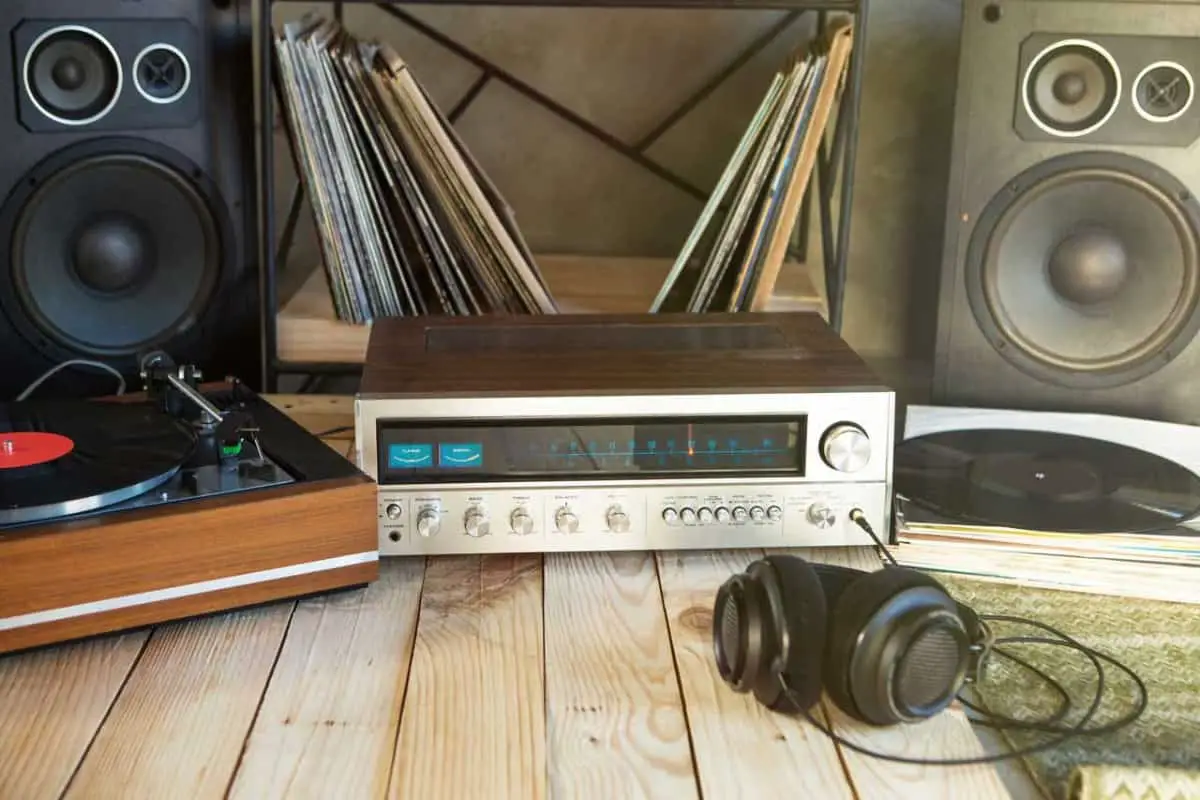
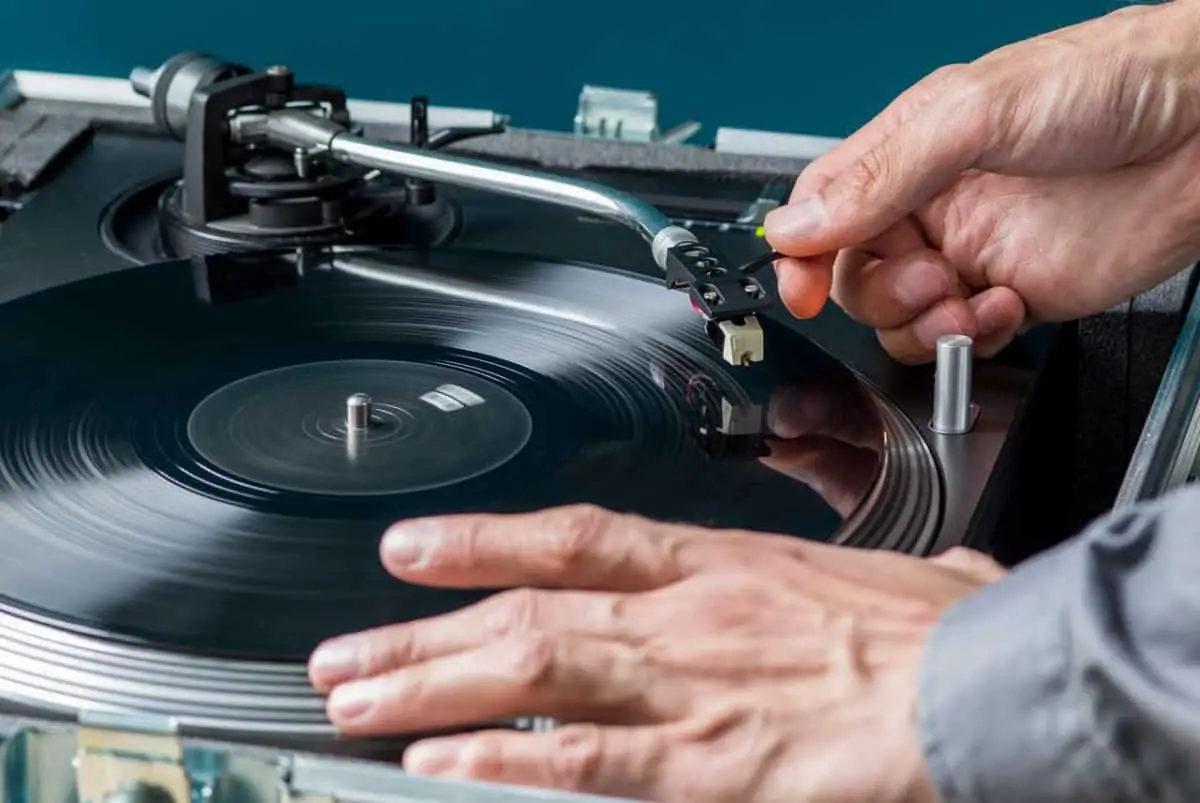
“I know that it may make me look quite ignorant, but do turntables require electricity?” That was me a few years ago, asking that to a resident audiophile in my community. This question is not an “ignorant” question but rather a pretty interesting one: do turntables require electricity?
All modern record players require electricity, and this was a common occurrence even a hundred years back. Electricity is essential for record players as they need electric energy to transform data into audible sound waves.
Why do modern record players require electricity, and what role does it play in creating music? These are the questions we would like for you to ask, and we will answer them below.
Question Numero Uno: Do Turntables Require Electricity? How Is A Record Player Powered?
As a technological advancement that has existed for way more than a century, answering this question is relatively simple yet complicated at the same time. The vast history of vinyl record players hinders us greatly from answering “easy” questions such as this. To answer this quite quickly, let us approach this chronologically, spreading and seeding some history lessons on the way.
The Phonographs Do Not Need Electricity
Phonographs are the earliest forms of record players out there, and they sometimes can come in various names; one of such is the gramophone. They work similarly with today’s record players, as such that it uses the patterns on grooves to store audio data on data storage devices known as “records,” the very descendant of our very own, very beloved vinyl records. However, they do operate very differently when compared to today’s vinyl record players. (2)
Although today, many consider the vinyl record player a manual machine with lots of old technology incorporated, the vintage gramophones included even more manual aspects to its operational processes. For example, unlike today with motor-powered record players or with belt-driven ones, the old gramophone or phonograph needed mechanical energy to operate. By mechanical energy, we mean that you would need to use your arms and crank the platter to rotate it, and literally, “manually manning” the whole thing.
Because the old gramophones needed mechanical energy, they would have no use for electricity and thus, did not require electricity. So to answer your question, “Do turntables require electricity?” the answer will be no (in this context at least).
The Portable Record Players Do Not Need To Be Plugged In
Once upon a time, wanting to own a computer meant that the computer would need you to allocate a whole room for its very existence. It was clunky, heavy, and indeed, it wasn’t too comfortable to use, unfortunately. Today, however, you are probably reading this very article using the computer you have in the palm of your hands; yes, your phone.
Portability is a fundamental aspect of a device, and it was an essential point indeed. Even though not as portable, the desire for portability and mobility encouraged the demand for MP3 players, mobile phones, and televisions. And although MP3 players do play the music, you may want, some still want a portable record player that was in the form of a turntable but still be a more portable option.
Enter: the portable turntable, a sleeker (not very sleek), lighter (not very lightweight), and more portable (not very portable) alternative to the traditional record player. The portable record player was not as mobile and portable as an MP3 player. Still, it did build a bridge between portability and experience, built for people with a keen sense of useability and purpose. (3)
Because the portable record players are serving its abilities for the mobile audiophile, requiring an alternating current input would make it a lost purpose. Therefore, instead of using alternating current energy input, it uses direct current energy input instead. What does this imply in real-world use?
Do turntables require electricity or portable turntables in this sense? Well, the answer is yes, but actually no. If you use a cable and plug it into a wall socket by electricity, then the answer is no.
However, by application, portable record players do need electricity as it uses batteries, which, in theory, uses chemical energy. However, batteries function in a way that uses chemical energy and transforms it into electrical power, which means that it uses electricity at the end of the day. Moreover, since these batteries are rechargeable, you will still need to plug them into a wall socket sooner or later.
Modern Record Players Need Electricity
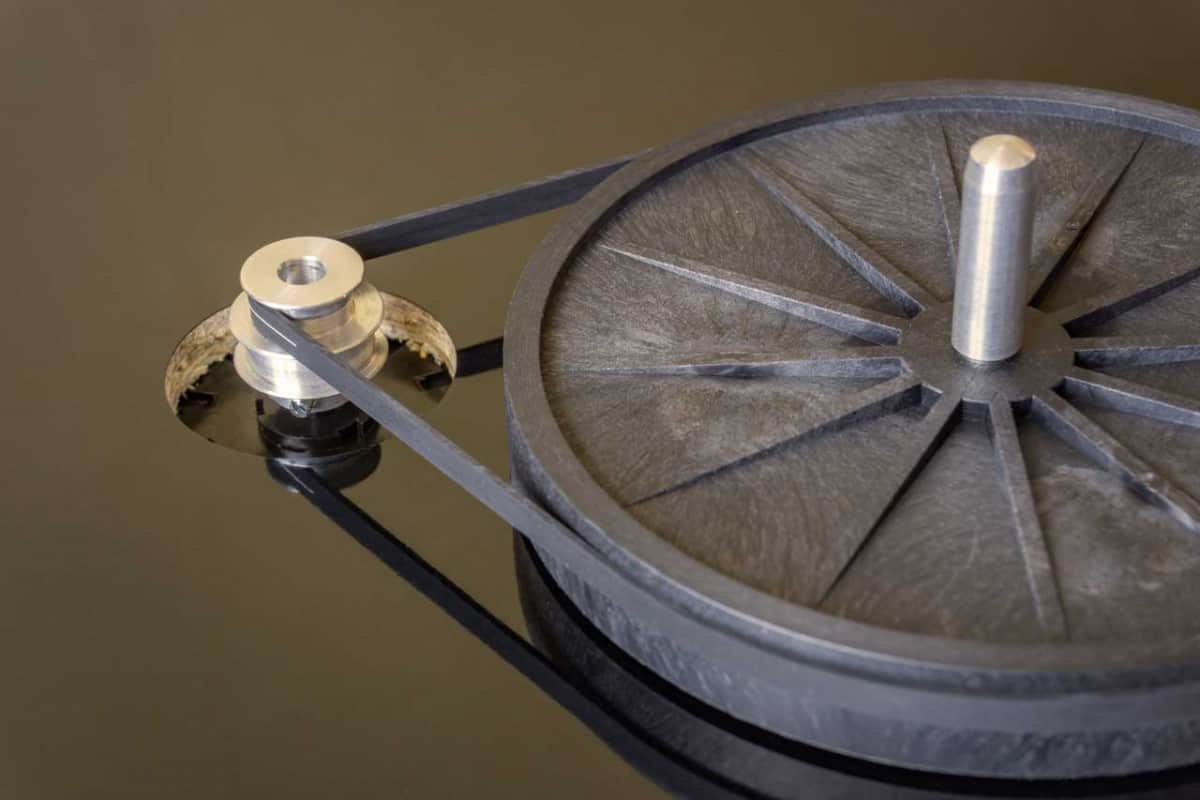
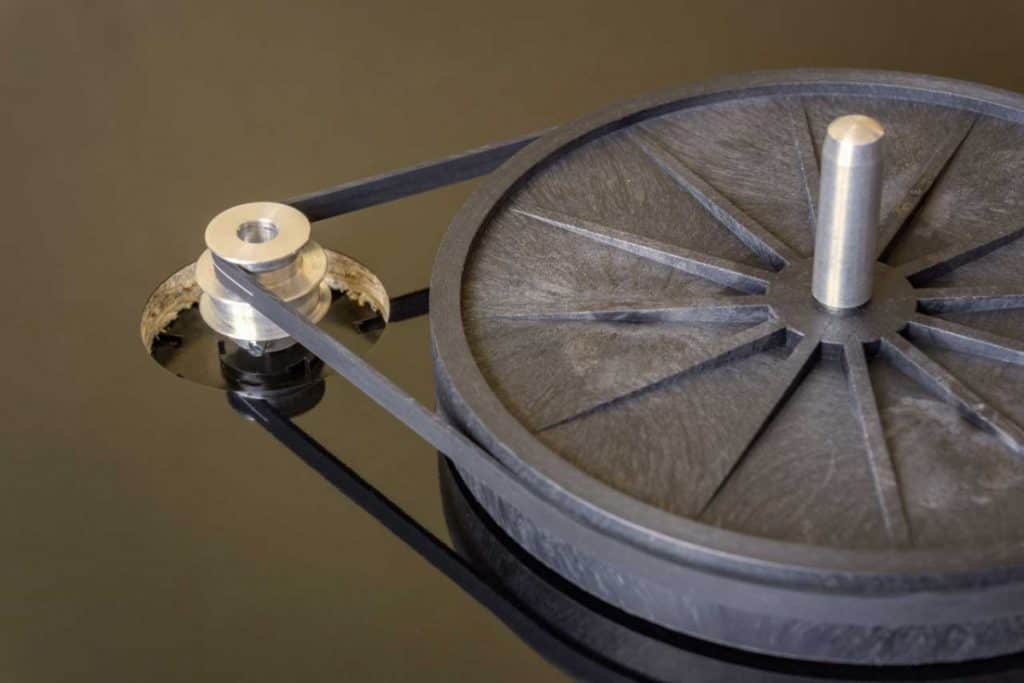
If you have read our previous articles, you may or may not have read all about the talk on belt-driven and direct drive record players. Simply put, belt-driven turntables require a physical belt to function, while direct drive turntables need none as they have a motor. It may seem like there is an implication that belt-driven turntables do not have motors.
However, the truth is more complex than that, such that the reality is, even belt-driven record players utilize a motor to rotate the platter. So what does this imply in our search for the answer, then? Do turntables require electricity?
The answer is a quick and resounding yes! All motors (which means all record players that have motors) will require electricity if you must know. Having a motor without needing electricity would be crude, as the definition of a motor is a device that transforms electrical energy into mechanical energy, meaning that it does require electricity. (4)
Okay, now we know that the turntable requires electricity, but what else requires electricity? Well, let us talk about that in the next section, shall we?
Question Numero Dos: What Components Of The Modern Turntables Require Electricity?
As we now know, unless you are using the ancient and very untimely gramophone, chances are your record player does require electricity in one way or another. So what components of the record player need electricity specifically? Well, let us get rolling then.
Do turntables require electricity? Well, first, let’s start with the speakers.
The speakers inside the record player require electricity as their primary purpose is to convert electrical energy into mechanical energy. You may be confused reading “mechanical energy,” asking yourself, “Isn’t it supposed to be sound energy?” The truth is how most speakers work is that they repeatedly move in a short period to create vibrations that our ears will then perceive as sound.
Of course, most turntables do not have a built-in speaker. However, to fully utilize a turntable, you will eventually make use of a speaker. To fully use the record player, you will need a speaker, which in turn, does use electricity. (5)
Aside from the speaker, we have also discussed one of the electricity hogs inside a record player: the motor. Because discussing it will be redundant, we will move on to the following aspects.
Many record players today incorporate some automatic feature one way or another. For example, when the stop button is pressed, cueing levers will help your record players raise the cartridge or the tonearm to minimize or mitigate damage that the needle may cause. Moreover, auto-stop features, a technology incorporated to automatically halt the platter’s rotation after the record has ended, are also automatic features.
These automatic features may seem mundane and may seem irrelevant and taken for granted. However, they, too, need electricity to operate to execute their crucial jobs.
You Ask The Questions; We Answer (The Frequently Asked Questions Section)
What are the essential components and parts of the turntable?
Although some of these parts may not come inherently included with the record player, they are required, ergo, needed to operate. These parts are the stylus, the cartridge, the speakers, the preamplifier, the amplifier, the tonearm, and the platter. There are more specific components, but they are for another discussion.
Why are there grooves on the vinyl record?
These grooves can be related to the writing we do on paper. The vinyl is like paper, while the grooves and the patterns in them are the writings. Simply put, they contain the data.
Are record players stereo?
They can be stereo or mono but mostly depend on the tonearm and the vinyl record itself. Most, if not all, modern record players are stereo out of the box.
In a world where Spotify, iPods, and compact disks exist, sometimes, we take for granted even the smallest of features: mainly pausing. While digital media can “play” and “pause” with the push of a button, this process is not precisely very straightforward on analog mediums. That is why today, we asked ourselves: “Can a record be paused?”
Despite the technical limitations, analog music formats such as vinyl records can be paused. However, the process isn’t so straightforward. It will require you to raise the cue physically.
In this article, let us talk about how to pause the record safely and consider what you should consider before hitting the play button.
Can A Record Be Paused?
Although not conventional, you can pause a vinyl record. However, in my opinion, I would not consider the process “pausing” rather than calling the method as stopping the record altogether. Why do I say this exactly? Let us find out.
Pausing The Old School Way
Vinyl records and turntables make themselves stand out as they are one of the last remaining analog mediums of playing recorded music that is still widely used. Despite its weight, exorbitant prices, cumbersome form factor, and fragility, vinyl records are considered the prime way of listening to music. They are uncompressed and have the nostalgia and experience factor added in. However, they are not considered to be the most convenient method of listening to music.
Why do I say this? Well, because of many factors. First, vinyl records are not precisely beginner-friendly, and they are certainly more prone to damage; moreover, the act of pausing isn’t precisely as straightforward as an MP3 player.
The pausing process goes like this: first, you will need to lift the cue to raise the tonearm. When you do this process, you will notice that the music has already stopped. However, this does not mean that it is paused, unfortunately.
If you are using the modern vinyl players (which you are probably using one), you will probably notice the lift arm button. Instead of manually lifting the cue with this button, you can lift it with the push of a button! It will make the process a lot easier and less cumbersome.
If you take a second look at your turntable, you will notice that vinyl is still rotating, which implies that it technically hasn’t stopped yet, only that there is no audio leaving the speakers anymore. In this step, you will need to “stop” the rotation by pressing the stop button on your turntable. (1)
So technically, you haven’t “paused” your vinyl record. You merely “stopped” the turning. However, it functions more or less the same as the pause button on your MP3 player, albeit less convenient, and is not very precise as well.
The next time you ask if a record can be paused, remember that you can pause it– but not in the same manner as you know it to be.
Why The Order Matters
If you read the process stated above, you may have noticed that instead of directly stopping the vinyl record’s rotation, we have lifted the cue and the tonearm first before proceeding with the stopping action. Why is this exactly?
It is not a “must-do,” but it is a recommended process. If you didn’t know, the needle of your record player’s tonearm is actually made out of the diamond. Earlier, we have discussed that vinyl records and record players are very fragile; let’s talk about that.
The diamond needle is not only very expensive (obviously) but is also pretty tough, especially the diamond tip. Using the Mohs scale of mineral hardness, we will notice that the diamond is the most challenging material globally, making the vinyl pale in comparison. Indeed, you wouldn’t want the ever-so-hard diamond needle dragging over on your delicate vinyl, wouldn’t you? (2)
It’s Not Exactly The Same. In Fact, It Is Quite Complicated.
Pausing a vinyl record player is not necessarily the same as the pausing option you have with your MP3 player. We have established that well enough already. However, can it get more different as well?
First of all, we have already discussed a specific “ritual” or order when pausing a vinyl record. Lift the cue, then stop the vinyl record. However, this is not the only way a vinyl record’s pause differs from the standard pause we have on our gadgets.
If you must know, there is a particular behavior of pausing that is exclusive to vinyl record players. Unlike MP3s, iPods, and the like, vinyl record players, when “paused,” do not resume the music or audio at the spot where you stopped it. Instead, it may skip through a few seconds of the track, especially if the whole process was manual and does not incorporate automatic cue levers.
So can a record be paused? Yes, but the process is not the same as how a DVD player would pause a compact disk.
Playing A Vinyl Record Player Is Not So Simple Either
We have discussed earlier how the pausing process is quite convoluted. However, the same can be said to the “playing” process as well. In the instance where you will need to resume your audio after pausing or when you are just initially starting to play your vinyl record, you do not just press play, as it always has been with vinyl record players; it is more complicated than that. (3)
Speed And Size
First, you must know all about the vinyl record’s speeds. Vinyl records are unique on their own as they have different sizes that can affect their rotation speed. When you play a vinyl record too fast or slow, you may not like the overall music output.
Second, you must know about the sizes. As of writing, there are still three relatively standard sizes, the seven-inch vinyl, the ten-inch one, and the twelve-inch one. (4)
The seven-inch and twelve-inch vinyl are generally used for singles and can hold up to two songs, one song on each side of the vinyl record. On the other hand, the twelve-inch vinyl is reserved for extended plays and can include multiple songs per side. These sizes handle different rotation speeds.
The 7-inch and 10-inch records play at 45 RPM, while the 12-inch records play slower at 33 1/3 RPM. So before you press play, make sure you are using the correct rotation speed first. Most modern vinyl players can operate under multiple rotations per minute options, so compatibility problems should not be too familiar.
Pressing Play
So how exactly does the process of pressing play go? Now that we have understood the speed and the vinyl sizes, I would like you to identify the speed needed for the vinyl record at hand. There are usually printed labels indicating the speed requirement of a vinyl record on the record itself.
Now, set up your vinyl record player at the appropriate speed. Wait for the vinyl record player to rotate that fast and then press play.
When using automatic record players, the cueing lever will rise and hover over the record. When using a manual record player, you may need to press on the tonearm’s cueing lever to lower it. (3)
Can a record be paused? Can a record be played? Of course, it can, and all it requires is wit and preciseness.
The Questions They Asked: Frequently Asked Questions
Will I damage the record if I leave the needle resting on it?
If you followed the steps earlier, you would notice that we recommend you raise the needle before you stop the record. We still want you to do the same.
Are there thicker types of vinyl?
Yes, there are. Although not necessarily affecting sound quality, it does improve durability by lowering the risk of vinyl warping, a phenomenon common in hot climates.
Does tonearm matter?
Yes. Some tonearms are much more suited to a specific sound than others.
It only happened recently when a heatwave struck the United Kingdom, but one of the oddest questions popped out of nowhere due to the event: what temperatures can vinyl records withstand? It all started with the media giant Tiktok, and when a vinyl record lover, Matt, discovered the heatwave left, his records warped. With the video gaining traction, many people have turned to ask the same question as you did. (source)
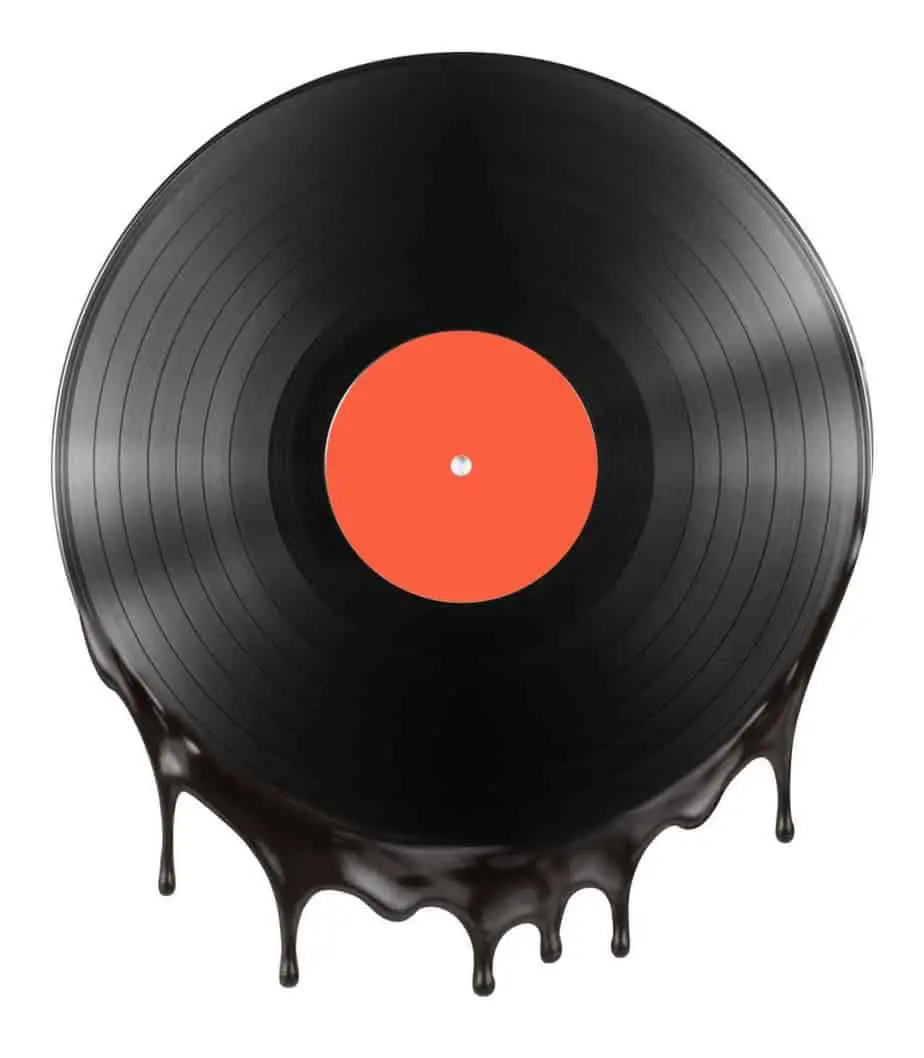
Typical vinyl records start to melt at around a hundred degrees Celsius, or approximately 212 degrees Fahrenheit. Despite indoor and outdoor temperatures not being that hot, the material can absorb heat which will help reach those dangerously high levels.
In this article, we take it upon ourselves to solve the phenomena of the melting vinyl records and finally answer the question, “What temperatures can vinyl records withstand?”
The Phenomenon That Sparked Curiosity: The Heat Wave And The Vinyl
Before we get started with all the “vinyl record warping science,” let us first investigate the very phenomenon that sparked the curiosity in everyone’s heads: the Tiktok video and the excruciatingly hot United Kingdom heatwave.
On a fateful week of July, the United Kingdom and Northern Ireland reported and recorded their hottest day yet– prompting The Met Office (The United Kingdom’s national meteorological service) to issue their first-ever extreme heat warning. Yes, you heard that right, they published their first-ever notice of such sort! (source)
Of course, many people tried to avoid experiencing the hot weather, wearing loose clothes, and staying indoors; the people of the United Kingdom sure did their very best to keep cool. However, some did get a little bit creative.
While a significant portion went out to enjoy the heat and play sports or went to get a tan, Tiktok user and vinyl lover “Matt” tried to be more creative.
Instead of going to Google and searching up “What temperature can vinyl records withstand?”, he instead tried to take it to the great outdoors to solve the question.
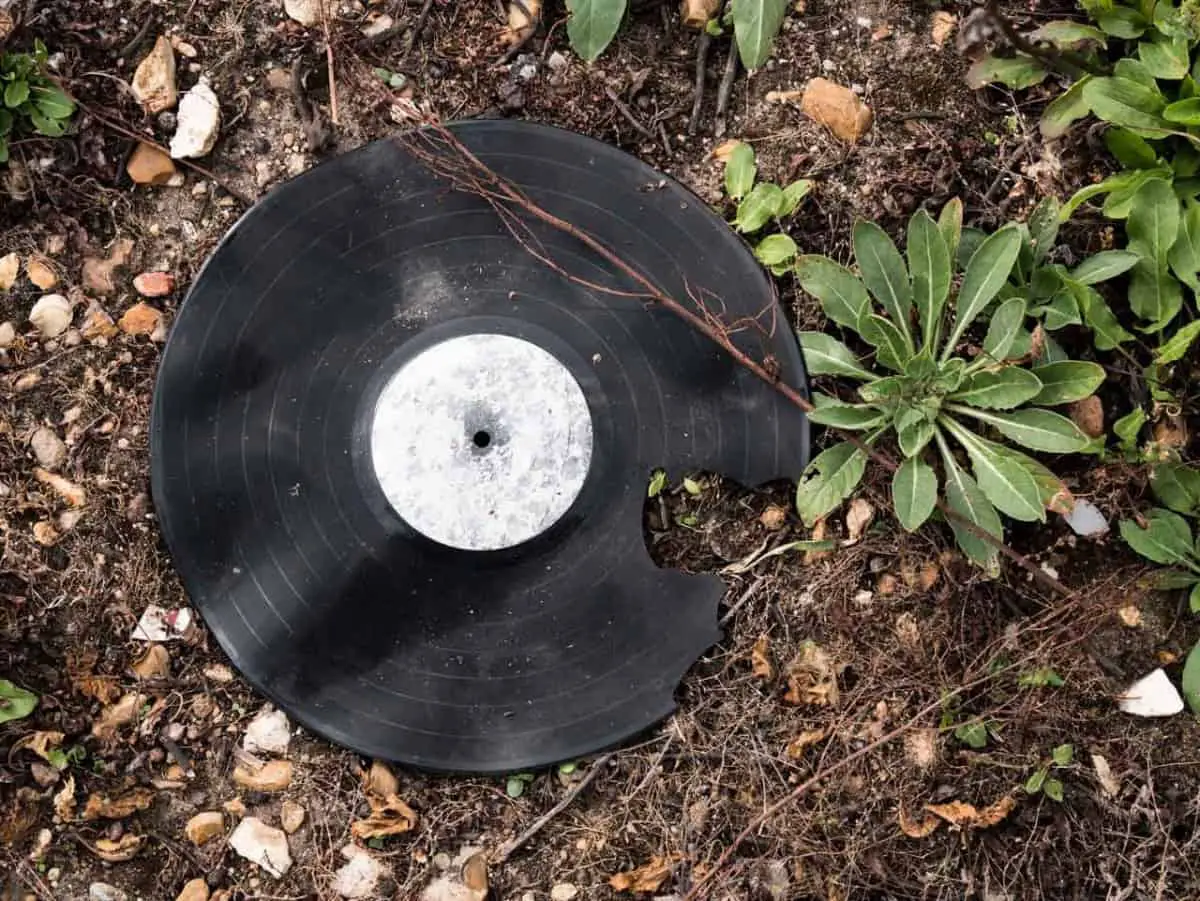
With the help of his trusty phone to help film the process, he used a Demi Lovato vinyl record (broken, of course) and went out to do some initiatives and left it amid the burning sun.
An hour into the experiment, the vinyl was starting to get a bit of a wobble. And by the three-hour mark, the record was beyond any hope for reviving (although the record was never functional anyway).
Despite the process not being exactly the most accurate way, nor is the most scientific way of doing experiments, they did (to some extent) find the answers to their inquiries. At least, he could infer that the high sun and the heatwave would bend their vinyl records.
Even though “Matt” did this experiment all in the name of fun, they were still able to give us a lesson that we should never, ever forget. We don’t need to know what temperature vinyl records can withstand to infer this. All we need to do is never expose our vinyl records to the hot sun!
What Temperature Can Vinyl Records Withstand?
Vinyl records are complex inventions that need precision to work. This intricacy signifies that to ensure the vinyl record’s integrity is to ensure that the records must not be scratched, nor be at any point be dropped or warped. So what exactly makes a vinyl record distorted and warped?
There are many reasons why vinyl records incur such damages, but we must never forget that vinyl records’ number one enemy will always be heat and mishandling.
For the sake of simplicity and to stay unto the subject matter at hand, we will only be tackling with heat. What is heat, and what temperatures can vinyl records withstand?
Keeping It Below Boiling Point
Let us get this straight: humans can only survive at a heat of a little bit more than 40 degrees Celsius or 110 degrees Fahrenheit at ten percent humidity. Yes, it only takes that amount for us to be “too hot” and experience hyperthermia and even death. Imagine that but double that number, and do that to your vinyl record. (source)
While not known as a very heat-resistant material, vinyl can absorb way better temperatures than us at around a hundred degrees Celsius or a little more than 210 degrees Fahrenheit. However, this does not mean that we should always expose them to such conditions.
Think of it in this way: while eating a little bit over our calorie budget will not harm us extensively in the short term, it will pose a significant threat in the long run.
As such, we should apply the same mentality to our vinyl records as well. We should not constantly expose them to temperatures even above 50 degrees Celsius, even more so in more extended periods.
If you love your vinyl records, you should not wait until a burst of heat to reconsider your vinyl handling practices. That’s because even a spark of a cigarette can start a wildfire. Let’s not wait until we see a wildfire of damage to vinyl and start disposing of our cigarette butts responsively and store our vinyl appropriately.
Cars Are A Different Story
It is not a secret that cars, especially when left under the heat of the midday sun, can get plenty hot. Many people, especially those living in the Southern United States, can even attest to this and have done their fair share of experiments as well. In the video linked below, we can see a person using a frying pan and an egg and placing it on the hood of his car only to successfully fry it. (source)
So let us go back to the topic at hand, shall we? So, what temperatures can vinyl records withstand? To give you a more physical example, I can confidently say that your car’s temperature is probably too hot for the vinyl.
As said earlier, vinyl records can begin to melt at boiling point or 212 degrees Fahrenheit or a hundred degrees Celsius. Of course, the temperatures within our cars do not reach that zenith of heat. However, by themselves, when left outside, they can reach temperatures of 43 degrees Celsius or 110 degrees Fahrenheit within an hour of exposure. (source)
Of course, 43 degrees Celsius is a far cry from the 100 degrees Celsius boiling point. However, we must note that a hundred degrees Celsius is the temperature where vinyl records melt. Therefore, we can imply that vinyl records warp at much cooler temperatures.
As to such, we have researched specific values as to what temperatures constitute “warping levels” for your vinyl records. With that in mind, we have found out that the answer to the question “What temperature can vinyl records withstand” is much lower than a hundred degrees celsius.
The actual number is that vinyl records themselves can withstand temperatures up to 60 degrees Celsius or 140 degrees Fahrenheit without warping. This lower limit of temperatures implies that the outside temperature must not be warmer than 97 degrees Fahrenheit or 37 degrees Celsius to assure a “no warping safe zone” for your vinyl. (source)
Direct Sunlight Is Much Worse
There are many variables as to why your vinyl records may warp due to heat. Of course, the temperatures are the main issue, but the context or the environment themselves play a significant role.
Although we have mentioned the magic numbers for vinyl records: 37 degrees Celsius and the boiling point, there is still a consideration. After all, your vinyl record can still warp even without reaching those peak numbers.
You may ask what can expedite the process, and the answer is direct sunlight. At this point, the question is more than just what temperatures vinyl records can withstand but more of how long can your vinyl records stay in direct sunlight.
The time it takes for your vinyl records to warp can vary greatly. You may be surprised how a vinyl in direct sunlight with temperatures of 38 degrees Celsius (100 degrees Fahrenheit) can warp your vinyl faster than exposure to 50 degrees Celsius temperatures (120 degrees Fahrenheit) inside shaded areas.
Just because the temperatures outside are not the hottest does not mean that you can leave your vinyl records outside. Remember that direct sunlight may damage your vinyl records way faster than constant room temperature, and cooler temperatures do not necessarily mean a warp-free environment.
Time Is Of The Matter
As said earlier, the warping of your vinyl records may not only result from a simple temperature rise. After all, it would take scorching temperatures to scathe your vinyl records. However, with the presence of environmental and uncontrollable factors, you may be surprised how fast your vinyl records can warp even without reaching maximum temperature. One of those so-called “factors” is time and duration of exposure.
I was hoping you could think of the situation this way: exposure to a hundred degrees Celsius of heat for five seconds will deal minor damage compared to 40 degrees Celsius of heat for thirty minutes. In this world (and yes, including vinyl records), the number one cause of corrosion is time.
This corrosion has reminded me of the quote by Veronica Roth, “I give you this to take with you: Nothing remains as it was. If you know this, you can begin again, with pure joy in the uprooting.” (source)
Leaving your vinyl records in the heat for extended durations of time will make sure that it will not remain as pristine as it was, as, after all, time and heat are a vinyl record’s main components for “corrosion.”
Keeping all the imagery aside, here, we have a list for easily giving you a timeframe of how fast it takes for heat to warp your vinyl records
Time It Takes For Vinyl Records To Warp:
Inside the car, a vinyl record will take only a little more than an hour to warp when outside temperatures reach above a hundred degrees Fahrenheit or 37 degrees Celsius. (source)
Leaving vinyl records outside in direct sunlight under temperatures of 35 degrees Celsius or 95 degrees Fahrenheit will start to warp your vinyl records in under an hour. (source)
Leaving your records under “normal” or below 35 degrees Celsius of heat in cars for less than an hour will not warp your records. (source)
Key Takeaways
To summarize our findings and compress them into digestible bits, we will put them into a list and label them as “Key Takeaways.” So to hasten this process, here is the list of answers to the question: “What temperature can vinyl records withstand?”
What temperature can vinyl records withstand:
Vinyl records will melt at the water’s boiling point or a hundred degrees Celsius (210 degrees Fahrenheit).
In most situations, keeping Vinyl records in hot conditions with temperatures more than 35 degrees Celsius (95 degrees Fahrenheit) in more than an hour will most certainly wrap them.
Cars are a vinyl record’s enemy, and leaving them there in more than 40-degree weather will warp them.
Direct sunlight, even at cooler temperatures, will be able to warp your vinyl records.
The Warping Situation: What Are The Reasons As To Why My Vinyl Records Will Warp?
Vinyl records, although quickly produced, are not made out of the most durable materials. Because vinyl records need to be light, malleable under processing, and cheap, they are composed of plastic vinyl (as stated in its name).
Despite the modern standards of vinyl records being considerably more durable than their older iterations, they are still pretty fragile. Even with slight scratches, warping, and dust, their performance will be disturbed, and the vinyl records will not achieve optimal sound.
Because it is so, it is always essential to make sure that your vinyl records are free from possibly damaging agents.
Aside from trying to answer the question, “What temperature can vinyl records withstand” we will also try to answer what other factors can warp your vinyl records?
Heat Is An Obvious Answer
Of course, making sure that your vinyl record is not subject to extreme temperatures is one crucial variable that will help avoid warping. Since we have discussed this point thoroughly already we shall proceed to the next issue.
The Method of Storing Vinyl Records Is Integral
When the space race first started, we did not know the implications of such an aggressive and lifeless environment to our human bodies. However, once we began to send out astronauts and cosmonauts into space, we noticed something. The people we sent to space when returning to Earth grew taller.
According to NASA, such a phenomenon exists due to the lack of gravity in space. As such, cosmonauts and astronauts grew a tad bit taller. Fascinating how much gravity has affected the shape and form of the human body! (source)
Of course, not only the human body is affected by the gravity of the Earth. Your vinyl records are also affected by gravity. It seems like the temperature vinyl records can withstand is the most crucial variable, but with gravitational force as well!
Of course, we do not bring our vinyl records to space, so that should not be too much concern. However, one thing we should take note of is the force exerted by other items placed on top of your vinyl records, which will exert pressure upon your vinyl.
There are many ways to achieve this: putting heavy objects on top of your vinyl is one, but a common mistake is stacking your vinyl records together.
Of course, vinyl records are not the heaviest, but when stacked, they can exert enough pressure to warp your vinyl records!
So aside from finding what temperature can vinyl records withstand, we should also consider what amount of pressure you should put on your vinyl records. And to that, I say, do not stack your vinyl records on top ofeachother! Store them vertically (upright) or at least stack them in the manner that they do not succumb to external horizontal pressure.
Frequently Asked Questions
How Can I Keep My Vinyl Records Safe?
To keep your vinyl records safe, keep them stored in a cool, dry place. Also, make sure to allot some budget into your vinyl storage system.
One of the main reasons why vinyl records succumb to damage is due to improper handling. We always recommend never to touch the surface of your vinyl records.
How Can I Save My Vinyl Records In A Heat Wave?
To keep your vinyl records safe in a heatwave, make sure to store them in a shaded area and keep them within their sleeves. As much as possible, use an air conditioner to cool off your records. Keeping them as cool as possible is serious business!
Are Vinyl Records Flammable?
Although they are prone to warping and melting under high temperatures, most of the time, they do not ignite.
There are so many questions in the land of audio that may pose too complicated for the common folk, such as knowing the types of amps for turntables. If you have tinkered with audio equipment before, you must have already known that there is always an amplifier for every speaker, as both are what I would call “partners in crime.” In this article, we will be dissecting the role of the amplifier in the vinyl record 2system, its types, and some of the editor’s recommendations.
There are two main classifications of amplifiers for record players. One of which is the phono preamplifier, an amplifier specific to vinyl players. The second type is called the outboard preamplifier, a more common type of amplifier. (source)
This article will explore the preamplifier, the need to have one, the types of amplifiers you can buy for your vinyl records, and some of the preamplifiers we recommend.
What Is An Amplifier?
If you have some knowledge regarding audio equipment, you should know that an amplifier is essential. Maybe a close friend said so, or a stranger from the internet told you such, that does not matter. However, while many people know the importance of the amplifier, many do not understand why it is essential in the first place.
In this section of the article, let us talk about the following topics to help you understand the basics of amplifiers. Aside from the types of amps for turntables, we will also talk about the importance of amplifiers. Additionally, we will be touching upon essential subjects, such as the differences between an amplifier and a preamplifier, and more!
The Importance Of An Amplifier
Before we proceed with the importance of an amplifier, let us first understand the definition of what an amplifier is. An amplifier is a device that, you guessed it, amplifies the electrical signal to increase either or all of these variables. (source)
Amplifiers can amplify the following:
Power
Voltage
Current
An amplifier is very helpful in a variety of fields. However, for this article specifically, we will be focusing on its uses on audio equipment with a more specialized view on vinyl record players.
So how do amplifiers work specifically for turntables, and what are the types of amps for turntables? Well, an amplifier works mainly by exaggerating audio signals. To put it simply, it is like “screaming a whisper.”
Suppose that you are an “amplifier.” At one instance, someone whispered something into your ears, and you, the amplifier, screamed it out for everyone to hear. By exaggerating signals, amplifiers help audiophiles and casual listeners enjoy music at a more audible range.
So what about the person that whispered into your ears? What is their role in a vinyl record player? Well, they are what we call your record player’s cartridges.
Cartridges are gadgets you can find at the tip of your turntable’s tonearm, and most often, they also house the needle. The audio signals read by the stylus (needle) from the vinyl records will go through the amplifier, which will amplify the signal into the speakers for you to hear.
How Does An Amplifier Amplify Signals?
An amplifier amplifies signals by taking power from a power supply. By doing this, the relatively low-power signal of your record player’s cartridge is amplified and strengthened for the speaker.
Since amplifiers amplify and strengthen signals, they may cause distortion and some noise. However, this does not outweigh the benefits of running an amplifier, as, without it, it will be virtually impossible actually to have a good listening experience.
The Duality: Two Types Of Amplifiers
Earlier, we discussed the two types of amps for turntables. Although considering both as amplifiers (despite both identifying as preamplifiers), their differences are still staggering.
The two types of amps for turntables are:
Phono Preamplifiers
Outboard Preamplifiers
In the following section, we will be differentiating the two and why you need not only one but both of them. So, let us not waste time and get started, shall we?
Phono Preamplifiers
Record players are complex machines, and to further understand the concept of phono preamplifiers and try to explain the types of amps for turntables, we must first grasp the concepts behind the vinyl record players.
There are four significant concepts that you will need to understand regarding vinyl record players. These are the following: (source)
Why Vinyl Records Need Phono Preamps
Vinyl record players rely on the physical artifacts stored in-between the grooves inside the vinyl to read the data and transform said data into audible audio.
Vinyl record players use the stylus or needle to do the “reading” process.
Needles are a part of a more extensive system called a cartridge, which produces electrical signals. Although these electrical signals are vital, they tend to be too weak.
Because the electrical signals are feeble, a phono preamplifier fixes this problem.
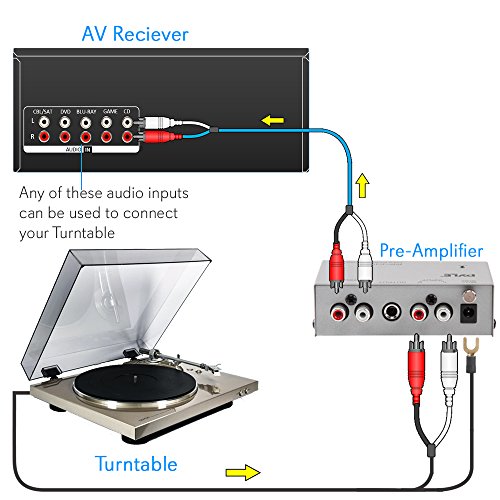
A phono preamplifier’s (phono stage) function is most often to amplify signals. Still, because of this ability, the effects of such amplifications transcend from just “mere amplifying” to other skills as well. For example, because of the phono amplifier, you can now connect your turntable to sound systems such as speakers and other amplifiers, just like how you would with other audio sources such as 3.5 mm jacks and microphones. (source)
Preamplifiers Versus Amplifiers: Does The “Pre-” Make A Difference?
Ah yes, the confusion is due to two things having almost the same names. It reminds me of the “lead as in leader and pencil lead” confusion we once had in college, but that’s irrelevant. However, many people tend to associate two things together just because they sound similar.
Okay, I get that both preamplifiers and amplifiers are amplifiers, but in reality, their functions are different as they tackle problems on different levels. First of all, we must understand that the preamplifiers are “pre-” for a reason: they handle ground-level situations while the amplifiers handle system-wide issues. (source)
At this point, let us first forget the types of amplifiers for turntables and let us first understand what preamplifiers are. Let us know firsthand the limitations of your vinyl records as to why a preamp is needed. With turntables (excluding those with built-in preamplifiers), most people must grasp that record players themselves are not responsible for the sound that comes out of your speakers.
The process is made out of different components helping out together. Preamplifiers are mainly responsible for amplifying the electronic signal from the amplifier to be on par with other audio sources. Then, the amplifier amplifies the sound for it to be audible to the human ear.
Amplifiers Versus PreAmplifiers:
Amplifiers handle and amplify the sound from sound sources such as microphones and other preamplifiers.
Preamplifiers boost audio signals of audio sources with weak signals (i.e., guitars and vinyl record players) to be on par with other sound sources.
Both amplifiers and preamplifiers are essential.
Both are prone to distortion.
A preamplifier’s quality will significantly impact the output of your vinyl record, so choose wisely!
While preamplifiers strengthen electrical signals to line-level, amplifiers advertise line-level signals by an even more significant margin.
Separating preamplifiers and amplifiers is crucial due to temperature concerns.
Now that we know the two types of amps for turntables, let us proceed to the following topic: the editor’s recommendations.
Meeting The Best Of The Best: Phono Preamplifiers Edition
Phono preamplifiers, as discussed earlier, is one of the two types of amps for turntables, and in fact, is an essential one at that
Phono preamplifiers, as discussed earlier, is one of the two types of amps for turntables, and in fact, is an essential one at that. As a quick review, phono preamplifiers are line-level amplifiers that help your vinyl record player enhance and amplify the signals from the cartridge for it to compete with other sound sources. However, even though phono preamps are considered a must-have, do you need to buy one, or should you skip this one?
Can I Skip Such An Essential Product?
Of course, without a phono preamplifier, it will be tough to make use of your vinyl record player. However, what if I tell you that there is a possibility that you might have one already? Yes, even if you specifically did not buy one, you might have one lying around.
Aside from the two types of amps for turntables, there are also other types of phono preamps: the built-in phono preamp and the external preamp. If you are not aware, your vinyl record player might have a built-in phono preamp already, so you might want to check with your manufacturer or with the product specifications. (source)
You Might Still Want To Buy A Separate Phono Preamp
Now that we have discussed the possibility of you having a built-in preamplifier, now let us discuss the reasons as to why you might consider buying a separate one, even though you may already have a built-in one. In this section of the article, we will discuss the differences and the rationales you might have for buying a separate phono preamp.
First of all, there is the elephant in the room: quality. Of course, most dedicated phono preamplifiers are much more high quality than the built-in ones as most of them use cheaper materials such as circuit boards and resistors. Moreover, since they use a smaller form factor, a sacrifice might have been made for miniaturization. (source)
Not all phono preamplifiers that are built-in are subject to such constraints. However, unless you are using the most high-end vinyl record players, you can bet on your money that the built-in phono preamplifier is a significantly stripped-down version of the external phono preamplifiers.
Here Are The Key Takeaways Why You Might Want To Consider A Dedicated Phono Preamplifier
Built-in amplifiers generally have lower quality sound
Most built-in amplifiers make use of cheaper component
The smaller size of built-in options suffer from problems related to miniaturization
Most dedicated phono amplifiers are more durable
Phono Preamplifiers: Our Recommendations
They say phono preamplifiers are a vinyl record player’s best friend, who, by themselves, is an audiophile’s best friend. Of course, you would want only the very best for your vinyl record player. Here are the types of amps for turntables that you would like for your very own.
Baseline Phono Preamplifiers For The New Audiophiles: Pyle Phono Turntable
Let us be honest, people, not all can shell out a hundred bucks for a phono preamplifier and call it a day. Some can only afford the bare minimum, but that does not mean that their experiences should be the bare minimum as well, as we believe that there are two types of amps for turntables: the trashy ones and the good ones. Nothing in there says anything about price, so do not fret.
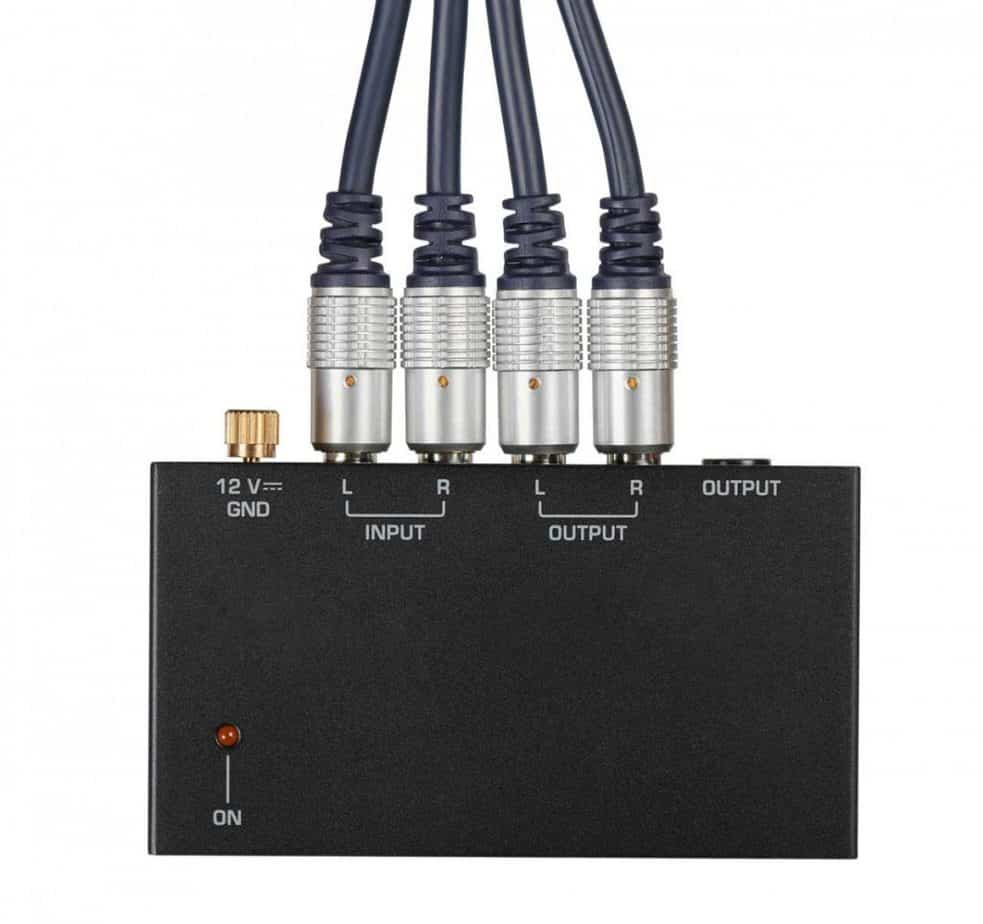
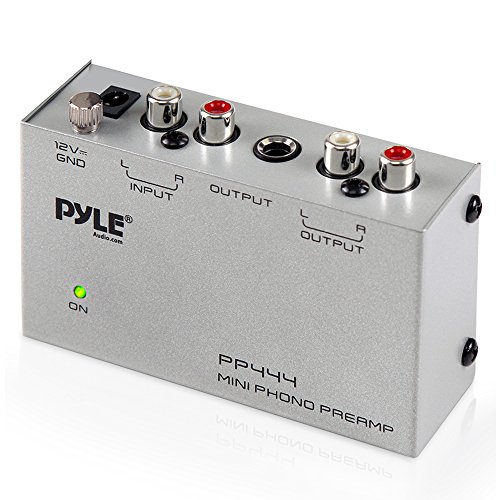
We think it would be only appropriate to offer a cheap yet nice-sounding product: the Pyle Phono Turntable Preamplifier for the new audiophile and the audiophiles on the budget. For the tech-savvy, here are the specifications. (sources)
Well, let us not fret upon the specifications, as all of these will not be more than moot if it sounds like trash. So for a $17 phono preamplifier, does it sound like its price? Well, truthfully, it does not sound like something above $100, but it is much better in comparison to other phono preamplifiers at its price range. (sources)
It offers excellent sound quality in the bass range, creating a tight, round bass quality.
It falls off when it comes to the mids and the highs, so instruments like the snare drum and the vocals are generally more washed-out when compared to high-end phono preamplifiers.
Compared to phono preamplifiers of its price range, it can be considered as excellent, a satisfying fit for a money-pinching audiophile.
Although the Pyle Phono turntable preamplifier (PP444) offers excellent sound, there may be concerns regarding its durability. For a $17 to 19 dollar offering, I would not expect much either. Looking at the silver lining, we can see its very generous warranty of one whole year, enough for you to judge it out.
This type of amp for turntables is modestly suitable for those looking for great basses and are not too concerned with the ultra highs and those who involve themselves with classical music. Below is a list of its recommended genres to listen to together with our affiliate link.
Genres Recommended For Pyle Phono Turntable Preamplifier:
Suitable for most rap songs and modern rap
Ideal for music with a lot of bass guitar
Not too good with percussions, especially with snare drums
It is not suitable for classical music or any very treble-heavy music.
Buy the Pyle Phono Turntable Preamplifier Here: Buy It Here!
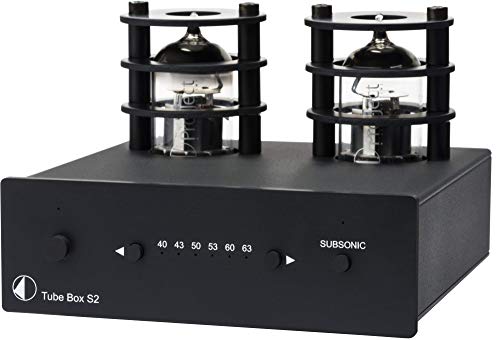
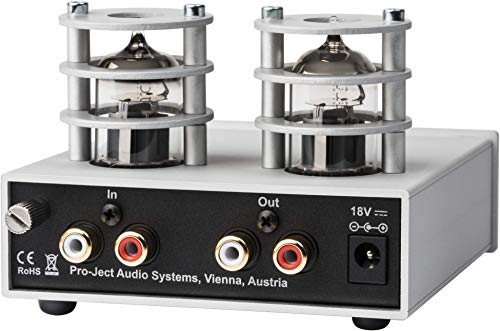
Seeing that you are still reading this article means that you do not lack cash, nor are you willing to skimp out for phono preamplifiers. Well, here it is, our recommendation for the high-end segment: the Pro-ject Tube Box S2.
The Tube Box S2 is a passion project by the Pro-ject, exemplified by its design, capabilities, and output. An intelligent design comes with quirky internal architecture, allowing it to be absent of operational amplifiers or OPAmps while coming in with replaceable tubes for tube rolling and sound-shaping. Below, we dictate its list of features. (source)
Pro-ject Tube Box S2 Features:
Allows the replacement of tubes for flexible listening.
Has no operational amplifiers
Suitable for MM and MC cartridges
Dual mono circuitry
Robust high-voltage anode power supply
Gold-plated RCA inputs and outputs
Sports polystyrene capacitors
Ultra-low noise circuitry
Again, now that we have discussed the specifications let us proceed with the real-world performance. How does it sound, and does it sound good? As a disclaimer, the sound performance will heavily vary with your setup, so your experience may not be holistically representative of yours. (source)
Pro-ject Tube Box S2 Sound Signature:
Because of its variable tubes, the sound signature will be varying.
It has a very smooth and warm sound.
Produces a rich, pleasant sound with no audible downsides
In conclusion, if you have the money for it, the Pro-ject Tube Box S2 will impress you with its output. However, that does not mean that you can’t experience good quality music without the Pro-ject Tube Box S2. As I said earlier, there are two types of amps for turntables: good ones and bad ones. No one says that just because something is cheap, it is terrible, nor just because something is expensive, it is automatically good.
If the Pro-ject Tube Box S2 tickles your fancy, then please we highly recommend you buy it. Buy it now with our affiliate link here: Buy It Here!
When it comes to turntables, everything affects the sound, even the material used for your turntable. Some may affect the overall sound output more than others, and the phono preamp is undoubtedly one of the significant reasons a turntable may turn out fantastic or a plain disappointment.
What are the differences between a solid-state preamp and a tube preamp?
A solid-state preamp uses transistors and operational amplifiers (Pyle), while tube preamps use vacuum tubes to amplify (Pro-ject).
Does the tube preamp sound better?
Of course, the sound output is always in the ear of the beholder. However, it is most often associated with a more warm sound signature, so whatever floats your boat, buy that one.
If you have ever seen or, better yet, held a vinyl record before, you will likely notice the texture on its surface, with grooves so defined you can feel them at every caress. Just like any curious mind, you might want to ask how these patterns are implemented into the vinyl record. We also had the same question as we had to ask ourselves: how do they define the pressing of a record?
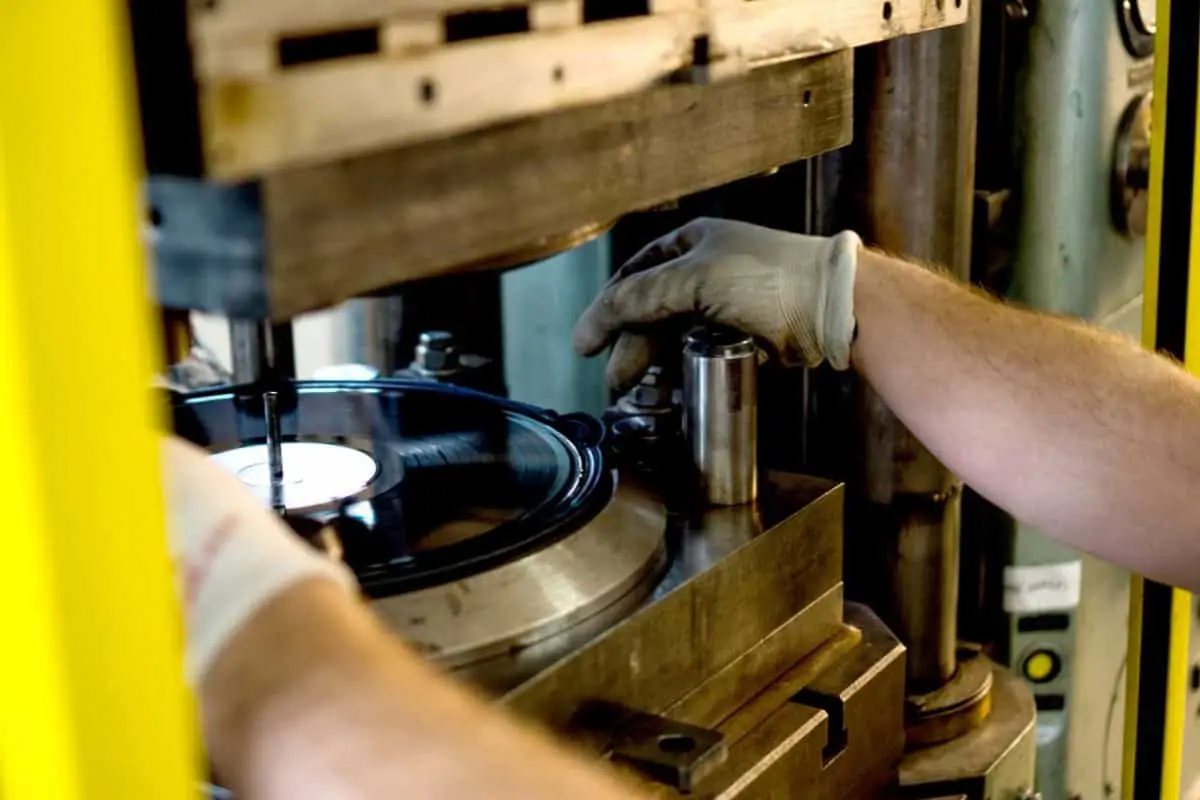
There is an intricate process dedicated to defining the pressing of a record. The pressing of a record involves many smaller, intrinsic processes, and it requires heat and a master disc. (1)
What is a master disc, and how exactly are vinyl records made? We will talk more about that in this article and the importance of the “first press.”
How To Define A Pressing Of A Record
You may be thinking of doing a homemade vinyl pressing service, or you are probably just curious. Either way, the fact remains that pressing a record is a complicated, intricate process involving a lot of technical knowledge, especially if one desires to mass-produce a record.
First, we may want to talk about why we need to define our records before asking how to define a record’s pressing. I mean, we could observe how compact discs work without grooves. Why do vinyl records need defined patterns, unlike compact discs?
One significant difference between a vinyl record and a compact disk is that a compact disk is a digital format, meaning that it relies on data stored as ones and zeroes to replicate music. For the case of a vinyl record, however, they utilize the patterns within the disc. The reason behind this is that vinyl records need the pattern to transcribe the stored data into audio.
At this juncture, let us talk about the main point, which is”how to define a pressing of a record” once again. Undoubtedly, the manufacturers don’t use needles by hand and start scratching the vinyl surface, do they?
In this article, we will talk about the process of defining the pressing of a record. We have formulated a step-by-step list to help you understand the process thoroughly.
1. The Audio
Before we get to the part where we define the pressing of a record, we should first settle the audio. After all, no one can create good vinyl records without good audio. Because of this, specialized audio engineers collaborate to create a perfect blend of music, specifically mastered to fit with the vinyl record’s standards.
There must also be precision and passion other than the instruments or the vocalists used in the audio. Moreover, a constant mindset of attention to detail is needed while working with vinyl records. While the vocalists and instruments need to be pitch-perfect for their job, the audio engineers must also be very meticulous to avoid errors, distortions, and audio skips. (1)
2. The Formation Of Master Discs
Next, we look at the master discs. Master discs, or lacquer, are like molds that enable vinyl records to be mass-produced. It would imply that no, vinyl records do not get scratched by hand at a recording studio.
What happens first is a master disc must be produced to quickly replicate vinyl records, ensuring that each one that goes out of the recording company is up to standard and are up to par with industry standards. (2)
Before producing the final master disc, it goes through multiple test cuts to ensure no problems arise, creating a domino effect on the production chain. Fun fact: instead of grooves, master discs have creases instead.
During the cutting process, problems may arise, especially when it comes to the range of the audio on hand. For example, powerful basses and trebles may create technical issues. Moreover, powerful basses can heavily hamper the recording time and reduce it significantly, as basses require deeper grooves. (1)
However, if you think that that is all with the process, the truth is that we are far from it. At this stage, the master disc is too vulnerable to damage and is, therefore, reinforced with strengthening materials.
Going back to the process of pressing a record: now you know that to define a record, you must first use a master disc.
3. The Pressing Stage
Now we are in the most awaited part: the pressing stage. However, before we proceed, engineers must first test out the master disc to mitigate possible errors. If the errors fail detection, then errors after mass production will incur heavy losses to the record companies.
After the testing phase, the pressing and the manufacturing stage follow. Liquefied pellets help to produce the vinyl, creating a patty-like form.
After this stage, the master disc is ready to be put to good use. Using stampers from the top and the bottom, they stamp the creases from the master disc and reinforce them to create grooves in the vinyl records. They may use pressure that can rise to more than a hundred tons and heat the presses at temperatures higher than 200 degrees Celsius. (1)
4. Labels And Packaging
Label and packaging are one of the most manageable parts of the process as they are not as volatile compared to, say, the vinyl records themselves.
First, they will need to contact artists that may do the label’s artwork or a graphic designer that will incorporate designs together to create a coherent piece. More often than not, this process will happen way earlier compared to the whole “pressing” process.
After the design, labels and packaging are printed, cut, folded, glued, and sealed to be ready for shipment. Despite not being a relevant answer to: “How to define pressing a record,” it is still a very integral part of the vinyl record experience.
What Is The First Press And Does It Matter?
So what is the first press exactly? The first press refers to a set of vinyl records produced using the first pressing of a master disc. The definitions of the first press vary heavily and are a cause of debate within the vinyl community.
Some may refer to the first press as the “first pressing,” while some may refer to it as the “first issues.” However, one thing that stands clear is a point of agreement between these parties, and that is that the first presses “sound way better” than the latter presses.
Another reason collectors and audiophiles prefer first pressings can boil down to another variable: the materials. These determined collectors have noticed that the materials used for first pressing vinyl records are significantly more durable than later pressings. They have justified this as they have pointed out that first pressings contain more material than later pressings.
The Frequently Asked Questions On Defining The Pressing Of A Record
How Do You Define The First Pressing Of A Record?
Some savvy audiophiles are very determined to find out whether a specific vinyl record is the first pressing or not. They have many ways of doing so. One of the key takeaways that will tell us whether something is first pressing or not is the labels.
Since each manufacturer uses a different labeling format, we cannot give you a magical guide for first presses. It means that if you are determined, you might need to do a lot of heavy research regarding the origins of your vinyl records, together with their manufacturers.
How Many Vinyl Records Can Be Made Within A Day?
A company in New York named Brooklynphono has claimed to have made 300 records per hour. However, the numbers will heavily vary per company’s resources. (2)
Can Vinyl Records Be Stereo, Despite Being Analog?
Yes, vinyl records can both be mono or stereo. Analog signals can be split into dual channels, or a stereo signal in other words.
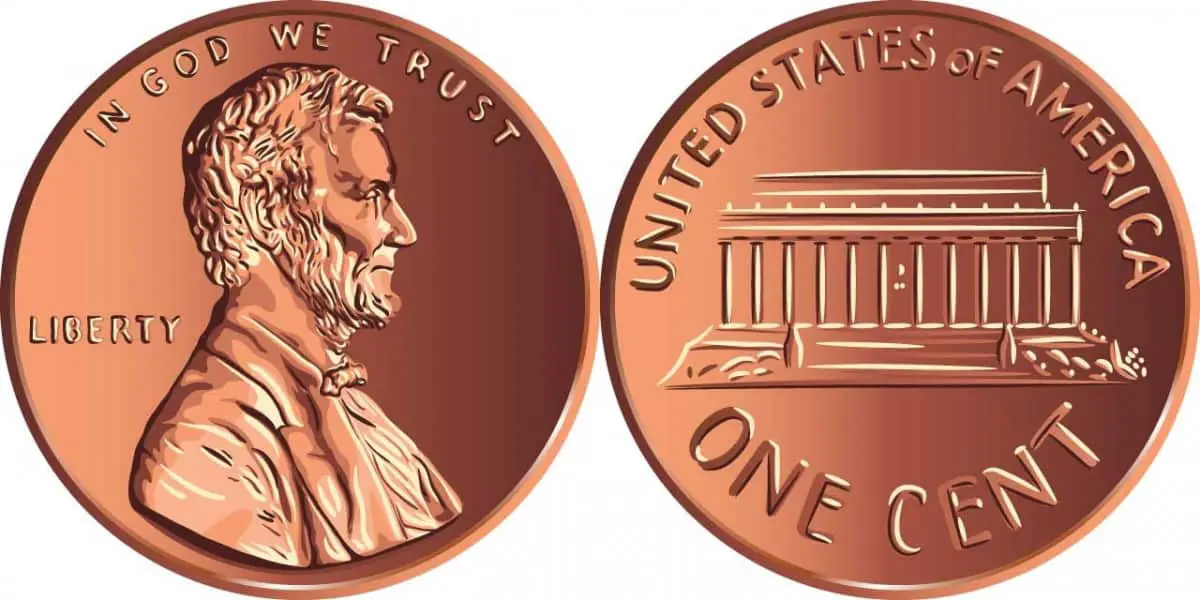
As a child, I was always fascinated with the penny on top of our turntables. This fascination was not because of its peculiar position but because I wanted to grab that penny and use it to buy candy. However, today, I am still plagued by the same question for a different reason: why do we put them there in the first place?
Pennies can act as an anchor, helping ground the needle or stylus to the vinyl record. This “penny on the record” action usually happens when the needle in the turntable is already damaged or has suffered some stress, causing it not to thread to the vinyl’s grooves properly.
Read on to find out more about putting pennies on a record player.
What’s The Rationale?
A turntable and a vinyl record are excellent mediums for listening to your favorite music tracks. However, the trouble with them is that they are not necessarily the most durable, nor are they degradation-free. Unlike the modern digital MP3s, which do not degrade and can be listened to from device to device, vinyl records, due to their analog processes, are heavily affected by physical changes and manifestations due to stress.
Due to this, many people encounter problems regarding vinyl records, from record playback issues to issues within the hardware itself. Even worse is that these hardware problems may manifest themselves from the external and internal components of the turntable to the vinyl itself. One of the banes for these turntables is the needles.
The turntable needles are an intricate part of the turntable, which, when harmed, can heavily affect the overall quality of the audio. We must understand how the needle of the turntables work and slowly work ourselves up to the central question of why there are pennies on a turntable.
What’s With The Needle?
A turntable’s needle may look like one of the most boring things out there, but trust me, it is much more interesting than it seems. There is a lot of science within that needle’s tip, especially considering it needs to work hand in hand with different types of vinyl records.
We already know that the grooves in a vinyl record are essential as it holds the information which will then transform as the music we hear from the turntable. However, not many people question the process of how the transmuting of the physical grooves into audio works, not realizing that the needle is the show’s star.
As the turntables turn the vinyl at a constant pace, the stylus touches the surface of the vinyl as it trudges through the grooves of the vinyl, bouncing along the groove. What happens is that the vibrations created by the grooves get changed into electric energy and are transformed then as audio, the same music we hear with our ears. (2)
Now that we know the importance of the needle or stylus, let us discuss why there are pennies on your record player– most specifically on top of the needle’s cartridge.
Why Was The Penny There?
Pennies are acting as anchors that help ground the needle or stylus to the vinyl record. This “penny on the record” action usually happens when the needle in the turntable is already damaged or has suffered some stress, causing it not to thread to the vinyl’s grooves properly.
When the needle is not grounded correctly, troubles may arise, such as skipping tracks or the stylus not detecting the grooves on the vinyl. Because of this, people tried to solve the issue by putting some “weight” on the needle. It was a penny, probably because it was the easiest thing to find that had consistent mass.
There are other use cases as to why the penny was there too. It didn’t necessarily have to do with a broken needle in the turntable; sometimes, it had something to do with the vinyl or parties (yes, the kind of party you are thinking of).
In clubs where a lot of movement is present, the turntables’ needles may jump off from one groove to another, causing it to skip a track. This “jumping tracks” action is a problem for obvious reasons. Additionally, some deejays do this to create some scratch or gritting sound to the overall mix.
However, one of the main reasons many people put pennies on their turntables’ needles is that the vinyl records they have been using have sustained some damage that can increase the likelihood of it jumping a track. These damages have manifested from different variables. For example, some vinyl damage is not necessarily considered as damage but does cause audio distortion.
One of the most common examples is when some dirt or solid matter is in the vinyl record itself. When this happens, make sure to clean the matter with appropriate tools such as a carbon fiber record brush. In my experience the carbon brushes are the best cleaners for dust and light debris. However, when using coarse materials, make sure to do the cleaning operation with intense care.
Another possible reason as to why a track may randomly skip is due to record damage. When this happens, sometimes, putting a penny on a record player can help, if not fix the problem as a whole. However, we do not guarantee that a simple penny will solve all your needle-related, skipping-inducing problems.
To Put Or Not To Put, That Is The One Cent Question!
Although the tradition of putting a penny on a record player has been practiced way before our time, that does not mean that it is a perfectly safe practice. It is quite the opposite. To the question, to put or not to put, we highly recommend you not to put.
There is a reason why the practice of putting a penny on a record player is not as common as it used to be: and one of the primary reasons? It is just not that good in the long run, especially for your record player, as it may be very detrimental to your record player’s health, and even to your vinyl record as well!
Let us talk about what happens when we put a penny on the record player. When a penny stands at the stylus, its weight drags down the entire needle mechanism, which in the short term, helps you prevent unwanted skipping. However, it can induce unnecessary stress in the long run, which may damage the record player. Especially if you find your record player unreplaceable, you might want to double think about putting a penny on your record player’s stylus. (4)
Another problem that is induced by the penny is putting unnecessary stress on the vinyl record itself. What does this imply, exactly? When extra pressure is placed on the needle, this is distributed directly to the vinyl, damaging the grooves.
The grooves are an integral part of a vinyl record as it is the grooves that represent the song inside the record player. Damage to the grooves would mean that the track inside the vinyl record will be altered forever! How horrifying is that?
The actual biggest reason why you should reconsider putting a penny on a record player is that record players have an adjustable knob that accomplishes the same things as a penny, minus the external stress. It will save you time and effort, but it will also save you from a lot of stress.
Instead of weighing the pros and cons of a penny on a record player, you should use the built-in features of the record player itself. It will surely help you with the problems related to track skipping.
Frequently Asked Questions About Pennies On A Record Player
Do Record Players Have A Warranty?
While these policies may vary from the distributor to the manufacturer, most record players have a one-year warranty covering all problems related to factory defects.
Is It Normal To Put A Penny On A Record Player?
While this was considered as standard practice back in the day, in contemporary times, this is no more than an unnecessary practice that may induce possible damages to your record player or record.
What Should I Do If My Stylus Is Damaged?
If it is due to factory defects, contact your distributor to avail your warranty. Moreover, you can also visit an expert to handle the problem better. If it is beyond repair, you might need to buy a new one.
Most turntables have one tonearm. However, you might also notice that some turntables have two, three, or even *gasps* four tonearms! How is this exactly, and why do some turntables have two (or more) tonearms?
Tonearms are crucial to developing a specific tone whenever a vinyl record is played on a turntable. As such, some people may have two or more tonearms for the sake of convenience, sound quality, or both.
In the article, we will be taking a deep dive into why some turntables have two tonearms and try to answer if you need more tonearms than what you already have. Let’s get tuning!
What Is a Tonearm? Why Is It So Important?
Before discussing how some turntables have two or more tonearms, let us first discuss what a tonearm is. After all, we can only talk about something we truly understand. If you already know what a tonearm is, you can skip directly to the appropriate sections.
A tonearm is functionally a supporting part of a turntable that helps hold the cartridge in the correct position of a vinyl record. The tonearm is very important as it maintains the cartridge and the needle at the perfect height at the right angle. Without a properly functioning tonearm, it would be virtually impossible to use your record table. (1)
Many people, even some audiophiles, may not know this, but the tonearms play an integral part in creating a unique signature within a record player’s output. We will later discuss the undeniable changes observed within different tonearms when discussing the two tonearm situation within the higher-end turntable units.
Why Do Turntables Have Two Tonearms?
A turntable having two or more tonearms is not unusual, especially when surrounded by an avid audiophile community or especially if that person is an audiophile themselves. However, to the newbies to the audiophile community or the casual listeners out there, having a turntable with two, three, or even four tonearms is undoubtedly a spectacle! This section of the article will answer the question: “Why do turntables have two tonearms?”
The Sound. It All Boils Down to the Sound.
If you ask any audiophile what the most crucial aspect of a turntable, an instrument, or audio technology in general, most of the time is, they would answer “the sound quality.” With that in mind, it is no surprise to know that one of the primary reasons some turntables have multiple tonearms is due to an audiophile’s particular attitude to sound quality. So why is this actually, and how does a tonearm have such a drastic effect on the sound quality?
First, let us understand that there are many types and genres of music. While some musical pieces may have many trebles, vocals, and an unspeakable amount of stringed instruments, some musical genres, especially the pop, EDM, and dance genres, rely on synthetic sounds and heavy booming bases. Moreover, while most modern songs include vocals, some music tracks and pieces, especially classical and instrumental music, do not contain any vocals.
What does this imply? It means that it would be tough to make a “one for all” outstanding audio equipment that would produce music at all those varying genres and still provide the best output possible. Notice how speaker systems have tweeters, woofers, and subwoofers for different sound frequencies, which are required to produce the best audio quality possible.
This analogy can also be replicated within turntables and tonearms. Some tonearms and cartridges are more functional or create better-sounding audio with a specific range of music genres or frequencies. So instead of swapping the cartridges and the tonearms whenever using a track, by using multiple tonearms, this work of switching and turning is significantly reduced. (2)
Some tonearms and cartridges are also attributed to the decade or era when a music style came out. For example, while “tonearm A” performs better on ’90s disco-pop, “tonearm B” might work better in the ’20s and ’30s jazz eras. Fascinating, isn’t it?
The next time you find yourself asking why turntables have two tonearms, remember: “sound quality is key.”
A Choice of Convenience
While some audiophiles will willingly do the “multiple tonearm situation” for the sake of sound quality, some do it for the sake of convenience. As said earlier, some cartridges and tonearms perform better under different musical genres and musical styles. So instead of switching the cartridges every time you pull up a vinyl record, you would have to use the other tonearm. (3)
However, this is not the only use case though. Some tonearms, needles, and cartridges are very expensive. It would mean that it would be unwise to use them often or on old or possibly damaged vinyl.
In this type of scenario, having two tonearms– a cheaper, older one and a newer, more premium one, can help preserve the integrity of your new and superior needles, tonearms, and cartridges. It allows you to use the subpar tonearm on possibly damaging tracks while using the delicate tonearms and vinyl records on the newer setup.
Mono vs. Stereo Debate
For this topic, let us back up a bit and take a history lesson. First, you must realize that the “all too normal” stereo audio was not “so normal” back in the day. Stereo didn’t even exist for the vinyl records. The structures of the grooves on the vinyl records were much simpler and less complex than the stereo technology we take for granted today.
Indeed, stereo arguably does sound better. However, this is not for all situations. Despite stereo offering a more immersive experience, some songs and vinyl records sound better in mono audio format.
We must first understand that mono and stereo vinyl records have different structures. As such, when songs recorded in mono are made a much more “better” stereo version, it ends up being worse (like non-spatial audio native music is repurposed and reformatted for spatial audio formats).
In these situations, it would be better to have two tonearms, one specializing in stereo, the other specializing in mono. It is so that when mono native songs are played, they can utilize the specialized mono tonearm. (2)
However, this does not mean that stereo cartridges and tonearms do not play mono vinyl records. The catch is that since they are not made for mono, they will indeed sound worse. The mono and stereo debate is undoubtedly one reason why turntables have two tonearms (or more).
“Do I Need the Extra Tonearm?” and Other Frequently Asked Questions Answered
Do I Need The Extra Tonearm?
If you find yourself very particular with the sound quality, then the additional tonearm might be worth it. However, if you are very content with what sound output you have on your current setup, you might not need the extra tonearm. Save yourself some bucks, as when you start hearing better audio quality, you will never go back.
Why Do Different Tonearms Have Different Sound Signatures?
The reason why most tonearms have different sound signatures is less of the tonearm itself but because of the cartridge used. However, the tonearm does play a function, such as its length.
It has been said that longer tonearms are less susceptible to distortions within the inner grooves. However, shorter tonearms have a lesser mass which can be beneficial as well. (2)
How Many Tonearms Can A Turntable Hold?
It depends. However, we do recommend you do your research when expecting multiple tonearms. For example, some turntables do not allow multiple tonearms.
Another point of contention is that you must also consider the space available within your turntable. Moreover, the angles needed for proper tonearm positioning must also be taken into consideration.
Despite vinyl records being more than a century old, they are still highly regarded today as the highest-quality audio storage material, mainly because it is highly analog. However, with that in mind, this means that physical damage to vinyl records can heavily hamper or degrade their sound quality. Here, we try to determine what happens if you drop your vinyl records.
Vinyl records can take a lot of stress before eventually breaking into pieces. However, it does suffer damage during falls, especially if it falls on pointed objects that may scratch the vinyl record’s surface.
This article will discuss the implications of dropping a vinyl record and cover other elements that may degrade or damage a vinyl record.
What Happens If You Drop A Vinyl Record
What happens when you drop vinyl records? Does it magically just fall off and not mind the external stress, or does it just break off into oblivion? Well, the answer to that is somewhere in between.
Unlike its predecessors, the current vinyl record is much more durable. It takes a considerable amount of force to break it. However, it does suffer damage during falls, especially if it falls on pointed objects that may scratch the vinyl record’s surface.
Compared to modern vinyl records, shellac is a brittle substance, making them unreliable for long-term audio preservation. If you drop shellac on the floor, it will probably break. Just like that, a precious piece of audio is now lost to external damage.
On vinyl records, the damage doesn’t come very quickly. That is the reason why you can still find antique vinyl records that still deliver on their sound quality and experience. Compare that to a five-year-old compact disc; you might notice how the compact disc is forever affected by slight scratches, with the majority of the scratches not caused by dropping but instead are just caused by sand rubbing on the surface of the compact discs.
One of the significant factors that may affect your vinyl records heavily when dropped is when they hit pointed objects like rocks, which may cause scratches. Despite not being completely cut into pieces, these scratches may still make the listening experience unbearable. (2)
Why Scratches On A Vinyl Record Matter (And How To Prevent Them)
Scratches were always an enemy of physical music storage options, from the easily broken VHS tapes to the digital compact discs, and yes– even vinyl records. For vinyl records, in particular, scratches are a massive blow to the quality of the sound. This section of the article will discuss why scratches are a big deal and prevent them from happening.
Vinyl Is Analog
Earlier, we have discussed how the analog part of vinyl records makes it one of the best audio storage options available. Since vinyl records have music engraved on their physical structure, it does not need to be compressed. MP3s, on the other hand, will need to be compressed for music streaming to efficiently cater to a massive crowd of people listening to their mobile devices simultaneously.
However, this unbeatable quality preservation feature of analog comes with an enormous cost: its vulnerability to physical changes. Since vinyl records rely on their physical structure to reproduce music, any alterations to the grooves will likely change music as well, especially if the alterations are scratches and the scratches are deep.
To understand this better, let us first know how a vinyl record works. A needle creates the grooves on vinyl records, used to represent soundwaves. They are then replayed utilizing a needle (again), using a transcription process, which transforms these grooves and transforms them into signals that you can turn into audible audio. (3)
Since scratches will change the physical form of the vinyl record, the transcribed audio will not be the same as the original recorded audio. More often than not, the artifacts of these physical alterations will be nothing more than popping sounds, which hampers the listening experience heavily.
So what happens if you drop a vinyl record? Most often than not, you will do more than creating scratches and some physical damage. You will also hamper the overall audio quality, despite not having the vinyl record snapped into pieces.
The Threat Of The Scratches Rely On How Severe They Are
It is more than obvious how the depth of the scratches will have variating impacts. For example, a small hairline scratch may have a lesser effect when compared to deep grooves across the board. However, it may be best to look at each type of scratch one by one.
A basic scratch severity test can be conducted to know the degree of the said scratch. Try running your finger through the scratch, and if you can feel it through your skin, most probably, the scratch will have a detrimental effect on the sound output of the vinyl record.
When these types of scratches appear, you may hear a “clicking” sound in your audio, an audible artifact of the degrading integrity of the vinyl. However, other scratches like those that do not have much tactile feedback will have minor effects on the overall integrity of the audio. However, you may still hear differences in output. (3)
With this in mind, it is imperative to keep your vinyl records from being damaged, which brings us to the next topic in question: the preservation of your vinyl record’s integrity.
Let us go back to the main question, shall we? So what happens if you drop a vinyl record? The answer will rely on the scale of damage.
Preserving the Integrity of Vinyl Records
Preserving the integrity of the vinyl record is vital to maximizing the listening experience. After all, despite vinyl being not portable, expensive, and very clunky, its listening experience is enough to convince audiophiles to continue using the format. It makes the preservation even more vital than it initially seemed.
One way to preserve your vinyl records is not to drop them. Moreover, keeping them in proper storage spaces will help increase the lifespan of a vinyl record by a significant margin.
Many people may not know, but one of the leading causes for scratching vinyl records is improper handling and storage and not dropping. Of course, proper storage is not only defined by having the presence of a record cabinet but also by ensuring that the environmental variables are well under control.
For example, high temperatures can cause your record to warp its shape. Moisture can facilitate the growth of mildew and molds that will heavily degrade the vinyl record’s integrity. (4)
However, one of the real threats to the preservation of vinyl records lies within your very hands. which means it is your very own hands. Touching vinyl for no appropriate reason or carelessly caressing it even though dust is present in your palms can affect your vinyl records significantly. Moreover, some natural excretions of human skin, such as oil and sweat, can also affect vinyl integrity.
Frequently Asked Questions: Vinyl And Integrity
What Is The Leading Cause Of Vinyl Record Damage?
Although dropping and moving vinyl can impact the record’s integrity, the leading reason for vinyl degradation is high temperatures. Moreover, worn-out needles also come second. Unnecessary touching and high humidity come in third and fourth, respectively. (4)
If you are concerned about your vinyl record’s integrity, make sure to keep them away from extreme conditions. It will make sure that your vinyl records will serve you for years and years to come.
How Can I Clean My Vinyl Records Without Damaging Them?
To clean your vinyl records straight out of the gate, avoid do-it-yourself solutions. Instead, grab a lint-free cloth and wipe them. Apply cleaning solutions appropriately.
How Long Do Vinyl Records Last?
It highly depends on how one handles their vinyl records. While some may only last for a couple of years, those handled with extreme care will last well over a lifetime.
Do turntables require subwoofers? Let’s find out. Turntables or record players are types of audio equipment renowned for their crisp sound, lossless audio, and most important of all, the vintage experience. However, a turntable is nothing if paired with speaker systems that have subpar capabilities and configurations.
Subwoofers are not a required purchase for vinyl record players. However, we highly recommend you buy one because you’ll enjoy the rich bass tones of your record’s audio.
If they are not required, then why exactly are subwoofers recommended? This article will answer all those questions, and to ensure peak experience, we delve into the unknown and try to answer the question, “Do turntables require subwoofers?”
Do Turntables Require Subwoofers? Here Are The Answers.
There is a chance that you might have seen it on your friends’ setup, and they swear to the audio gods that a subwoofer is worth it– worth every cent. You’ve seen the articles saying the same thing as well, but still, as critical as you are, you are making sure that you will not be making hasty, impulsive purchases. So what is the deal, really, and do your turntables require subwoofers, or are they just a fad?
Subwoofers are not a fad, and they generally bring fantastic value to your whole audio setup. However, determining if that value is worth it for the price is generally more complicated. Many reasons may stop or discourage you from buying subwoofers.
You have a system tailor-made for your preferences, a perfect treble, the right amount of bass, and the crisp mids and vocals. If you find yourself ideally in line with your current setup, then, by all means, we recommend you to keep your money and spend it on something else. Subwoofers generally help your system sound better, but if your tweeters and woofers are already fulfilling that gap, to begin with, then there is no good reason for you to buy one. (1)
You might need to know that subwoofers are extensive audio equipment, more prominent than your woofers, and even more extensive than your tweeters. I am sure that you already know this for a fact, but still. If you find your listening room (if you have one) already cramped as it is, it may be better not to buy a subwoofer.
However, it is pretty unfair to only talk about the reasons why you might not consider buying a subwoofer. The reasoning behind this is because subwoofers do offer unreplaceable value to you, your ears, and your audio equipment! Your woofer may finally love you like the deep ends of audio will now be redirected to a piece of more suitable equipment.
If you like listening to bass-heavy music, especially modern pop music and jazz music, I must tell you that buying a subwoofer is especially recommended. Subwoofers help flaunt the deep bases and well-rounded lows. They can significantly help your sound system provide a more holistic sound, and generally, bases are fun to listen to.
If you find your current system lacking those deeper ends, then we suggest you buy a subwoofer for your setup. On the contrary, if you prefer classical music or more music focusing on acoustic guitars, strings, and pianos, buying subwoofers may be a waste of your most essential resources: time, space, and money.
We suggest that you think about things thoroughly before buying them. When you are ready, answering the question: “Do turntables require subwoofers?” should be more straightforward.
What Is A Subwoofer Exactly? And Is It Important?
Subwoofers are precisely like a Doberman’s “woof.” Not only are they humongous, and some even take up twice the size of a regular woofer, but they also make big, deep sounds. The sound they make is what the Beats earphones lineup would like to copy (although failing horribly at it). For short, they are all about the bass.
There are three major divisions in a speaker system: the tweeters, the woofers, and the subwoofers. You may be tempted to say that the subwoofers are redundant if you have woofers because they are practically the same. I will have to tell you that such conjecture is incorrect politely, and we will explain why that is the case later.
What Is A Tweeter? Do I Need One For My Vinyl Record Player Setup?
If you came to ask me if you need a tweeter for your setup, the answer is a quick and resounding yes. Unlike the subwoofer, getting the tweeter is a no-brainer. There isn’t much to say about this.
To explain why that is, let us first understand what a tweeter is. A tweeter is the exact opposite of the subwoofer; not only are the tweeters small, but they are also in charge of the high-frequency audio in comparison to the subwoofer’s low-frequency tones.
They are very critical as most vinyl record player owners typically prefer vintage, classical stringed music with fantastic vocals. The common denominator between most vintage music, classical music, stringed instruments, guitars, and great vocals is that they heavily rely on the tweeters.
That’s right! All of that music is handled mainly by the small, minuscule tweeters! So if you are thinking of skimping your budget on tweeters– well, just don’t!
The tweeters are mainly in charge of audio frequencies ranging from 2 kHz to 20 kHz for the technicalities. So if you are a full-on audiophile, you may want to consider buying excellent tweeters for superb audio reproduction! (3)
Subwoofers Vs. Woofers: The “Woofing” Comparison!
Now we are finally here: what’s with all this “woofing?” Is there a difference between a woofer and a subwoofer? Well, let us discuss that, shall we?
First, let us get their similarities before comparing them with each other. Both woofers and subwoofers focus on the basses, and both are relatively large (the tweeters are dwarfed next to them).
However, despite their similarities, if you ask me, “do turntables require subwoofers, or do they need woofers more?” I would likely side with the woofers on this one.
Subwoofers offer narrower ranges of sound frequencies. While woofers may produce 20 Hz to 2 kHz sound frequencies with a hitch, a subwoofer may only be comfortable with frequencies up to 200 Hz. Although the woofer may not necessarily sound better than subwoofers, woofers have more flexibility.
As you can see, their ranges are starkly different. As a recap, a woofer is a specialized speaker for lower frequencies, while a subwoofer is a specialized woofer. (4)
If Subwoofers Are So Inflexible, Why Recommend Them Then?
It seems that we have circled back to the original topic, “Do turntables require subwoofers?” Well, the thing is, since subwoofers are specialized, they are not of great value in all situations. However, they do offer great importance to those who need them.
Despite woofers also covering the ranges of the subwoofers, the subwoofers are so specialized with the lower range that they practically produce significantly better lower range outputs than woofers do. As said earlier, if you have many low-ends on your vinyl music tracks, then subwoofers become an easy recommendation!
Frequently Asked Questions
Do Turntables Have Speakers?
No. Most turntables do not have speakers built-in. Because of this, we recommend hooking up high-quality audio systems to provide justice to your vinyl speakers.
If you want a very convenient experience, you can also buy Bluetooth speakers, as they are more versatile and easier to set up! However, do note that some speakers do not have built-in amplifiers, so you may also need to consider that.
Do I Need Two Subwoofers For My Record Player Setup?
No. Buying one was already a stretch for some people. Although some may benefit from it, “need” is a pretty strong word if you ask me.
Is It Better To Have A Separate Subwoofer?
Of course! If you find money not a huge issue and would like to invest in your audio equipment, buying a subwoofer should be a no-brainer.
Turntables (or vinyl record players, depending on how you see them) are complicated machines. They aren’t as easy to use as “press play” with your iPods, iPhones, and DVD players. Because of this, we bumped on the question regarding how tight a turntable belt should be.
The key to determining a turntable belt tension is balance. The grip must not be too tight that it hampers the overall mechanism and creates too much friction, but not too loose that it won’t work at all.
In this article, let us tighten our seatbelts and know how tight a turntable belt should be and the processes to determine that.
What Is a Turntable Belt in the First Place?
Before we try to answer how tight a turntable should be, we should first learn to define what a turntable belt is. So really, what is a turntable belt?
Turntable belts are essential parts of belt-driven turntables but are nonexistent on direct-drive turntables. Essentially, the difference between belt-driven turntables and direct-drive ones is that the belt-driven employs turntable belts as methods to rotate the platter. The direct-drive ones instead use a motor to drive the plater, thus eliminating the need for belts. (1)
Turntable belts are essential parts of belt-driven turntables but are nonexistent on direct-drive turntables.
For a belt-driven turntable, the belts are required for the cartridge to navigate through the vinyl record, which ultimately helps the record player read data and express it in the form of sound. If you use a belt-driven turntable, you will know added complexities to using such technology. One of the added complexities is exemplified and amalgamated in the very question of how tight a turntable should be.
Balance is Key: How Tight a Turntable Belt Should Be
Turntable belts are essential parts of belt-driven record players, and assuring their appropriateness is critical for better sound quality and stabler feedback. Despite its essentiality, many audiophiles still find themselves lost in their turntable belt’s “appropriateness.” As such, we have tried to ask ourselves the same question as well.
In questions like these, it is pretty hard to define a quick and precise answer. However, we have specific guidelines that will help you answer how tight your turntable belt should be.
A key to understanding how the standard goes is to know that a turntable belt is off balance. Some turntable belts are thicker, while others are thinner, so knowing this “balance” is crucial to override such differing factors. As such, we have defined the general guidelines below.
Turntable belts must not be too loose that it loses its grip, as a loose turntable belt is no more valuable than a wisp of air trying to lift a log of wood. Moreover, you must also ensure that it is not too tight, as doing so imposes the risk of interfering with your turntable’s operations. To know the appropriate tightness, ensure that the turntable’s platter rotates consistently and smoothly without any hitches or signs of stress. (2)
We most often recommend having your turntable belts tighter rather than loose. However, we always remind other audiophiles that having turntable belts too tight may damage your equipment, so make sure you are going on the right track.
Speaking of damage, the stress induced by tight turntable belts will heavily impact the mechanisms, the motor used for rotating the belt, or the bearings, and more. Additionally, it can cause your turntable to result in a complete halt of operations, with repairs costing you many times the original price of the belt. (2)
Size Matters
We always remind our fellow audiophiles to have a suitable diameter of the belt for their turntables. It can prevent extra stress on the record player while still reducing the possibility of loose installations.
There are five standard belt diameters to be considered for your record players. Make sure you have the right one. The standard diameters are the following: 128 mm diameter belts, 150 mm diameter belts, 172 mm diameter belts, 206 mm diameter belts, and 300 mm diameter belts.
So the next time you view some of the available diameters for turntable belts, make sure to constantly assess it using the general guidelines, as this is how tight a turntable belt should be.
Why Do People Still Use Belt-Driven Turntables?
If you have not realized already, direct-drive turntables offer a much smoother, less clunky experience than belt-driven ones, and as such, offer a more direct and easier-to-navigate experience. With the belt-driven turntables having significantly larger moving parts compared to the minuscule motors of the direct-drive turntables, many have turned to ask why there are still belt-driven turntables in the first place.
The Price Matters
Since the direct-drive record players use a smaller approach to their technology implementation, it will also bear the cost of miniaturization. Simply put, all of that technology and all that engineering marvels required to make the package a little bit smaller and less clunky will obviously drive up the cost of the overall product. Because of this, it is most evident that the direct-drive ones are significantly more expensive than the belt-driven record players.
Other reasons aside from the engineering driving up the cost are also the inherent cost of the belts compared to motors. Unlike the less complex belt, motors are intricate and complex mechanical components used in many machines today.
As It Is With Most Audiophiles: It Sounds Better
Of course, the main reason why many opt to buy belt-driven turntables is the sound. For most audiophiles, one of the most quintessential qualities or variables of audio equipment should be sound quality. In the case of belt-driven and direct-drive record players, simply put, audiophiles prefer the sound produced by the belt-driven record players. (3)
So why exactly do belt-driven record players sound better than direct-drive record players? The true answer: engineering. Inherently, motors are said to be much noisier than belts, and for a piece of audio equipment, any unnecessary noise is a huge variable that can affect sound quality significantly. Unlike the motors, belts run smoother, thus eliminating or at least mitigating any excessive noise.
Although the belt-driven turntables do sound better, they still have a sense of clunkiness, as explained by the constant queries “How tight a turntable should be, and more.” Speaking of clunkiness, this leads us directly to our next segment.
Where the Direct-Drive Record Players Win
As stated earlier, direct-drive record players and turntables are often much less clunky than their belt-driven counterparts. However, these are not the only variables and features that direct-drive record players have significantly improved upon from their belt-driven predecessors.
Most DJs use direct-drive record players simply because it allows them to change where the record players turn. It will enable them to achieve the signature DJ “scratching” sound. (3)
Moreover, the smaller moving parts incorporated in these players also last longer than the belt of the belt-driven turntables. Unlike the more stable motors, belts have greater chances of failing and will need more frequent maintenance at the same time.
Turntable Belt Frequently Asked Questions
How Do I Preserve The Integrity Of My Belt-driven Turntable Belts?
To preserve the integrity of your turntable belts, make sure to always check them once in a while, and make sure you are using the appropriate diameter and the appropriate thickness. Moreover, we recommend everyone not wait until the turntable belt is completely unusable before replacing the belt.
How Do I Replace My Turntable’s Belt?
Replacing a turntable belt is no mentally intensive exercise, nor is it physically exhausting. We recommend you remove the rubber mat first as this exposes the belt. After that, lift the platter.
The belt will then be exposed fully, and we will need to replace it. Grab your new turntable belt and put it on the bottom of the platter, aligning it to the inner circle. Slowly slide the platter upside down and put it back to the turntable, returning all the removed parts.
How Often Should I Replace My Belts?
We recommend replacing them every three to five years, depending on the mileage.