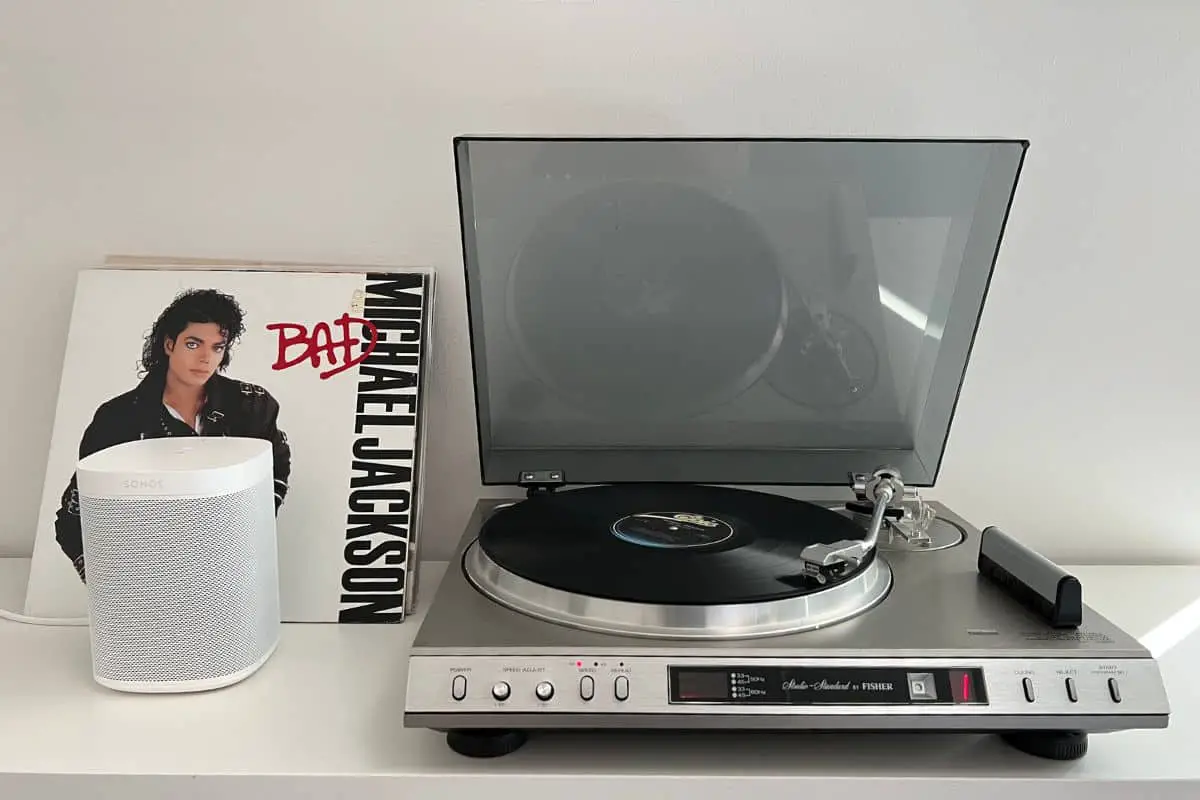
Category: Amplifiers

  • How To Connect a Turntable to Sonos? Let’s Find Out!

    How To Connect a Turntable to Sonos? Let’s Find Out!

    Sonos speakers are classy, easy on the eyes, and have terrific sound quality. If you consider yourself an audiophile, there’s probably nothing more exciting than pairing the uncompressed sound of a turntable with the power of a Sonos speaker. But how do you connect a turntable to your Sonos product?

    Here’s how to connect a turntable to Sonos:

    1. Learn about the different options Sonos offers.
    2. Check if your turntable has a phono preamp.
    3. Purchase any required extras (such as cables or preamps).

    In this first step, we will talk about the different Sonos options and how to connect Sonos speakers to your turntable (regardless of whether you have a phono preamp). If you have a turntable that doesn’t have Bluetooth modality and a phono preamp, we will discuss that a little later. Let’s dive in!

    1. Learn About the Different Options Sonos Offers

    If you’re scouring the internet for information on how to connect your Sonos product to your turntable and finding very little information, there’s a reason for it. Sonos sells a plethora of different products that can pair with a turntable. As you’ve probably found, each one connects a little bit differently. Not only do they connect differently, but they function differently as well. 

    Below, we’ll discuss the main Sonos products that pair with a turntable. We’ll discuss what makes them different from the other options and how to connect them to a turntable with or without a preamp.

    Sonos Amp

    The Sonos Amp and Sonos Connect: Amp have line-in ports to connect your turntable to your other speakers. In general, amps take an electrical signal and “amplify it.” You may be interested in this product if you want an undistorted sound through all of your speakers. It gives you more control, as you can adjust the bass, treble, and loudness. 
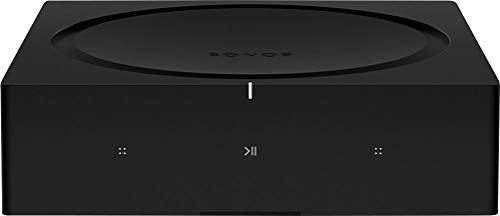
    New Sonos Wireless Amplifier 125 Watt Black Amplified Streaming Music System AMPG1US1BLK

    Amps are not speakers but means by which you can control the speakers you already have. They essentially power the speakers you have on your wall or your ceiling. If your home has Sonos speakers in each room that connects wireless or over your wired network. The Sonos amp will help connect your turntable to connect the rest of the speakers. 

    Here’s how to connect your Sonos Amp to your turntable:

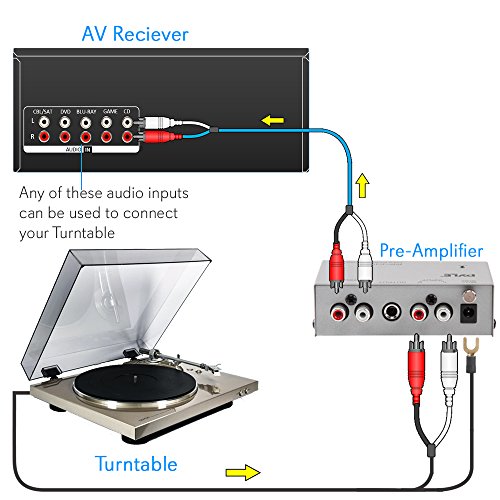
    1. You will need an RCA cable which you can find on Amazon here its not included with your Sonos Amp, plug one end into the turntable (or the turntable preamp if yours doesn’t have a preamp built-in).
    2. Plug the other end of the cable into the corresponding ports in the back of the Sonos Amp (IN).
    3. Place a record on your turntable and play it.
    4. Using the app, connect the amp to other speakers by going into the settings tab and looking for “Line In” devices.
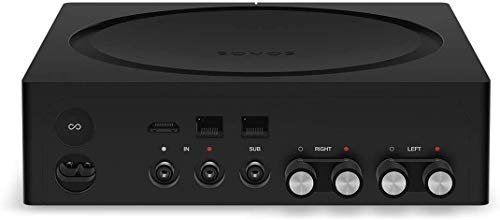
    Sonos Amp - The Versatile Amplifier for Powering All Your Entertainment - Black

    The Sonos amp will typically work with speakers that need no more than 2*125 watts. If you already have your favorite pair of active speakers then you can easily integrate them into the Sonos ecosystem by connecting them to a Sonos Amp.
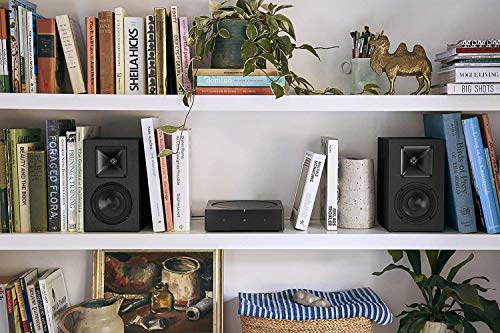
    New Sonos Wireless Amplifier 125 Watt Black Amplified Streaming Music System AMPG1US1BLK

    Sonos Amp is also often used for speakers connected to the ceiling or wall in your home. Now, you can enjoy the unfiltered record sound through all your speakers!

    Sonos Five

    The Sonos Five is an excellent choice if you want the power of a speaker and still need something that has a line in connection for your turntable.
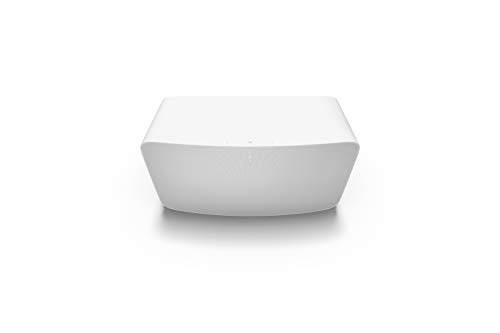
    Sonos Five - The High-Fidelity Speaker for Superior Sound - White

    This high-quality speaker has a 3.5mm input built into the back of it and comes with an auxiliary cable so you can hook it up to your TV, CD player, old iPod, or turntable. Unlike the amp above, the Sonos Five is a speaker, so you can plug your turntable in directly and start playing music in addition to connecting to other speakers on your Sonos network. 

    To connect your Sonos Five:

    1. Plug an RCA-Y cable (not included with Sonos Five) into the corresponding port on the back of the Sonos Five. This should be the side that only has one connector. If you don’t have an RCA-Y cable I recommend this one from amazon.com
    2. Connect the other side of this cable (which should have colors and two connectors) into the back of your turntable where the colors match up (or into a phono preamp if yours doesn’t have one directly built-in).
    3. Place a record on the turntable and start playing it.
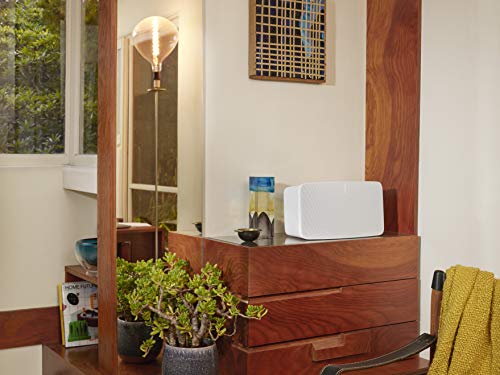
    Sonos Five - The High-Fidelity Speaker for Superior Sound - White

    If you’d like to connect it to other speakers on your Sonos network, you can go into the app and find the “Line In” option under settings. This way, you can hear the pure sound of your favorite record on the high-quality Sonos Five and any other speakers on your network. 

    Sonos Port

    Like the amp, the Sonos Port isn’t something that will directly play your music aloud. Instead, the Port is kind of like a control tower for all the speakers within your home. It doesn’t power anything like the amp but puts all speakers onto the same network. It’s just like a Wi-Fi router that unifies all smart devices.

    Sonos Port - The Versatile Streaming Component for Your Stereo or Receiver

    With Sonos Port, You can enjoy endless possibilities for multiroom listening and get the Sonos experience on your existing stereo, receiver, and turntable. You can also stream music, radio, audiobooks, and more from your favorite services.
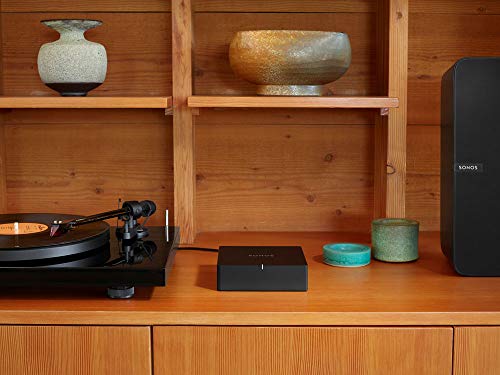
    Sonos Port - The Versatile Streaming Component for Your Stereo or Receiver

    The Sonos Port works with turntables just like both products mentioned above. Essentially, you use this product to connect your turntable to the network. 

    To do this, you will:

    1. Plug one end of the audio cable (not included with the Port) into the back of the Sonos Port. 
      I recommend this RCA cable available from Amazon.
    2. Connect the corresponding connectors into the turntable (or phono preamp) in the L/R inputs.
    3. Play a record on your turntable.
    4. Open the app and select the settings.
    5. Find the “Line-In” option and connect this to the rest of your speakers (or the speakers you would like to use).

    Now, your turntable will be a part of the more extensive network of speakers in your home. The added benefit of this with your Sonos app is that instead of just one speaker playing your music, you can have the cumulative sound of all of them playing it!

    Sonos Speakers 

    There are many different types of Sonos speakers, and you can connect via any of the options above using the “Line-In” option on your settings.

    But what if you don’t have any of the above products?

    Unfortunately, no ordinary Bluetooth speaker will connect to your turntable unless you have a modern Bluetooth-enabled turntable. The above products work because they connect through some means to the turntable through a cable and can then connect via the Sonos app to other speakers (which is what makes Sonos so cool!). If you’re struggling to connect a Bluetooth speaker to a normal turntable, you should consider purchasing the Amp, Port, or the Five.  

    If you’re still unsure which product is best for you, the audiophiles at Smart Home Sounds Ltd. have an in-depth video on selecting the right Sonos product for you:

    They also go through a few different setups to inspire your next purchase.

    2. Check if Your Turntable Has a Phono Preamp

    You’ve probably noticed that I’ve referred to different turntable features already one important feature is the phono preamp. Some turntables have one built-in; others require an external phono preamp. The PCMag Encyclopedia describes a phono preamp as a “circuit that amplifies and equalizes.” This thirty-minute YouTube video by the Audiophile mangoes in-depth about different phono amplifiers and their purpose:

    For our purposes, we’ll summarize that a phono preamp is an important part of your turntable system. It supports the sound, and it’s needed to connect a Sonos speaker or a line-in chord. 

    Turntable With a Phono Preamp

    If your turntable has a phono preamp built-in, then congratulations! 

    You won’t need a secondary system to plug into your Sonos speakers. Instead, you’ll just plug the line-in chords directly into your system.

    If you are on the lookout for a new turntable and your goals would be much better suited to one with a phono preamp already built-in, we will give you a few suggestions for turntables with preamps already in them. Be wary, though. Some audiophiles still purchase a phono preamp separate from their built-in one to get the sound quality they like.

    Here are a couple of turntables with excellent built-in phono preamps:

    Audio-Technica AT-LP60 Fully Automatic Belt-Drive Stereo Turntable (Amazon.com)

    This turntable comes with a built-in preamp. It also comes in a few lovely colors. Audio-Technica products are known for being stylish and have tons of positive reviews on Amazon. This turntable would make a great addition to your audio setup, regardless of your aesthetic.

    Fluance RT81 Elite High Fidelity Vinyl Turntable (Amazon.com)

    The Fluance vinyl turntable is sleek, attractive, and highly regarded. This one has a built-in phono preamp as well. It makes connecting it to your Sonos speakers a straightforward endeavor. The finish and hardware on Fluance turntables are particularly reminiscent of those old, classic vinyl players, which pay an homage to the past!
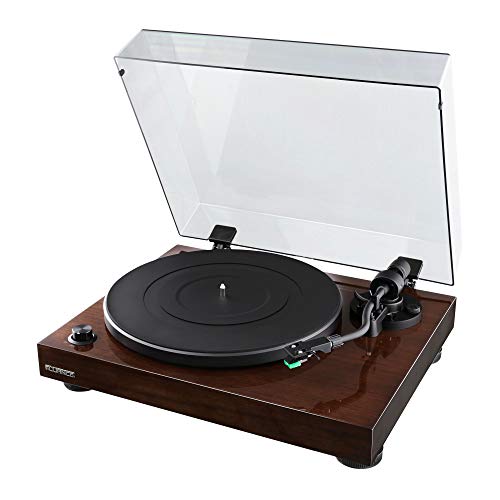
    Fluance RT81 Elite High Fidelity Vinyl Turntable Record Player with Audio Technica AT95E Cartridge, Belt Drive, Built-in Preamp, Adjustable Counterweight, Solid Wood Plinth - Walnut

    If you want to dig deeper into the subject then you can take a look at this article about the best turntables for Sonos.

    Turntable Without a Phono Preamp

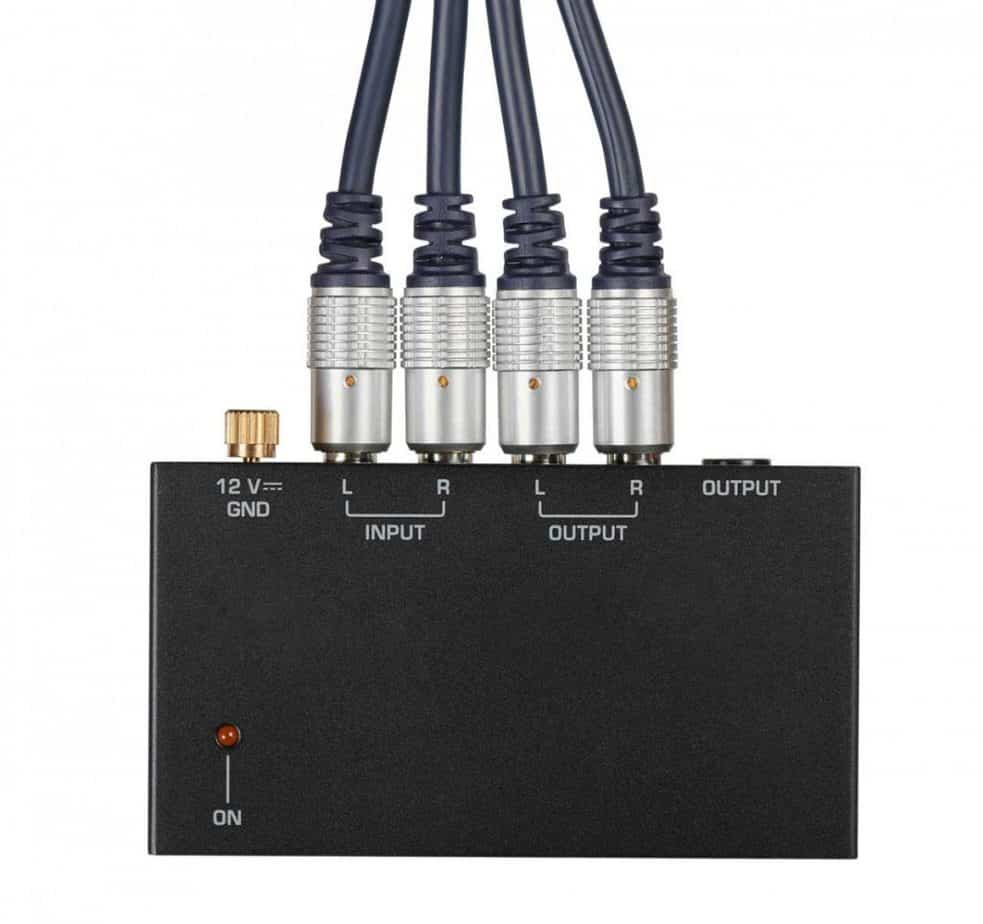
    If you have a turntable without a phono preamp built-in, you aren’t alone. In fact, most turntables are built without one. This just means that your phono preamp will need to come from an outside source, which you’ll first connect to your turntable and then connect to your Sonos speakers.
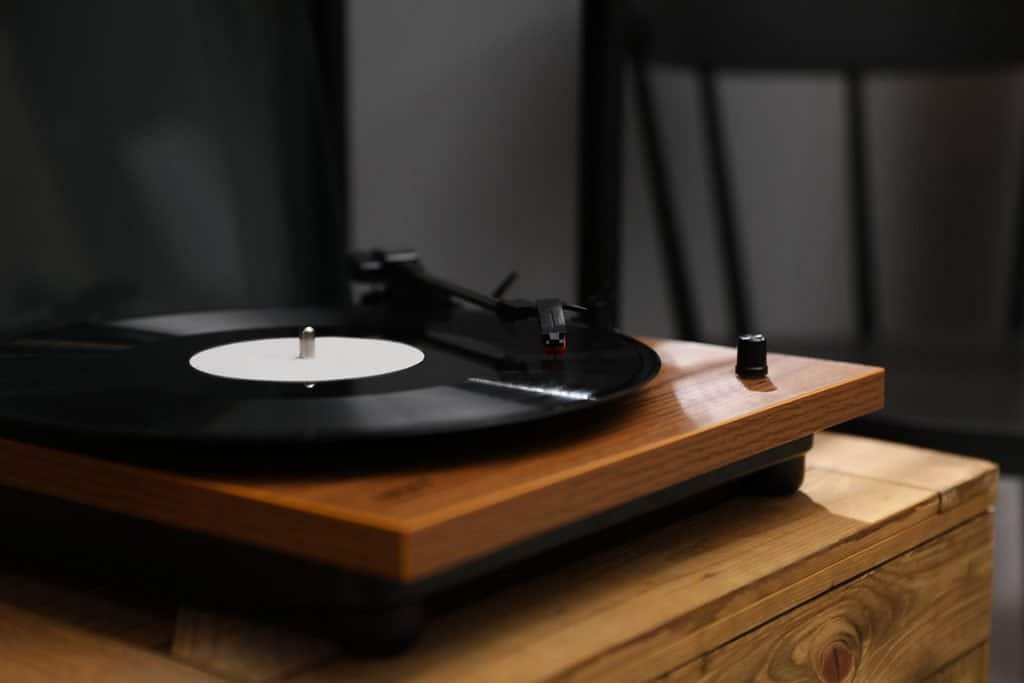
    Why would someone make a choice to buy a turntable without a phono preamp if they’re so important, though? Because many audiophiles already have their favorite phono amp that they want to use.

    If an additional device with cables isn’t a big deal to you, then this doesn’t matter as much. Some people prefer the certain look of a turntable rather than the features, or it could have something to do with nostalgia.

    Regardless, there are tons of low-cost and high-cost turntables that’ll need a phono preamp to connect to Sonos speakers. Once you have your phono preamp, setting it up is fairly simple.

    3. Purchase Any Required Extras (Such as Cables or Preamps)

    As mentioned above, there may be a few other things you have to purchase, particularly if you don’t have a turntable with a built-in phono preamp. Be on the lookout for RCA cables, which you need to connect your turntable to the phono preamp. 

    A phono preamp is essential for the quality sound of your turntable. If sound quality is important to you (as it is with most vinyl listeners), you’ll want to make sure you find one that doesn’t filter out the sound of your records. Here are a few preamps I like: 

    Pro-Ject Audio Phono Box (Amazon.com)

    This phono preamp is simple, straightforward, and no-fuss. The sleek, gray design doesn’t prompt much attention, which is perfect if you’d like to keep the simplistic look for your audio setup. The quality of this phono box is why it’s listed on Amazon’s Editor picks!
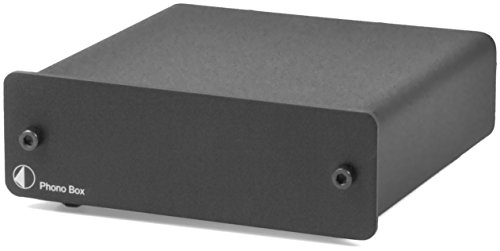
    Pro-Ject Audio - Phono Box DC - MM/MC Phono preamp with line Output - Blk

    Fluance PA10 High Fidelity Phono Preamp (Amazon.com)

    The Fluance PA10 is deemed High Fidelity for a reason. With over 85% of users rating it five stars, this phono preamp is a pick you can be confident in. The wood finish looks great with most entertainment centers, but it is a little larger than most preamps. 

    Fluance PA10 High Fidelity Phono Preamp (Preamplifier) with RIAA Equalization for MM Turntables/Vinyl Record Players

    Fluance PA10 High Fidelity Phono Preamp (Preamplifier) with RIAA Equalization for MM Turntables/Vinyl Record Players

    SUCA-AUDIO Phono Preamp (Amazon.com)

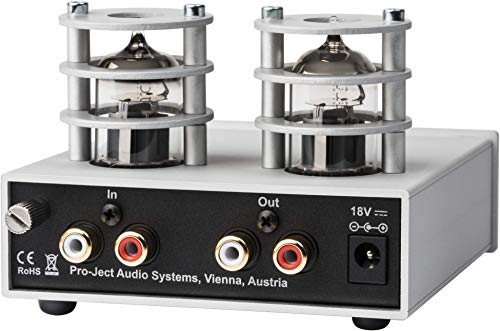
    This is a Tube phono preamp, but this might be a huge plus based on your style! Tube phono preamps use analogue tubes and valves to amplify the signal that turntables emit when they play vinyl records. Meanwhile, solid state preamps use silicon transistor components to amplify the same signal.
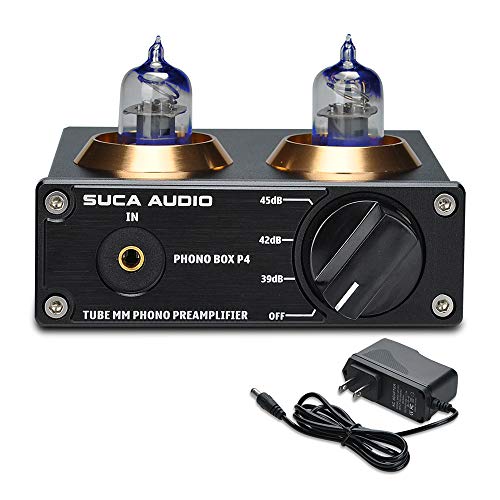
    SUCA-AUDIO Phono Preamp for Turntable MM Phonograph Vacuum Tube Preamplifier with Gain Gear Mini Hi-Fi Stereo for Home Audio with DC 12V Power Supply

    Audio Cables 

    Most preamp setups will require an RCA cable or some other audio cable, which is usually included in the box. However, some may not come with it. When purchasing a preamp, look for information revealing what pairs with your turntable and what cables need to go between the preamp and the turntable.

    Conclusion 

    Sonos speakers have terrific sound quality that won’t muffle the unfiltered sound of your turntable.

    Here are a few things you need to remember:

    • You will need a “middle man” (such as the Sonos Five, Sonos Port, or Sonos Amp) if you are trying to connect your turntable to a Sonos Bluetooth speaker unless you have a Bluetooth turntable. 
    • If you don’t have a phono preamp built into your turntable, you need to get one to connect to the Five, Port, or Amp.
    • You can use the app to connect your turntable to any speakers on your Sonos network.
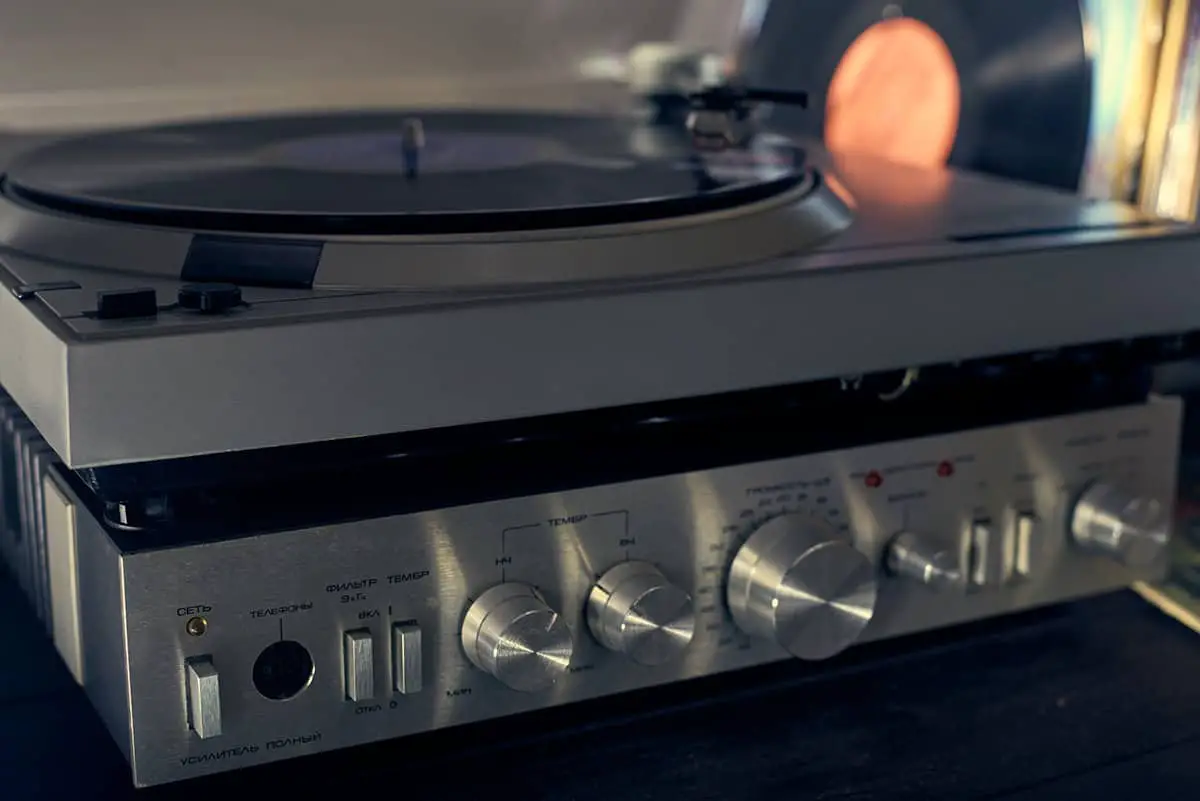
  • 10 Vintage Amplifiers for Turntables We Bet You Would Like

    10 Vintage Amplifiers for Turntables We Bet You Would Like

    If you own or are looking for a turntable, it means that you appreciate a good, smooth sound, and you enjoy high-quality sound systems. It also means that you need an amplifier, in which case you might be considering choosing a vintage one. So what are the best vintage amplifiers for you out there?

    Here’s a list of some vintage turntable amplifiers that are generally considered to be among the best.

    1. NAD 3020
    2. Marantz 2270
    3. Pioneer SX-1250
    4. Yamaha CR-1020
    5. Sugden A21
    6. Mission Cyrus 2
    7. A&R A60
    8. Audiolab 8000A
    9. Creek CAS4040
    10. Naim NAIT

    This article elaborates on the features that make these vintage amplifiers the best choice for your turntable. We’ll also give you some useful points to consider before choosing a vintage amplifier. 

    Factors To Consider

    Amplifiers are essentially devices that boost (or indeed, amplify) the power of a signal. You need an amplifier to have a strong enough signal to drive the speakers. 

    An amplifier with an AM/FM radio tuner built-in (an integrated amplifier) is called a receiver. In order to choose the option that would best suit your needs, you should keep in mind where your priorities lie when looking for an amplifier.

    Some important amplifier features that you might want to consider before making an expensive purchase are:

    • Power (measured in Watts): the maximum power that an amplifier can extrude.
    • Headroom: the extent to which an amplifier can reproduce sudden, very loud sounds.
    • Distortion: anything that degrades the signal and, consequently, the sound’s quality.
    • Output Impedance: the amount of restriction of a speaker to the power of an amplifier.
    • Frequency Response: the extent to which the output of the amplifier is affected by the frequency of the signal received by the input terminal.

    All of these features contribute to the quality of the sound and the general experience of  enjoying music recordings. Once you know the characteristics of an amplifier, all you need is to review your options. Nowadays, a lot of audiophiles choose vintage amplifiers, and not just because they’re cool and interesting to look at.

    New isn’t always better when it comes to hi-fi. There are a lot of vintage amplifiers that not only work perfectly but are also aesthetically pleasing while being reasonably priced. Having said that, before you choose to go the vintage route, you need to make sure that the amplifier is in good condition and safe to use.

    So what are the best vintage amplifiers for turntables out there?

    Best Overall: NAD 3020 

    Specifications:

    • Power output: 20 watts per channel into 8Ω (stereo)
    • Frequency response: 10 Hz to 70 kHz.
    • Total harmonic distortion: 0.02%
    • Input sensitivity: 2.5mV (MM), 150mV (line)
    • Signal to noise ratio: 75 dB (MM), 110 dB (line)
    • Dimensions: 420 x 96 x 240 mm (17 x 4 x 9 in)
    • Weight: 5.26 kg (11.60 lbs)
    • Year: 1978
    • Price: c.$150

    NAD 3020 is probably one of the most classic and well-known vintage amplifiers. It was a game-changer for amplifiers in many ways, and it became one of the best-selling integrated amplifiers.

    The power output of NAD 3020 is among the lowest and yet it can outperform speakers with a much higher power level. This is thanks to the design of the power supply system that allows it to perform exceedingly well with more complex speakers.

    NAD 3020 is the best example of a high-quality budget amplifier. The sound is soft and sweet, and the bass is incredible. These qualities also make it ideal for those buying an amplifier for the first time who want to experience its benefits without making a risky investment. 

    This amplifier has a notable feature called “Soft Clipping,” which limits the output of the amplifier in cases when it’s being pushed to higher volume levels. This way, the sounds stay cleaner and softer, avoiding distortion.

    It’s hard to find better features and value when it comes to the under $200 price point, this is why the NAD 3020 takes the best overall title.

    Marantz 2270 Stereo Receiver

    Specifications:

    • Power output: 70 W per channel into 8Ω (stereo)
    • Frequency response: 7Hz to 50kHz
    • Total harmonic distortion: 0.3%
    • Input sensitivity: 1.8mV (MM), 180mV (line)
    • Speaker load impedance: 4Ω to 16Ω
    • Dimensions: 17-21/64 x 5-25/64 x 14 inches (356 mm)
    • Weight: 38.5 lbs (174.6 kg)
    • Year: 1973
    • Price: $550 – $1300

    Marantz is well known for building some of the finest pieces of hi-fi, especially its 2200 series of receivers. Audiophiles regard Marantz receivers as some of the best, being able to go against even modern amps nowadays.

    Marantz 2270’s sound is rich, full, and warm, ideal especially for orchestral recordings; reviewers say it feels like it fills the whole room. The design is unique and quite memorable with the blue backlit dials and the aluminum faceplates. Its combination of features make it ideal for more experienced users and collectors looking to find the finest options the market has to offer.

    When it comes to the price, the Marantz 2270 is among the more expensive Amplifiers, which makes it a true investment piece. You might find one in pretty good condition at around $550, but others are valued at more than $1200. While it might be costlier than others, it’s relatively easy to find replacement parts if you would like to service it..

    Pioneer SX-1250 Stereo Receiver

    Specifications:

    • Power output: 160 watts per channel into 8Ω (stereo)
    • Frequency response: 10Hz to 50kHz
    • Total harmonic distortion: 0.1%
    • Speaker load impedance: 4Ω (minimum)
    • Dimensions: 556 x 186.5 x 464.5 mm (22 x 7.3 x 18.3 in)
    • Weight: 29.2 kg (64.4 lbs)
    • Year: 1976
    • Price: $800 – $3700

    A beast from the 1970s, the Pioneer SX-1250 is a high-quality receiver with plenty of power and a sleek, vintage design. The sound is clear and detailed. The sound quality is superb, and the wood-side panels with the silver faceplate make this receiver a classic. It’s quite large and heavy, a testament to the tendency of manufacturers’ wattage wars at the time for big, powerful amps.

    The price varies, but it’s possible to find it on sale. One downside is that some of them need restoration and new parts, because at the moment they’re more than 40 years old. 

    The good news is that finding Pioneer SX-1250 parts in decent condition isn’t as challenging as you may think. 

    However, you can also find some options in perfect condition, which are reasonably much more expensive.

    Yamaha CR-1020

    Specifications:

    • Power output: 70 watts per channel into 8Ω (stereo)
    • Frequency response: 10Hz to 100kHz
    • Total harmonic distortion: 0.05%
    • Input sensitivity: 2mV (MM), 120mV (line)
    • Signal to noise ratio: 81dB (MM), 100dB (line)
    • Output: 120mV (line)
    • Speaker load impedance: 4Ω to 16Ω
    • Dimensions: 540 x 167 x 415 mm (21.3 x 6.6 x 16.3 in)
    • Weight: 18.8 kg (41.4 lbs)
    • Tuning range: FM, MW
    • Year: 1977
    • Price: $800-$1200

    Yamaha CR-1020 was introduced in the late 1970s and to this day is regarded as a great, high-quality piece of hi-fi. It’s known for the excellent quality of sound as well as the famous

    “loudness” dial that Yamaha amplifiers were known for at the time.

    Although modest in terms of power, the CR-1020 has a full, clean, and detailed sound.

    The bass is impressive, and the drums sound incredibly full. You might like the loudness control dial, which gives you a bass boost at low volume.

    The CR-1020 is particularly good-looking and unique compared to most amplifiers. Its silver fronts with analog power meters and the vintage wood side panels give it a distinct appearance.

    Like the Marantz, this amplifier can also be quite expensive compared to most vintage amplifiers, though the price will depend on the condition. You can find CR-1020s in good condition at $800 to $1200.

    Sugden A21

    ​Specifications:

    • Power Output: 23 Watts into 8 Ohms
    • Frequency Response: +/-1dB 10Hz-20kHz
    • Signal to Noise: 70dB (MM), 70dB (ceramic), 80dB (line)
    • Phono Input Sensitivity: 3mV/mm, 0.2mV/mc for max. output
    • Dimensions: 393 x 127 x 228 mm (15.5 x 5 x 9 inches)
    • Gross Weight: 11 kg (24 lbs)
    • Year: 1969
    • Price: c. $200

    The Sugden A21 is another high-quality amplifier dating back to the late sixties. Nowadays, you might recognize the name from some later models, but the one I want to talk about is the 1969 one.

    The Sugden A21 provides a sharp, clear sound with a lot of depth to it and remarkable bass quality. Although it’s rated at a much lower power level than others, it can hold its own among competitors. The Sugden A21 is relatively small compared to a lot of amplifiers. The design is simplistic but elegant.

    The prices at which you can find the Sugden A21 are pretty reasonable, especially compared to other vintage amplifiers. One disadvantage is that it uses DIN connectors, which can create problems with connectivity in the long run.

    Mission Cyrus 2

    Specifications:

    • Power output: 50 watts per channel into 8Ω (stereo)
    • Frequency response: 1Hz to 50kHz
    • Total harmonic distortion: 0.003%
    • Input sensitivity: 0.2mV (MC), 3mV (MM), 50mV (line)
    • Signal to noise ratio: 75dB (MC), 84dB (MM), 86dB (line)
    • Dimensions: 85 x 215 x 345 mm (3 x 8 x 14 in)
    • Weight: 5 kg (11 lbs)
    • Finish: black / grey
    • Year: 1984
    • Price: c. $350

    Cyrus 2 is a stylish amplifier from the 1980s that immediately catches your eye. It features a significant improvement from its predecessor, Cyrus 1, with increased headroom and power.

    The sound of Cyrus 2 is lively, powerful, and quite precise. It performs well enough to compare with modern amplifiers. The case has a unique look with incredible paintwork. All these features come at a pretty reasonable price point, which means the amplifier will deliver a lot of value for your investment..

    One major advantage of Cyrus 2 is the fact that the company is still committed to servicing even the earliest models in order to bring them back to life. Therefore finding parts and maintenance services is significantly easier than with other alternatives. 

    A&R A60

    Specifications:

    • Power output: 40 watts per channel into 8 ohms (stereo)
    • Frequency response: 20Hz to 20kHz
    • Total harmonic distortion: 0.2%
    • Input sensitivity: 0.1mV (MC), 2mV (MM), 100mV (line)
    • Signal to noise ratio: 63dB (MC), 70dB (MM), 85dB (line)
    • Dimensions: 450 x 255 x 60 mm (18 x 10 x 2 in)
    • Weight: 5 kg (11 lbs)
    • Year: 1977
    • Price: c. $70

    The A&R A60 is another affordable amplifier from 1977. It’s an excellent classic with good

    sound and an impressive built-in phono stage.

    The sound is smooth and powerful without being too harsh or abrasive. The bass is superb, although it doesn’t exactly pack a punch the way some contemporaries in the same price range do. The A60 impresses with an eye-catching, sleek, and retro design when it comes to design.

    The A&R A60 is very affordable; you may find earlier versions with DIN sockets at around $30, or you can spend a little more for later, more sophisticated versions. Either way, it can be an excellent starting point from which you can move onto more sophisticated models. Therefore if you’re looking to buy your first amplifier, this might be the ideal choice.

    Audiolab 8000A

    Specifications:

    • Power output: 60 watts per channel into 8Ω (stereo)
    • Frequency response: 20Hz to 20kHz
    • Total harmonic distortion: 0.05%
    • Input sensitivity: 0.11mV (MC), 2mV (MM), 100mV (line)
    • Signal to noise ratio: 75dB (MC), 78dB (MM), 80dB (line)
    • Speaker load impedance: 4Ω to 16Ω
    • Dimensions: 445 x 74 x 335 mm (18 x 3 x 13 in)
    • Weight: 7.6 kg (16.8 lbs)
    • Year: 1985
    • Price: c. $300

    Audiolab 8000A is a powerful, high-quality amplifier with a clear and cohesive sound. It first came out in the 1980s, but it was produced by Audiolab until the 90s, so you may find newer versions.

    The sound of 8000A is very powerful and dynamic, although it can get harsh if pushed too hard. The design includes many exciting features, and the tone controls are excellent.

    A disadvantage of 8000A is that sometimes the quality of connections and sockets

    might be poor, and it might need servicing.

    Creek CAS4040

    Specifications:

    • Power output: 30 watts per channel into 8Ω (stereo)
    • Frequency response: 20Hz to 20kHz
    • Input sensitivity: 2.5mV (MM), 250mV (line)
    • Signal to noise ratio: 79dB (MM), 79dB (line)
    • Dimensions: 420 x 60 x 185 mm (17 x 2 x 7 in)
    • Weight: 4.4 kg (9.7 lbs)
    • Year: 1983
    • Price: c.$90

    This amplifier is known for its very soft and smooth sound. It came out in the early 1980s, and even when it was introduced, it was presented as a high-quality amplifier at a more reasonable price than most. For a budget amplifier, it was incredibly popular and managed to stand apart from the rest at the time.

    CAS4040 has a sweet musical sound, much smoother than most of its competition at the time. It is powerful and dynamic enough for its size. Some disadvantages of the original included a high level of distortion at times, which was then remedied in the subsequent units produced.

    You can find a CAS4040 at excellent prices nowadays, ranging from $150 to $400.

    Naim NAIT

    Specifications:

    • Power: 13 watts per channel into 8 ohms
    • Features: mute switch, tape monitor switch, Solid-state integrated amplifier
    • Inputs: one tape monitor, one MM phono input, two line-level inputs
    • Dimensions: 206 x 286 x 76 mm (8 x 11 x 3 in)
    • Year: 1984
    • Price: c.$860

    Naim Nait is probably one of the most legendary pieces of hi-fi of all time. Introduced in 1983, the Nait was the subject of many debates because of its unique sound and design. Decades later, it’s still considered a legend and a favorite among integrated amplifiers.

    Nait’s sound is strong and dynamic, despite the low power output. The tone is warm, and the bass is dry. Nait shines in the high range, smoothing the edges, but it can be harsher in the mid-range.

    The design of the Naim Nait is elegant and simplistic; it’s a small, black aluminum case. It’s pretty expensive compared to other 1980s amps, but its unique sound makes it worth the money.

    Price Comparison

    Vintage AmpPrice
    NAD 3020 c. $150
    Marantz 2270 $550 – $1300
    Pioneer SX-1250 $800 – $3700
    Yamaha CR-1020$800-$1200
    Sugden A21c. $200
    Mission Cyrus 2c. $350
    A&R A60$70 – $150
    Audiolab 8000Ac. $300
    Creek CAS4040c.$150-$400
    Naim NAITc.$860

    As you can see, the price ranges from $70 to $3700, which is not unusual because we’re talking about vintage amplifiers. You might find much lower or higher prices at a vintage store near you, but these are the prices you will most likely encounter.

    The cheapest options would be A&R A60, Creek CAS4040, NAD 3020, and Sugden A21. Even though they’re relatively inexpensive, that doesn’t mean they won’t perform at the same level as the most expensive ones. These cheap turntable amplifiers are smaller and more compact than the others, but they produce high-quality sound nonetheless.

    Power Comparison

    Vintage AmpPower
    NAD 302020 W per channel into 8Ω
    Marantz 227070 W per channel into 8Ω
    Pioneer SX-1250 160 W per channel into 8Ω
    Yamaha CR-102070 W per channel into 8Ω
    Sugden A2123 W per channel into 8 Ω
    Mission Cyrus 2 50 W per channel into 8Ω
    A&R A6040 W per channel into 8Ω
    Audiolab 8000A60 W per channel into 8Ω
    Creek CAS404030 W per channel into 8Ω
    Naim NAIT13 W per channel into 8Ω

    The most powerful turntable amplifier is the Pioneer SX-1250, at 160 W, followed by Marantz 2270, Yamaha CR-1020 at 70, and Audiolab 8000A at 60.

    The greater the power output, the louder the amplifier will be. Plus the difference between a 50W amplifier and a 100W one doesn’t mean that the latter will be twice as loud as the former.

    Generally, an amplifier at 50 to 100 watts is good enough for a home setting. Anything more than that would be more suitable for bigger spaces.

    Best Vintage Turntable Amplifier

    The best vintage turntable amplifier I can recommend would be the NAD 3020, based on a combination of features and price. It’s a very high-quality amplifier that provides smooth, clear, and detailed sound. It might not have the biggest power output, but it can still outperform even new amplifiers, thanks to the impeccable craftsmanship with which it was designed.

    At around $150, it’s among the cheapest options you might have for vintage amplifiers for the kind of quality it offers. If you’re after power and are willing to spend whatever it takes, Marantz 2270, Pioneer SX-1250, and Yamaha CR-1020 are probably three other good options.

    If you’re looking for cheaper vintage amplifiers that still provide a perfect sound, you may check A&R A60 and Creek CAS4040.

  • Tube Phono Preamp FAQ and Recommendations for Any Budget

    Tube Phono Preamp FAQ and Recommendations for Any Budget

    Tube phono preamps are great, but many people have questions about them and how they work. They also wonder how much they cost. Luckily, the answers to those questions are below if you keep reading.

    Tube phono preamps increase and improve the sound that turntables play. Tube phono preamps use vacuum tubes to amplify the signal turntables emit when playing music, which makes the music louder and clearer. Tube phono preamps cost $65-$3,000 and are more expensive than other type of phono preamps.

    Now that you know how tube phono preamps work and how much they typically cost, you may be wondering why they cost so much, and what types of phono preamps there are. Keep reading to find out.

    Are there Different Types of Phono Preamps?

    There are multiple types of phono preamps. There are tube phono preamps and solid state preamps. Solid state preamps are slightly more popular than tube phono preamps because they are typically cheaper, but both types of phono preamp work well.

    There are also phono preamps that work with Moving Magnetic Cartridges (MM) or Moving Coil Cartridge (MC) turntable systems. Most phono preamps nowadays work with both MM and MC systems, but some don’t.

    Tube phono preamps use analogue tubes and valves to amplify the signal that turntables emit when they play vinyl records. Meanwhile, solid state preamps use silicon transistor components to amplify the same signal.

    Tube phono preamps are typically more resistant to voltage spikes and other things associated with electricity that can cause solid state preamps to malfunction and stop working. However, tube phono amps require more electricity than solid state preamps in order to function properly, so they will increase your electricity bill, even if you don’t use it for a long time.

    Tube phono preamps are more fragile than solid state preamps. The tubes and coils that tube phono preamps use to work are fragile and expensive. if you drop a tube phono preamp machine, it will break and you will likely have to purchase things to repair it. Solid state preamps are more durable than tube phono preamps, but it is very expensive to have them repaired when they break.

    It is very easy to fix tube phono preamp machines because the tubes break more frequently than other parts. When one of the glass tubes break, they can just be unscrewed and replaced with a new one. They only cost between $12-$20 and can be found on many online shopping websites or at stores that sell vinyl records.

    But which type of phono preamp machine should you choose? If you plan on moving your phono preamp machine often then don’t choose a tube phono preamp machine as it will likely break when moved, and you don’t want that to happen.

    Now that you know a little bit about tube and solid state phono preamps, you may be wondering if tube phono preamps are useful.

    Are Tube Phono Preamps Useful?

    Tube phono preamps are useful because they make the music that is playing from your turntable louder, clearer, and improve the quality. However, sometimes you don’t need to purchase a separate tube phono preamp system.

    Many record players nowadays have preamp systems built in, so you don’t need to purchase a separate phono preamp system. However, if you do want to purchase a tube preamp system and your turntable already has a system built in, you can turn it off and use the separate system. Although, you will save money if you just use your turntable’s phono preamp system instead of purchasing a separate phono preamp system. (Source)

    Overall, tube phono preamps are useful if you have a turntable that doesn’t already have a tube phono preamp system installed, or when the already installed phono preamp system doesn’t work well.

    How Much Do Tube Phono Preamps Cost?

    Tube phono preamps typically cost between $65-$3,000 dollars, so they are not cheap. Turntable phono preamps typically only cost $20-$2,000, so tube phono preamps are more expensive than other phono preamp systems. However, many people who have tube phono preamp machines think that the cost is worth it.

    Tube Phono Preamp Recommendations

    Now that you know what tube phono preamps are and how they work, you may be wondering what the best ones are. Luckily, compiled below is a list of the best ones. if you are worried about how much they cost, don’t worry, as there are some machines on here that work with smaller budgets.

    ICON Audio PS1 MkII MM/MC Tube Phono Preamplifier

    The ICON Audio PS1 MkII MM/MC Tube Phono Preamplifier is the best expensive tube phono preamp. It is rated 5 stars and costs $2,499.

    The ICON Audio PS1 MkII MM/MC Tube Phono Preamplifier is wired by hand, which increases the price, but it removes impurities that reduce the quality of the music when older records are played, which makes this the best preamp for people who frequently listen to old records.

    With the ICON Audio PS1 MkII MM/MC Tube Phono Preamplifier, you can control the volume and increase it so you can hear the wonderful, detailed sound coming from it. You will definitely enjoy playing your records when you use this preamplifier.

    Click here if you would like to purchase the ICON Audio PS1 MkII MM/MC Tube Phono Preamplifier.

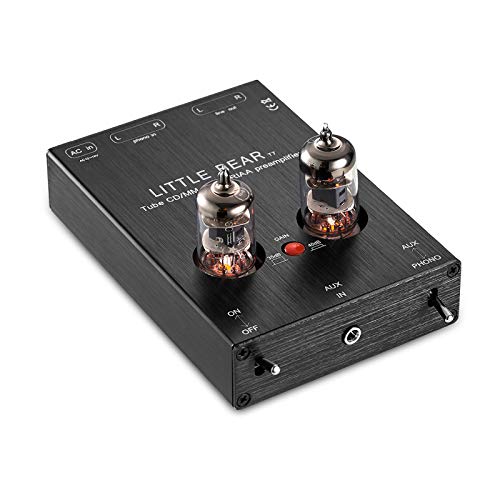
    Little Bear T7 Vacumn Tube Mini Phono Stage

    The Little Bear T7 Vacumn Tube Mini Phono Stage is also a wonderful tube phono preamp that is highly rated. It is rated 5 stays and only costs $65-$81 at the time of writing.

    The Little Bear T7 Vacumn Tube Mini Phono Stage can only be used with MM turntables, so make sure that your turntable is an MM system before you purchase this machine. The bulbs on this tube phono preamp can be easily replaced when they break, and it is compatible with 5654, 6AK5, and EF95 tubes.

    The Little Bear T7 Vacumn Tube Mini Phono Stage comes in black or silver and it is small and portable, so you can move it with little worry about if the tubes will break.

    If you would like to purchase the Little Bear T7 Vacumn Tube Mini Phono Stage, click here to go to Amazon

    Little Bear T7 Vacumn Tube Mini Phono Stage RIAA MM Turntable Preamp & HiFi Tube Pre-Amplifier (Black)

    EAT E-Glo S Hybrid Tube Phono Preamplifier

    The EAT E-Glo S Hybrid Tube Phono Preamplifier is one of the best tube phono preamps. It is rated 5 stars by consumers, but it costs $2,995.

    The EAT E-Glo S Hybrid Tube Phono Preamplifier is portable and can be tucked away when it is not being used. You can control and change many things on the front control panel. One neat feature about this tube phono preamp is that the control panel is lit by small LED lights so you can change the settings even when the lights are off.

    The EAT E-Glo S Hybrid Tube Phono Preamplifier produces wonderful sound so you can enjoy listening to your vinyl records. Unfortunately, the tubes that help it produce that sound are not common. They are Swiss-made and use zircon anodes rather than graphite anodes, which are more expensive to produce. This means if the tubes on this tube phono preamp machine break, you will have to pay a lot of money to replace them.

    If you would like to purchase the EAT E-Glo S Hybrid Tube Phono Preamplifier, click here.

    Valhalla 2 Headphone Amplifier

    The Valhalla 2 Headphone Amplifier is one of the best tube phono preamps as it is rated 5 stars and only costs $349, which is relatively cheap for this type of phono preamp.

    The Valhalla 2 Headphone Amplifier comes in a silver color that will look great in your home. It comes with a 5 year warranty so you won’t have to pay to replace it if it breaks for a long time.

    The Valhalla 2 Headphone Amplifier has a gain switch on the front that allows you to control the amount of output level and impedance that comes from it. It also produces wonderful sound when you use it. You can plug your headphones into this phono preamp so you can hear the sound it produces when it is late or if you want to enjoy the music your playing from your turntable.

    If you would like to purchase the Valhalla 2 Headphone Amplifier, click here.

    Eat E Glo Petit Hybrid Tube Phono Preamplifier

    The Eat E Glo Petit Hybrid Tube Phono Preamplifier is a great tube phono preamp. It is rated 4.9 stars by consumers, and it costs $1,495.

    The Eat E Glo Petit Hybrid Tube Phono Preamplifier is made out of aluminum so it is slightly more durable than some other tube phono preamp machines. It is designed to be slim and not take up a lot of room in your household, so you can put it nearly anywhere. the tubes are even hidden so they won’t break as easily as when they are exposed.

    The Eat E Glo Petit Hybrid Tube Phono Preamplifier produces clear midrange sound, and any music that you are playing from your turntable will be clear and wonderful.

    If you would like to purchase the Eat E Glo Petit Hybrid Tube Phono Preamplifier, click here.

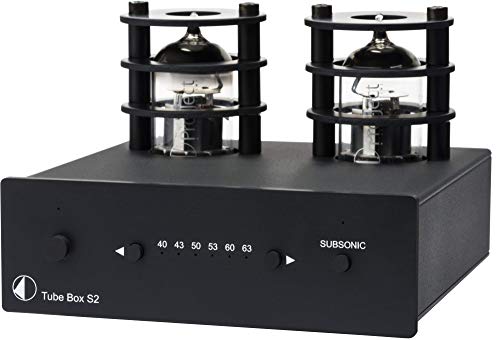
    Pro-Ject Tube Box S2 Black Tube Phono Preamplifier

    The Pro-Ject Tube Box S2 Black Tube Phono Preamplifier is a really nice tube phono preamp. It is rated 4.6 stars by consumers and costs $499.

    The Pro-Ject Tube Box S2 Black Tube Phono Preamplifier is encased in metal and aluminum, which makes it more durable than many other tube phono preamps. The tubes are easy to replace if they break or if you want to change the level of sound that this preamp produces. It has 5 impedance settings that you can adjust to make the music it plays suit your preferences.

    Pro-Ject Tube Box S2 Phono Preamplifier - Black

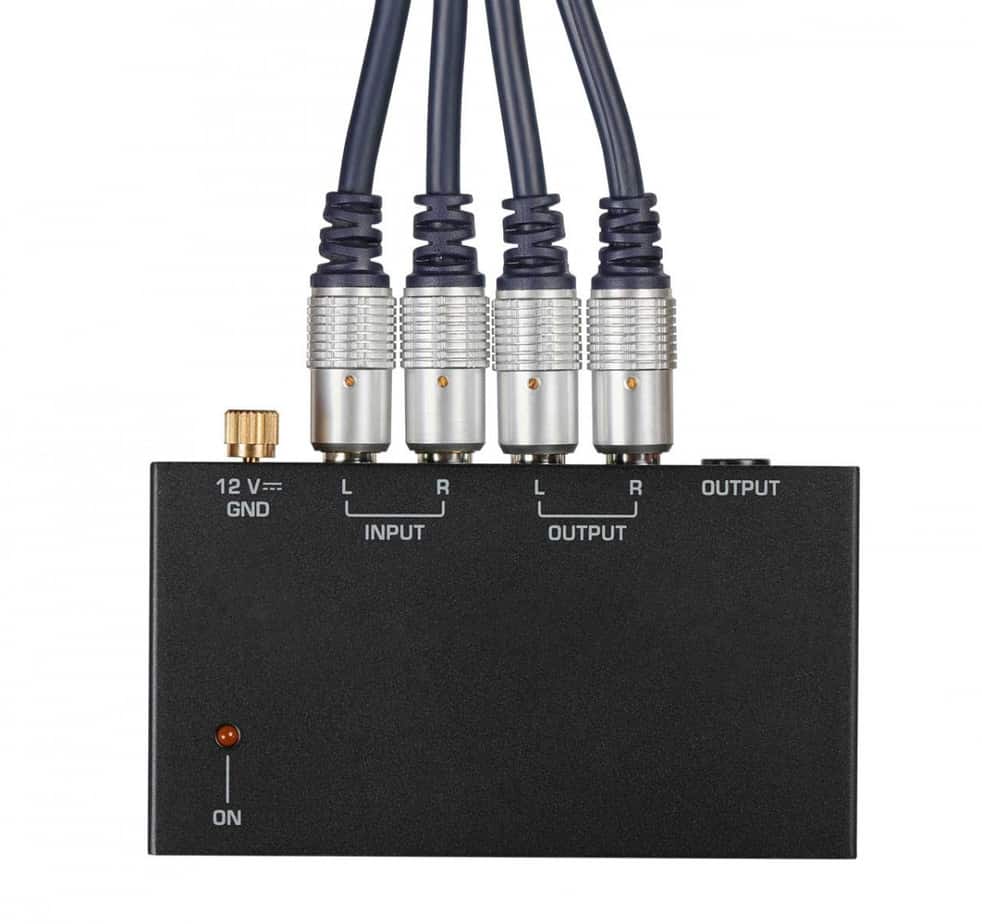
    You can use both MM and MC turntables with the Pro-Ject Tube Box S2 Black Tube Phono Preamplifier. The connection points are also gold-plated so they will not become corroded over time, which means you will be able to use this phono preamp machine for years to come if you purchase it.

    If you would like to purchase the Pro-Ject Tube Box S2 Black Tube Phono Preamplifier, click here to go to Amazon.

    Any of the tube phono preamps will work very well, but which one you choose to purchase is up to you. Although all of these preamps seem very expensive, they will all last for years to come and help you enjoy listening to your vinyl records that you treasure. if you purchase one of these tube phono preamp machines, you will be able to enjoy your vinyl records for years to come, and your turntable will be able to produce clearer and louder music than before.

    Tube phono preamps work well and improve the quality of the sound that comes from your vinyl records, which is very important to many people. Although the tubes are easy to break, so you may not want to put one of these preamps in a place where young children can reach them, they are also easy to replace and most of the time only cost $12-$20 per tube.

  • What is a Turntable Phono Preamp? We Explain

    What is a Turntable Phono Preamp? We Explain

    Turntables and records are making a comeback, and many people have vinyl record versions of their favorite albums. But now that they have a turntable for their vinyl records they are wondering if they need a turntable phono preamp. What is a turntable phono preamp?

    A turntable phono preamp is an electronic circuit that converts phono signals to line signals so the music coming from the vinyl record is clear. It helps increase the volume of the music coming from the record, and makes sound come out of speakers or stereo systems that are connected to turntables.

    Now that you know what turntable phono preamps are, you may be wondering if you need one if you have a turntable and how much they typically cost. Keep reading to find out.

    What is a Turntable Phono Preamp?

    Turntable phono preamps are electric circuits that helps boost the output of a vinyl record. They also equalize the output of a turntable so the sound that comes from the turntable is correct and sounds like it should. Some phono preamps are not included in turntables and are part of an external system, but most modern turntables have a phono preamp included in the turntable system. (Source)

    Phono preamps make the sound quality of a vinyl record better. They make the record sound more similar to the sound that a CD or tape would produce so people don’t think that the sound that a CD and a vinyl record are really different, although there are differences in the sound that each of them produce.

    When a turntable plays a vinyl record, they produce a phono output signal that needs to be converted to a line level signal, otherwise known as an AUX signal, in order for the music to be played through speakers or another sound system. Phono preamps receive the phono output signal and convert it to a line level signal so it can be played, and you can hear the music that you are playing on the turntable. (Source)

    Phono preamps also emphasize the high and low frequencies that hide the sound that the turntable needle makes as the vinyl record spins so you can hear the music clearly, without any irritating scratching noise that will make the music less appealing.

    A phono preamp is also known as a phono stage. When turntables were used in almost every household, a phono preamp was included in the turntable system so it was easy to use the turntable and no one had to purchase extra parts in order to play their music.

    However, as tapes and CDs became popular and people nearly stopped purchasing turntables altogether, companies removed the phono preamp system in order to save money. Now that turntables are making a comeback and people are purchasing turntables to play their vinyl records, companies have put the phono preamp system back into them. However, not all companies put the phono preamp system in turntables, as it is cheaper for them to leave it out. (Source)

    Most phono preamps nowadays reduce the amount of hissing and rumbles that are commonly heard when a vinyl record is played. This makes it so the music playing is clear and of a high quality.

    Most phono preamps are small and compact so you can keep them stowed away when you aren’t using your turntable. If you have a turntable and need a separate phono preamp, make sure that you purchase one that works for your turntable. Although most phono preamps nowadays work with both moving magnetic (MM) and moving coil (MC) turntable systems, before you purchase one make sure that it works with the turntable system that you have.

    Do I Need a Turntable Phono Preamp?

    You need a turntable phono preamp if your turntable does not have the system already included in it. If your turntable system has a USB or has a phono preamp system already included, then you don’t need to worry about purchasing a separate phono preamp system.

    Separate phono preamps are necessary if the turntable system does not have it included because they make the sound of the vinyl record the turntable is playing louder and clearer than if the phono preamp system was not included, so they are necessary if you want to hear your music clearly while using a turntable system. (Source)

    According to Reddit users, you don’t need a separate phono preamp system if your turntable system already has it, as it won’t make much of a difference in the sound quality. When you connect a phono preamp to a turntable system that already has it included, it doesn’t change anything because there is nothing to change, so the sound quality doesn’t improve as it can’t be improved. (Source)

    Some turntables and speakers have phono preamps or something similar already included in them. Before you purchase a phono preamp, make sure your turntable or speakers don’t already have the system, as this will make the purchase of a phono preamp system useless.

    How Much Do Turntable Phono Preamps Cost?

    Turntable phono preamps can cost anywhere from $20 to $500. Most phono preamps can be connected to turntables, but some can’t so you will need to double check before you purchase one if you intend to use it with your turntable.

    However, some phono preamps can cost $20,000. These super expensive phono preamps are typically large and used by DJs and other people who work in the music industry.

    Luckily for people who don’t want to or can’t spend $20,000 or more on a phono preamp system, most high-quality phono preamp systems only cost between $20 and $200. It is very easy for you to find a phono preamp that is reasonably priced and helps produce a high quality sound.

    Most of the time, the more expensive the phono preamp system is, the better quality sound it will produce from your turntable, and the more you will be able to enjoy your vinyl records.

    Best Turntable Phono Preamps

    Now that you know what turntable phono preamps are and what they do, you may be wondering what the best phono preamps are and how much they cost. Keep reading to find out, and look into purchasing the ones that you are interested in purchasing.

    Schiit Mani Phono Preamp for MC and mm Cartridges

    The Schiit Mani Phono Preamp for MC and mm Cartridges is one of the best phono preamp machines on the market. It is rated 4.7 stars by consumers, and it costs $129, which is relatively cheap for a quality phono preamp machine.

    The Schiit Mani Phono Preamp for MC and mm Cartridges can be used with both MM and MC turntable machines, so you can use them with almost any type of turntable without worrying about whether or not it will work properly. It has a 2-year warranty.

    Click here if you would like to purchase the Schiit Mani Phono Preamp for MC and mm Cartridges machine.

    Pro-Ject Phono Box DC -Black Flexible Phono Preamp

    The Pro-Ject Phono Box DC -Black Flexible Phono Preamp is the best turntable phono preamp machine. it is rated 4.8 stars by consumers. The best part about this phono preamp machine is that it only costs $99, which is quite cheap for a quality phono preamp machine.

    The Pro-Ject Phono Box DC -Black Flexible Phono Preamp machine has gold-plated sockets that will not become corroded over time, which means you can use this machine for years to come, even if you use it frequently.

    The Pro-Ject Phono Box DC -Black Flexible Phono Preamp can be used by MM and MC turntable machines, so you can use your turntable no matter what system it uses. It produces a high-quality sound, so you can enjoy your vinyl records and hear the music clearly.

    If you would like to purchase the Pro-Ject Phono Box DC -Black Flexible Phono Preamp, click here.

    Rolls Bellari PA550

    The Rolls Bellari PA550 is a great phono preamp machine. It is rated 4.7 stars by consumers, and it only costs $129. It is encased in metal, so it is very durable and will not break easily even if it is dropped. This is a very portable machine, so you can take it anywhere you go, or stow it in a small place when you are not using it with your turntable.

    The Rolls Bellari PA550 can be used with headphones, so you can use your turntable with your headphones at night when others who live in the area are sleeping and it would otherwise be rude to use your turntable, even if you want to, as it would likely wake them up.

    The Rolls Bellari PA550 has rotary bass and treble controls on the front of it so you can customize the equalization of the music that is playing on your turntable. This feature is not available in most phono preamp machines, but it is a great feature because it allows you to customize your vinyl records and how you listen to them.

    If you would like to purchase the Rolls Bellari PA550, click here.

    Behringer Microphono PP400 Phono Preamp

    The Behringer Microphono PP400 Phono Preamp machine is a great phono preamp machine. It is rated 4.5 stars. However, the best part about this phono preamp machine is the price. It only costs $25, and it still helps your turntable produce great sound that you will very much enjoy.

    The The Behringer Microphono PP400 Phono Preamp is only 1.25 inches tall and 4 inches deep, which means that it is very compact and can be stored nearly anywhere when you are not using it, and it won’t take up a lot of space while you are using it.

    Click here if you would like to purchase the Behringer Microphono PP400 Phono Preamp machine.

    Cambridge Audio Phono Preamplifier

    The Cambridge Audio Phono Preamplifier is a great phono preamp machine. it is rated 4.7 stars by consumers and costs $179. It comes in a silver color, so it will blend in with many other silver devices that you have in your home.

    The Cambridge Audio Phono Preamplifier is one of the larger phono preamps on this list, but it is not large enough to be a hassle or take up too much room in your home. It looks sleek enough to keep out all of the time, even when you are not using your turntable. If weighs 1 pound so it can easily be moved if you need to, but you will likely not have to move it.

    The Cambridge Audio Phono Preamplifier will allow you to listen to your vinyl records and hear the music quite clearly, which everyone enjoys. Unfortunately, if only works with MM turntable machines, but as long as you have one it will work wonderfully. It has a 1 year warranty, and it will last for a long time after the warranty expires.

    if you would like to purchase the Cambridge Audio Phono Preamplifier, click here.

    Now that you know what the best turntable phono preamp machines available are, choose which one is best for you and your turntable, and enjoy the clear music that you will hear coming from your favorite vinyl records. Keep in mind that many turntables that have been made in recent years already have phono preamp systems installed, so you don’t need to purchase an extra one in order to properly enjoy your vinyl records.

    Any of these phono preamp machines on this list will work wonderfully, but it is up to you which machine you choose to use. As the machines listed cost a variety of prices, but are all high quality, it is up to you to choose which one fits your budget the best, and which one will work well with your turntable that does not already have a phono preamp system installed or included already. Remember, phono preamp machines aren’t necessary if the turntable already has a phono preamp system included in the turntable’s software or machinery.

    Related Article

    Two Types Of Amps For Turntables (And A Few Recommendations We Bet You Would Like)

  • Two Types Of Amps For Turntables (And A Few Recommendations We Bet You Would Like)

    Two Types Of Amps For Turntables (And A Few Recommendations We Bet You Would Like)

    There are so many questions in the land of audio that may pose too complicated for the common folk, such as knowing the types of amps for turntables. If you have tinkered with audio equipment before, you must have already known that there is always an amplifier for every speaker, as both are what I would call “partners in crime.” In this article, we will be dissecting the role of the amplifier in the vinyl record 2system, its types, and some of the editor’s recommendations.

    There are two main classifications of amplifiers for record players. One of which is the phono preamplifier, an amplifier specific to vinyl players. The second type is called the outboard preamplifier, a more common type of amplifier. (source)

    This article will explore the preamplifier, the need to have one, the types of amplifiers you can buy for your vinyl records, and some of the preamplifiers we recommend.

    What Is An Amplifier?

    If you have some knowledge regarding audio equipment, you should know that an amplifier is essential. Maybe a close friend said so, or a stranger from the internet told you such, that does not matter. However, while many people know the importance of the amplifier, many do not understand why it is essential in the first place.

    In this section of the article, let us talk about the following topics to help you understand the basics of amplifiers. Aside from the types of amps for turntables, we will also talk about the importance of amplifiers. Additionally, we will be touching upon essential subjects, such as the differences between an amplifier and a preamplifier, and more!

    The Importance Of An Amplifier

    Before we proceed with the importance of an amplifier, let us first understand the definition of what an amplifier is. An amplifier is a device that, you guessed it, amplifies the electrical signal to increase either or all of these variables. (source)

    Amplifiers can amplify the following:

    • Power
    • Voltage
    • Current

    An amplifier is very helpful in a variety of fields. However, for this article specifically, we will be focusing on its uses on audio equipment with a more specialized view on vinyl record players. 

    So how do amplifiers work specifically for turntables, and what are the types of amps for turntables? Well, an amplifier works mainly by exaggerating audio signals. To put it simply, it is like “screaming a whisper.”

    Suppose that you are an “amplifier.” At one instance, someone whispered something into your ears, and you, the amplifier, screamed it out for everyone to hear. By exaggerating signals, amplifiers help audiophiles and casual listeners enjoy music at a more audible range.

    So what about the person that whispered into your ears? What is their role in a vinyl record player? Well, they are what we call your record player’s cartridges.

    Cartridges are gadgets you can find at the tip of your turntable’s tonearm, and most often, they also house the needle. The audio signals read by the stylus (needle) from the vinyl records will go through the amplifier, which will amplify the signal into the speakers for you to hear.

    How Does An Amplifier Amplify Signals?

    An amplifier amplifies signals by taking power from a power supply. By doing this, the relatively low-power signal of your record player’s cartridge is amplified and strengthened for the speaker.

    Since amplifiers amplify and strengthen signals, they may cause distortion and some noise. However, this does not outweigh the benefits of running an amplifier, as, without it, it will be virtually impossible actually to have a good listening experience.

    The Duality: Two Types Of Amplifiers

    Earlier, we discussed the two types of amps for turntables. Although considering both as amplifiers (despite both identifying as preamplifiers), their differences are still staggering.

    The two types of amps for turntables are:

    • Phono Preamplifiers
    • Outboard Preamplifiers

    In the following section, we will be differentiating the two and why you need not only one but both of them. So, let us not waste time and get started, shall we?

    Phono Preamplifiers

    Record players are complex machines, and to further understand the concept of phono preamplifiers and try to explain the types of amps for turntables, we must first grasp the concepts behind the vinyl record players.

    There are four significant concepts that you will need to understand regarding vinyl record players. These are the following: (source)

    Why Vinyl Records Need Phono Preamps

    • Vinyl record players rely on the physical artifacts stored in-between the grooves inside the vinyl to read the data and transform said data into audible audio.
    • Vinyl record players use the stylus or needle to do the “reading” process.
    • Needles are a part of a more extensive system called a cartridge, which produces electrical signals. Although these electrical signals are vital, they tend to be too weak. 
    • Because the electrical signals are feeble, a phono preamplifier fixes this problem.

    A phono preamplifier’s (phono stage) function is most often to amplify signals. Still, because of this ability, the effects of such amplifications transcend from just “mere amplifying” to other skills as well. For example, because of the phono amplifier, you can now connect your turntable to sound systems such as speakers and other amplifiers, just like how you would with other audio sources such as 3.5 mm jacks and microphones. (source)

    Preamplifiers Versus Amplifiers: Does The “Pre-” Make A Difference?

    Ah yes, the confusion is due to two things having almost the same names. It reminds me of the “lead as in leader and pencil lead” confusion we once had in college, but that’s irrelevant. However, many people tend to associate two things together just because they sound similar.

    Okay, I get that both preamplifiers and amplifiers are amplifiers, but in reality, their functions are different as they tackle problems on different levels. First of all, we must understand that the preamplifiers are “pre-” for a reason: they handle ground-level situations while the amplifiers handle system-wide issues. (source)

    At this point, let us first forget the types of amplifiers for turntables and let us first understand what preamplifiers are. Let us know firsthand the limitations of your vinyl records as to why a preamp is needed. With turntables (excluding those with built-in preamplifiers), most people must grasp that record players themselves are not responsible for the sound that comes out of your speakers.

    The process is made out of different components helping out together. Preamplifiers are mainly responsible for amplifying the electronic signal from the amplifier to be on par with other audio sources. Then, the amplifier amplifies the sound for it to be audible to the human ear.

    Amplifiers Versus PreAmplifiers:

    • Amplifiers handle and amplify the sound from sound sources such as microphones and other preamplifiers.
    • Preamplifiers boost audio signals of audio sources with weak signals (i.e., guitars and vinyl record players) to be on par with other sound sources.
    • Both amplifiers and preamplifiers are essential.
    • Both are prone to distortion.
    • A preamplifier’s quality will significantly impact the output of your vinyl record, so choose wisely!
    • While preamplifiers strengthen electrical signals to line-level, amplifiers advertise line-level signals by an even more significant margin.
    • Separating preamplifiers and amplifiers is crucial due to temperature concerns.

    Now that we know the two types of amps for turntables, let us proceed to the following topic: the editor’s recommendations.

    Meeting The Best Of The Best: Phono Preamplifiers Edition

    Phono preamplifiers, as discussed earlier, is one of the two types of amps for turntables, and in fact, is an essential one at that

    Phono preamplifiers, as discussed earlier, is one of the two types of amps for turntables, and in fact, is an essential one at that. As a quick review, phono preamplifiers are line-level amplifiers that help your vinyl record player enhance and amplify the signals from the cartridge for it to compete with other sound sources. However, even though phono preamps are considered a must-have, do you need to buy one, or should you skip this one?

    Can I Skip Such An Essential Product?

    Of course, without a phono preamplifier, it will be tough to make use of your vinyl record player. However, what if I tell you that there is a possibility that you might have one already? Yes, even if you specifically did not buy one, you might have one lying around.

    Aside from the two types of amps for turntables, there are also other types of phono preamps: the built-in phono preamp and the external preamp. If you are not aware, your vinyl record player might have a built-in phono preamp already, so you might want to check with your manufacturer or with the product specifications. (source)

    You Might Still Want To Buy A Separate Phono Preamp

    Now that we have discussed the possibility of you having a built-in preamplifier, now let us discuss the reasons as to why you might consider buying a separate one, even though you may already have a built-in one. In this section of the article, we will discuss the differences and the rationales you might have for buying a separate phono preamp.

    First of all, there is the elephant in the room: quality. Of course, most dedicated phono preamplifiers are much more high quality than the built-in ones as most of them use cheaper materials such as circuit boards and resistors. Moreover, since they use a smaller form factor, a sacrifice might have been made for miniaturization. (source)

    Not all phono preamplifiers that are built-in are subject to such constraints. However, unless you are using the most high-end vinyl record players, you can bet on your money that the built-in phono preamplifier is a significantly stripped-down version of the external phono preamplifiers.

    Here Are The Key Takeaways Why You Might Want To Consider A Dedicated Phono Preamplifier

    • Built-in amplifiers generally have lower quality sound
    • Most built-in amplifiers make use of cheaper component
    • The smaller size of built-in options suffer from problems related to miniaturization
    • Most dedicated phono amplifiers are more durable

    Phono Preamplifiers: Our Recommendations

    They say phono preamplifiers are a vinyl record player’s best friend, who, by themselves, is an audiophile’s best friend. Of course, you would want only the very best for your vinyl record player. Here are the types of amps for turntables that you would like for your very own.

    Baseline Phono Preamplifiers For The New Audiophiles: Pyle Phono Turntable 

    Let us be honest, people, not all can shell out a hundred bucks for a phono preamplifier and call it a day. Some can only afford the bare minimum, but that does not mean that their experiences should be the bare minimum as well, as we believe that there are two types of amps for turntables: the trashy ones and the good ones. Nothing in there says anything about price, so do not fret.

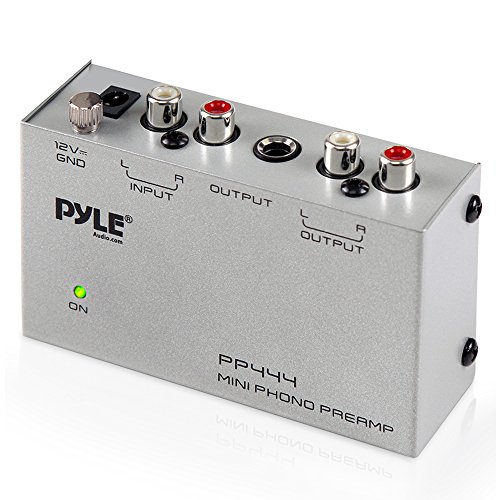
    Pyle Phono Turntable Preamp - Mini Electronic Audio Stereo Phonograph Preamplifier with RCA Input, RCA Output & Low Noise Operation Powered by 12 Volt DC Adapter (PP444)

    We think it would be only appropriate to offer a cheap yet nice-sounding product: the Pyle Phono Turntable Preamplifier for the new audiophile and the audiophiles on the budget. For the tech-savvy, here are the specifications. (sources)

    Pyle Phono Turntable Preamplifier (PP444) Specifications:

    • Powered by a 12 Volt DC Adapter
    • RCA Output
    • RCA Input
    • It has a green LED indicator
    • Input sensitivity of 3 mV at 50k ohms

    Pyle Phono Turntable Preamp - Mini Electronic Audio Stereo Phonograph Preamplifier with RCA Input, RCA Output & Low Noise Operation Powered by 12 Volt DC Adapter (PP444)

    Well, let us not fret upon the specifications, as all of these will not be more than moot if it sounds like trash. So for a $17 phono preamplifier, does it sound like its price? Well, truthfully, it does not sound like something above $100, but it is much better in comparison to other phono preamplifiers at its price range. (sources)

    Pyle Phono Turntable Preamplifier (PP444) Sound Signature:

    • It offers excellent sound quality in the bass range, creating a tight, round bass quality.
    • It falls off when it comes to the mids and the highs, so instruments like the snare drum and the vocals are generally more washed-out when compared to high-end phono preamplifiers.
    • Compared to phono preamplifiers of its price range, it can be considered as excellent, a satisfying fit for a money-pinching audiophile.

    Although the Pyle Phono turntable preamplifier (PP444) offers excellent sound, there may be concerns regarding its durability. For a $17 to 19 dollar offering, I would not expect much either. Looking at the silver lining, we can see its very generous warranty of one whole year, enough for you to judge it out. 

    This type of amp for turntables is modestly suitable for those looking for great basses and are not too concerned with the ultra highs and those who involve themselves with classical music. Below is a list of its recommended genres to listen to together with our affiliate link.

    Genres Recommended For Pyle Phono Turntable Preamplifier:

    • Suitable for most rap songs and modern rap
    • Ideal for music with a lot of bass guitar
    • Not too good with percussions, especially with snare drums
    • It is not suitable for classical music or any very treble-heavy music.

    Buy the Pyle Phono Turntable Preamplifier Here: Buy It Here!

    High-End Phono Preamplifier: Pro-ject Tube Box S2

    Seeing that you are still reading this article means that you do not lack cash, nor are you willing to skimp out for phono preamplifiers. Well, here it is, our recommendation for the high-end segment: the Pro-ject Tube Box S2.

    Pro-Ject Tube Box S2 Phono Preamplifier - Black

    The Tube Box S2 is a passion project by the Pro-ject, exemplified by its design, capabilities, and output. An intelligent design comes with quirky internal architecture, allowing it to be absent of operational amplifiers or OPAmps while coming in with replaceable tubes for tube rolling and sound-shaping. Below, we dictate its list of features. (source)

    Pro-ject Tube Box S2 Features:

    • Allows the replacement of tubes for flexible listening.
    • Has no operational amplifiers
    • Suitable for MM and MC cartridges
    • Dual mono circuitry
    • Robust high-voltage anode power supply
    • Gold-plated RCA inputs and outputs
    • Sports polystyrene capacitors
    • Ultra-low noise circuitry

    Again, now that we have discussed the specifications let us proceed with the real-world performance. How does it sound, and does it sound good? As a disclaimer, the sound performance will heavily vary with your setup, so your experience may not be holistically representative of yours. (source)

    Pro-Ject Tube Box S2 Phono Preamplifier - Black

    Pro-ject Tube Box S2 Sound Signature:

    • Because of its variable tubes, the sound signature will be varying.
    • It has a very smooth and warm sound.
    • Produces a rich, pleasant sound with no audible downsides

    In conclusion, if you have the money for it, the Pro-ject Tube Box S2 will impress you with its output. However, that does not mean that you can’t experience good quality music without the Pro-ject Tube Box S2. As I said earlier, there are two types of amps for turntables: good ones and bad ones. No one says that just because something is cheap, it is terrible, nor just because something is expensive, it is automatically good.

    If the Pro-ject Tube Box S2 tickles your fancy, then please we highly recommend you buy it. Buy it now with our affiliate link here: Buy It Here!

    Highly Anticipated Questions

    1. Do Phono Preamps Affect Sound Quality? 

    When it comes to turntables, everything affects the sound, even the material used for your turntable. Some may affect the overall sound output more than others, and the phono preamp is undoubtedly one of the significant reasons a turntable may turn out fantastic or a plain disappointment.

    1. What are the differences between a solid-state preamp and a tube preamp?

    A solid-state preamp uses transistors and operational amplifiers (Pyle), while tube preamps use vacuum tubes to amplify (Pro-ject).

    1. Does the tube preamp sound better?

    Of course, the sound output is always in the ear of the beholder. However, it is most often associated with a more warm sound signature, so whatever floats your boat, buy that one.

    https://www.devotedtovinyl.com/whats-the-best-amp-for-a-turntable/
    https://www.sweetwater.com/insync/amplifier/
    https://www.audioadvice.com/videos-reviews/what-is-a-phono-preamp/?__cf_chl_captcha_tk__=pmd_Pj5ag1yvUgEIYmLnMjMEoWIBBX6TFJXYI4P2PAQATOI-1631527313-0-gqNtZGzNAuWjcnBszQi9
    https://blog.andertons.co.uk/labs/preamp-vs-power-amp
    https://toprecordplayers.com/built-in-preamp-vs-external/
    https://www.whathifi.com/best-buys/accessories/best-phono-preamps
    https://www.analogplanet.com/content/19-pyle-phono-preamp-anything-crap
    https://www.amazon.com/Pyle-Phono-Turntable-Preamp-Preamplifier/dp/B004HJ1TTQ/ref=sr_1_1?dchild=1&keywords=Moon+110LP+v2+phono+stage&qid=1631609792&sr=8-1
    https://www.project-audio.com/en/product/tube-box-s2/
    https://vinylrestart.com/pro-ject-tube-box-s2-review/
    https://www.amazon.com/Pro-Ject-Tube-Box-Phono-Preamplifier/dp/B075KPB1P2/ref=pd_sbs_4/134-5383634-3524100?pd_rd_w=ftsbc&pf_rd_p=3676f086-9496-4fd7-8490-77cf7f43f846&pf_rd_r=1WPDRV00XZY116AYQ88H&pd_rd_r=ee305d0d-288a-4e80-9926-d6db40c7ae98&pd_rd_wg=QKpLS&pd_rd_i=B075KPB1P2&psc=1