Category: Record Players

  • Is Victrola a Good Record Player? Let’s Find Out!

    Is Victrola a Good Record Player? Let’s Find Out!

    Victrola offers a wide range of record players for all types of listeners. The company has been around for over a century, so it definitely knows which products and styles people prefer. However, mixed reviews can make it difficult to know if Victrola offers high-quality record players or if they’re best left in the past.

    Victrola is a good record player for beginners and children. The audio quality is mid-range, whereas the prices range drastically. Modern Victrola record players are affordable, while old-school ones are much more expensive and sought-after for their nostalgic collector’s value.

    Throughout this post, I’ll explain everything you need to know about Victrola record players, including features, expenses, reviews, and more. I’ll also help you decide if these record players are right for you.

    Are Victrola Record Players Good?

    Victrola was founded in New Jersey in 1906. The company has used the same business model that made them a household name throughout the previous several decades. The fact that this brand has been around for over a century is a testament to its reliability, quality, and overall performance.

    That being said, there are some who question Victrola’s modern record player lineup. The company doesn’t make the same wooden, hand-made record players they used to in the early 1900s. Furthermore, they’ve shifted toward making entry-level record players.

    Here’s a breakdown of what you need to know about Victrola:

    Features

    Victrola record players come in all shapes and sizes, including various models with unique features. However, if they don’t have the features you’re looking for, you might want to look at another manufacturer.

    Here’s a list of the best features Victrola offers:

    • Bluetooth streaming is built in on some Victrola record players. This allows you to connect your smart device to your record player for modern convenience with a classic appeal. You’ll enjoy the same high-volume output without needing any records to use your Victrola record player.
    • Built-in radio receivers let you cycle through AM and FM radio stations. You can listen to your favorite sports stations, podcasts, or radio channels from your Victrola record player. This unique feature is extremely rare in many record players because it doesn’t require massive antennas and other dongles.
    • Aux inputs. This allows you to plug your smartphone, laptop, MP3 player, and other devices into your record player.
    • CD compatibility. Many Victrola record players include CD compatibility, which means you can forget about tossing your extensive CD collection. They play CDs with the same speed and quality as the records they use.
    • Speed selections range between 33 RPMs to 78 RPMs for optimal sound and performance control. You can use these selections with records and CDs, so you can make all the adjustments you need. Victrola also provides speed recommendations to fit your records and other connected audio devices.
    • 100 dB speakers use 50 watts to provide more than enough volume. For comparison, 100 dB is about the same sound level as a blaring car horn. These volume adjustments make a Victrola record player more than enough for outdoor parties, at-home relaxation, and everything in between.

    Cost

    Most Victrola record players cost less than $200. However, Our Past Times reports Victrola record players can range from $100 to $1,000 or more. Below, you’ll find five primary factors that affect the cost:

    1. Nostalgia: Older Victrola record players are worth more money, especially if they weren’t widely produced. Victrola has a model designed after 1920s record players, but it’s still a modern appliance, so it doesn’t have the same value.
    2. Quality: Materials and build construction both influence the final price tag of a Victrola record player. Metal and wood are the most sought-after materials, whereas plastic cuts corners and weight.
    3. Capabilities: Modern Victrola record players with Bluetooth compatibility typically cost more than modern models that only come with basic features. Don’t forget to check if your records are compatible with your desired Victrola model.
    4. Target Audience: Victrola makes record players for adults and children. Most record players intended for children are much cheaper for various reasons. Any Victrola record player designed for nostalgic purposes or for limited times is usually more expensive.

    User Reviews

    While any company will highlight positive reviews, it’s important to know what customers are saying outside of the company’s website. Victrola has over 700 5-star reviews on its website. However, many Reddit users share a different story.

    For example, one Reddit user on r/vinyl explains that Victrola record players are known for scratching records after heavy usage. Many commenters agreed with these claims, though a sizeable amount of customers claimed Victrola record players are more than suitable for the average listener.

    If you’re determined to get a Victrola record player, I highly suggest checking out the reviews for the specific model and year you choose. Remember, Victrola shouldn’t be compared to luxury-tier record players.

    Music Quality

    Victrola is often known to offer mid-level audio quality. It’s not the worst on the market, but it’s definitely not close to the best. These record players can wear records down after a few years. Furthermore, they don’t have the crystal-clear sound that you’ll get from better brands you come across.

    However, Victrola record players have excellent volume controls. If you use the Bluetooth connection function, you can control the bass, treble, and many other features from your connected device. This process allows you to wirelessly customize your listening experience anywhere near your record player.

    Victrola’s audio quality fluctuates depending on the make, model, and age of the record player. The company’s older record players have better sound quality, but they don’t always stand the test of time.

    Who Should Get a Victrola Record Player?

    People who should get a Victrola record player include first-time turntable owners, people with records that aren’t extremely valuable, and children who want to learn more about vinyl records. While Victrola might not be the highest tier compared to other record players, it definitely deserves a wide customer base.

    However, Victrola record players aren’t for everyone. Not only do they pale in comparison to other high-end companies (Audio Technica, Sony, Linn, Rega, etc.), but they also don’t have the best reputation when it comes to using valuable records.

    So, who are Victrola record players best for?

    Budget-Friendliness

    Unlike many top-shelf record player brands, Victrola offers record players with all sorts of price tags. Most of them are affordable, which is why so many people prefer Victrola over other brands. It’s also an excellent brand for those who want to stick with the same company from low-end to high-end record players.

    If you’re looking to buy a record player as a gift for someone, Victrola could be the go-to choice for you. Their budget-friendly price tags and convenience makes them gateway record players to get people interested in the inner workings of this fascinating industry. Victrola is using reduced prices to breathe life into an older way of listening to music.

    For example, the Victrola 3-Speed Vintage Record Player costs a fraction of the price of most record players with the same sound quality. It also comes with AUX inputs, Bluetooth connectivity, and headphone compatibility. It’s made in over 10 colors, all of which fold up into a small suitcase with handles.
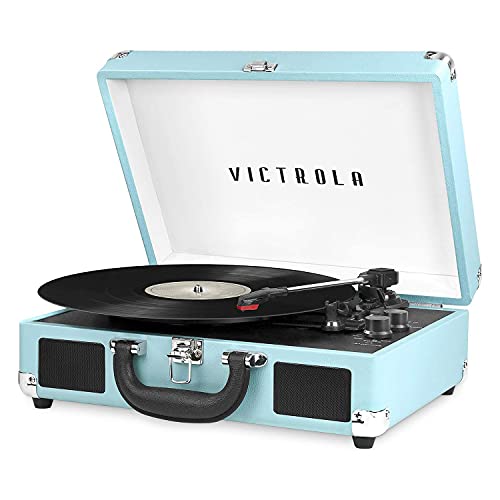
    Victrola Vintage 3-Speed Bluetooth Portable Suitcase Record Player with Built-in Speakers | Upgraded Turntable Audio Sound| Includes Extra Stylus | Turquoise, Model Number: VSC-550BT

    Quality and Reliability

    Victrola and reliability are synonymous with each other. These record players last many years. In fact, some Victrola record players have lasted up to a century. They maintain their same condition and quality, provided they’re taken care of.

    This company might not offer the highest sound quality in the industry, but it undoubtedly beats the majority of drop-shipping brands. Furthermore, Victrola charges the same prices as most third-party record player sellers while offering much better sound quality.

    If you’re searching for a record player that won’t phase out after a few years, Victrola should be near the top of your list. You don’t need to spend an arm and a leg to get mid-level quality and high-level reliability for the foreseeable future.

    However, it’s important to consider other brands if you’ve never had a record player. Below, I’ll explain who should get a Victrola-brand record player.

    Who Are They Best For?

    If you’re in the market for a record player, consider Victrola if any of the following details apply to you:

    • Victrola record players are excellent for children and teens. They’re not too expensive and they have enough features to familiarize youngsters with record players. They also have a classic look and feel that people want when looking for a record player.
    • Old-school Victrola record players are often considered collector’s items. They’re one of the oldest names in the business, so it’s no surprise that many collectors want to get their hands on an older Victrola record player. Keep in mind that this stature doesn’t exist with newer Victrola record players because they’re so widespread.
    • If you want to listen to music and you don’t have high-quality records, Victrola is an affordable option. While some people complain that Victrola record players scratch their records (especially the cheaper ones), it’s not that much of an issue if you’re using low-quality or inexpensive records.
    • Victrola offers portable suitcase record players that are great for people on the go. These foldable record players have protective cases that prevent them from being damaged. They also come with handles to help you carry them around. If you love modern music with an old-school touch, Victrola is worth looking into.

    Final Thoughts

    While Victrola might not offer the best sound quality, its record players are ideal for people who want to break into the record player industry. They offer beginner and old-school, stylish record players, all of which Victrola backs with its countless positive customer reviews.

    If you’re an audiophile or have an extensive record collection, you’re better off looking at higher-quality brands. You don’t want to run the risk of damaging your vinyls.
  • Why Does My Record Player Sound Distorted? Let’s Find Out

    Why Does My Record Player Sound Distorted? Let’s Find Out

    People love listening to music on vinyl because of its high-quality sound and robust listening experience. A record’s audio data is wholesome and provides arguably the most authentic listening experience. But all that can easily be undone by distortion, so you’ll want to find a solution quickly when your record player gets affected. 

    A record player may sound distorted due to inner groove distortion, a dirty/worn-out stylus, or inappropriate cartridge weight and height. Potential fixes for this problem include switching to ideal cartridge height and weight, cleaning the records and the stylus, and replacing the stylus.

    In the rest of this article, we’ll review the above causes of distortion in a record player in greater detail. We’ll also look at potential fixes for this problem, so be sure to stick around to the end. Let’s dive in! 

    Clean Your Records and the Stylus

    A seemingly insignificant amount of dust can create distortion even if the record is perfectly fine. Check to make sure the stylus is dust-free and clean it if necessary.

    While you’re at it, address the real culprit: the records. Start by brushing off excess dust with a carbon fiber record brush and then wipe off the remaining grime with a soft cloth and record cleaning fluid. Want more details on how to clean your records and your turntable? check out these articles:

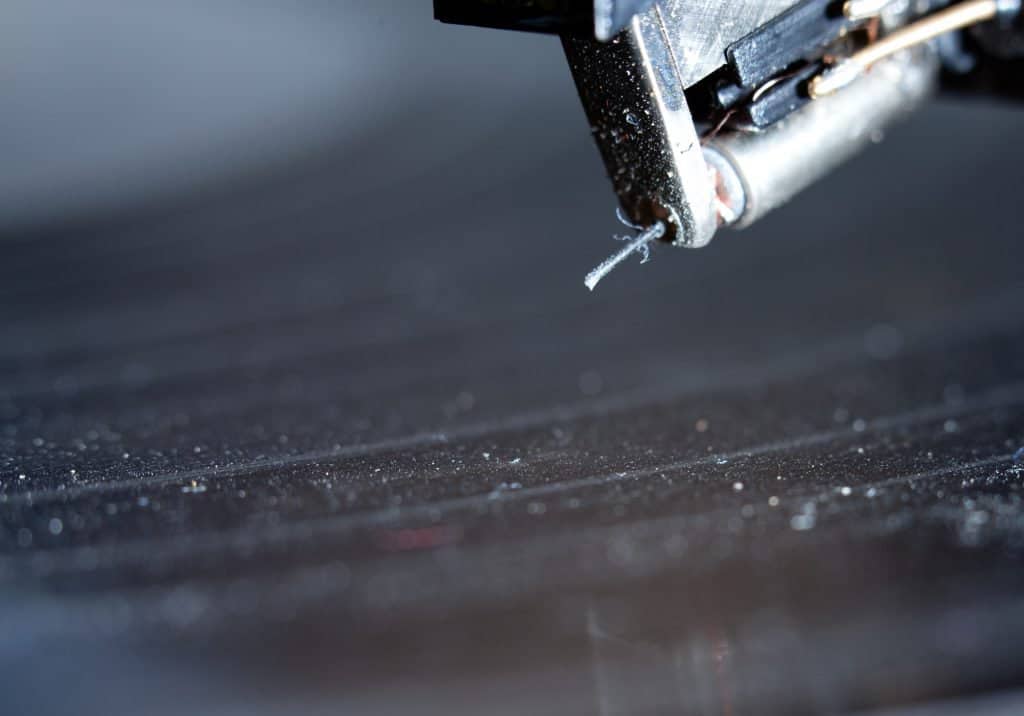
    Dirty turntable needle hovering above dusty vinyl.

    Inner Groove Distortion

    A common distortion issue that many vinyl owners face is inner groove distortion. As the name describes, this is when you experience distortion towards the end of the record, on the inner grooves. This issue is an inherent manufacturing flaw for vinyl records. Luckily, it’s becoming less common as manufacturers update their methods. 

    Inner groove distortion has a lot to do with the way the music is compressed on vinyl records. The circumference of each groove decreases as you get closer to the end of the record. This increasingly smaller space means that the music has to be compressed more compactly later on in the album. 

    When comparing the first song of the side to the last, the circumference of the grooves decreases significantly. Your stylus also does not have the same amount of time to trace the grooves in the last song as it did in the first song. 

    Some record manufacturers attempt to avoid this issue by spreading the music out as much as possible. Even if the record is short enough to fit on one record, some manufacturers opt to spread the music out over two records. This method works to avoid those tricky inner grooves as much as possible, giving you the best listening experience.

    You can tell if you are suffering from inner groove distortion with a simple test. Where is the distortion occurring? If the first song on the album sounds perfect, but the last song produces distortion, then inner groove distortion is likely the culprit. 

    For more information on inner groove distortion, you can check out this informative video on YouTube from Fluance Audio: 

    A Dirty/Worn Out Stylus

    The stylus is arguably the most common cause of distortion in record players. This part of a record player is mostly affected by the dirt it picks up as it tracks record grooves. With enough time and regular use, dirt can build up on the stylus tip and compromise its ability to accurately track the groove, ultimately causing distortion.

    The stylus can also be compromised by wear and tear. While this is less common due to the typical durability of the stylus, it’s still worth looking into. To do that, use a jeweler’s magnifying glass to check for any flat spots on the stylus. If you notice any, wear and tear is likely the cause of the distortion. 

    Inappropriate Cartridge Weight/Height

    Getting the right cartridge weight is important for the balance of the tonearm. If your cartridge is too light for your record player, the tonearm won’t be able to rest properly on the record. On the other hand, a cartridge that’s too heavy will rest too firmly on the record, potentially damaging its grooves with every minute of playing time. Either way, you’ll experience distortion.

    The height of your cartridge impacts the tonearm’s Vertical Tracking Angle, a crucial determinant of the Stylus Raking Angle. The latter angle describes how your stylus makes contact with the record, and impacts the sound it ultimately produces. For the best sound quality, you need to maintain a consistent cartridge height.

    How To Fix Distortion on a Record Player

    Whether you’re suffering from inner groove distortion or another type of general distortion, there are a series of checks and upgrades you can make to your system to improve the sound quality. Let’s take a look at what you can do for your stylus and cartridge to make sure they’re reading each record perfectly. 

    Upgrade or Align the Cartridge

    Checking your cartridge for overdue upgrades and misalignments is a great first step to battle distortion. Depending on the age and mileage of your current cartridge, you may choose to upgrade altogether and purchase a newer, higher-quality option. 

    If you choose to purchase a new cartridge, there are a few things to keep in mind as you install it in order to give you the highest-quality listening experience. 

    First, keep in mind that the height of the cartridge is important for producing the best quality sound. The height of the cartridge will be influenced by your record player’s tonearm. This component may or may not be adjustable, depending on the make and model of your device. 

    If your record player doesn’t have an adjustable tonearm, you’ll need to recreate the height of the original cartridge. The manufacturer will provide specifications for replacement cartridges so you can find one that’s compatible with your device. 

    Switch to Ideal Cartridge Weight

    Another important factor to check when replacing an old cartridge is the ideal weight for your record player. Different makes and models will have different ideal cartridge weights, measured in grams. 

    Manufacturers usually specify the ideal weight for each record player, so be sure to check your user manual or product specifications for that. If you find that you’re using the wrong weight, replace your cartridge.

    For more information on replacing your cartridge, you can check out this tutorial on YouTube:

    Replace the Stylus

    If you have an older stylus that has seen a lot of use, it might be time to get a new one. Take a close look at your current stylus. If it’s visibly worn down, you can trust that it isn’t reading your record as well as it could, and that an upgrade is overdue.

    It can be advantageous to replace your cartridge and stylus at the same time. If you’ve had your record player for a while or had purchased it used to begin with, consider upgrading both components together. This dual upgrade will give you the best chance at improved sound quality without having to replace your whole record player. 

    What Happens If Nothing Worked?

    If nothing worked and you’re still experiencing distortion after attempting the above fixes, it might be time to replace the record. Records aren’t immune to wear (particularly the grooves), and overplayed ones can cause distortion. 

    With enough groove wear, the stylus may slide off the grooves when you attempt to play the record. If this happens, this is a clear sign that the record has been played out and needs replacement.

    You can also check if a particular record is the culprit by swapping it for a newer one. If the distortion disappears when you play a different record, chances are your record player isn’t the problem; a worn out record is.

    Summing Up

    If you’re experiencing distortion when listening to your favorite record, it could be due to inner groove distortion, a worn-out record, a dirty/worn out stylus, or inappropriate cartridge weight and height. 

    Depending on the cause, you can fix the distortion by switching to the recommended cartridge height and weight, cleaning the records and the stylus, or replacing the stylus. If nothing works, check the record for wear and tear and replace it if necessary.

  • Do Record Players Spin Clockwise? Let’s Find Out

    Do Record Players Spin Clockwise? Let’s Find Out

    We all know the clock moves clockwise, hence the name. The planets and other celestial bodies revolve counterclockwise around the sun, and water drains counterclockwise in the Northern hemisphere. But which way does a record player spin?

    Record players spin clockwise universally. They rotate to the right if they’re working correctly. Turning a record player counterclockwise would damage it and is, therefore, not advisable.

    To understand this better, in the rest of this article, I’ll explain the design of a record player and why it spins the way it does.

    Berliner Designed Record Players To Turn Clockwise

    The reality is, record players on this side of the world spin clockwise because Berliner, who invented disc recording, was used to things turning that way. If you’ve looked at the clock your entire life, your brain automatically assumes clockwise is the normal way to spin. Also, Berliner based the design of his flat disc player on a music box that turned clockwise.

    There’s no scientific or technical explanation for why a disc should spin to the right and not to the left. It’s just that clockwise seems like the most natural rotational movement to most people. 90% of the world population is right-handed, and placing the tonearm with the left hand is counterintuitive and awkward, to say the least.

    However, there’s a design aspect in play, too.

    To play a record player, you need to put the needle on the groove. The needle and the record’s rotation must go in the same direction; otherwise, the needle would bend backward and break or scratch the disc. Since needles in the USA and this side of the world are designed to travel from the outside, the player must turn clockwise to match that rotation.

    You would imagine that record players in other parts of the world turn anticlockwise because their designs might be different. For instance, some people have the perception that record players in the Southern hemisphere, especially Australia, spin counterclockwise. However, this is not the case since record players turn clockwise universally.

    Greg, a store attendant working at RoundAgain Record Store in Australia, confirmed this. 

    “All record players in Australia spin clockwise. Spinning your player in a counterclockwise direction would only damage it, hence it’s unadvisable to do so,” he said.

    What Happens if You Play the Record Counterclockwise?

    The stylus and the disc itself will get damaged if you play the record counterclockwise or backward. Numerous cartridges aren’t designed to run in reverse, so playing the record counterclockwise means that the record is going against the law of their nature. 

    For this reason, the sound you get will become horrible, and people say it sounds like the devil’s voice.

    When you play a record counterclockwise, the vinyl grooves push against the stylus because they come towards each other instead of moving in the same direction. Think of it as the difference between dragging a stick behind you when walking and trying to push it forward when it’s in front of you. The latter will be harder, and the stick will likely break at some point.

    Some people claim that playing a record backward can help you hear tracks that contain subliminal messages. While that may be true, you do it at the risk of destroying your record player and the records you are playing.

    Do DJ Record Players Spin Clockwise?

    DJ record players, known as turntables, spin clockwise until the DJ starts back spinning. Back spinning is where the DJ manually manipulates the vinyl record playing on the turntable using his hand’s force to spin backward, despite the platter’s rotation under it. 

    Back spinning allows them to go back to a particular point in the record, cut music, or juggle beats. Deejays use a slipmat to reduce friction between the record and the platter when spinning the wrong way. You can tell it’s going the wrong way because it makes a shrill sound, otherwise known as a scratch.

    However, it’s important to know that DJ turntables are designed a little differently from regular record players. Deejays prefer direct-drive turntables over belt-driven record players because the belt is likely to get stretched or damaged during ‘scratching.’ That said, Deejays are aware that scratching affects the records, and they replace them often.

    If you try to spin records in your record player like a DJ, all you’ll accomplish is destroying the setup.

    Common Record Player Issues Related to Spinning

    Sometimes record players stop working or work in ways they’re not supposed to. Therefore, it’s important to make sure you take good care of your record player. Some of the issues that a record player may face are as follows:

    The Record Player Is Not Spinning

    There are plenty of reasons a record player would stop spinning, and most of them are fairly easy to solve:

    • There is a lack of power. As embarrassing as it is, the main reason why a record player doesn’t play is that it’s not plugged in or plugged properly. Start by checking the power source and move on to other culprits if that’s not the issue.
    • The tonearm isn’t reset. Most record players’ tonearm holding the stylus needs to be frequently reset because it clicks off when a record ends. The player won’t play until the arm is reset to the correct position. Gently push it back until you hear a clicking sound, and the player will spin again.
    • There are belt drive issues. The belt may get too loose or wear out in belt drive players. Such a problem can be solved by tightening the belt in case of looseness or buying a new one if it’s old. Belt issues are a very common problem, so it should be one of the first signs you check out.
    • There are direct-drive issues. If you have a direct drive record player, it could be the internal mechanism of the motor, often affected by dirt or debris getting stuck in the shaft. A jammed platter and faulty on and off switch could be the issue. Regular maintenance and keeping the player clean is the only way to prevent the issues. You can also take it to an expert for a check-up, as most direct drive issues are complicated.

    The Record Player Makes No Sound

    What do you do when your record player is turning just fine, but there’s no sound coming from it? Do the following:

    1. Start by checking the connection on the cartridge. Make sure the stylus is sticking down on the cartridge.
    2. Ensure the volume is up by turning it clockwise.
    3. Ensure nothing is connected to the earphone jack on the back.
    4. Check that the stylus is in the correct position and reset it if it’s not.
    5. Ensure the speakers and amplifier are connected and powered on if you can hear the music on the turntable but not on the speakers.

    The Record Player Plays Too Fast or Too Slow

    Do you think your record player is moving too fast? You may not be imagining things. Sometimes, the speed selector may become faulty due to dirt or grime build-up over time. This causes it to send too much voltage to the motor, making the record spin too fast. You can clean the switch and lubricate it or replace the entire thing if it’s too old.

    A loose and misaligned belt is another reason a player can move too fast. With time, belts stretch and get repositioned, causing deviations in speed. You need to replace the belt with a new one.

    But what if it’s playing too slow instead? Consider doing the following:

    • Lubricate the parts. Some gears and motors under the platter need to be lubricated to reduce friction.
    • Change the speed selection. When you change records of different sizes, it’s easy to forget to switch the speed selector from 33 rpm to 45 rpm or vice versa. It will affect the speed, so you need to do it with every change.

    Final Thoughts

    Under perfect conditions, a record player should spin clockwise until the record is up and then stops. Something is wrong with your record player if it stops playing somewhere in the middle or starts spinning backward. You need to have it often serviced and keep the parts clean.

    For people who may want to spin records backward, a spin table designed for Deejaying is the best option for you.

  • Do All Record Players Use The Same Needle? Let’s Find Out

    Do All Record Players Use The Same Needle? Let’s Find Out

    Your record player cartridge comes with a stylus, also referred to as a needle that sits on the record’s groove. Unfortunately, when that needle goes, you’ll need to replace it, but are they all the same? Can you just swap it out with a generic one? I wanted to know if they were all the same, so after thorough research, this is what we found out.

    When it comes to stylus or needles, no one needle fits all. Therefore, all turntables don’t use the same needle or stylus. After all, they have different designs, and different types of stylus vary in designs, material, even how they mount.

    The cartridge is the most crucial part of the record player responsible for reading the vibrations on the vinyl record. In this article, we will show you why record players don’t use the same needle. We will also show you the different types of needles for record players.

    What Is A Stylus?

    A stylus is a uniquely shaped needle that rests on the record player’s grooves and helps pick the vibrations. In fact, the names needle and stylus are used most of the time interchangeably. The needle is the only part of the turntable that comes into contact with the vinyl record. Unfortunately, this component is subjected to hard wear thanks to the pressure it applies to the grooves. (source)

    Luckily, there are three desired characteristics of these needles:

    • The needle faithfully follows the vinyl record’s groove contour and picks the transmitted vibrations.
    • Secondly, the needle does not break the vinyl record despite the amount of force used while on the record’s grooves.
    • The stylus is resistant to wear; therefore, it can take years before you ever have to replace your turntable’s needle or cartridge. (source)

    Remember, a damaged needle can degrade the quality of sound produced and damage the vinyl records’ grooves. Manufacturers have used different materials to make the needle over the years; in fact, Thomas Edison introduced a diamond stylus in 1910 and a sapphire one in 1892. The early record players used short-lived needles besides the diamond and sapphire stylus.

    In fact, the most preferred materials for turntable needles over the years have been tungsten, copper, steel, and bamboo, among others. Unfortunately, steel needles needed replacement regularly, thanks to the high wear and tear rate. Therefore, the adverts asked folks to replace the steel needle after listening to each side of the record player, which meant that you had to purchase lots of needles at once.

    Luckily, the steel needles were relatively cheap; in fact, you could get a packet of 500 needles for only 50 American cents. Plus, they were sold in small tins and packets. These needles varied in length and thickness. The longer stylus produced muted softer tones while the short, thick ones made loud, intense sounds. Therefore, record players used the same needle in the past, so you had to pick which type of music you wanted to listen to and enjoy. (source)

    The shortage of steel in 1916 forced people to turn to tungs-tone needles. Produced by Victor, these needles played between 100 to 300 records before being replaced. They were long, so you had to use them until they were too short to be used. (source)

    Therefore I am sure you are wondering, do record players use the same needles? Technology has changed over the years with better and reliable needles produced. After all, high-end turntables don’t use the same needles as the low-end record players.

    Do All Record Players Use the Same Needle?

    All turntables come with many components that work together to convert the vibrations to music. And depending on the cartridge, record players can be grouped as the moving coil and magnet cartridges. (source)

    The cartridges are electromagnetic generators that convert the vibration (mechanical movement) picked by the stylus. The cartridge converts the vibrations to an electric signal amplified and converted to sound by the amplifier and speakers.

    Both the magnetic coil and moving magnet cartridges use a coil and a magnet, vibrating in unison with the needle assembly. These cartridges come with either a permanent or removable stylus; therefore, each turntable brand has a unique needle. Luckily, there is a perfect replacement that you can install in your record player.

    Remember, low-end record players, come with a permanent cartridge that supports needle replacement. So when upgrading your turntable, you can install a new high-end stylus that can improve your listening experience.

    Therefore, turntable styli are not universal; every turntable comes with a specific needle. After all, folks are allowed to upgrade the stylus of their low-end turntable with the high-end options. But for it to work, you have to make sure that it is compatible with your record player’s original needle. So you may have to do some research online for compatible options for your turntable.

    Plus, different types of needles vary in material, size, and shape. These needles also vary in shank construction. Therefore, when replacing your turntable’s needle, you can’t just walk into the local store and pick the first stylus you get on the shelf. You have to choose a replacement needle that matches your device’s needle.

    You have to make sure that the replacement needle fits your cartridge perfectly and is compatible with your device. Luckily, many replacement needles match your device online that you can order.

    Construction Of The Stylus

    Before we even talk about the different types of needles, we need to consider the shank construction. Remember, this needle sits at the tip of the cantilever in the cartridge connected to the tonearm. The needle attached to the cantilever is either a tipped diamond or a nude diamond.

    Just as the name suggests, the tipped diamond comes with a diamond tip on the stylus, while the other part consists of metal. But with the nude diamond, the stylus is made from diamond and attached to the cantilever. Luckily, the diamond tracks easily and accurately; plus, it has a lower mass, which means it applies less pressure on the vinyl record’s grooves.

    The diamond-tipped needles are less costly to produce, but they increase the stylus’s overall mass. This design will affect the transient response of the tipped diamond than a nude stylus.

    Types Of Stylus

    As aforementioned, there is no one fits all needle. And that is because every manufacturer tries to design a perfect needle for their different record players. Plus, these needles are designed for reading certain types of vinyl records.

    Generally, there are four types of needles, excluding those meant for reading the 78 RPM records. After all, the needles for reading the grooves on 78 RPM are about four times wider than the typical needle for 33 1/3 records. (source)

    The radius of the tip for a 78 RPM stylus is about 20mm, and anything smaller than that can ride low in the vinyl’s grooves. A typical stylus will produce noisy signals with a 78 RPM record, accelerating its wear. Plus, 78 RPM records are pretty rare these days, so the four types of the stylus are:

    Conical Or Spherical Stylus

    The spherical stylus is the most common and the least costly in the market. (source) This stylus resembles the tip of your ballpoint pen. And thanks to their huge radius, this stylus traces less on small grooves with high frequencies.

    The rate of wear and tear with the spherical is debatable among members of the Hi-Fi community. Some claim that this needle produces the most wear since the contact region is restricted to only 2 points. On the other hand, some music lovers claim that the spherical stylus produces minor wear. (source)

    This stylus has a radius of about 0.6mil*; therefore, it does touch the center of the vinyl record’s groove. This device works perfectly with older and lower to moderately priced turntables. Plus, the tonearm tends to apply high tracking force than the other types of needles. (source)

    Elliptical Stylus

    The second most common needle in the market is the bi-radial or elliptical stylus. The elliptical stylus contacts a larger area of the grooves than the dual radii. It guarantees you lower distortion (especially in the hard-to-track parts of the grooves), improved phase response, improved frequency response, and more precise tracking.

    These needles tend to wear a bit faster than the conical stylus. So, you will have to pay attention to the tonearm alignment and cartridge for perfect results. (source) The elliptical stylus has two radii; the wider front radii and the side radii. Its unique design makes it possible for the needle to track the middle of the groove. At the same time, the side radius allows it to track more accurately. (source)

    Compared to the spherical stylus, this needle has a narrower back to the front area and an extended vertical contact region. This needle is available in 3 sizes: 0.4 by 0.7mil, 0.3 by 0.7mil, and 0.2 by 0.7mil, with the first number representing the side radius. Remember, the smaller the side radius, the better the sound quality produced. The smaller the tip radius, the less tracking force you will ever need. (source)

    Hyper Elliptical

    The third most common stylus is the hyperelliptic needle, also referred to as stereohedron, fine line, or Shibata. This stylus represents the next phase of stylus evolution, which is sharpening the needle for more significant contact. When correctly aligned, this needle can offer low record wear, improved tracking, longer tip life, and high-frequency performance. This stylus has an even longer vertical contact area than the elliptical needles.

    But thanks to its vast tracing footprint, this stylus can produce more noise on worn-out records. This stylus is ideal for high-end cartridges. (source)

    The MicroLine Stylus

    The Microline also referred to as the micro-ridge, is one of the most advanced needles in the market. This computer-designed needle has a unique tip that resembles the stylus used to make the master disc. Its unique multilevel ridge shape will guarantee high-performance frequency with exceptional life and extended record. Unfortunately, they are pretty expensive and difficult to manufacture. (source)

    Why Does The Shape Of The Stylus Matter?

    If you are a casual turntable enthusiast, you don’t have to lose too much sleep over the shape of the stylus. But for audiophiles, the shape of the stylus matters because of the following:

    • The construction and shape of the needle play a key role in sound replication, thanks to its access to the groove’s surface.
    • The shape of the stylus also plays a crucial role in the record player’s rate of wear and tear.
    • The shape and construction affect the stylus price; therefore, if you have some cash and want to upgrade your record player, you need to know the benefits and types of the style.

    How Do You Know When It’s The Right Time To Replace The Stylus?

    Fortunately, physical and audible indicators can tell you when to replace the needle. A few things on the physical sign can show you if the needle is damaged. Some of them include:

    • Misshaped or crooked needle tip
    • The stylus may jump or skip out of the record’s grooves when playing.
    • Accumulated muck on the tip of the stylus might be the culprit. The accumulated dirt can be black spots, which means that you haven’t cleaned your record player in a long time.

    On the audible side, there are a few things you have to listen to and consider. Some of them include:

    • The record won’t sound great when using a damaged or old stylus
    • The record will produce a static or crackling noise
    • It may create distorted music

    When this happens, then it is time to replace the turntable needle. But make sure you get a suitable replacement for your record player. And if the record player’s needle cannot be removed, you will have to replace the entire cartridge. (source)

    If you didn’t purchase a new turntable, the chances are that the needle is not in good shape. Plus, you don’t know if the previous owner took good care of it. So the first thing you should do is replace the stylus with a new one. You can even choose to upgrade your device’s needle to a high-end option.

    How To Replace The Stylus

    Generally, you should replace the needle after every 3 to 5 years or after 1,000 hours of play. So if you can replace your record player’s needle, then you should do the following:

    • Unplug the turntable and hold its arm using your non-dominant hand.
    • Grip the metal or plastic case covering the needle using the other hand
    • Pinch the sides of the needle and remove it
    • Slide the needle out of the cartridge while ensuring it is parallel to the tonearm. If the needle can’t come out, you will have to go online and look for the manual.
    • If the stylus is attached to the cartridge frame, then it’s not removable. So you may have to replace the entire cartridge.
    • With the old stylus removed, you can look for a perfect replacement. Most needles have some numbers or letters on them. These numbers are the model numbers, and they can help you get a replacement. You can order a suitable replacement online or a better option if you’re upgrading the turntable.
    • Slide the new needle into the cartridge with the stylus facing outside. Remember, the stylus is very sharp; you should wear some rubber gloves, but make sure you don’t touch the needles’ tip. (5)

    FAQs

    Does The Stylus Fit Any Turntable?

    The stylus, also referred to as the needles, are not universal. Every turntable uses a certain kind of stylus, so it is technically impossible to replace your record player’s needle with a different type of needle. So make sure they are compatible with the original stylus before purchasing it.

    How Do I Know If The Needle For My Turntable Can Be Replaced?

    If you are not sure it is replaceable, you can look at the tonearm. You can replace the needle if some screws mount your cartridge to the tonearm. But if there are no screws, you will not be able to replace them.

    Are All The Needles Diamond?

    Most of the modern needles are made using either sapphire or diamond. But there are some needles made from sapphire-diamond combination and steel. Therefore, not all needles are made from diamonds or have a diamond tip.

    Conclusion

    The needle is the most crucial part of the turntable, which is responsible for the quality of the sound produced by your record player. Unfortunately, no one needle fits all kinds of turntables. So before replacing your record player’s needle, you need to know the difference between the several types of needles in the market. Remember, before installing a different kind of needle, you have to make sure that it’s compatible.

    Sources

    1. Audio-Technica staff, Audio-Solutions Question of the Week: What are the Differences Between Moving Magnet and Moving Coil Phono Cartridges? Accessed January 07, 2022
    2. Wikipedia Contributor, Phonograph, Accessed January 07, 2022
    3. Jess Thompson, The Different Types of Turntable Styli (and Which is Right for you) Accessed January 07, 2022
    4. Tucker Bowe, When Should You Replace Your Turntable’s Stylus, Accessed January 07, 2022
    5. Eric McClure, How to Change the Needle on a Record Player? Accessed January 07, 2022
  • Reasons Why Your Record Player Is Making Loud Humming

    Reasons Why Your Record Player Is Making Loud Humming

    To most folks, the sound produced by the vinyl record when playing on the turntable is unmatched. It provides an unforgettable listening experience with inherent warmth that you can only compare to live music. Unfortunately, disruption of this exceptional listening experience by a loud humming noise produced by the record players can happen. So, after thorough research, we compiled the following article on the main reasons your record player is making a loud humming noise.

    When it comes to record players, the main reasons why it produces humming noises is feedback and ground loops. Remember, the hum is a low-pitched continuous tone produced by turntables, and you can easily correct the humming noise triggered by grounding problems. (source)

    The buzzing or humming noises are so annoying, right! These noises can mess up your vinyl record experience. So in this article, we’re going to troubleshoot the problem and find out the main reasons why your record player is making a loud humming noise. We’ll also show you how to solve this humming problem once and for all.

    Why Is the Record Player Producing Humming Noises?

    Vinyl records are excellent sources of analog music that were once thought dead but are making a comeback. And that is because they produce sound in its original form without any distortion or background noise. In fact, this music source is only rivaled by live music; after all, it is a perfect recording of live music. (source)

    It has forced many turntable producers to manufacture modern record players with fewer distortions. Digital music has dominated the sales record for decades, but for the first time, record sales exceeded CD sales in 2020, thanks to the COVID pandemic. (source) After all, most audiophile and live music lovers couldn’t access the live concerts. Therefore, they had to settle for record players, which produce high-quality analog music.

    Over the last few years, the increase in popularity of vinyl records and turntables has introduced a few record player issues that most folks had forgotten. And one of the most problematic issues is producing a loud humming noise when playing the vinyl record. Plus, with many young audiophiles turning to turntables, most folks don’t know how to fix most of these issues.

    Remember, the hum is a low-pitched continuous tone produced by turntables, while noises can be howls, hisses, clicks, or sharp crackling sounds. The hum or buzz noise produced by a turntable is a low-frequency noise linked with induced 60-cycle noises, and in most cases, it often has something to do with ground loops. (source) Some of the leading causing of the humming or buzzing noises include:

    Problems With the Amplifier

    If your turntable produces humming noise, the first thing you should focus on is the amplifier. If you lower the volume and the humming noise persists, the amplifier may be the issue. There is a connection between the amplifier’s chassis and the metallic part of the turntable from where you can ground this system to the water pipe. But if the issue persists even after creating a ground loop, you need to service the amplifier.

    Grounding Issues

    As aforementioned, there is a connection between the metal part of your system and the amplifier’s chassis where you can easily ground the system. Without proper grounding, your device will produce humming noises when playing the music. (source)

    Feedback

    A turntable is a susceptible unit that can be easily affected by the surrounding noises. So if placed on a tape recorder or a power amplifier, the record player will start producing the humming noises. Plus, being a sensitive device, the turntable can pick the humming noises made by other devices near it and amplify them.

    The best solution for getting rid of feedback noises is isolating the turntable. So if feedback noises are a problem, you can move the turntable away from the power amplifier, speakers, or tape recorder. After all, a motor or transformer can produce an isolated hum field. (source)

    The humming produced by ground loops differs from the noises made by feedback. Plus, feedback humming is relatively high when the volume of the record player is high. (source)

    The Turntable Motor May Have Excessive Hum Field

    Even though this is quite rare, it does happen in some situations. Some turntable motors come with excessive hum fields. In fact, the excess hum field occurs when you install a magnetic pickup in a vintage records player designed for a ceramic pickup. (source)

    Cartridge’s Metal Headshell Is Not Grounded

    The metal headshell isn’t grounded if the hum increases when you place your hand on the cartridge headshell. If your turntable has a plastic headshell, then it should also come with a metal grounding clip that is usually marked “RG.” If your device has a metal headshell that produces a steady hum, uninstalling the grounding clip can help. (source)

    Another solution is removing and then installing the headshell, ensuring correct installation. If the problem persists, you can clean its contacts using isopropyl alcohol. And before reinstalling the headshell, you can check if the wires connecting the cartridge to the headshell are sturdy. If any of the cables are loose, you can tighten it and confirm if it still produces the humming noises. (source)

    A Connection Between the Turntable’s Metal Parts and Cables’ Shield

    Lift the turntable and look at all the connections on the underside of your device. Remember, there should be no connection between the cables’ shield and the metallic parts of the turntable. These connections can force your turntable to start humming when playing your favorite records. If there are connections, you should remove them and install a new ground wire. (source)

    How to Get Rid of the Humming Noise Produced by Turntables

    The leading cause of the humming noise is usually obscure, and it even baffles most experts; fortunately, the hunt for the reason can be fun. After all, the worst enemy for exceptional music produced by turntables is the noise and hum. Noises are any disturbing crackling howls, clicks, or hisses produced by turntables when playing your record, while hums are low-pitched noises. So instead of hiring a professional to help you solve this issue, you can track the leading cause of the problem. (source)

    Therefore, the first step to solving this problem is locating the cause of the humming noise. If you hear the hum only when one of the sources of sound is being used (radio tuner and record player), then the issue is in that device. The problem is more than one element if you can hear the noise with the record player and radio tuner. The humming noise may originate from the units’ wiring, external cabling, the speaker, or the amplifiers. (source)

    So when troubleshooting the humming noises, you should start with:

    The External Wiring

    When troubleshooting this issue, the first place you should look at is the external wiring. The AC cables can produce humming noises when placed near the other audio cables. So, it would help if you didn’t tie the AC cords together with other lines simply because they look neat. After all, they may seem extraordinary, but the amount of humming they will produce will disrupt your music experience.

    When diagnosing this issue, you should unplug everything, insert every cable in the chassis socket, and confirm if it produces noises. But make sure the record player is playing your favorite music. If it produces a humming noise when plugged in, then the issue may be a loose socket/plug contact or loose connections in the contacts. So you may have to repair the damaged socket contacts before reinstalling the cables.

    When examining the cables, you shouldn’t forget to flex the cables a bit before plugging them in. if the cable produces a sharp crackling noise when bent, the cable may have broken braids in the shielding braid or the inner conductor. (source) Therefore, make sure you replace the broken cables with new ones and try and confirm if it is still producing humming noises.

    To Ground Or Not Ground

    To lower the hum and noises in your system, you should be ready to ground the turntable. It would be best to connect a particular part of the system to the water pipe using a ground wire and create an earth ground. Creating a ground loop is an exceptional idea, but don’t assume that it will always work; it can sometimes worsen the situation.

    When connecting numerous components, you may create more than two ground connections between the external ground wire, power cables, and audio cables, among other elements. These connections can create a closed-loop, also referred to as a ground loop, that serves as a pickup coil. The hum fields nearby can induce a hum voltage in the ground loop.

    The condenser connected from the chassis to the power cord may also be a hidden connection to the earth’s ground. After all, the power line is already grounded; therefore, it produces a small hum voltage that can magnify by the high-gain amplifier between the water pipe and the grounding point. Consequently, it would help approach the grounding connection with an open mind.

    So, it would help if you started with some trial connections at different positions. And make sure the volume is adequate so that you can notice any changes in the sound produced. Try and ground various components separately or together while monitoring the reduction or increase in hum. Remember, all the hi-fi installations are different, so you may have to experiment before finding an ideal arrangement. (source)

    Treat Your Amplifier as a Separate Unit

    Even if the power supply, power amplifier, and pre-amp are separate, you may want to consider treating them as a single unit. So you should reverse the AC plugs in the wall socket; if you have several AC cords, you should try different combinations. Try troubleshooting with these questions:

    • Are the bass and treble inadvertently set at extreme ranges?
    • Are the tuner and record player feeding more than enough signals to the amp?
    • Have you installed the equalizer in the wrong place? It can force it to start hissing excessively. (source)

    Add a Hum-Balancing Control

    Most modern amplifiers come with a hum-balancing control unit that helps silence the record player. So if your record player doesn’t have one, you install one. Look for a 2watt 100-or-50ohms potentiometer and install it in the chassis near the input tube. If a certain part of the radio player is grounded, you may have to disconnect the ground wire at all the tube sockets and pass the wire to the transformer.

    In some hi-fi amplifiers, the filament will be parallel wired, with the filament’s center tap winding around the grounded transformer. So, before installing the hum-balancing control unit, you should disconnect the center-tap ground. Next, connect the potentiometer’s outer lugs to the filament lugs of the input tube. Finally, you can connect the potentiometer’s center lug to the chassis ground and then confirm that every ground line is passing through the potentiometer.

    After installing it, you can adjust the minimum hum of the hum-balancing control for the minimum buzz using the input selector on the magnetic phono. You should turn the bass control to maximum bass, and the volume control should be wide. Look inside the amplifier for poorly or missing seated shields on the glass tube. You can tap all the tubes with a pencil and confirm if the humming changes with intensity or steadiness. If it doesn’t, you should replace it, since it’s faulty.

    If the tapping noises duplicate a howling or humming noise and you hear them on specific notes, the speaker may be the issue. The speaker may cause certain parts of the tube to vibrate. So if the new tube is not enough to stop the humming, you should try wrapping solder around it. Substitute all the tubes in the pre-amp and amplifier separately.

    Tighten all the screws holding the power transformation perfectly. After all, the loose laminations can vibrate the first-stage tube to start humming. If the vibration is too much, you should mount the transformer on rubber washers and ground its case to the chassis.

    Clean the tone, and loud volume controls using the contact cleaning fluid. Examine the chassis for bare sires and connections touching the chassis or each other and suspicious solder joints, particularly the ones binding the braids to the chassis.

    If the amplifier doesn’t have a bottom plate, you should make one. If that is not an option, you should set it on a sheet and bind it to the ground wire. If the problems persist, you should contact a technician to help you replace the electrolytic capacitors. (source)

    Repair a Damaged Loudspeaker

    The speaker’s cone might have a tear, resulting in the production of rattles. So if the puncture is large, then you may have to replace the cone, but if it’s a puncture, you can repair it using masking tape. Try and press the center of the cone lightly and see if the humming stops.

    If the noise stops, the voice coil may be rubbing against the magnet. If this is the case, you should hire a professional to help center the cone. Vibrating panels and loose joints can force the speaker to produce some noises. (source)

    Consider the Record Player

    If it turns out that the noise is coming from the record player, you should try and find out if you are mistaking the rumbling noise for humming. Remember, the rumble is the outcome of the roughness in its mechanism that vibrates the stylus, so if you hear any disturbance when the music starts but stops when you lift the stylus on the disc, it is rumbling.

    The cause of the rumble is misaligned idlers and drive wheels or dirt. If the rumble is a hum, then you should check the following:

    • The cartridge leads are too close to the motor wiring
    • Loose grounding bond between the deck and motor frame
    • Bad shield connection to pre-amplifier chassis, deck, and cartridge case
    • Pickup can be affected by the motor’s hum field

    With its motor running, you should try swinging its arm across the turntable. If the humming worsens when the pickup is over, the motor is the cause. If you have a separate tonearm, you should mount it in different positions. (source)

    FAQs

    Why Is My Turntable Producing Weird Noises?

    A worn or old stylus can cause the vinyl record to produce ominous or scratchy noises. But if it has some ground issues, it will start making humming noises. In this case, you may have to connect your system directly to the wall outlet.

    How Can I Fix a Humming Record Player?

    There are many solutions for the humming noises, with the main one being connecting the turntable to the ground earth cable. If the cause of the humming is feedback, then you should move it away from the source of the humming noises, like the speaker or external amplifier.

    What Are the Causes of the Humming Noises?

    The leading causes of humming are feedback and ground loops. The ground loops get triggered by grounding issues which you can easily correct by adding a ground cable. But with feedback, you have to relocate the turntable to another surface away from the source of the humming noises.

    Conclusion

    Nothing is more disappointing than a loud humming noise disrupting your music experience. And to make it worse, the humming noise can increase when you increase the voice. Luckily, there are many methods you can use to eliminate the humming noises.

    Sources

  • Why Your Record Player Sounds Muffled And How To Fix It?

    Why Your Record Player Sounds Muffled And How To Fix It?

    Notice a strange sound from your record player, and you’re unsure what it is? All you know is that it sounds muffled and unclear.

    You don’t have to throw out your record player for this reason, as it is entirely fixable. There are several reasons why your record player can produce muffled or fuzzy sounds and quick DIY fixes to sort this issue. The first step is to identify why it sounds fuzzy.

    Fuzzy or muffled sounds are not uncommon when it comes to record players. Several reasons can cause this distorted sound: dust, a record player kept in poor condition, a worn-out stylus, or a poorly set up record player.

    Let’s examine each reason, how to prevent them from happening, and proffer solutions on how to fix these issues.

    Common Issues That Might Result In Muffled Sounds In Record Players

    These are some of the reasons that may cause your record player to sound muffled:

    1. Dirty, Broken, or Worn Out Needles

    The leading cause of most audio issues associated with a record player is the needle. The needle is an essential part of your record player and should be in optimal conditions at all times.

    Refined sound comes from the record player’s groove edges, where the stylus usually reads. A damaged stylus would be hitting down your record, not the edges anymore, and this would result in distorted sounds. (Source)

    Subsequent use of a lousy needle might damage your records as well as produce worse sounds. Examine your stylus for dirt or damage once you notice any strange sound coming from your record player. If you see your needle damaged, you should get a new one and change the old set.

    Depending on your budget and preferences, you can change the needle or get a whole new cartridge set.

    You should check your needle for dust balls or debris. If you find some stuck on the needle, this might cause a poor sound. To clean off the dust, do not use your fingers. Record player needles are pretty fragile. (Source)

    If you own a dust cleaner, now is the time to bring it out and put it to use. You can also try to blow off the dust gently. There are stylus cleaners designed specifically for your needles to solve this issue quickly. (Source)

    2. Faulty Records

    There are several reasons why a record can be faulty. One of such reasons is the accumulation of dust on the record surfaces. Once dust particles have gathered or settled on the record, then it becomes difficult for even a new stylus to read the groove properly as it should.

    Your new record can produce fuzzy or muffled sounds. It is because dust particles must have settled on it through the manufacturing and shipping process before it gets to you.

    To fix this, all you need is a good cleaning brush. Record cleaning brushes will effectively clean out all dust specks and particles without causing any damage to the record.

    3. Worn Out Records

    Another reason the sound produced is muffled, or fuzzy is an overplayed or worn-out record. It is possible to get so lost and carried away in the beauty of the great sound produced that we overplay a record till it dies.

    When the stylus goes over and over and over the record continuously, wear and tear eventually starts to set in, which has a negative effect on the sound produced.

    To confirm if your record is bad, try to compare it to a newer one. If you notice some flattening, then yup, lousy record.

    Another way to check if you notice your stylus sliding off the record, that’s an indication that it’s time to throw it out.

    There is no quick fix to a worn-out record. Once it’s bad, you have to throw it out and get a new one. Not only do you have to deal with awful sound, but continuous play might also cause damage to your needle or worse. The best advice would be not to overplay any particular record.

    There are digital vinyl libraries for your indulgence. You can easily switch between your record and the digital counterpart, reserving your record for special moments.

    4. Wrongly Setup Record Player

    It is a broad topic with several factors involved in faulty or wrongly setting up record players. However, we would try to narrow it down and make it as brief as possible.

    The first of these issues could be a misaligned cartridge. The primary function of the cartridge is to turn mechanical movements into a signal. In an ideal situation, a properly functioning cartridge change all the vibrations picked up by the stylus into electrical energy, then converted into sound.

    Getting your cartridge set up correctly is essential to reduce wear and experience optimal sound production. A misaligned cartridge would only produce awful sounds or cause damage to your records.

    Setting up the cartridge is tedious, mainly because you have to correctly get the angles and positions. The invention of the cartridge alignment protractor has made this easy.

    It makes realigning the cartridge fast and straightforward. Once you’ve completed this and the tracking weight has been reset; you should experience an immediate change in the quality of sound produced.

    5. Faulty Record Player

    What type of record player do you own? Did you buy a pre-owned set or a cheap new one down the block? The sound produced by your record player is only as good as the record player itself.

    If you happen to own a pre-owned set, you have to run a check through yourself or with the help of a professional to be sure all components are of optimal quality.

    If you happen to own a cheap set, this might be the cause of the terrible sound production. Some of these cheap record players are made without following the proper guidelines or with shoddy components that are as good as dead.

    Instead of having to spend double the price from fixing broken parts or purchasing a new one entirely, you should instead save up and do proper research before buying a set.

    6. Faulty Tone Arm

    The tonearm is another essential component of the record player that significantly affects the sound it produces. Properly setting up your tonearm is crucial as this affects the quality of sound made and the balance of the turntable.

    The job of the tonearm is to support the cartridge, apply the anti-skate force, apply the correct weight and pressure, and maintain a fixed angle for the cartridge. Any slight change in this ultimately affects the overall function of the record player.

    With the tonearm, there are two types of problems: the mechanical problem that you can see with the naked eye and other less visible issues but affect sound quality. Our focus is on the issues that significantly affect the sound quality.

    The first of the tonearm’s less visible issues would be a humming or muffled sound. In this case, you should check to see if your tonearm has a ground wire; if it does, confirm that it’s properly connected to the ground terminal. The record player’s manual would be a helpful guide in fixing this.

    Another possibility is the balance fix. It has to do with the vertical tracking force. Without the right amount of weight bearing down on the stylus, the stylus won’t track the record properly. It leads to weak or muffled sound production or, in some cases, loss of bass frequencies.

    The manufacturer determines the correct amount of VTF, and it is usually stated on the cartridge package. (Source)

    7. Nonlevel Surface And Inner Groove Distortion

    Placing your record player on a level surface before starting your music playing section is equally as essential. A nonlevel surface will result in vibrations and shakes that will affect the quality of sound produced.

    In cases where the record player tilts forward or sideways, the needle drags on the inner walls of the grooves and causes a distorted sound.

    To sort this, all you have to do is ensure that your turntable is on a level and balanced surface. Avoid placing the record players on your speakers and woofers. You can equally purchase a slipmat; this helps hold the record player in place sturdily and filter out external vibrations.

    Loose screws could also cause muffled or sound distortions. A misaligned record player will also produce distorted or muffled sounds.

    Check through the components of your record player to be sure everything is correctly in place. Tighten loose screws and play a record to ensure the problem is fixed correctly, or you’ll have to troubleshoot further.

    8. Sound System Setup

    Suppose your record player connects to a receiver with other components such as a CD player and TV. You have ruled out other possible possibilities that could be causing the muffled sounds.

    In that case, you should check the input ports on your record player to be sure they are correctly connected. If you have a new set of cables, you can even swap them to ensure it’s not a bad cable issue that’s causing you problems.

    Another possible cause could be your input cables are wrongly connected. In this case, switch them, making sure each cable mouth goes into the correct port.

    Your sound speakers and how they are positioned could be the reason for your muffled sound production, as the positioning is known to have significant effects on the quality of the sound produced and the richness.

    Keeping your speakers side-by-side would significantly differentiate between the sounds from instrumentals and other musical pieces. Keeping them close to a wall could muffle up the bass sounds.

    Try to keep your speakers away from the wall as much as possible, especially if they are significant. Try to keep a reasonable distance between the two speakers and the record player.

    9. Check Your Phono Preamp

    The sound produced by the record player naturally is a shallow audio signal that needs amplification. The preamp is just the device for that. It acts like a booster for the signal transmitted by the record player.

    Another function the phono preamp has is to help apply the RIAA equalization curve. What this does is that it effectively balances out the high and low frequencies of the record, thereby allowing for a better-equalized playback. (Source)

    An incorrectly set up phono preamp can cause your record player to produce muffled sounds.

    The Types of Phono Preamps and How They Can Cause Muffled Sounds

    There are two types of phono preamps, the internal and the external. You practically have little to no control over the internal preamp and might be unable to fix it if that’s the cause of the muffled sound.

    However, that’s not to say you cannot tweak a few things with this. A common mistake with the internal phono preamp is the setting switch is commonly left on the wrong option. Often, they have the internal phono preamp set to LINE and the audio cables plugged into PHONO on the receiver. It is bound to give out distorted sounds.

    Internal phono preamps on record players should be set to PHONO, while you should plug the audio cables into the PHONO input on your receiver.

    The External Phono Preamp

    The external phono preamp is our focus here. With this, you have complete power over controlling the quality of sound produced. A separate power supply source also cancels out the electrical noise the internal phono preamp often picks up.

    To set up your external phono preamp, you need audio cables; you will then plug these audio cables into the L/R output ports on your record player.

    Once complete, you should plug the other ends of these audio cables into the input ports on your external phono preamp. If your record player has a ground terminal, you should connect to it as required by the set-up instructions.

    The next step is to connect excellent and quality audio cables to the output jacks on your external phono preamp and then plug the other ends of the cables into your audio system. It could be your amplifier or speakers.

    Whatever you do, make sure you don’t plug them into a phono input by accident, as this would cause massive sound distortion.

    When it’s down to connecting this equipment, it is essential to avoid running the power and audio cables parallel.

    You should also ensure they don’t cross one another. It helps prevent your cables from getting tangled up and tied together. Mangled cables can cause humming feedback or muffled sounds too.

    Just as with your record player, pay attention not to place your external phono preamp on other devices or equipment. It can lead to muffled sound production or hums. Be careful not to plug your phono preamp into a different audio device, such as a TV. The difference in signal level can lead to severe damage.

    How to Maintain Your Record Player

    We have explored the different possibilities as to why your record player might produce muffled sounds and simple DIY fixes to get it back to normal.

    Now let’s talk about maintenance processes that could help you avoid some of these issues.

    • Try to purchase a vinyl record cleaning kit. These kits are specially designed for vinyl and would not cause static or damage. The kit’s contents include an anti-static brush, a cleaning solution, and some wipes. You can buy a kit off Amazon.
    • If you cannot purchase a cleaning kit, you can wipe down your record with distilled water and a clean microfiber cloth. (Source)
    • Keep your record player away from direct sunlight, excess heat or exposure to water, and other harmful liquids.
    • Try to clean your record player once a week with a clean microfiber cloth, distilled water, and wipes.
    • Regularly check that you’ve installed all components correctly and screws fastened before use.
    • Always keep your record player on a level surface. Avoid shaky surfaces or vibration-prone surfaces.

    Conclusion

    Muffled or fuzzy sound production by your record player is not enough reason to discard or throw it out. All it could require is a simple fix. However, suppose you’re unfamiliar with the components of a record player, or you own a high-end record player with expensive parts.

    In that case, it is advisable to seek professional help since record players that belong to the high-end group commonly come with warranties, so that should keep you covered.

    The above-outlined factors are hiccups your record player could be experiencing, causing it to produce muffled sounds.

    Now, suppose you have tried any of the above methods without any success. In that case, you should try visiting your local store or seeking the help of a professional to prevent further or irreparable damage to your record player or records.

    Sources

    1. Ngai, Mun‐Hay. “Record player.” The Journal of the Acoustical Society of America 68, no. 4 (1980): 1241-1241.
    2. Walter L. Welch. 1972. “Preservation and Restoration of Authenticity in Sound Recordings,” Library Trends (1972) 21(1):83–100.
    3. How to Change the Needle on a Record Player ” Wikihow, Accesses November 17, 2021
    4. “Audio Solutions Question of the Week: How Do I Balance the Tone Arm and Set the Tracking Force for the AT-LP120-USB and AT-LP1240-USB Turntables?

    Accessed November 17, 2021,

    1. Galo, Gary A. “Disc recording equalization demystified.” ARSC Journal 27, no. 2 (1996): 188-211.
    2. Bret Helm’s Life On This Planet Blog, “Spin Clean Vinyl Record Washer: Demo & Review,” YouTube Video 9:14, Posted By “Bret Helm,” March 4, 2014, https://youtu.be/DaUKsA_yytA
  • A Guide To Fixing A Record Player That Plays Too Fast

    A Guide To Fixing A Record Player That Plays Too Fast

    Does the fact that your turntable is revolving too fast keep you up every night? If it does, you’re an audiophile, and you appreciate the music art. Therefore, you love the idea of listening to live music, and digital music just can’t cut it for you. Plus, you may have a perfect pitch and can tell when the turntable is playing too fast. So to help you solve this issue, we have prepared the following guide to fix a record player that plays too fast.

    The vinyl records come in three speeds: 78 rpm, 45 rpm, and 33 1/3 per minute (generally referred to as a 33). The RPM shows how fast your record player should be spinning; therefore, you will know when the speed changes. (source)

    Generally, one determines the speed of the record player by the vinyl record; after all, they are designed to spin at a certain pace when playing. You have come to the right place if you notice that your record player is moving too fast. So in this article, we will show you how to fix a record player that is playing too fast. We’ll also show you why your record player is playing too fast.

    Is the Record Player Playing Too Fast?

    You should first pick the right spinning speed when you purchase the record player. And if it is not spinning at the right pace, then a technician at the store will help you calibrate it. After all, if calibrated correctly, it can play different vinyl records.

    Remember, if the record player is spinning too slowly, it will sound like the battery is low. If the record player is spinning too fast, the music will sound like Alvin-and-the-Chipmunks. (source) And as an audiophile, this can be very frustrating. Therefore, you will know when the speed of the turntable changes.

    Generally, only three turntable speeds can play all the vinyl records in the market. For 12-inch vinyl, you will require a rate of about 33 RPM. On the other hand, a 7-inch disc requires a 45 RPM, while the older 10-inch discs play at 78 RMP. So it’s crucial you set the record’s speed correctly. But at times, the record can start spinning faster than usual. (source)

    Unfortunately, once you start believing that your record player is playing too fast, your subconscious will convince you that you’re right, and you’ll begin hearing more evidence. So before jumping to a conclusion, it’s always a good idea to first determine if it’s spinning at the right speed. But most folks don’t know how to test the speed of their record player. In fact, most record player owners have never heard of a device for setting the pace of their player.

    How Can I Determine the Speed of My Record Player?

    To test the speed of the turntable, you need a stroboscopic system. This system features a cardboard disc with equally spaced marks that goes on the record player. In fact, some record players have stroboscopic markings on their edges. This process works thanks to the optical illusion that can help you make precise and fast adjustments when the speed increases. (source)

    DollaTek LP Vinyl Record Turntable Phono Tachometer Calibration Strobe Disc Stroboscope Mat 33.3 45 78 RPM

    If you reside in Australia, Asia, or Europe, you will require a 50 Hz disc, and in North America, you will need a disc marked 60 Hz. Fortunately, you can download these discs from the internet or purchase the disc from the local stores. If the record player is spinning at the right speed, the markings may seem to stand still. If the turntable appears to rotate to the right or left, then the spinning rate is off, So you have to adjust it.

    The slower or faster the drift, the bigger the error; this illusion is more visible under most lights, including fluorescents. However, some folks prefer LED bulbs or specialized strobe lights. Press the play button, place the strobe disc, and lower the tone-arm for better results. Lowering the tone-arm and pressing play will let you compensate for the extra drag that the stylus and record will impose. (source)

    Some unique apps can also help you determine the turntable’s speed, such as the RPM iOS. The RPM (iOS) uses the phone’s gyroscope to measure the turntable’s speed. (source) All you have to do is start the program and place your smartphone on the platter, and press play. The program will measure the speed of the turntable.

    How Can You Fix a Record Player That Is Spinning Too Fast?

    Even though you set the speed correctly when you purchased the turntable, some record player parts will start wearing out with time. And this will force some features of the record player to either spin faster or slower, thereby distorting the quality of your music. But before you start looking for solutions for this issue, you need to find out the cause of the problem. Plus, this will help you troubleshoot and eventually repair your record player:

    Lube, Clean, and Check Every Part of the Turntable

    The first thing you should do is ensure that every movable part of the turntable is lubricated and clean. After all, the accumulation of dirt and dust can leave some turntable parts dry and clogged. So before you even test anything else, you should first ensure that the device is well maintained.

    Remember, lots of gears and motors in the turntable help your device function better. And for these parts to work, they have to be lubricated, and if there is too much friction, then the turntable’s speed can change. Too much friction can strain some parts of the turntable leaving the others to move even faster than expected.

    Another reason the turntable can move faster is the presence of grime and dirt on some of the most crucial parts of the turntable. Dirt or grime on different parts of the turntable can affect the turntable’s speed. So before you even check the other details for wear and tear, you can lube and clean all the movable parts of the turntable.

    After all, you must make sure everything is working flawlessly before tweaking the machine. So the first thing you should do is uninstall the platter and look at the motor’s tip. If you notice any grime or dirt, you should scrape it off before cleaning it using a few drops of synthetic oil like the Redline D4-ATF.

    Remember, the spindle and the motor’s shaft enter the housing, so you should only use two drops of the Redline D4-ATF. If purchasing a quart of high-tech, cool, exotic transmission lubricant is too much, you should go for the 20-weight oil with PTFE. Before reinstalling the platter, you should also examine the belt. The belt can get misplaced or stretched if it is rubbing on anything.

    On the other side, if particles of the turntable belt wear out, they can gunk on the motor pulley resulting in the record player spinning faster. And that is because of the increase in diameter of the motor pulley. So when this happens, you should remove the belt and then clean the pulley using a Q-tip cotton swab dipped in alcohol. But make sure you don’t use rubbing alcohol as it contains lanolin that will force the belt to slip. (source)

    After cleaning and lubricating some of the most crucial parts of the turntable, you should reassemble the device and test it. If the speed of the record player is still high, you should proceed to the next step.

    Confirm if There Are Any Turntable Belt Problems

    The turntable belt resembles all the other straps you may have seen in other devices, including vacuum cleaners. Therefore, it is bound to get repositioned or stretch with time resulting in the speed of the turntable changing. When stretched, even a few millimeters, it can slow down. Even as little as an increase by 6mm can distort your music. (source)

    The turntable’s speed can change when one repositions the belt, and its spinning rate increases or decreases accordingly. If it stays in the wrong position for too long, it can become overstretched. If it is repositioned, it can tighten, resulting in the speed of the record player increasing. The best solution is to replace the belt, but you could shrink it back to the average size if it’s still in exceptional condition.

    If the turntable belt ends up stretching because of being repositioned, then you should either shrink it down or replace it. To replace the belt, you should do the following:

    How to Replace a Damaged Turntable Belt

    When dealing with any repair work, the first thing you should do is disconnect it from the power. Unplugging the turntable will help prevent electrical shocks and keep the motor safe. Next, remove the plastic mat that supports the record when playing. Removing the plastic mat is relatively easy; all you have to do is pull it off and place it in a safe place.

    Remove the platter situated below the plastic mat, which has two access holes that make it possible for you to monitor the motor. Turn it upside down and place it on a flat surface and then stretch the new belt over the platter’s center hub. Make sure the belt is straight, and if there is a ribbon on it, you can align it with the access holes. It makes it easy for you to install the belt over the motor.

    If the platter has no access holes, then you should place a peg on the platter’s edge with the belt already installed on the center circle. Stretch it over the peg and create a round-bottomed triangle. You should ignore this step if the platter has two access holes.

    Reinstall the platter making sure the access holes expose its motor; you can use the access holes to access the motor and then stretch it around the body of the motor. If it doesn’t have access holes, you should align the peg or post with the motor spindle. Finally, you can spin the platter clockwise and then anticlockwise to hook the belt on the motor. (source)

    After replacing the turntable belt, you can proceed and measure its spinning speed and confirm if it’s back to normal. If the problem persists, you should try switching the spinning speed using the speed selector switch. If it doesn’t work, you should proceed to the next step.

    A Speed Selector Switch Issue

    All the turntables made after 1960 come with a 2-speed speed-selector switch for 33 1/3 and 45 RPM. (source) Unfortunately, the speed selector can get damaged or be covered with dust, resulting in the speed of the turntable increasing. Accumulation of the grime or the dirt in this switch can force too much voltage on the turntable’s motor, forcing it to spin faster.

    If the platter spins slower or faster when you switch the spinning speed, the issue could be the switch. So you can either clean it or replace it once and for all. Cleaning it can work but only for a short period. On the other hand, replacing it can seem costly, but it will save a lot of cash in the end. After confirming that every component is functioning perfectly, the issue may be with calibration.

    Rotation Speed Calibration Problems

    The calibration issue is the most straightforward solution, especially if you already know how to set the turntable’s speed. Generally, the turntable comes already calibrated when new and functions correctly. But with time, the motor’s speed can change abruptly and need to be calibrated. But before you conclude that it is a calibration problem, you should troubleshoot the above issues.

    If the problem persists even after cleaning and lubricating the dry parts of the turntable, then the issue may be with calibration. If the turntable’s speed is still high, you should try calibrating your turntable. Fortunately, most turntables come with manuals that you can find online. Plus, most manuals will show you exactly where the adjustment screws are situated.

    If you are using a vintage turntable and can’t find the manual, you can look for a similar model. If you still can’t find the adjustment screws, then you should lift the pad and confirm if the adjustment screw is below the platter. If the adjustment screws are not below the platter, you should look below the motor.

    Some turntables have surface holes or knobs that make it easy for you to adjust the turntable from the surface. You can change other turntables from beneath. But you must level your record player before you make any adjustments. Place it on a piece of wood or between two tables to access the underneath parts of the turntable.

    The adjustment screws are a set positioned next to each other. The screw that turns clockwise increases the turntable’s speed while the other one lowers the rate. So make sure you set the 33 1/3 RPM first. Some audiophiles use a small screwdriver to adjust, but that is not mandatory. the screws can help change the velocity of the potentiometers, so you should be patient and measure the speed using the app. (source)

    Remember, it can be almost impossible to set the right speed, and you might never get to the point in some cases. After all, even if you are 3% off, you will still notice the lag or speed of the turntable is still high. So you have to be very careful and take your time to get within 1% of accuracy.

    FAQs

    Why Are My Vinyl Records Playing Fast?

    The issue is usually a belt that has been improperly installed. If your turntable’s belt slips out of its grooves when the record is playing, it will start riding up and down. The movement of the belt up and down the spindle will force the platter to start spinning fast. Therefore, you will have to reinstall the belt in the platter’s inner ring.

    How Can I Fix a Record Player That Is Spinning Too Fast?

    The best method for repairing a turntable that spins too fast is recalibrating it. Some screws below the splatter can help you set the right spinning speed. If you don’t know where the calibrating screws are, consult the manual.

    Can Dirt Accumulation Increase the Speed of the Turntable?

    If not well maintained, most turntable’s movable parts can dry, resulting in increased friction. High friction can strain some parts of the turntable, leaving others to spin very fast.

    Conclusion

    If not well maintained, the turntable’s speed can increase, resulting in it producing distorted sound. When new, turntables are typically well-calibrated, but the spinning rate can improve with time. Luckily, there is a solution for this problem, and if every other component is working perfectly, then the only solution is recalibrating it.

    Sources

    1. Rich Tozzoli, Here’s What You Need to Know About Vinyl, Accessed December 24, 2021
    2. Libby Plummer, How toSet Up and Maintain Your Turntable for Analogue Audio Joy, Accessed December 24, 2021
    3. Nelson Kline, Dialing in Your Turntable Speed, Accessed December 24, 2021
    4. Wikihow Contributor, How to Replace a Record Player Belt, https://www.wikihow.com/Replace-a-Record-Player-Belt/ Accessed December 24, 2021
    5. Sam Sauls, Audio Production Worktext: Concepts, Techniques, and Equipment, Accessed December 24, 2021
    6. NewYork Times staff, How to Set Up Turntable, Accessed December 24, 2021
  • 11 Reasons Why Your Record Player Is Quiet

    11 Reasons Why Your Record Player Is Quiet

    Has your record player suddenly gone quiet, and you’re looking for ways to solve the problem? Then you’re in the right place. This article discusses all the possible reasons why your record player is quiet and the best ways to get the volume back up.

    The most common culprit behind a record player suddenly going quiet is the cartridge. However, several faults can arise and cause your record player to go silent. The good news is that it is easy to fix all of these faults.

    Record players, by nature, are not designed to give out the sound with the volume you would get from your regular TV or CD player.

    Record players instead produce a super low electrical signal produced by the movement of the stylus on the groove.

    These electrical signals need double amplification. It is where the preamplifier and the amplifier come in.

    The preamplifier reads these signals and changes them into a LINE. The amplifier then reads this LINE signal and then transmits it aloud as the sound or music we enjoy.

    If you follow the instructions in the record player’s manual to the detail and set it up correctly, then your record player should not be quiet. If you are experiencing sound issues with your record player, there might be other reasons for low sound or sound loss.

    The Most Common Reasons Why Your Record Player Is Silent

    Let’s go over some of the possible reasons for a quiet record player and how to solve these issues.

    1. Cartridge Problems

    A record player cartridge is also known as a phonograph cartridge, and this component houses the stylus that reads the sound from the record’s groove.

    The cartridge identifies the sound patterns and runs through the grooves to produce quality musical notes.

    There are two variations of a record player’s cartridge.

    They are known as the

    • Moving Magnet Cartridges (MM)
    • Moving Coil Cartridges (MC)

    Standard or lower-end turntables, in most instances, come with a Moving Magnet cartridge. At the same time, the higher-end record players are populated by Moving Coil cartridges.

    It goes without saying that if you are not a vinyl record lover with a costly record player, you quite possibly own a record player with a Moving Magnet cartridge.

    Record-loving fans prefer the record players with Moving Coil cartridges is because MC cartridges have a lower mass that allows them to read the grooves in the record with more precision, speed, and accuracy. It, in turn, results in better reproduction of the recorded sound.

    On the other hand, the MC cartridges are known to produce a much weaker Phono signal than the premium MM cartridges. It is why they are primarily found in lesser record player models.

    Differences between both cartridges are shown in the table below.

    Cartridge Type

    Phono Output

    Moving Magnet (MM)

    5mV ( range is between 2mV – 8mV)

    Moving Coil (MC)

    0.5mV (range is between 0.2mV – 1.5mV)

    The PHONO signal released from an MC cartridge is typically weaker than the PHONO signal emitted from a MM cartridge.

    By default, the MC PHONO signal will need more amplification than a MM PHONO signal to reach the standard LINE signal level of 0.316 Volt.

    When purchasing an external preamp, it is vital to check that it supports the cartridge type you use. Some high-output type MC cartridges produce nearly the same signal level as a MM cartridge.

    2. Cheap Quality Record Player

    The quality of sound your record player will produce depends on the quality of the record player itself. A cheap quality record player will not give you the same sound quality as a high-end record player.

    Although high-quality players might seem costly, they are worth investing in in the long run. These record players will last much longer than the cheap ones and will hardly give you difficulties.

    3. Needle Problems

    The stylus is a pretty essential component of the turntable. It is a tiny dot that rests on the groove, thereby reading and producing sound.

    The stylus is bound to lose its texture after a long period of continuous usage. However, the needle can wear out before its time due to dust accumulation.

    Although needles are made up of solid materials, they can be affected when dust particles stick to them during the usage period.

    Non-stop contact with dust will wear out the needle and make your record sound quieter over time. Excessive use can also cause the stylus to lose its sturdy grip.

    4. Bad RCA Cables

    It is quite a common occurrence. Many of these cables are cheap and poorly designed, so much so that the soldered connections at the tips eventually break loose due to bending and a few hours of usage.

    You can tell your RCA cable is bad by using a multimeter. Once you notice they’re bad or worn out, try to replace your RCA cables with some quality ones. (Source)

    5. Speaker Problems

    Speakers are responsible for providing us with a good sound, and they come with a remote controller to easily control and adjust the volume.

    There are two main types of speakers, the cable speaker that is directly connected to the record player and the Bluetooth speakers that can be connected using a remote control. Most people prefer the second option due to the fast and easy connection and a long time usage guarantee.

    Cheap speakers can wear out very quickly. A quick way to find out if you are experiencing speaker problems is to connect your record player to a different speaker. If the problem continues, then you are sure your speaker is yet to wear out.

    6. Tonearm Problems

    A tonearm is a long arm that supports the cartridge to run smoothly and stop the record disc. It houses the cartridge and stylus and maintains the perfect angle and height with accurate pressure to process its function.

    It is an essential component of a record player and most times houses the most problems. Some of the issues that you may experience with tonearms include:

    • Tonearm swinging to the side – This issue can arise if your record player is not on a level surface or the balance is off with the arm. Most of the tonearms are incredibly delicate and, as such, need to be handled carefully in the correct manner.
    • The tonearm is not lowering – You should notice that the tonearm is not making direct contact with the disc and causing some skips while playing the record. It can be down to the tonearms bridge screw being screwed down too tightly or too loose. A simple adjustment to this bridge screw should fix the problem.

    7. Wrong/Incorrect Wiring

    It is not at all uncommon for a record player newbie to experience wrong wiring or output connections. However, a few boxes need to be checked before you can conclude or determine if you got your external wiring wrong.

    8. Absence Of A Phono Preamp

    Every record player needs a preamplifier. It can be a built-in internal preamplifier or a separate external preamplifier. You can also use the preamplifier on your receiver, which you can find in the phono input section.

    To produce clear and quality sound, it is imperative to determine which preamp your player utilizes and use just that.

    Changes might lead to sound distortions. If your record player does not have a built-in preamplifier, you can purchase an external preamp or use the preamp on your receiver. Qualities to look out for when buying an external preamp include:

    • Good timing
    • Dynamic and expressive sound
    • Sleek design
    • Moving magnet
    • Moving coil

    9. Non-operational Internal Preamp

    For record player models that come with a built-in preamp run a check to confirm your record player’s inbuilt preamplifier is on. You should find an on and off switch for this simple command.

    If your record player’s internal preamp is on, do not connect your record player into the phono input on your receiver that would result in you using the preamp on the receiver simultaneously. Using both preamps will result in terrible sound distortion and quality.

    10. Record Player Plugged Into The Wrong Phono Input On The Receiver

    Most audio receivers have a phono input. It is an analog input that is made just for record players. It houses an internal preamplifier that transmits the electronic signal to a line-level which can then be amplified to the speakers.

    On the other hand, a line signal is the standard audio output level that most audio devices use as an industry standard.

    Devices such as CD players, laptops, mobile phones, and TVs will produce a line signal without any changes or amplification of the signal.

    Line signals are more substantial than phono signals, being amplified to an industry-standard voltage. While a phono signal is 0.005 of a millivolt, a line signal is 0.316 volts root-mean-square.

    The audio recordings produced from these devices show a much higher electrical signal, and as such, they do not require extra amplification.

    By default, when you plug a device into the line input, it will easily play the sound without changing or amplifying the electrical signals.

    Differences between line and phono signals are shown in the table below:

    Line

    Phono

    Weak Signal 0.3 Volt

    Weaker Signal 0.005 Volt

    Boosted Bass (RIAA equalized)

    Flat Frequency Curve

    Record player owners should pay attention to these differences because the variations strongly affect the production of sound.

    You should plug the RCA jacks into the correct phono input for quality sound production if your receiver houses an analog input. It is not uncommon to randomly plug in your record player’s jack into any input on your receiver.

    However, it is essential to note that they do not serve the same functions. So always make sure you have plugged in the jack correctly for excellent sound production.

    Difference Between The Line Output And The Line Input

    Displayed behind your turntable or other audio playing device multiple times, you may find the word “line.” While one of the labels may be just beside the word”phono,” other labels might read “line-in” or “line output.”

    It, however, does not mean they are related to line signals entirely.

    The line input port close to the phono input port is meant to plug in the audio device cable.

    The line-in labeled port is designed to assist with maintaining audio quality while recording.

    The line output jack is where you can plug in an external amplification cable. It could be a PA system, headphones, or home theaters.

    11. Cheap/Worn Out Record

    Cheap records poorly made might be a contributing factor to low sounds. Excessive play of a particular record, too, might result in scratches and wears. It can lead to poor or low sound production by the record player due to its inability to correctly read the record.

    How to Make Your Record Player Louder

    We have outlined some of the problems you might be experiencing that would cause your record player to be quiet or produce low sounds. Now let’s talk about how to make your record player loud again with a few helpful tips.

    Replacing the Cartridge

    A faulty or worn-out cartridge is one of the problems to be considered when the volume of the sound produced suddenly goes down. If you have used the cartridge for quite some time, it is possible that the needle has gathered dust or has other defects like scratches and this, in turn, affects its output.

    Run a check through the surface of the cartridge to make sure that you are not replacing a fully functional component.

    A second method to fix the cartridge issue is to replace the cartridge with an output level that is double its current output level. It is conducive to increasing the sound quality and producing a much louder sound. (Source)

    Change The Amplifier

    It costs a lot of money to change an amplifier, so you want to be sure the fault is from the amplifier before you decide to make such a pricey investment. Once you have confirmed the preamplifier and the cartridge are not the problems, you can consider changing the amplifier.

    The amplifier can be described as the final stage of the record player as it re-equalizes the electronic signal converted by the preamplifier and then amplifies the sound.

    You can make the switch to a more powerful version after confirming the current one is faulty so that you can enjoy a much louder and more refined sound. You can / should also seek professional help before making such a decision.

    Use High-Sensitivity Speakers

    A speaker’s sensitivity is the volume of music a speaker can deliver when a specific power (Watts) passes through it. A higher sensitivity means that most of the power sent to it is converted into sound.

    As opposed to a speaker with lower sensitivity that converts all its energy into heat, which is pretty much not useful. (Source)

    Sound sensitivity is an essential factor to consider when experiencing any sound complaints. Sound sensitivity is also necessary with loudspeakers and home theatres, not just with your record players but generally with your sound electronics.

    Install A Phono Preamp

    The function of the phono preamp is to receive the signal sent by the stylus and translate it into a LINE, and it also pre amplifies the sound produced by the record player.

    The sound produced by a record player is nothing compared to the sound produced by a CD player or your Home Theater. The quality of sound produced by a record player without using a preamplifier will be low or non-existent. (Source)

    If your record player already has an inbuilt phono preamp, but you would still want a louder voice, the next step you should consider would be updating the existing preamp with a higher output level.

    A phono preamp with a higher gain will positively affect the quality of the sound produced. The updated preamp will use advanced technology to filter out songs in a better manner, thereby making them super clear and loud. (Source)

    There are two types of phonograph preamp, the kind that comes already pre-installed in your record player and the external type that can be attached using external cords.

    For built-in record player preamps, mostly its output and gain level are always relatively low. Ensure the external preamp you purchased is of higher quality than what you already have to avoid further damages or complications.

    Conclusion

    Record players are sensitive items that require proper care and utmost careful maintenance to continue working perfectly.

    There are several reasons for a record player to experience volume issues. We have extensively talked about several reasons that could be responsible for low sound production or sound loss and how to solve these problems.

    Hopefully, after reading this article, you can troubleshoot and identify the issue with your record player and get it fixed.

    Reaching out to an expert for professional help if you realize your record player requires more attention or diagnosis than explained is a great idea. You can also visit your record store for advice or to seek clarity.

    Poor or low sound production is not a good enough reason to discard your record player. There are several repair options and hacks to leave it feeling brand new again.

    Source

    1. Hand Tools For Fun, “How To Test RCA Cables with A Multimeter,” Hand Tools For Fun, Accessed November 18, 2021, https://handtoolsforfun.com/how-to-test-rca-cables-with-a-multimeter/
    2. Crutchfield, “How to Replace Your Phono Cartridge,” YouTube Video 9:14, Posted By “Crutchfield,” March 18, 2020, https://www.youtube.com/watch?v=1J_kI2hhV5A
    3. Gary Altunian, “What Is a Speaker Efficiency or Sensitivity Rating?”, LifeWire, Accessed November 18, 2021, https://www.lifewire.com/amp-power-speaker-efficiency-3135077
    4. The Next Web, “Does your record player need an external phono preamp?” The Next Web, Published July 8, 2021, Accessed November 18, 2021, https://thenextweb.com/news/does-record-player-turntable-need-external-phono-preamp-stage
    5. Julian Krause, “USE YOUR GAIN! The TRUTH about maximum gain setting (set preamp gain properly and minimize noise),” YouTube Video 11:25, Posted by “Julian Krause,” August 6, 2020, https://www.youtube.com/watch?v=beXVfl1TSD0
  • What Happens If You Leave A Record Player On All Night?

    What Happens If You Leave A Record Player On All Night?


    Can you leave a record player on all night? People who enjoy music at night may find this habit safe. However, you need to know that there are consequences to leaving your record player running all night.

    You can leave your record player on all night only if it is once or twice. Doing this out of a habit will waste the life of your turntable since most styluses only have 1000 hours of playback time. Leaving a turntable running all night may also scratch your vinyl record.

    Can You Leave A Record Player On All Night?

    Sometimes, you turn your record player on at night to relax before sleeping. However, music can be too relaxing that it makes you fall asleep. If this happens, you will leave your turntable playing all night.

    Moreover, a turntable is a delicate device. For this reason, you sure want to give it the best care that you can. So, you might be wondering what will happen if you leave a record player on all night.

    Will It Hurt To Leave A Turntable On All Night

    You can leave a record playing all night, only if it is a one-time thing. However, the problem with leaving your device playing overnight is that no one would keep an eye on it when the record ends.

    The reason is that record players have moving internal parts that will not stop operating even when a record ends playing. For instance, the turntable’s stylus, needle, and internal mechanisms will wear out if you always leave the device on overnight.

    In addition, most needles have 1000 hours of playback. So, leaving it spinning all night without music will waste many playback hours.

    What Could Go Wrong

    It is safe to leave most record players on all night; once or twice that is. But regularly doing so can harm your turntable. It might also pose a fire hazard, depending on the conditions. The reason is that many things could happen as you sleep. Most of them can damage your record player, needle, and the record you are playing.

    For instance, the stylus can loop in the same spot overnight, causing it to ruin your record. If this issue happens, the stylus will scratch up your record grooves.

    The stylus arm could also get stuck up halfway on the return. As a result, it would repeatedly try to return to its position, thus damaging the needle, gears, and internal mechanisms of your turntable.

    More than that, old record players could overheat if you leave them running all night since they have outdated wirings. So, leaving them playing overnight can cause a fire danger. While the chances are slim, the possibility is still there nonetheless.

    That said, you should never leave a record player on all night unless by accident. (source)

    Can Vinyl Records Catch Fire?

    Music enthusiasts witness how huge the comeback that vinyl records did. The vinyl record industry recorded 16 million sales in 2018, just when everyone thought we had moved to the digital music format. (source)

    That said, it is safe to say that many homes own one or more vinyl records. But one concern that some record owners have is at what temperature a vinyl record could catch fire. Of course, such a concern is understandable since no one would want their records to cause danger to their home.

    But are vinyl records flammable?

    Vinyl records melt and burn on the fire. However, they would not ignite if you tried to light them up. For this reason, vinyl records do not pose a significant fire hazard by simply sitting on your shelf. In fact, the only flammable part of the vinyl record is its cardboard sleeve. Not to say vinyl isn’t flammable, but it won’t light up light cardboard, that’s for sure.

    So, even if you leave a record player on all night, your vinyl record will not ignite if you have a modern model.

    What Temperature Will Melt A Vinyl Record?

    Vinyl records will start melting at a temperature of more than 200 degrees Fahrenheit. For this reason, it is safe to store them anywhere in your house since the temperature inside does not reach that high. For comparison, rubbing alcohol, hand sanitizer, and nail polish remover are more flammable than vinyl records. (source)

    What Will Happen If A Vinyl Record Gets Hot?

    Your vinyl record will begin to warp if you accidentally leave your vinyl record where direct sunlight touches it for a long time. However, it will certainly not burst into flames. If such a thing happens, your record will not play as smoothly as it does before.

    But even if vinyl records are not flammable, letting them melt is bad for your health. The reason is that vinyl records are made from plastic, fossil fuel, chemicals, and other harmful materials. So, melting them means vaporizing the toxic chemicals that they contain.

    In addition, a vinyl record’s surface consists of PVC, which is relatively difficult to recycle. And since the record surface is made of PVC, it will acquire scratches if you leave a record player on all night. (source)

    Should I Keep My Record Player Closed?

    Every record player has a plastic lead called a dust cover. Its purpose is to protect your record of every mechanism on the top of the platter when it is not in use. It prevents the record player’s surface from accumulating dust, compromising the device’s parts, such as the cartridge.

    In addition, it is a lot easier to clean the dust cover than every component of your turntable platter.

    When Should I Close My Record Player?

    Just like you should never leave a record player on all night, you should not leave the dust cover open when the player is not in use. This way, the cover can serve its purpose of preventing your turntable from collecting airborne dirt and dust. Needless to say, you should keep your turntable close every time you are not using it.

    However, it is not ideal to leave your turntable’s dust cover closed when the device is in use. You do not need to worry about dust getting onto your record platter. The reason is that there will not be a significant amount of dust accumulation when the device is in use.

    But if you leave it down while listening to your records, chances are the record will skip when you raise it again.

    Moreover, record skipping can be harmful not only for the record itself but also for the stylus. Even worse, if you turn your volume high with your turntable closed, the dust cover can pick up the bass resonance. As a result, your tonearm will vibrate, and your record will skip.

    What Can Dust Do To A Record Player?

    As mentioned, dust can be detrimental to a record player. But what exactly can it do to your turntable?

    Playback Issue

    You are sacrificing sound quality if you leave a record player on all night. Similarly, your cartridge will sound bad due to dust buildup. The reason is that the cartridge needs to be in close contact with the record grooves and stylus to produce accurate sound. But with dust interfering with this contact, the music produced by your turntable becomes scratchy or muffled.

    Scratch Vinyl Records

    The dirt, dust, and airborne debris that touch your vinyl record are abrasive, no matter how tiny they are. Such is especially true if this debris gets caught between the record groove and the stylus.

    Dust and dirt will wear down your vinyl record little by little the same way if you leave a record player on all night. But if your stylus also has dust buildup, it will accelerate the process, thus leading to poor sound quality. (source)

    Is It Bad To Leave A Record On The Turntable?

    Discipline is the key to achieving your vinyl record’s best possible sound quality. Unlike digital music form that does not need maintenance, vinyl records are delicate. For this reason, you need to exert an effort to take care of them so they will remain in their best state.

    If you are new to using vinyl records, chances are you tried leaving them on your vinyl record. However, leaving a vinyl record on a record player can harm it when it is not in use.

    Moreover, the only time you can keep your record on the turntable platter is when using it. Leaving it on the platter for a long time will expose it to dust and dirt, which can scratch its surface.

    If you leave a record player on all night, you increase the chances of ruining your vinyl record. Similarly, leaving the vinyl record on the platter can harm it even if the turntable has a dust cover. A vinyl record has a record sleeve to protect it. For this reason, make sure to put it in its sleeve right after listening to some good music.

    Other Bad Habits That Can Ruin Your Vinyl Record

    Knowing that you should not leave your record on your turntable is one thing. However, it is only the first step to keeping a vinyl record in an excellent state. So, here are the other habits that you need to avoid to ensure that you will not damage your record:

    1. Stacking the records horizontally

    You may think that stacking your records horizontally on a shelf will let you save space. But while that is true, you need to avoid this storage method as it can do more harm than good.

    Stacking your records on top of each other can render them unplayable under extreme circumstances. The reason is that the vinyl records at the top will apply so much weight to those stored underneath. The records will warp and permanently damage the record and its sleeve.

    2. Picking up the record while the platter is still spinning

    If you leave a record player on all night, you will undoubtedly scratch the vinyl record spinning on the platter. The same thing can happen if you pick the record up while the platter is still spinning. This habit can scratch the other side of the wax, which will decrease its sound quality.

    Flipping the vinyl record as soon as the music stops playing can be tempting. But your patience will prevent any damage to your record and prolong its lifespan. (source)

    3. Poor cleaning method

    You need to avoid using household cleaning products when cleaning your vinyl record. The reason is that most of these chemicals contain harsh chemicals. So, using them on your record will damage its surface, thus rendering it useless.

    For this reason, make sure that you have the following record cleaning materials:

    Anti-Static Record Brush

    It lets you remove dust from the record grooves while ensuring that no static will occur.

    Micro-Fiber Cloth

    It is soft enough to remove dust and dirt from your vinyl records without scratching them.

    Clean Water

    • You need to ensure that you use clean water when you need to dampen your cloth for hard-to-remove dirt.
    • Using distilled water is also ideal.
    • It is essential to note that you should never let water touch the center label to keep it intact.

    Cleaning Solution

    You can find a cleaning solution online. Alcohol-free cleaning solutions will allow you to get rid of stubborn dirt without putting too much pressure on wiping.

    Stylus Brush

    Like the scratch that can occur on the vinyl record if you leave a record player on all night, a dirty stylus can do the same. For this reason, you need to use a stylus brush to remove dust buildup before they can even damage your record. (source)

    4. Putting your record inside the sleeve carelessly

    Some people place their vinyl record inside its sleeve carelessly. But what they do not know is that this habit can damage both the vinyl record and its sleeve.

    Habitually letting the record slip into the sleeve will punch a hole on the bottom of the sleeve. Even worse, you will scratch the record surface.

    For this reason, make sure to open the sleeve wide enough. This step will reduce the contact between the vinyl record and the sleeve. (source)

    What Does A Turntable Mat Do?

    There will always be confusion regardless of whether you are new to turntables or not. For instance, you might not know that you can scratch a vinyl record if you leave a record player on all night.

    But another thing that might confuse you about record players is the turntable mat.

    What Is A Turntable Mat?

    A turntable mat or a platter mat is a thin, disc-shaped object covering the platter. You place the vinyl record on top of the mat before turning on the power. This way, you can prevent the vinyl record from getting scratches while playing.

    Moreover, a platter mat is about the same shape and size as the platter. It is also usually 1.5mm to 4mm thick.

    What Does A Platter Mat Do?

    The primary purpose of a mat platter is to dampen resonances. It also minimizes other vibrations from the surface where you place your turntable, the platter, and other record player parts.

    When used correctly, a platter mat can provide a higher quality of music experience. As a result, there will be lower skip rates, and the music will be more integrated with the system. This way, you will be able to create a more natural sound.

    However, it is essential to note that a turntable platter will not help you protect your vinyl record if you leave a record player on all night.

    Types Of Turntable Mat

    There are four significant types of turntable mats, and each of them can create different sound qualities.

    1. Felt Platter Mat

    Felt is the most aesthetically pleasing type of platter mat. But apart from aesthetics, this material reduces friction, thus allowing the vinyl record to spin quickly. The only downside is that felt attracts dirt and static.

    2. Rubber Platter Mat

    This type of platter mat is lightweight and firm. For this reason, it provides an extra grip on the platter. This additional grip lets the record stay isolated from vibration by ensuring it sits completely flat. However, it is worth noting that the rubber platter mat is useless if you leave a record player on all night.

    Moreover, rubber platter mats create a more profound and warmer sound.

    3. Cork Platter Mat

    Cork provides the most significant sound difference out of all platter mats. It is inexpensive, yet it can create a smooth contact between the platter and the record. Additionally, cork dampens resonances more effectively than other materials.

    4. Leather Platter Mat

    What makes leather an excellent material for a platter mat is that it can dampen sound and enhance its quality simultaneously. It is also popular for people who love bass, as leather can create a warm sound. This material is also soft and smooth, making it easy to remove the vinyl record when the music stops.

    Final Thoughts

    Leaving a record player on all night can harm the vinyl record and the device itself. You will increase the chance of scratching your vinyl record as the turntable’s needle may get stuck on the record grooves. Leaving your record player on all night can also damage the stylus.

    In addition, most record players only have 1000 hours of playback time. So, leaving it running all night will waste this time, thus reducing the lifespan of your record player.

    Source

    1. Brule, Steve. “I Accidentally Fell Asleep Listening To A Record And Left The Table Spinning All Night With The Cartridge On The Disc. Did I Just Completely Ruin My Cartridge?” Reddit
    2. Bonnie Brennen, Opting Out of Digital Media. New York: Routledge, 2019.
    3. Lorene Edwards Forkner, Handmade Garden Projects: Step-by-Step Instructions for Creative Garden Features, Containers, Lighting, and More. China: Timber Press, 2011.
    4. John Steventon, DJing For Dummies. West Sussex: John Wiley & Sons, Ltd, 2014.
    5. Sam Sauls, Craig Stark, Audio Production Worktext: Concepts, Techniques, and Equipment. UK: Focal Press, 2013.
    6. Jenna Miles, The Beginner’s Guide to Vinyl: How to Build, Maintain, and Experience a Music Collection in Analog. Massachusetts: Adams Media, 2017.
    7. ” How To Take A Record Out Of Its Cover Without Scratching It.” Popular Science, August 1957, 158.
  • Turntable vs. Record player: (We Explain the Difference)

    Turntable vs. Record player: (We Explain the Difference)

    Playing vinyl records is one of the most satisfying experiences you can have. If you’re into vinyl records, you may have faced the dilemma of having to choose between a turntable or a record player. So, are they different? 

    While turntables are the main part of record players, they can be standalone units. However, they need external amps or speakers. Turntables are compact, portable, and upgradeable, whereas record players are bulky, stationary, and non-upgradeable. However, record players often have more features.

    Keep reading this article to learn more about the differences between turntables and record players. We’ll go over each one in detail to help you make an educated choice. 

    Are Turntable and Record Players the Same?

    Turntables and record players aren’t the same, yet they work similarly. While both spin the records and use a cartridge to read the musical footprints carved onto them, turntables can’t play music independently. Conversely, record players have all they need for outputting music and even more.

    Here are some pros and cons of both devices to consider when you’re trying to figure out which one suits you best: 

    Turntable

    Pros

    • Easy to upgrade 
    • Customizable 
    • Portable 
    • Unlimited sound quality potential
    • Portable  

    Cons

    • Require maintenance 
    • Can be expensive  
    • Require additional components to set up

    Record Player

    Pros

    • Can work standalone
    • Lots of additional functions
    • Budget-friendly 
    • Stylish

    Cons

    • Sound quality may degrade over time
    • Large and stationary
    • Require care
    • Little upgrading potential   

    What Is a Turntable?

    You may have seen turntables as one of the main components of record players, but as we said, they’re purchasable as standalone units too. 

    A standalone turntable unit is a device for playing musical records. It’s made of components like a stylus, cartridge, and tonearm, but it doesn’t have any built-in speaker or amplifier. However, turntables are highly customizable, allowing you to enhance the sound quality.

    The biggest drawback of turntables is the lack of built-in speakers or amplifiers, but it can also be seen as their most significant advantage! 

    The lack of any components reduces their size and weight, making them even more convenient to carry around, leading to their higher customization potential. 

    Consequently, you’re free to add different components from the brands you prefer. Your options are literally endless. By choosing the right parts, you can improve the sound quality. As you know, built-in speakers and amps are no rival for external ones. 

    And while a turntable has limited features to offer compared to the record players, you can “scratch” them — something you can’t do on record players. Scratching is a technique used by DJs and turntablists in which they move the vinyl record back and forth to produce percussive or rhythmic sounds. 

    A turntable gives you the freedom to add any device and use it for different aims, but it all comes at a cost. While the turntable itself can be cheap, adding those external and high-quality components can significantly increase your expenses.

    The Components of a Turntable 

    A traditional turntable setup requires a preamp, an amplifier, and speakers for playing vinyl. Note that all these components are standalone units. 

    The turntable reads the records, and the preamp boosts the signal. The amplifier also strengthens the signal, and the speakers transform it into music you can hear.

    However, a turntable has more components. Although the parts in question vary by model, these are the most common ones found in almost every turntable:

    • Plinth: It’s the foundation of the turntable and supports the other components by separating them mechanically. So, ideally, it’s best if it’s made of heavy metal.
    • Tonearm: It’s the part of a turntable that grips the cartridge and moves it on the records while playing. One end of it is connected to the plinth.
    • Stylus: commonly called the “needle,” the stylus gets into the carved grooves on records and reads them. It’s ideally made from diamond, but, most commonly, it’s made of sapphire.
    • Platter: This is the part of the turntable that the records are placed on. This spinning surface plays a vital role in turntables. It maintains a consistent speed and prevents undesired vibrations.
    • Cartridge: It’s an electro-mechanical device translating what’s in the record’s grooves into an electrical signal that turns into music by amplification.
    • Speed selector: This component allows you to select at what speed the turntable spins. It will enable the turntable to spin and play music at 33 RPM (rotations per minute), 45 RPM, and occasionally 78 RPM. 

    Some turntables also have a preamp and produce line signals, while a turntable without a preamp produces phono signals. 

    Turntables allow you to change or upgrade some components to add the required parts. For example, you can change/upgrade the stylus or cartridge whenever you want. The stylus can wear out over time, and upgrading the cartridge can improve sound quality. 

    Besides, most turntables allow you to adjust the cartridge alignment, the stylus downforce, and anti-skate. Such adjustments can make the turntable deliver the optimal sound quality and reduce the wear and tear of your records.

    How a Turntable Works 

    As the name suggests, a turntable turns. It has a belt drive or direct drive motor that makes the platter that holds the record turn with it. Then when you place the stylus or needle on the record, it catches into the carved grooves on its surface. 

    These grooves, which appear as rings on the record, are pressed into it when it’s created. The stylus then reads these grooves and translates them into soundwaves (or phono signals) that go through the preamp to get amplified. 

    The audio signal is the electrical translation of vibrations from the record. It’s too weak to go into the speaker before amplification.

    That’s why they need other components. A turntable can’t play any music by itself. It needs a built-in or external preamp to boost the phono signal coming from the turntable. The preamp boosts it to a line-level frequency to make it usable by the amp.

    Then the signal is sent to an amplifier for further boosting, and finally, speakers output music as we know it.

    The speed at which a vinyl record is played is also critical — that’s why they’ve got a speed selector. This depends on the speed at which the record is originally “cut.” Most of them are either 33.5 RPM or 45 RPM. The older ones sometimes run at 78 RPM. 

    What Is a Record Player? 

    A record player is a comprehensive audio system setup equipped with built-in speakers, amplifiers, and a turntable. Besides, it comes with many additional features that allow it to play different file formats, including MP3, CD, radio, etc.

    Record players aren’t just simple players; they’re comprehensive systems with many components and functional features. They have their own built-in speakers and amplifiers, plus a turntable. So, basically, there’s no need to pay extra cash to buy additional components. 

    While these built-in components mean lower sound quality, they can suffice for most people to enjoy their music. However, most record player models allow you to use external components like preamps and speakers to improve sound quality.

    Besides, a record player offers convenience. You just need to plug it in and enjoy the music directly out of the box — no setup required. That’s why they’re usually budget-friendly unless you want extra functions, have an external preamp, or prefer high-end models.

    What’s more, record players have a lot of additional features in one place. For example, they can play a wide range of different formats, from MP3 and CD to AM/FM radio. Some can even copy the vinyl records to MP3 files or a CD. 

    However, record players are usually hefty devices that can’t be moved or carried easily. The inclusion of all those built-in components has turned them into large musical devices that occupy a lot of space. That’s why you typically set and forget them.

    Another drawback of record players is that you can’t use them for scratching.

    The Components of a Record Player

    Record players also come with a plinth, tonearm, stylus, platter, cartridge, and speed selector. But there’s more.

    Record players also have built-in preamps, amplifiers, and speakers. Since they’re all included in the box, you won’t need additional boxes or cables to play records. This feature poses some limitations regarding changing or upgrading the components or adjusting the cartridge and stylus. 

    Some modern record players have additional features that turn them into an all-inclusive audio entertainment set. Here are a few of those features:

    • Built-in CD drives
    • Cassette players
    • USB ports
    • Bluetooth
    • AM/FM radio

    You can even see record players equipped with audio converters and recorders, which allow professional musicians to record audio files and transfer them from vinyl to digital devices. 

    How a Record Player Works

    The basics of a record player are almost the same as a turntable. All those steps we mentioned above happen behind the scenes, and all you have to do to enjoy music is plug the record player in. 

    As mentioned, record players have all their required parts in one place and don’t need additional devices like speakers or amplifiers. Thus, once you power it on and place a record on its platter, the turntable does its job, and the produced signal is then amplified and heard from the speakers.

    The Difference Between a Turntable and a Record Player

    The main difference between a turntable and a record player is that a record player is an all-inclusive device. Turntables are only the main part of a record player and can’t play music without additional hardware. That’s because turntables don’t have built-in speakers and amplifiers. 

    This lack of built-in speakers and amplifiers leads to another key difference between the two devices — a turntable is small and more compact than a record player, making it much easier to move and carry around. 

    Another distinction between the turntable and the record player is the number of features. Turntables have very few features compared to record players. While modern versions of turntables come with Bluetooth, USB, and software, record players have more versatile features like audio converters and recorders. They allow you to mix and play vintage records with modern audio components. 

    Turntable vs. Record Player – Which One Is Better? 

    You can’t say with certainty which one is better; it heavily depends on what you expect from the device, along with a few other considerations. Besides, both have their own advantages and disadvantages. 

    A record player can’t work without the turntable, and a turntable cannot play music without additional devices to output the produced signals. 

    Today, many people prefer record players and are quite happy with them. That’s because it’s an all-in-one device that’s ready to play music once it’s plugged in. You don’t need additional devices or a specific setup. Besides, they offer a lot of functions, such as playing different formats and copying vinyl records to CDs.

    However, the biggest issue with a record player is the inability to upgrade its components, which usually aren’t of the highest quality — especially the preamp and speakers. Although some models allow you to use external hardware, a good turntable always beats a decent record player. 

    That’s why professionals and those who care more about sound quality opt for turntables. They’re highly customizable, allowing the DJs to connect whatever components they want to the turntable to achieve superior sound quality. Besides, turntables are more compact, allowing for better portability.

    The final decision, however, depends on your needs and considerations. 

    If you just want to enjoy music, get some retro vibes on budget, and don’t care about its large size and lack of portability, a record player can be your friend. But if you want excellent sound quality, have a high budget, and want something portable, only a turntable can satisfy you.

    Final Words 

    Turntables and record players have their own unique advantages and shortcomings. Look at your needs and consider your budget to make a wise decision. Not all people have sensitive ears. Some of us just want a pleasing retro record player as room decor!