Category: Vinyl Records

  • Is It Worth Keeping Your Vinyl Records Sealed?

    Is It Worth Keeping Your Vinyl Records Sealed?

    Should I keep vinyl records sealed? One of the most rewarding aspects of having a vinyl collection is keeping them long enough to become valuable. But is keeping the records worth the profit in the long run? Keep on reading to find out. 

    What increases the value of a sealed record over time?

    1. The release or version of the record.
    2. The condition of the record.
    3. The pricing guide of that time.

    Even if you keep the record for a long time, the Goldmine standard will assess the vinyl record’s value. 

    You’re welcome to keep reading if you want more information on sealed records, their value, and what happens to records if you seal them for a long time. 

    Should I Keep Vinyl Records Sealed?

    This issue has been a debate in the vinyl record community for years. Some audiophiles argue that you’re supposed to play records and not seal them for decades and decades to profit off of them. 

    It is an emotional rollercoaster for some and a business for others. Nevertheless, the decision is personal and based on some factors mentioned earlier. This article will discuss further in detail. 

    Is A Sealed Record Worth More?

    In my experience, it’s pretty tricky to assume that sealed records will cost more. Why? Well, the future is unknown, and anything could happen in the upcoming years that could render a record unprofitable. 

    For example baseball cards, in the 1980s, baseball cards turned into collectibles. However, not every baseball card is worth the penny today. You can say the same for Pokemon cards. Only a few Pokemon cards can be worth the investment, and you determine their value by special features, dates, and unique aspects. 

    Here are the factors that determine the value of a sealed record.

    1. The release date or version of a record

    An album’s release date is one of its core value assessment factors. Collectors are much more interested in first release dates. Manufacturers release vinyl albums in different pressings. Earlier release dates will have a limited number of copies in that pressing, thus increasing the value. 

    Here are other factors that go into assessing the release date of an album: 

    • The catalog number
    • Compare the different record labels.
    • The runout area should have some clues that collectors look out for when assessing. 

    2. Assessing the condition of the record using the Goldmine standard

    If you’re new to the vinyl record community, you may or may not have come across the Goldmine standard. What is the Goldmine standard?

    The Goldmine standard is a buying and selling guide for vinyl guides. It is the most widely used guide in the vinyl record market. Platforms like Discog, eBay, and independent websites use this standard as a measure of value. 

    Using a source of light, here’s what collectors typically look for:

    • Water damage
    • Tears
    • Bent edges
    • Discoloration

    The Goldmine standard uses a grading system. This grading system is on the master tier level, and so many aspects of vinyl condition go into the system. Not only that but records are graded into two ways:

    • Grading for the record
    • Grading for the cover

    According to Goldmine, they consider albums without covers absolutely worthless. Here’s how a typical record grading would go: 

    Album A has a record cover grading of VG (very good) and a record grading of VG +. Goldmine would take these two values, add them together and divide the answer by 2. 

    The result would give a mixed grade rough estimate value of the vinyl record. 

    Here’s a list of the vinyl record grades: 

    • M: Mint
    • NM: Near Mint or M-
    • VG+ or E: Very Good Plus or Excellent
    • VG: Very Good
    • G, G+ or VG-: Good, Good Plus or Very Good Minus 
    • P & F: Poor and Fair

    3. The pricing guide of that time

    Collectors will utilize sales data from the internet to evaluate the current market price of the vinyl record. Websites like Discogs and Popsike are excellent references to know what exact value the record would fetch. 

    As you can see, a lot goes into assessing the value of a record and not just keeping it sealed for an entire decade. If you do believe that in the long run, the value of your sealed vinyl record will bring in loads of profit, you’re welcome to keep it sealed. 

    However, this article is not a financial guide. Your sealed record and estimated value are up to you. Whether it appreciates or depreciates in time is a risky choice to make. 

    What Happens To Sealed Vinyl Records While In Storage?

    Nothing will happen to sealed vinyl records most of the time unless you don’t store them properly. One thing that vinyl enthusiasts emphasize is storing vinyl records. 

    If vinyl records are not stored properly, they are prone to warping, discoloration, and damages to the grooves. Vinyl records require consistent optimum temperature with little to no exposure to dirt or dust. 

    Since the latter is impossible, experts recommend consistently cleaning your vinyl records. 

    However, that isn’t the case for sealed records. Remember that the Goldmine standard assesses the condition of the record cover. A gatefold is one aspect that gets easily damaged on a sealed record if the sealed record is not stored correctly. 

    What Is A Gatefold? 

    A gatefold was a popular packaging method in the 1960s. In short, if the artists or company wanted to add interesting information onto an album, such as artwork, it would be placed on a gatefold. 

    There are modern gatefolds. However, they don’t make them as they used to in the 60s. It is essential that you correctly store and maintain (the little there is) your sealed vinyl records. 

    If collecting sealed records is something you’re interested in, go for it. If you want to make a profit on it, be careful and don’t rely on it as a source of income ten years later. Anything can happen in the timeline. 

    Some Vinyl FAQs To Help You

    1. How Do Other Vinyl Owners Take To Opening Sealed Vinyl Records?

    It’s a mix of emotions. Some vinyl owners are excited by the fact, while others are in a fit of rage. The keeping of sealed vinyl records has been a consistent debate in the vinyl record community. 

    It’s pretty much up to you and whether or not you can fight the temptation to open a sealed record. 

    2. Is It Wrong To Leave A Vinyl Record In Its Factory Seal?

    If you’re looking to keep the record sealed, there’s no problem with that. In fact, it would be best to buy an outer sleeve to keep its condition as mint as possible for the next couple of years. 

    It’s also alright to keep price tags or stickers that may come with the vinyl record. It adds to the authenticity of the record and will work great for your Goldmine standard grading. 

    However, it may also not work in your favor if the collectors deem the record a lower grade. Regardless, if you’re keeping the record sealed, anything that will attest to its press is an excellent choice to keep.

    3. Should You Take The Plastic Off The Records?

    The plastic wrap on records is known as shrink wrap. Again, if you’re keeping the records, buy an outer sleeve and keep the entire record, including the shrink wrap in the outer sleeve. With this method, you can keep the record’s authenticity while also adding to its mint condition in the long run. It won’t harm the sealed record inside as long as you keep the record in optimal conditions. 

    Sources

    1. Jenna Miles, The Beginner’s Guide to Vinyl Records: How to Build, Maintain and Experience a Music Collection in Analogue (Massachusetts: Adams Media,2017) Accessed August 14th, 2021.
    2. Steven Williams, How to Estimate The Value of A Record Collection, Discogs, https://blog.discogs.com/en/how-to-estimate-the-value-of-a-record-collection/ Accessed August 14th, 2021.
    3. Patrick Prince, Record Grading 101: Understanding The Goldmine Grading Guide, Goldmine, https://www.goldminemag.com/collector-resources/record-grading-101 Accessed August 14th, 2021.

  • Can You Bring Vinyl Records On A Plane? (Heck Yeah, You Can!)

    Can You Bring Vinyl Records On A Plane? (Heck Yeah, You Can!)

    Can you bring vinyl records on a plane? Many vinyl owners are curious about that answer, and fortunately, this article is here to answer your question as candidly as possible. 

    Yes, you can pack vinyl records and travel with them on a plane. Why can vinyl records pass through the checkpoints?

    1. TSA does not mark vinyl records as restricted goods.
    2. Vinyl records are not considered explosive luggage.
    3. There is no history of civil fines associated with vinyl records and air travel.

    This article will give you in-depth information on traveling with your vinyl records on planes. If you’re about to travel soon and your vinyl records will be part of your luggage, you’re in the right place. Be sure to keep reading for further information.

    Can You Bring Vinyl Records On A Plane?

    Many vinyl owners have posed this question multiple times. You can consider internet forums and Reddit as valuable sources, but everyone has different experiences at the TSA. 

    Some TSA officers may handle things differently from one another. It’s always best to get the correct information from the horse’s mouth. Keep reading for more crucial information.

    In my experience, I haven’t had any issues bringing vinyl records on a plane. Crossing the checkpoints was a breeze. TSA had no qualms or double-checked the luggage with a suspicious eye or something along those lines. 

    Is there a specific number of vinyl records you can carry on a plane?

    As long as you’re not carrying an entire record store, a good and reasonable amount that meets your luggage weight should be fine. 

    Remember that both hand luggage and checked-in luggage have a weight limit. So as long as you do not exceed that limit, you’re good to go. 

    The Faa Airplane Luggage Restrictions And Airline Restrictions

    Since this article has delved into the topic of luggage restrictions, it’s best to give more details on how exactly it works. The FAA, aka The Federal Aviation Administration, is the government body that has set specific weight and size dimensions for plane luggage. 

    The FAA will only allow you to have one carry-on luggage. It could be a backpack, briefcase, handbag, etc. The choice is up to you but make sure you have enough room for your vinyl records. 

    Regarding the weight and size dimensions, it’s all up to the airline you’ll be flying with, alongside your vinyl records. 

    Different airlines have different weight and size limitations for both your carry-on and checked luggage. Before you delve deep into your suitcases or bags, make sure you check what weight and size limitations you’re working with for your trip.

    So far, American Airlines and United Airlines have the most accomodating carry-on weight limit, sitting at 35 lbs.  

    Nevertheless, it’s not like you’re carrying an entire record store from one place to another, right?

    Do You Pack Records As Carry-on Luggage Or Checked Luggage?

    Whether you decide to carry the vinyl records as your hand luggage or checked-in luggage, there won’t be any issues. Vinyl records are not considered harmful, and so you can package your vinyl records in either of the two types of plane luggage. 

    Rest assured, you won’t have any issues with the TSA, so if you do decide to carry the vinyl records as part of your carry-on or hand luggage, it’s all fine and dandy. 

    What If You Need Some Extra Assurance That Vinyl Records Can Be Part Of Your Luggage On A Plane? 

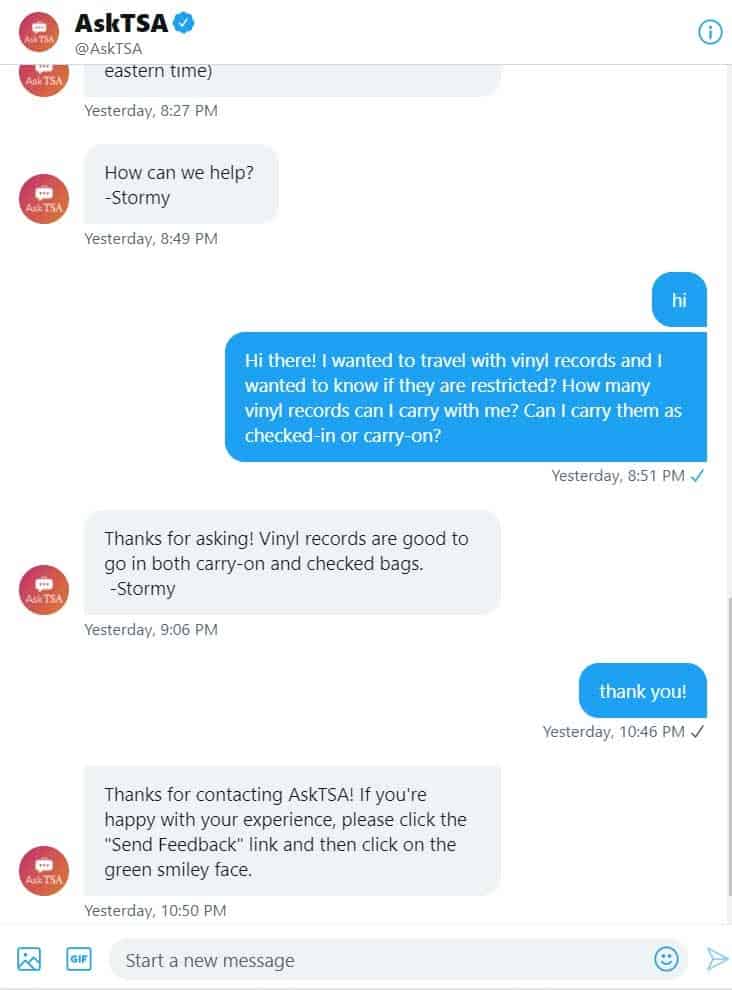
    Well, dear reader, to add to this article, I decided to inquire on whether or not vinyl records you can pack vinyl records as part of your luggage on a plane. 

    After sending my dm ( direct message) on Twitter, I got a response from a TSA representative. The message read that vinyl records are A-okay for flights. 

    If you check the TSA website and search what you can and cannot bring, vinyl records don’t show up. Hopefully, this research attempt will assure you of your future travels with your vinyl records. 

    Here are some helpful tips to help you keep your vinyl records safe away from any risk of breaking

    1.Put the records in a box and then put them in a suitcase. By doing this, you are creating your little section where all the vinyl records are together in one immovable location. It also ensures that the vinyl records don’t pose any harm to each other.

    2.Use your clothes as a type of barrier. Standard packages will have bubble wrap to protect the items inside the packages. Well, you can substitute your clothes for bubble wrap. Ensure that you organize your clothes in a travel-friendly manner. You want to form a safety barrier in the suitcase and also have all the necessary items for your trip in place. It’s killing two, maybe even three, birds with one stone. 

    3.Remember that point about airline weight limitations? Well, it would be in your favor to weigh the suitcase before heading out to the airport. You can even buy one online. They are affordable, and knowing the weight of your suitcase makes things a lot easier. 

    Flying is stressful, and without the proper preparations, it can be the most considerable pain in the neck. Flying with your vinyl records isn’t going to stress you out as long as you do it correctly. 

    Are You Interested In What Other Vinyl Owners Are Asking? Here Are Some Helpful Faqs On Vinyl Records And Air Travel.

    1.Is traveling on a plane with vinyl records, or should I ship the vinyl records to my house?

    Honestly, both methods can work. The method of transport should not constrict you from taking your vinyl records from point A to point B. It is still possible for you to travel with your vinyl records on a plane, and you can find a shipping company and have them delivered separately. 

    If you don’t have a huge vinyl collection and shipping would be too costly, don’t worry and travel with your vinyl collection. 

    2.Is there a probability that TSA would confiscate your vinyl records?

    No, there is a zero percent chance that TSA would rid you of your beloved vinyl records. The reason being, TSA doesn’t want to keep your stuff. Another reason is that TSA does not have an issue with you carrying vinyl records.

    Vinyl records are neither harmful nor toxic in any way, shape, or form. So you are unlikely to have your vinyl records lawfully taken from you. Plus, TSA wouldn’t even take the vinyl records. 

    What would happen then? They would ask you to leave them with another party or find another means to transport them. The probability of this scenario happening is low as well. 

    Don’t panic. Your vinyl records will surely go through the checkpoint.

    3.What’s the best way to carry vinyl on a plane?

    A lot of vinyl owners may have this concern. Is it better to pack them as carry-on luggage or checked-in luggage? If you have maybe one or two (if you’re stretching it, then three should suffice), then having them as part of your carry-on luggage should be fine. 

    However, it would be best to have them as your checked luggage if you have more vinyl records. Not only that, but if you’re looking to start your vinyl record collection, it would be best to ensure the safety and priority of your vinyl records. 

    What better way to do that than by having them as part of your checked luggage? Please note that this is a recommendation. 

    Sources

    1.Retroonly, How to Transport Vinyl Records on a Plane, https://retroonly.com/how-to-transport-vinyl-records-on-a-plane/ Accessed July 27th, 2021.

    2.CNN News, TSA’s naughty list: What you should not take on a plane this holiday season, CNN News, https://edition.cnn.com/travel/article/tsa-prohibited-items/index.html Accessed July 27th, 2021.

    3.Luggage Pros, Carry-on Items, Luggage Pros https://www.luggagepros.com/pages/carry-on Accessed July 27th, 2021.

    4.FAA, Dangerous Goods, FAA https://www.faa.gov/hazmat/ Accessed July 27th, 2021.

  • Can Records Be Stored Horizontally?

    Can Records Be Stored Horizontally?

    Storage is one of the routine maintenance practices for your vinyl records; the way they are stored directly affects their functionality and life shell (2).

    You should never stack your vinyl records horizontally because stacking them on each other causes scratches and warping the records over time.

    This article will discuss the difference between vertical and horizontal storage, why you should not store records horizontally, why they should be stored vertically, and how to keep your vinyl records.

    Can Records Be Stored Horizontally? – Vertical Or Horizontal Storage?

    Vertical storage style has always been the best record storage practice, while horizontal storage style damages records over time.

    The storage style of your records matters a lot; they determine the life shell of your vinyl records and their sound quality. 

    If you are storing less than five records, then you can try the flat storage style. If you own more than five records, make sure to keep them vertically. In my experience, The weight on the vinyl records at the bottom of a horizontal storage style causes many damages. 

    There are many reasons you should always consider vertical storage style, from saving the vinyl records from bearing unnecessary weight to avoiding warping or mishappening of your vinyl records and crack. 

    Dangers Of Horizontal Storage Of Vinyl Records

    There are a lot of dangers attached to storing your records horizontally. They are not risks or probable outcomes but direct and definite consequences of holding records horizontally, which I have encountered in the world of vinyl collection. Here’s some of them:

    1. Warping – When you stack your records on top of each other, distortion is inevitable. Warping means your vinyl records will start to bend to the weight and become deformed, taking another shape entirely. Warping can cause your vinyl record to become unplayable permanently; it will no longer be flat but have a bowl-like form, which definitely cannot be played. Many record owners have tried flattening it out again (1), but there is only a slim chance of that working out, and in the end, you might have to throw it out.
    2. Skipping – In some rare cases where warping has not started yet, cutting takes place. The weight applied to your vinyl records will cause them to miss while playing them when they have endured the weight for too long. While playing, some parts might get cut off or not play at all; this is caused by applying weight on your vinyl records. 
    3. Scratch from Pressure – The pressure generated from the weight on the records at the bottom of the stack is high, and your vinyl records cannot hold pressure. They are fragile materials that cannot withstand too much pressure on them. This pressure ultimately begins to cause scratches on the vinyl records, which continue to get deeper until they are no longer playable. Scratches happen when your vinyl records are in sleeves; by forcing them out from under the stacks. Therefore, the sleeves that are supposed to protect them from scratches cannot do their jobs but damage the records because of their storage conditions. 
    4. Heat Generation – Storing your records on each other does not allow air to go in between them to keep them aerated. Getting oxygen is also essential for your vinyl records because heat causes them to be damp, and this is also a perfect condition for molds to grow. When the heat gets too much, moisture accumulates, causing mildew growth and rendering them unplayable. 
    5. Cracking – The worst thing that can happen to your vinyl records is getting snapped. Cracking often occurs when you store your vinyl records horizontally, especially on an unstable surface. They crack easily from the pressure, and sometimes when you are pulling them out. 

    Why Is Vertical Storage The Best?

    There are several reasons why vertical storage of your vinyl records is the best for you. Below is just a few:

    • When you store your records vertically, you do not need to worry about warping because there is no pressure on them, and nothing can make them bend. They remain flat and always ready to be played.
    • There will no longer be any weight on them, and this means no scratches. There will be no force to pull out a record since they are not stacked anymore. Your record sleeves can do their jobs of protecting the vinyl records from getting scratched and won’t damage them either. 
    • Elimination of mold growth due to proper aeration between your records occurs. They now get a fair and adequate air supply, no more dampness or moisture accumulation that grows mold.
    • There is no risk of getting cracked or broken anymore, and this can only now occur when you are handling them, but not while in storage. 
    • This storage improves your vinyl record’s shelf life; they can be stored vertically for years without damage. They will not depreciate or sound quality because they are correctly stored. 

    How To Store Your Vinyl Records

    Proper storage of your records goes beyond horizontal or vertical storage styles; you must take several steps for an adequate repository for fragile vinyl records (3). I have broken them down into five quick and easy steps:

    1. After playing your record, the first thing to do is to clean your vinyl record. Cleaning can be done with vinegar and distilled water solution, cleaning the vinyl record properly, rinsing out the mixture, and drying the vinyl records. There are other cleaning methods, but ensure that you follow one of them appropriately, using the correct tools and measurements. Improvising some of them might cause severe damage to your records. 
    2. After cleaning them and drying them correctly, make sure you put your records back in their sleeves. Your vinyl records must always be in their sleeves, except you are playing them at the moment. Keeping them in their sleeves prevents the accumulation of dust and dirt on them, another risk factor to vinyl health. Sleeves save your records from getting scratched or cracked by mistake due to bad handling. 
    3. Your records must be in vertical positions; this means they should be upright in their shelves or boxes. To avoid warping, skipping, cracking, and other damages to them, you have to store them vertically. 
    4. Never store your vinyl records horizontally for any reason, the risks are way too much to deal with, and some are permanent and cannot be fixed or reversed. Frequently you might not get those vintage records anymore, so ensure to treat them nicely to avoid damages.
    5. Play your records the right way. Do not directly touch the surface of your records; handle them by the edge only. Skimming the surface of your record can cause scratch or transfer of oils to them, which affects your sound quality. Always wait for your song to come on, do not handle the needle while playing to search for songs; this can cause severe damage when placed on the wrong grooves. 

    Frequently Asked Questions (FAQ)

    Can I Store Less Than 20 Records Horizontally?

    The best storage practice is the vertical style, and to be on the safe side, make sure you store your records in a secure manner irrespective of the number of records.

    It should not matter how many records you have before following the best storage guideline. Store your record vertically only, do not let them get stacked on each other because there will be adverse effects over time, and they might not be reversible.

    How Long Can I Store Records Vertically?

    There is no time limit for vertical storage; you can store your records uprightly forever.

    Vertical storage keeps your records fresh for as long as you have them; you can store them vertically for as long as you want. Ensure they are in a place with the right amount of air, free from external risk factors, and carefully handled when you want to play them. Doing this protects them for as long as you own them.

    How Long Does It Take For Records To Get Warped?

    Warping takes a very long time, but it can take less than a month when there is a heat source or improper aeration from lousy storage.

    Warping from horizontal storage is a very long process, but it occurs fast when a heat source is applied to the record or generated from the inadequate air supply. Store your records vertically, away from the heat source, and ensure an adequate supply of air.

    Summary 

    Vinyl records can be stored horizontally, but they come with substantial risk factors when they become a long-time habit and when the records are more than five. Vertical storage poses no threats irrespective of the number of records. If you have further questions, kindly leave a comment below.

    Sources

    1. McCrigler, Brittany, et al. “How to Repair a Warped LP Record.” iFixit, 2014, https://www.ifixit.com/  Accessed 13 July 2021.
    2. Rigby, Paul. “How to store your record collection in 8 steps.” The Vinyl Factory, 2015, https://thevinylfactory.com/ Accessed 13 July 2021.
    3. Storage, Life. “5 Best Practices You Need to Learn about Record Storage.” LifeStorage, 2017, https://www.lifestorage.com/  Accessed 13 July 2021.
  • Can You Skip Songs On Vinyl Records? (We’ve Got The Answer)

    Can You Skip Songs On Vinyl Records? (We’ve Got The Answer)

    Skipping songs on a vinyl record can be considered a skill set. It requires precision, confidence, and semi-accuracy that not many people have. Nevertheless, this article will help you master the trick behind skipping songs on a vinyl record. 

    In my experience, here’s how you can get to your favorite tracks on an album:

    1.Release the needle
    2.Remove the protective casing over the needle 
    3.Push the needle toward the record
    4.Lift the needle on top of the thick indentations on the vinyl record
    5.Lower the needle and mission complete.

    Not only will this article provide you with the trick behind skipping songs on a vinyl record, but it will also give you bonus information in caring for your vinyl records. If you’re interested in this and more information, be sure to keep reading.

    Can You Skip Songs On A Vinyl Record?

    Quite frankly, yes, you can skip songs on a vinyl record. It’s a process that requires a steady hand an even steadier disposition. Be patient. You may not ace it the first time.

    A viny record manual does not exist, but a record player manual does. However, that doesn’t come with the knowledge required to skip songs. Nevertheless, this article will be the answer to your problem. 

    First things first are to look at the different types of vinyl records.

    What are the different types of vinyl records, and how do you skip songs on them? 

    There are two types of vinyl records:

    1. 45 RPM records
    2. 33 RPM records

    The 45 RPM records contain two songs, while the 33 RPM records contain an entire album. Be sure to check which type of RPM or revolutions per minute type of album you have at hand. 

    The RPM refers to the speed at which your vinyl record will play the songs. This fact matters a lot down the line, but let’s elaborate further on the main parts of this article. 

    How Do You Skip Songs On A Vinyl Record?

    1. Release the needle

    A needle is also known as a stylus. It is at the tip of the metallic arm on the record player. You gently place the needle on the vinyl record, and it’s one of the primary sources of sound.

    It does the sound generating by touching the grooves while the vinyl record is in motion. 

    Depending on the type of record player you do have, it’s essential to release the needle. With this, you can move the needle on either side to choose your desired song. 

    1. Remove the protective casing on the needle

    Needles consist of two types of materials:

    • Diamond
    • Sapphire 

    The needles can also be either elliptical or spherical shaped. Because of this design, most needles will come with a protective casing, also known as a stylus guard. 

    If you don’t have one for your record player, it’s good practice to have one to help maintain your stylus or needle and protect it from unwanted external factors.

    Make sure that you remove the stylus guard or protective casing. You will be using the record player shortly. 

    1. Push the needle toward the record

    It’s almost time to put theory into practice. Push the needle toward the record, and let’s move on to the next step. Be sure not to push the needle down. 

    Some record players will come with a safety lock. Make sure to release the safety lock before pushing the needle toward the record. You must conduct the process carefully and correctly.

    1. Lift the needle on top of the thick indentations on the vinyl record

    On the 33 RPM vinyl records, these indentations are much more prominent. The indentations represent the songs in the album. Remember that there are songs at the front of the vinyl record and the back of the vinyl record.

    Slowly but surely, move the needle on top of one of these indentations.

    Lower the needle and let it play your song. Voila! Mission accomplished. You have successfully skipped a song on a vinyl record.

    If you want to skip the song on the 45 RPM vinyl record, both songs are on different sides of the vinyl record. It means that you have to flip the record over, and you have achieved what you once sought out. 

    1. Lower the needle and mission complete

    After completing all these steps carefully and hopefully with a steady hand, you can listen to the song of your choice. The record player will continue to play the rest of the songs as usual. 

    The disclaimer behind skipping songs on vinyl records

    Skipping songs on vinyl records may come across as easy without the exception of having a steady hand while doing it. However, there is a risk involved in this process. 

    Skipping a song on a vinyl record increases the likelihood of damaging the vinyl record or the record player. You may accidentally press on the needle or stylus or probably even drop the stylus. 

    The risks are unknown and are in your hands. Experts recommend forgoing the skipping process to eliminate the risk. Vinyl records and vinyl record players are pretty fragile. 

    Therefore, if you have no choice but to skip a song, do it slowly and carefully. Take your time and exert patience while doing it. You want to make sure that you do not damage the stylus or the vinyl record itself. 

    May the odds be in your favor.

    Are You A Vinyl Record Owner Interested In What Other People Are Asking? Here Are Some Helpful Faqs To Get You Started.

    Can You Fast-forward A Vinyl Record?

    Unfortunately no. You cannot fast forward a vinyl record. Vinyl records exist in two types of speeds:

    • 33 RPM typically (12-inch records)
    • 45 RPM typically (7-inch records)

    These speeds mean that you should play these two types of vinyl records at their specified speeds. Any faster or slower would not play the songs on the vinyl record as intended.

    Not only that, but as a vinyl record owner, you need to take better care of your equipment. 

    With great power comes great responsibility and even more fragile needles. Thus, play your vinyl records at their specified speeds. It won’t hurt to stick to the design rules of vinyl recordsHokk. 

    Can You Play Specific Songs On Vinyl Records?

    Yes, you can play specific songs on vinyl by carefully positioning the needle on one of the thick indentations on the vinyl record and lowering the needle. 

    You can easily switch between songs on the vinyl record. The only downside to this process is that you may not get it right if you don’t have a steady hand. 

    Positioning the stylus or the needle is the hard part of this process. The trick is to get it as accurate as possible. Be sure not to push the needle down or try any risky maneuvers to get it right. 

    You can consider using hand-eye coordination without applying any unnecessary forces to the parts in question. 

    Not only that, but you can also consider not skipping songs at all. Experts recommend not skipping songs on vinyl records because skipping songs increases the risk of damaging either the stylus (aka the needle) or the vinyl record. 

    Remember to take care of your equipment. 

    How Do You Figure Out Where A Song Starts On A Vinyl Record?

    Honestly, it takes a lot of practice to know where a song starts. On a 33 RPM vinyl record, the thick indentations on the vinyl record represent the different songs on the vinyl record. 

    For you to skip songs on a vinyl record, the indentations are the key to your lock. However, it requires practice and patience to get it right. 

    Sources

    1.Jenna Miles, The Beginner’s Guide to Vinyl Records: How to Build, Maintain and Experience a Music Collection in Analogue (Massachusetts: Adams Media,2017) 256.

    2.Victrola, Getting Started: How to Use a Record Player, Victrola https://victrola.com/blogs/articles/getting-started-how-to-work-a-record-player Accessed 17th July 2021.

    3.Record Player Expert, Skipping tracks on Vinyl, Record Player Expert https://recordplayerexpert.com/ready-why-its-not-a-good-idea-to-skip-tracks-on-vinyl/ Accessed 17th July 2021.

    4.Victrola, Understanding the Difference: Turntable vs. Record Player, Victrola https://victrola.com/blogs/articles/understanding-the-difference-turn-table-vs-record-player Accessed 17th July 2021.

  • Why You Should Never Use Windex To Clean Vinyl Records

    Why You Should Never Use Windex To Clean Vinyl Records

    The internet is full of suggestions and mystery recipes on what to use to clean vinyl records. One such suggestion is using Windex glass cleaner, which quite frankly is a nightmare waiting to happen. Here’s why you should never use Windex to clean vinyl records. 

    These are the reasons why vinyl record owners should not turn to Windex glass cleaner to get the dust off of their beloved vinyl records:

    1. Windex contains ammonia and alcohol

    2. The product is a glass cleaner and not a specialized vinyl record cleaner

    3. Professionals recommend not using Windex on your vinyl records.

    This article will not only give in-depth explanations on the list mentioned above. It will also cover other harmful substances to your vinyl records and give you bonus information on cleaning vinyl records. Keep reading for more information. 

    Here’s Why You Should Never Use Windex To Clean Vinyl Records

    In my experience, a lot of people attested that Windex was their go-to vinyl record cleaner. They swore by it and what it offered to your vinyl records afterward. 

    Long story short, they started to notice their vinyl records slowly turning grey. That color change is never a good sign for any vinyl record owner. Here’s why. 

    1. Windex Contains Ammonia And Alcohol

    If you pull up Windex online, you can quickly get the contents of the product. Windex contains 4.0% isopropyl alcohol and 0.05% of 28% of ammonia. 

    These numbers aren’t the same on all Windex products; some have a lesser percentage while others have a higher percentage. The truth of the matter is that they still contain ammonia alcohol. 

    But why are ammonia and alcohol the big bad in this story? 

    Alcohol and ammonia dissolve your vinyl records’ essential compounds and subsequently damage your vinyl records to an irreversible state. 

    Slowly, you will start to notice your vinyl records turning into an unwanted shade of gray. 

    Towards the last leg of your vinyl record’s lifespan, it will slowly start to corrode to the point of no return. You will be the Avengers, and Windex will be Thanos. You saw how that went the first time. 

    Alcohol and ammonia are the main reasons why Windex is a poor cleaning choice. It’s also why it’s the first reason on the list. Windex’s primary contents do not provide the proper cleaning mechanism. 

    2. The Product Is A Glass Cleaner And Not A Specialized Vinyl Record Cleaner

    If you’re starting your vinyl collection and someone recommends this product to you, be sure to confirm the actual purpose of the product. 

    Sure some products work great in other industries. You cannot apply that logic to Windex. 

    The product manufacturer laid out the contents of the product, its purpose, and its intended surface. That is enough reason to keep your vinyl records and your window cleaner miles away from each other. 

    It will not end well. The vinyl record industry has numerous specialized vinyl record cleaning options to choose from, both affordable and expensive. Look into them and see if they will satisfy your needs. 

    3. Professionals Recommend Not Using Windex On Your Vinyl Records.

    Experts in the vinyl record will confirm that Windex is not a good cleaning product for your vinyl records. Used as a glass window cleaner, it’s great. Your windows will shine like never before.

    However, using it as a vinyl record cleaner, it’s best to move away from that logic and consider much better and safer options. It’s not only good for you and your hobby but also your state of mind. 

    No vinyl record owner would like to wake up to corroding vinyl recorders. It’s sad, honestly. 

    Here Are Undeniable Record Cleaning Methods To Avoid

    1. Cleaning Using Wood Glue

    A couple of years ago, a video went viral on YouTube of someone cleaning their vinyl records with wood glue. Yes, you read that right, wood glue. 

    In the video, they ask users to add the glue while the record is on the turntable. The glue dries overnight, and you peel it off the following day to reveal a new and easily cleaned vinyl record.

    This method may seem like magic, an overnight cleaner with a fun and satisfying peeling session at the end? 

    Unfortunately, it’s not as fun as it sounds. The wood glue method would eventually damage your vinyl record. 

    Not only that, but you have to add the glue to the vinyl record while it’s on the turntable, and the vinyl record must spin while you do this. 

    How do you spare the rest of the record player? 

    The wood glue method is inefficient, messy, and poses a much higher risk. Experts recommend staying far from this substance and turning to other effective methods. 

    Not only that, but experts advise you to clean your vinyl record before using it on a record player and after using it. After completing this phase, you can properly store it. What if you wanted to use it in a couple of hours?

    The inefficiency of this method persists.

    2. Dish Soap

    Dish soap may have come up multiple times in forums and chats as a substitute vinyl record cleaner. Again, some people can attest to some brands and their efficiency. 

    Its best practice to sit down and look at the list of products present in dish soap brands. Not only that, but brands change their formulas over the years. 

    A dish soap brand that was great five or six years ago may not be the exact product today. Brands evolve with time, and changing their formulas may be a thing of the norm for them. 

    Because of this risk, experts advise steering clear from dish soaps if their formula will react badly to PVT (the main component of vinyl records) and if the formula changed with time.

    Still, there are other specialized products in the market to help you clean your vinyl records. A silver lining exists for vinyl record owners.

    Summary Of Cleaning Vinyl With Glass Cleaning Products

    1. Is It Okay To Clean Vinyl Records With Windex?

    No, it is not okay to use Windex glass cleaner as a vinyl record cleaner. Windex contains amounts of ammonia and alcohol. Regardless of the amount, these substances are harmful to vinyl records. 

    Ammonia and alcohol cause vinyl records to corrode. The vinyl records also become incredibly damaged and cross the point of no return. You can never restore the vinyl records.

    Experts also advise keeping your vinyl records and Windex glass cleaner far from each other. It’s too toxic. 

    2. What Shouldn’t You Use To Clean Vinyl Records?

    Experts advise staying away from Windex, wood glue, dish soaps, and anything else containing ammonia and alcohol. Or even anything that can negatively affect PVT, the main component of vinyl records.

    These substances will cause harmful effects to your vinyl records. Moreover, if you can consult a record collector, be sure to consult on what they use to clean vinyl records. Check with other reputable sources on what the good and the bad of vinyl record cleaning are in the industry.

    Research is a core part of the process. You cannot dismiss it. 

    3. Can You Use Any Other Glass Cleaner On Vinyl Records?

    Ammonia and alcohol are one of the most common ingredients in glass cleaners. Inevitably, you cannot escape the glass cleaner ghost. It will haunt and corrode your vinyl records. 

    Be sure to check the ingredients of a glass cleaner. Despite the amount of ammonia and alcohol, it will damage your vinyl records as long as it’s present. 

    Take care of your vinyl records, and glass cleaners are not the way to do it. 

    Related Articles:

    Sources

    1.Jenna Miles, The Beginner’s Guide to Vinyl Records: How to Build, Maintain and Experience a Music Collection in Analogue (Massachusetts: Adams Media,2017) 256.

    2.Brenntag, The Various Chemicals in Glass Cleaners, Brenntag, https://www.brenntag.com/en-us/industries/household-industrial-institutional/chemicals-in-glass-cleaner/ Accessed July 18th, 2021.

    3.Wikipedia, Windex, Wikipedia, https://en.wikipedia.org/wiki/Windex Accessed July 18th, 2021.

    4.Marc Henshall, How not to clean vinyl records, Sound Matters, https://www.yoursoundmatters.com/how-not-to-clean-vinyl-records/ Accessed July 18th, 2021.

  • Is Vinegar a Good Way to Clean Vinyl Records?

    Is Vinegar a Good Way to Clean Vinyl Records?

    Is vinegar a good way to clean vinyl records? That’s a good question. Vinyl records are currently considered antique items collected by many, but many music enthusiasts still love them. In the last few years, vinyl has even made quite the comeback, and it looks like it’s here to stay, so keeping your old vinyl clean might not be a bad idea.

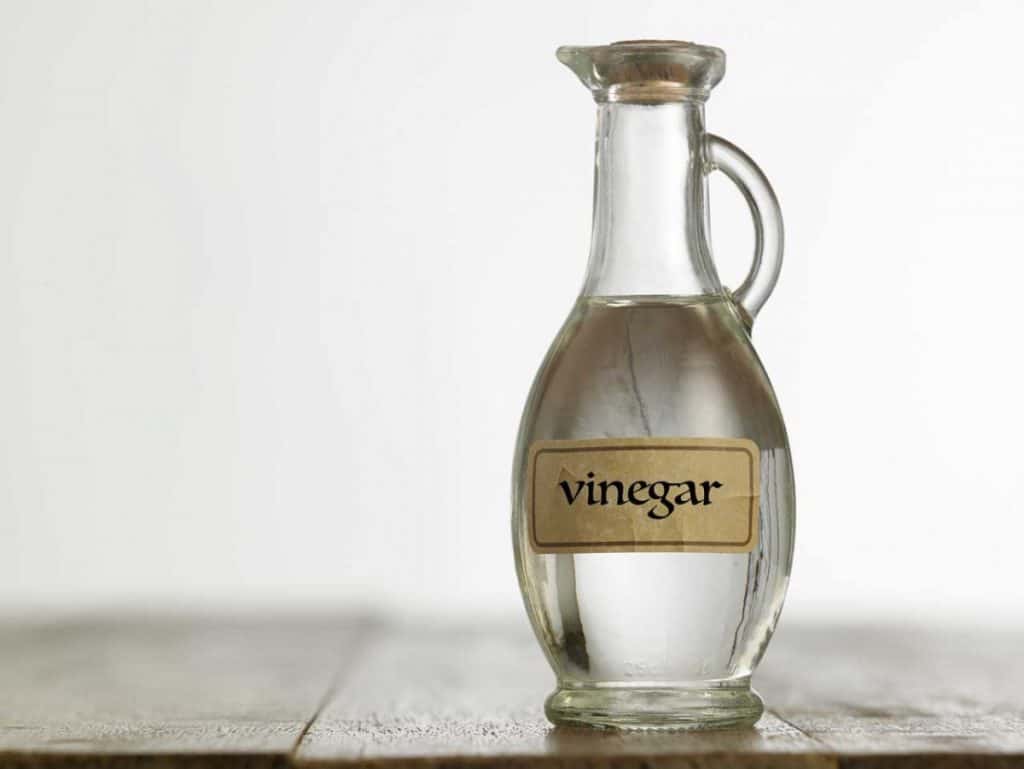
    Vinegar, which is popularly known as the perfect natural cleanser, is also suitable for vinyl records. When properly diluted, vinegar aids in removing grime, dust, and oils from your vinyl records when applied with a soft cloth.

    In this article, I will be taking you through reasons you should consider vinegar for cleaning your records, how to use it, some cons involved, and the best type of vinegar for cleaning vinyl records.

    Can You Use Vinegar to Clean Vinyl Records?

    Vinegar helps clean vinyl records; however, only plain white vinegar is appropriate in cleaning vinyl records effectively. It eliminates microbial organisms on your vinyl record. Vinegar can help keep your records clean and new; it’s non-toxic and cheap to make or buy. There are many reasons why vinegar helps to clean your records. (source)

    Why You Should Use Vinegar

    As stated earlier, vinegar is a popular natural cleaner; it is efficient, effective, and cheap. It is also safe to breathe due to its non-toxic nature, especially homemade vinegar solutions. (source)

    There are lots of reasons why you should decide to use vinegar solutions to clean your vinyl records; these are the same reasons and outcomes I have experienced: 

    • When applied to the vinyl record, vinegar immediately breaks dust deposits on your vinyl records and breaks the grime. Deposits like cheesy fingers from eating chips or processed snacks are no match for vinegar.
    • The solution dries up fast and lets you have your record ready to play again in no time.
    • It is budget-friendly, and homemade vinegar solutions have also been widely effective among vinyl collectors and lovers like me.
    • The solution also has certain antibacterial features. So, you also have your records germ-free to some extent.
    • It is non-toxic, safe to breathe in the fumes without fear of toxic exposure, and not harmful to the health of humans when the fumes are inhaled or liquid touched. As you know, you can sprinkle it on your fries or fish and chips too.
    • It keeps your record looking polished, shiny, and neat, irrespective of how long ago it was cleaned last or how dirty it might be.
    • Vinegar does no damage to your records when adequately diluted.
    • When vinyl records are stained with grease or an oily substance, vinegar solutions clean them as effectively as they clean dust and dirt.

    How Do You Use Vinegar to Clean a Vinyl Record?

    There are a few precautionary steps to follow when using vinegar to clean your vinyl records; these steps also involve the quantity to use; these steps are essential and influential to the outcome, so it’s best to take heed:

    1. The first and most crucial step to using vinegar is to ensure you clean your record with a carbon brush first, wiping off the dust. This step is helpful for daily cleaning without any solutions and essential when using any substance or cleaning agents, including vinegar. Getting rid of loose stuff first is best, so you don’t smear wet dust into a groove.
    2. If there is a lot of dust on the record, it is not advisable to directly apply your vinegar solution on the vinyl record. Doing this will make it messy and sticky, and the answer to this is using PVA glue on your vinyl record surface, causing all the dust particles to stick to it. Then the glue is pulled out, and vinegar is applied to clean the record.
    3. The next step is to prepare your vinegar solution, and this includes a mixture of a 50 by 50 ratio of vinegar and distilled water. Many people add a few drops of dishwashing soap to the mix, which works well but is not mandatory.
    4. Ensure to use lukewarm distilled water in your mixture, avoid directly applying boiling or hot water on your record and avoid chilled water. The water used in the combination should be at room temperature before mixing and application.
    5. After you complete these steps and clean your record, check it for any residual solution. If any left, use soft linen cloth to wipe off the residual solution properly. Then use your carbon brush to remove any lint fibers left from the cloth.

    Can You Use White Vinegar to Clean Vinyl Records?

    In my experience, white vinegar is unarguably the best vinegar solution for cleaning vinyl records. 

    Flavored vinegar, like chili vinegar and others, must not be used to clean vinyl records. The only good vinegar to use in cleaning your vinyl record is plain white vinegar. It gives excellent results, highly effective for cleaning, and perfect for your records. The white vinegar also kills bacterial organisms and keeps them free from microorganisms like dust mites. 

    Killing microbes with vinegar is done using unflavoured plain white vinegar with a lukewarm distilled water solution to clean your records. Apple cider and rice bran vinegar are also not suitable for vinyl records; plain white is the only acceptable vinegar variant for your vinyl record (source).

    Disadvantages of Using Vinegar to Clean Vinyl Records

    Everything in life has a good and bad side, and the same goes for the act of using vinegar to clean your records. Vinegar is excellent for cleaning but is not perfect due to its acidic nature. 

    The rare aluminum records might get destroyed by vinegar over time due to its acidic nature. They gradually corrode, and the best solution to this is to ensure that after each vinegar cleaning, wash your record with only the lukewarm distilled water and wipe off with a clean and dry cloth (source). 

    After the record is dry, always use a carbon fiber brush to remove any lint left from the clean cloth used to wipe the record.

    Frequently Asked Questions (FAQ)

    Is Vinegar Bad For Vinyl Records?

    Vinegar is excellent for cleaning vinyl records. It kills disease-causing germs, wipes off any greasy stains, and is not toxic to humans.

    Most cleaning agents like soaps and others usually leave residues that are hard to get off; however, vinegar residues can be wiped off with just lukewarm water and a dry cloth to keep it shiny, new, and clean. 

    How Long Can Vinegar Be Used to Clean Vinyl Records?

    There is no expiration date on the use of vinegar in cleaning vinyl records. 
    People apply it multiple times to any vinyl record or as often as you wash them.
     It does not damage your record over time, as long as it is diluted accordingly.

    How Do I Mix the Vinegar Solution for Cleaning?

    Plain white vinegar is mixed with lukewarm distilled water to clean vinyl records; evenly measured. If you use two cups of vinegar, mix two cups of lukewarm distilled water to mix before use. Vinegar cannot be directly applied to a vinyl record by collectors because it is acidic and can corrode the vinyl record. It is mixed with distilled water to tone down its capacity and wiped off with lukewarm water and a clean, dry cloth after cleaning.

    Related Articles:

  • Is It Bad To Touch A Vinyl Record? (Let’s Find Out)

    Is It Bad To Touch A Vinyl Record? (Let’s Find Out)

    Everyone who has vinyl records touches them. And you’ve likely heard that it isn’t suitable (for the record). But what validity is there to that, and on the flip side, is it even safe for you (who cares about the record)? I was determined to find out, and you’ll be surprised at what I found!

    It is not a good idea to touch vinyl records with your bare hands. The act is potentially bad for the record and also potentially bad for your health.

    Wait, (record scratches to a stop), did that just read “bad for my health”? Yes, you read that right. So, let’s find out why touching vinyl records are wrong, shall we?

    Is It Bad To Touch A Vinyl Record? (For You, Or The Record?)

    Touching vinyl records typically have zero effect on either your health or the record, assuming your hands are freshly cleaned. However, there is another consideration, and that is – is the record itself clean (read: safe) for your hands to touch?

    We all know that your hands can get naturally oily, but I wasn’t so aware of what might be on or leaching out of the record itself. So, I decided some deep research was in order. Here’s what I found out, starting with the skin on your hands and what is likely to make contact with the record.

    What’s On Your Hands

    Let’s assume that your hands are clean. You had just washed them several minutes ago, and there has been not even the mention of sticky foods like donuts in your near past. So, you would assume your hands to be clean and safe to touch a record. Think again.

    Your skin is covered in microscopic pores. These pores secrete sweat and oils. So, although your hands are clean, your pores are spewing out sweat and oil. 

    Sweat consists of water and a tiny amount (about 1.5%) of salt, amino acids, and proteins. (source)

    The salts, amino acids, and proteins will not evaporate like the water in the sweat, so they stick around to leave a natural residue.

    The tiny pores on the fingertips don’t secrete much oil. But your face and other parts of your body sure do. Your sebaceous glands secrete the oils in the skin.

    A study in Australia on quantifying the hand-to-face contact rate found that the subject tested touched their faces on average 15.7 times per hour. That’s an average of once every 3 minutes 48 seconds. That means that if you were awake for an entire 24-hour period, you’d touch for face on average 379 times. That’s a lot of oil transferring from your face to your fingertips.

    What Type Of Vinyl Makes Vinyl Records – What’s In That Stuff?

    Records are made from varying formulations of polyvinyl chloride, or PVC for short. PVC is resistant to grease, oil, and chemicals, so its applications range from water lines to chemical carrying pails. The plastic is stable and not prone to de-polymerization. (source)

    PVC can be made with a variety of nasty chemicals that pose significant risks to the environment and you. The manufacture of records can produce:

    • Dioxin – an organic pollutant that bio-accumulates in the food chain and is very bad for your health and the environment
    • Chloro-ethene monomer – a somewhat carcinogenic compound released during manufacture. This cancer-causing chemical can also slowly release during the lifetime of the plastic, making it potentially dangerous to humans exposed to the chemical.
    • Plasticizers and Group Phthalates – chemicals used to soften the plastic or add flexibility can slowly leach from the PVC. These chemicals are typically toxic to humans.

    As you can see, PVC is not the wonder plastic many think it is. There are significant issues with the manufacture and also the final product. And because you aren’t eating off your vinyl records, lax laws stipulate very little about the quality of the plastic.

    It’s one of those grey situations. Although it is understood people are going to touch their vinyl records, there are no existing laws that state the vinyl has to be of a specific type or quality. I was unable to find any laws addressing vinyl records at all in terms of their composition.

    Most of the laws present in the United States concerning PVC are concerned with the manufacturing process and the pollutants the process creates. Vinyl chloride, for example, is a nasty pollutant used to make PVC and is a rather bad air pollutant. (source)

    So, Is Touching A Record Bad, Or What?

    At the end of my research, I concluded that the amount of chemical exposure might be pretty negligible from vinyl records touching your hands. There is likely a greater risk to the record than there is to you. Still, it’s pure speculation because I could not find any study completed on the residue or leaching of chemicals from vinyl records. The only information was regarding the horrifically environmentally harmful manufacturing processes.

    The oils your skin produces that wind up on your fingers do not harm the vinyl record chemically. PVC has the natural ability to withstand many oil and chemical exposure events. However, PVC is not able to withstand oil merely sticking to it. The oil can trap dust and dirt and act as a sort of glue to hold dust and dirt on the surface of your record.

    The dust and dirt or other contaminants that stick to the oils both on your fingers and deposited (albeit sometimes microscopically) onto the record can cause the record to sound quality to suffer if they build upon the needle. Extreme cases may cause the record to skip if enough dust or debris builds upon the needle or collects in one place on the record causing the needle to jump a groove.

    What’s The Best Solution?

    A wise old DJ once showed me an interesting method. He wore gloves. He used those cheap white woven cotton gloves with the rubber dots glued onto the fingertips and palms for grip. The funny thing was that he was a pretty decent scratch DJ too. 

    I recall seeing a friend laugh at my gloved DJ friend. Still, I also recall seeing one of the most impressive record collections of classic vinyl in pristine condition that I think I’ve ever seen outside a specialty vinyl shop. In the end, looks aren’t everything and if you’re an audiophile who loves your record collection, then investing in a pair of cotton gloves to use only for handling your records is one way to keep your collection in pristine condition. It also removes the potential for touching chemical residue from the PVC manufacture or vinyl composition.

    Keeping your vinyl clean is the ideal result for handling and storing your precious vinyl collection. If you choose not to use cloth gloves for handling (it may seem excessive), ensure your hands are clean. Don’t handle records after snacking on cheesy flavored chips or other such things that leave sticky food residue on your hands.

    Remember that the grooves on a record are as tiny as a human hair is wide. That’s a narrow groove that the tiniest of dust or sticky dirt hand grime can find its way into, causing record playback problems. You may not see oil on your fingers, but I guarantee you it’s there just waiting to stick to your record.

    The last piece of advice I’ll relay from my experience is that if you are going to handle your vinyl records with bare hands, only touch the extreme outer edges or the inner label of the record. Never touch the record anywhere else. Use the record sleeve to handle the record as much as possible to avoid touching it with your hands. And if the records are ancient, then it’s not a bad idea to wash your hands after touching the record either, to avoid old and poor quality PVC leaching chemical residue onto your skin. Not that it’s overly likely to be enough to harm you, but why take that chance in the first place.

  • Why Vinyl Records Are So Expensive

    Why Vinyl Records Are So Expensive

    Being a connoisseur of classic vinyl, I’ve always set some cash aside to purchase my next favorite record. I wondered why vinyl records are so expensive because it seemed that my budget to buy a record kept needing to grow to buy the same amount of vinyl. I decided to study the subject and share what I found out with you, and it’s pretty fascinating stuff, so stick with me.

    Vinyl records are expensive because demand worldwide has grown consecutively for the last 15 years. Worldwide there are only 341 vinyl pressing companies. Sales of vinyl records leaped from 18.84 million in 2019 to 27.5 million in 2020 in the United States alone.

    That growth of 8.66 million in sales in a single year meant that pressing companies felt the pressure to keep up, and many refused to take further pressing orders just to keep up with the existing demand.

    The supply vs. demand ratio ultimately controls the cost of all products. Add potential material supply chain disruption combined with the sociologist spending effects of the pandemic of 2020, and you have a perfect storm for the rising of vinyl record costs.

    What Makes Vinyl Records Expensive – It’s Just Vinyl Plastic!

    I mention some stats later to support how vinyl records, in my experience, have grown in price over the years. However, the question is why. I mean, we know demand has grown, but with the fantastic technology, the ability to manufacture ludicrous amounts of products, why exactly are vinyl records more expensive?

    The actual cost behind the production of vinyl records lies in three primary factors:

    1. Labor
    2. Materials
    3. Time
    4. Trends

    How Labor Affects Vinyl Record Price

    The process of pressing vinyl records is a labor-intensive one. Despite modern manufacturing technologies, a large number of people are required to complete the manufacture. The cost of labor is always one of a business’s highest expenses. Therefore a labor-intensive manufacturing process will always keep the cost of the product higher than one might have otherwise anticipated.

    While studying the manufacturing process, I learned that you just couldn’t rush the pressing process. The quality of the pressing process has a tremendous impact on the finished record’s quality. A rushed record is one that won’t make it past the waste bin.

    How Materials And Supply Affects Vinyl Record Price

    Worldwide there are only 341 vinyl pressing companies with less than a hundred in the United States alone. Considering the staggering growth from 2019 to 2020 alone, it’s a wonder anyone could keep up. (source)

    The problem deepens with the fact that although there are many companies offering record pressing services, most all use the same 20 or so vinyl pressing plants available in the US. (source)

    There just isn’t enough pressing plants to meet the soaring demand. It is the driving factor behind the supply and demand ratio that drives the price of vinyl records up.

    The manufacture of records is not a cheap process. It’s true; the vinyl itself that makes records is not overly expensive. However, the special lacquers and other materials used in the production are most expensive, pound for pound.

    Include a significant industrial accident in the industry, like the fire that tore apart Apollo – one of the leading manufacturers of the specialty lacquer used in the vinyl record pressing process, and you’ve got a supply shortage to bottleneck the already astounding growth in demand further. (source)

    How Time Affects Vinyl Record Price

    Vinyl record manufacturing is a highly specialized process that typically takes about 30 seconds while inside the press itself. However, most commercial vinyl record press companies that offer small batch record pressing have a typical turnaround time of 7 to 12 weeks.

    Some companies are telling potential clients 20 weeks turnaround. Even more are refusing to take orders for the remainder of the year, having already booked their presses with orders for the duration.

    Given the length of time required merely to press a single record, a single press can only create at best two records per minute. That’s a lifetime in today’s modern manufacturing sphere.

    How Trends Affect Vinyl Record Price

    Do you want to know what drives a record price up? It’s you; it’s me; it’s everyone else who wants to buy that specific hot record this year. Add in a limited supply of a special release from a prominent artist, and we’re talking big money.

    Vinyl records are a niche trend that appeals to audiophiles with an ear for deep and rich sound. You just can’t get a better, warmer, rich sound on any device compared to a turntable, in my experience.

    Given the specialty nature of the trendiness of vinyl records and the astute devotion that you and I and other fans of the media have, it’s no wonder some records will break your credit card wide open.

    Looking at the extent that trends affect vinyl, let’s look at the top-priced vinyl records sold in 2020. According to Discogs, the number one vinyl sold in 2020 was Scaramanga Silk – Choose Your Weapon. The 12” sold for a ludicrous $41,095.00. I just can’t imagine liking a breakbeat enough to spend a car on a single record, but someone apparently thought it was worth it.

    The second most expensive vinyl of 2020 was The Nightriders – St.Loo / Lookin’ For My Baby. This record sold for $4999.00. Not bad for a rhythm and blues record!

    As you can see, trends and popularity have a massive influence on the final price of a vinyl record. The rarity and demand play a dance of pricing entanglement as they spiral vinyl record prices to new heights.

    What Is The Average Cost Of A Vinyl Record?

    Vinyl records have ranged widely in price over the years. Back in 2007, the average cost in the US for a vinyl record was $4.80. You can’t even buy a cheeseburger for that now. In 2017, the average cost rose to $28.40, a 490% increase. (source)

    Keep in mind with the above figures that we’re talking about average costs here. You must realize that if it’s a famous artist’s new album, in my experience, the cost is going to be double or even triple the above-mentioned average prices.

    How Much Should I Pay For Vinyl Records?

    Hunting for bargains is a trend that most vinyl enthusiasts know well. But, how much should you pay for vinyl records? And what are the popular records going for these days? Let’s find out.

    Popular records sold in vinyl format in 2020 include the following:

    • Harry Styles – Fine Line – Sold online at major retailers for approximately $30 when writing for the 12” vinyl.
    • Billie Eilish – When We All Fall Asleep, Where Do We Go? – Sold online for anywhere between $18 and $40, depending on the version collectibility and retailer.
    • The Beatles – Abbey Road Anniversary [LP] – Sold used online from $10 and selling in collectible format for as high as $70 at major retailers.

    Where Can I Buy Vinyl Records Online?

    There are many companies selling vinyl records online, from small retailers to the giant Amazon. However, knowing where to buy vinyl records online means you know where to get the best, latest, and rarest tracks at a reasonable cost. The solution isn’t what you might think.

    What About Buying Vinyl Records From Amazon?

    Amazon is a ludicrously large retailer and has a vast amount of sellers on the platform selling records. From my experience, it can be a minor hit and miss.

    If you purchase a vinyl off Amazon that Amazon themselves fulfills, you’re going to get a half-decent record in terms of quality. Watch out for the non-Amazon sellers on the platform, though. I’ve received used records that were sold as new. I’ve also received warped records. Luckily, I’ve got some tricks to fix a warped record (you can read about how I fix warped records here).

    The basic rule I use for buying vinyl records off Amazon is that you are safe if it’s a mass production record. But rare records, proceed with caution and review the seller information first.