Blog

  • The 7 Best Vertical Vinyl Record Players

    The 7 Best Vertical Vinyl Record Players

    If you enjoy listening to records, then you likely appreciate vinyl records and the authentic, beautiful sound they produce. And if you’re in the market to purchase a record player, it is worthwhile to consider a vertical vinyl record player.

    The best vertical vinyl record players are: 

    1. Pro-Ject VT-E-R Record Player
    2. Floating Record Vertical Turntable 
    3. Easygoproducts Vertical Bluetooth Turntable
    4. Fuse REC Vertical Vinyl Record Player
    5. Pyle Bluetooth Vertical Record Player
    6. TECHNICS SL-V5
    7. Sony PS F-5 

    In this article, I will cover the features for each of these vertical vinyl record players in-depth, weighing the pros against the cons and considering the specifications. I will also explain what to look for in a vertical player to help you find the best one for you.

    1. Pro-Ject VT-E R (OM5e) – Black Vertical Turntable

    The Pro-Ject VT-E-R Record Player can be purchased on Amazon.com. This sleek, modern record player can be placed on a flat surface or wall-mounted to want to save space. It is made with high quality, state-of-the-art materials that allow it to offer excellent sound quality. 

    Specs 

    Here is what you get with the Pro-Ject VT-E-R Record Player:

    • Precision belt drive. The belt drive on this vinyl record player has an advanced design made to reduce  the amount of vibration and audio distortion. 
    • 8.6″ aluminum tonearm. This feature allows the player to pick up pure sound from the record and filter out any other external noises, such as the sound of the needle on the record. 
    • Made with plastic in a back matte style. 

    Pros 

    Some of the outstanding features of this option include:

    • Design and aesthetics. This record player is made with high-quality materials, which ensures its longevity. Plus, it is available in three different colors; black, red and white. It can be placed freestanding on a flat surface or mounted onto a wall to save space. 
    • Sound quality. Thanks to the tonearm and precision belt drive, this record player offers excellent audio. 
    • Easy to use with a comprehensive user guide is included. 

    Cons 

    The main drawback of this record player is that it is made with plastic, and this design may not suit some old-fashioned rooms and decor. 

    Bottom Line 

    The Pro-Ject VT-E-R Record Player is an excellent option at a cost-effective price as it has excellent sound. It can easily be mounted onto a wall, so it doesn’t take up too much space. However, the design may not suit all interior environments. 

    2. Floating Record Vertical Turntable 

    Made by Vertical Grooves, the Floating Record Vertical Turntable is available to purchase on VerticalGrooves.com. This is an elegant record player that offers great sound and acoustics. Notably, it is hand-assembled and can support a variety of different record types. 

    Specs 

    Here are the specs for the Floating Record Vertical Turntable:

    • Has two built-in 2″ speakers. 
    • Has vibration dampening feet, which keeps it stable even while playing deep bass or an upbeat tempo. 
    • Compatible with international voltage capabilities. 
    • Has a built-in headphone jack. 
    • A 2x15W Stereo Audio Amplifier for enhanced sound quality
    • Capable of switching between 33 ½ and 45 RPM, allowing you to use different vinyl records. 

    Pros 

    Some highlights of this unique turntable are:

    • Aesthetics and design. Made with a walnut or maple wood base and MDF, this record player is minimalistic and elegant in every room. 
    • Sound quality. This record player offers excellent sound quality and volume range. 

    Cons 

    The downsides of this choice include:

    • Can’t be mounted on the wall. This means you’ll need to find enough space on a flat surface to hold your record player. 
    • Has limited additional features. While this can support different sizes of records, it doesn’t have many of the additional capabilities that other modern record players have, like Bluetooth connectivity, the ability to play CDs, or a radio. 

    Bottom Line

    The Floating Record Vertical Turntable record player is an excellent option if you purely want to play vinyl records and have a few different record sizes you need to play. Overall, it is moderately priced and will make a beautiful addition to any room. 

    3. Easygoproducts Vertical Bluetooth Turntable

    This is a three-speed record player that offers excellent value for money, particularly because it has plenty of additional features. As it can be mounted on a wall and displayed on a table, it is versatile and will suit a range of environments. You can purchase this record player on Amazon.com.
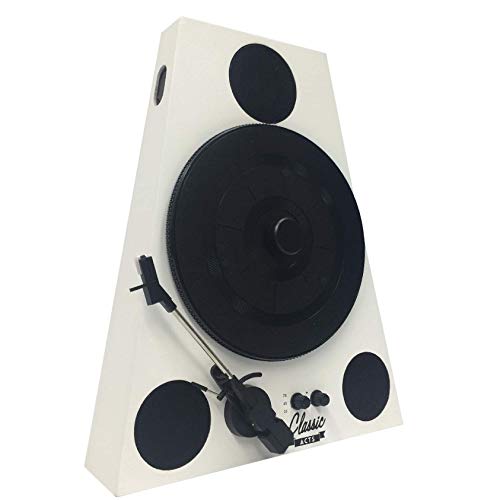
    Easygoproducts Vertical Bluetooth Turntable – 3 Speed Record Player – Auto Stop Feature – Amplified Triple Built-in Stereo Speakers – Headphone Jack Input and RCA Outputs - White

    Specs 

    Some alluring specs of the Easygoproducts Vertical Bluetooth Turntable include:

    • Triple built-in stereo speakers, which allows it to produce different sound quality. 
    • Can be connected to external speakers using right and left jacks to elevate the sound it produces. 
    • Has a magnetic record holder. 
    • Allows you to play records at three different speeds. 

    Pros 

    Notable standouts of this vertical record player are:

    • Design and build. This record player is built with high-quality materials, assuring longevity. It can be mounted on a wall with a bracket or placed on a shelf or table by standing it on built-in feet. It also has a built-in magnetic holder to store your records without them getting damaged. 
    • Extra features. This record player has Bluetooth functionality which allows you to connect it to your phone, computer, and other devices to play music from. It also has aux cables which also allow you to connect to devices. 
    • Satisfaction guarantee. Easy products offer you a full refund within 30 days if you are unsatisfied with the record player for whatever reason. Thanks to this guarantee, you can test it out before deciding to keep it. 

    Cons 

    While the player has an excellent sound quality for high frequencies, some users have noted that it can distort frequencies lower than 300Hz. This may limit the type of records you can play on the record player. 

    In addition, this record player can only receive Bluetooth connections and not transmit them. Therefore, if you want to play your records on a phone or laptop, you’ll need to use a different device. 

    Bottom Line 

    Consider getting the Easygoproducts Vertical Bluetooth Turntable if you are looking for a record player that you can mount and store your records in. However, it would be best to consider the frequency you want your record to play before buying this record player. 

    4. Fuse REC Vertical Vinyl Record Player

    This is another elegant vertical vinyl record player made with handcrafted ash wood. As well as being able to play vinyl records, it has several additional features, including Bluetooth connectivity. You can purchase this record player on Amazon.com.

    Fuse REC Vertical Vinyl Record Player with Bluetooth + Audio Technica Cartridge - Handcrafted Ashtree Wood

    Specs

    Here’s what makes the Fuse REC Vertical Vinyl Record player great:

    • Has full-range 3″ stereo speakers that offer excellent sound quality. 
    • Equipped with an Audio Technica AT3600L cartridge which produces excellent bass and sound quality. 
    • Can run at 33 1/3 or45 RPM. 
    • Can be connected to Bluetooth, has a built-in, and connects to external speakers. 

    Pros 

    Some positive aspects about this player are:

    • Aesthetic and design. This is an elegant record player made with the ash tree wood. It has a simple interface. 
    • Additional features. This record player has several additional features, making it excellent value for money. It has Bluetooth, USB ports, and the ability to dial into the radio. It can also function as an alarm clock. 
    • Sound quality. Thanks to the speakers and the needle, this record player offers clean and high-quality sound. 

    Cons 

    The main downsides of this player include:

    • After multiple uses, this record player may start dragging sound. However, the company may offer a replacement if this happens. 
    • Complexity. Users have noted that changing the modes on this record player can be complicated; the Mode button requires connecting to Bluetooth before toggling between modes. 

    Bottom Line 

    The Fuse REC Vertical Vinyl Record is a pocket-friendly choice that offers a range of different features. However, it should be noted that this record player may not last as long as other models. It’s a good option if you are looking for an entry-level record player to test using vinyl records. 

    5. Pyle Bluetooth Vertical Record Player

    This is a vintage-style record player which blends traditional design with modern features. As well as vinyl records, it can play mp3 records and read audio files from USBs. This versatility makes it an excellent purchase. 

    Specs 

    The specs for the Pyle Bluetooth Vertical Record Player include:

    • Dual built-in stereo speakers.
    • Can function at three speeds; 33 ⅓, 45, and 78 RPM. 
    • Has a ceramic stereo cartridge. 
    • Has a belt-drive turntable system. 

    Pros 

    Reasons to purchase this player include:

    • Additional features. This record player has several additional features, including the ability to receive and stream Bluetooth from 30 feet (9.1 m)  away. It also has a USB flash drive reader, supporting a 32 GB Flash drive. 
    • Build and Design. This player resembles a vintage piece with a sturdy wooden base, making it a beautiful addition to any room. 
    • Range of controls. This player has a range of different controls that allow you to manipulate the sound and speed of the audio. 
    • Warranty. Pyle offers a one-year warranty on this product, allowing you to exchange it if you face any problems. 

    Cons 

    While this record player offers excellent sound when playing vinyl, some users note that the Bluetooth sound is a little distorted. In addition, it can only act as a Bluetooth receiver and not a transmitter. 

    Bottom Line 

    Choose the Pyle Bluetooth Vertical Record Player if you want to play vinyl on a device with modern features but old-world charm. It is available to purchase from Pyle Audio. 

    6. TECHNICS SL-V5

    This is a vintage vinyl record player that isn’t being produced anymore. However, you can buy it online and at some record stores. Indeed, it is a great vertical vinyl record player which produces excellent sound. 

    Specs 

    Here’s what makes the TECHNICS SL-V5 a good choice:

    • Equipped with a brushless dc motor. 
    • Can run at two speeds; 33 and 45 rates per minute with both auto and manual speed selections.
    • Fully automatic and can autorun, auto-stop, and automatically select the size of the record. 
    • Has a tonearm with a 12-hertz resonance frequency to provide clear sound. 

    Pros 

    Some of the favored characteristics of this player include:

    • Aesthetics. The Technics SL-V5 can add character and visual appeal to any space as a vintage model. While it cannot be mounted on a wall, it looks striking when placed atop a flat surface. 
    • Linear tracking model. Because this record player has linear tracking, it doesn’t have issues like anti-skating. 
    • Automatic features. This model can automatically select and play the size of the records lined up, which requires only minimum engagement. 
    • Made of metal. This model is made with high-quality metal, which ensures its longevity. 

    Cons 

    Some notable downsides of this model are:

    • No longer under warranty. Since this model is no longer in production, finding parts and repairing any malfunctions can be both time-consuming and expensive. 
    • You may need to upgrade particular parts of this model like the cartridge to ensure it runs smoothly. 
    • Doesn’t have any additional features. 

    Bottom Line 

    The Technics SL V-5 is an excellent vintage record player to consider. However, you should buy it only if you have a technical understanding of record players and are prepared to upgrade it if necessary. 

    You can find the Technics SL V05 for sale online or at record shops and vintage stores. 

    7. Sony PS F-5 

    The Sony PS F-5 is another excellent model that’s no longer in production but still available to purchase second hand. It was initially in production in 1983 and is one of the best older record players you can buy. 

    Pros

    Here are some of the best features of the Sony PS F-5: 

    • Flexible. The Song PS F-5 can play both 7 and 12″ and 33 and 45 RPM records.
    • Portable. This record player is both small and light, making it easily portable. It is powered by AA batteries, allowing it to be used in spaces with no power accessible.
    • Made with high-quality materials. This model is made with quartz and is painted with pearlescent paint, which has assured its longevity. 
    • Sound quality. Users are impressed by the continuing sound quality that the Sony PS F-5 offers.

    Cons 

    If you consider getting the Sony PS F-5, you should note it can be expensive to upgrade. If you buy a secondhand model, you may have to upgrade some of the parts, which may be more expensive than if you get a model which is still in production/ 

    Bottom Line 

    Consider buying the PS F-5 if you are looking for a portable record player with excellent sound quality. Look to purchase the PS F-5 online. 

    Reasons To Choose a Vertical Vinyl Record Player 

    While vertical vinyl record players don’t have different sound quality and acoustics compared to the more traditional horizontal ones, there are some reasons you may choose a vertical record player:

    • Aesthetically pleasing. Vertical record players make the records look like they are floating in the air offering exciting visuals. They can also make a great design focal point in any room. 
    • Easy to use. Vertical vinyl players are easy to use – similar to horizontal players, you have to slip in the records and select the right mode to play them. 
    • Takes up less space. Some vertical vinyl players can be wall-mounted, so they take up less space than traditional ones. 

    It should be noted that there are fewer vertical vinyl players on the market than horizontal record players. Because of this, it can be hard to identify the best vertical record players that support vinyl. It’s important to do your research before making your final decision. 

    Finding the Best Vertical Vinyl Record Player for You

    When choosing a vertical vinyl record player, here are the factors you should consider: 

    • Sound quality and volume capacity 
    • Display capabilities 
    • Design and visual appeal 
    • Extra features 

    Each of these factors is explored in further detail below to help you choose the best vertical vinyl record players. 

    Sound Quality 

    As you will be using your vertical record player to play and enjoy vinyl records, sound quality is one of the most important factors to consider. Look for record players with a low tendency to warp sound and create distortion. Instead, the record player should play clear sound. It should also have a decent volume range.

    To judge the sound quality, you can look at the record player’s specifications. However, it would be best to test the sound of the record player before buying it. 

    Display Capabilities 

    Vertical vinyl record players will have different display options. While some may be built to sit on a flat surface, others can be mounted onto walls. When choosing the best record player for you, consider the space you have available. 

    Design and Visual Appeal 

    When selecting a record player, you should look for one made with high-quality materials to ensure its longevity. Naturally, you’ll also want to choose a record player suited to your design aesthetics. Some vinyl record players have a sleek, modern look, while others are vintage in style. 

    Extra Features 

    Modern vinyl record players can do much more than play records. Look for record players that have additional features like playing a CD, connecting to Bluetooth, and connecting to tune in to the radio. These additional features ensure that you are getting the best value for money. 

    Classic Vinyl Albums to Purchase 

    If you’ve chosen a vertical vinyl record player, your next focus may be building your vinyl record collection. Here are some of the most classic vinyl albums and records you should try tracking down, especially if you’re starting your collection. While these are no longer in production in vinyl, they can be purchased at record and vintage stores.

    Some classic vinyl albums and records are: 

    • Pink Floyd – The Dark Side of the Room. This album offers a depth of sound and range of instruments that make listening to a record player an almost transcendent experience. This was popular when released in 1979, and it can easily be tracked down for purchase. 
    • The Beatles – Sgt Pepper’s Lonely Hearts Club Band. This is a highly coveted album by The Beatles. As well as offering a range of acoustics, it features songs that reflect history and popular culture. 
    • Bruce Springsteen – Born to Run. This song features various guitar tracks, assuring you a beautiful sound on your vertical record player. This record can be a little challenging to track down, but you may be able to find it in vinyl online. 
    • Joy Division – Unknown Pleasures (1979). This is an album known for its atmospheric sound. IT was Joy Division’s debut album featuring various vocals and guitar melodies. 
    • Simone and Garfunkel – Bridge Over Troubled Water. This folk-rock song is a true classic which features seminal vocals and instrumentals. The vinyl for his can be found in vintage stores and online. 

    Related articles:
  • What is a Slipmat, and Do I Need It? Let’s find out!

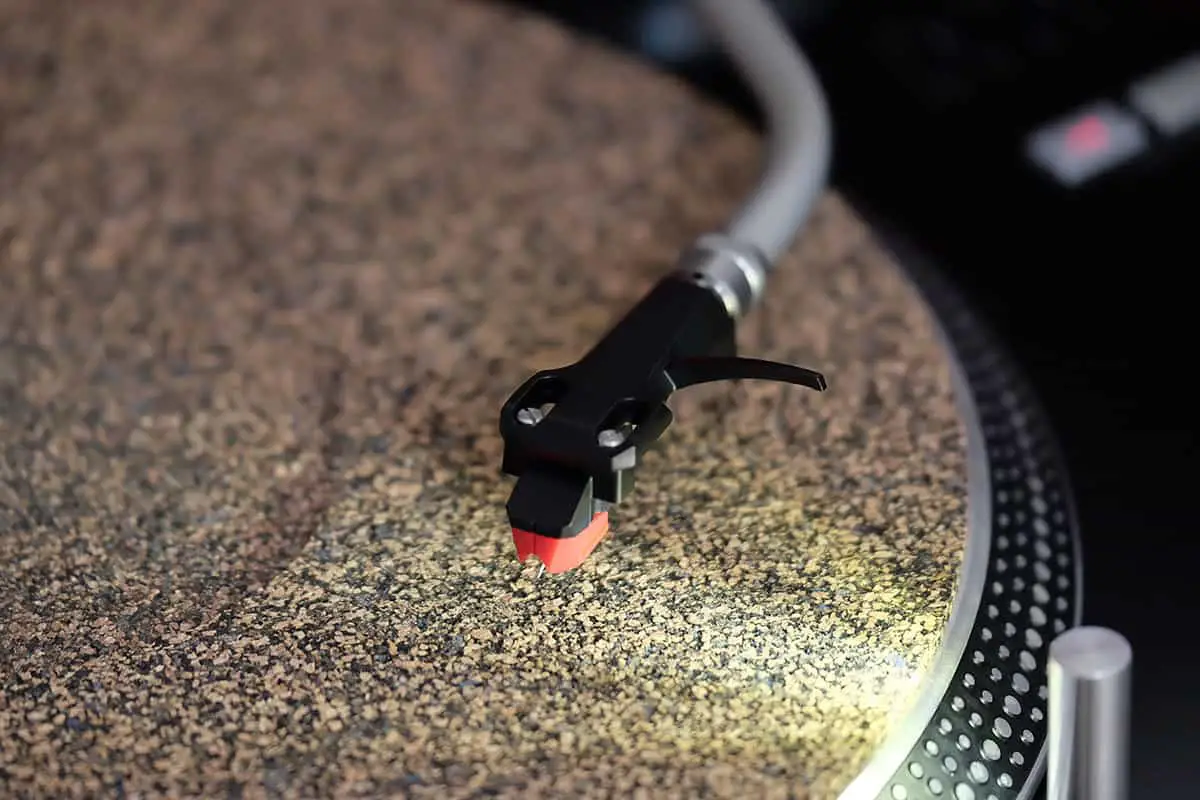
    What is a Slipmat, and Do I Need It? Let’s find out!

    Slipmats are essential for an excellent vinyl experience, both for DJing or just recording. A slipmat can help produce a better sound when scratching, so the platter doesn’t stop when in use. Knowing the difference between a rubber mat, a felt mat, and a slipmat is essential when experimenting with different sounds. 

    You need a slipmat for your record player for scratching or DJing. Slipmats can help when mixing, but they also change the sound and feel of your turntable. You may eventually decide that you don’t like how it sounds or feels, but it’s a worthwhile accessory for your turntable nonetheless.

    This article will explain and explore what record slipmats do, if you need one for an acrylic platter, whether they affect the overall sound, and if you can make one yourself.

    What Does a Slipmat Do?

    Record players sometimes come with felt slipmats or rubber mats. There’s a bit of a difference between the two, and it’s up to you whether or not you choose to use one. Nevertheless, most pros recommend the use of slipmats. 

    A record slipmat is a safe, soft surface that protects against scratches and scuffs. They’re fantastic for smooth transitioning or mixing. However, they do collect dust and lint and, if they’re too thin, can sometimes cause a suction-like effect that causes your music to sound off. 

    A slipmat is different from a rubber mat; rubber mats are made to hold the record in sync with the platter. Slipmats slip onto the platter, allowing a DJ to manipulate a record on a turntable while the platter rotates. It doesn’t just aid the DJ in moving the record, but it also adds to the aesthetics of your turntable.

    DJs recommend using a thin felt platter because they don’t make wind-like sounds like plastic mats, and they’re easier to manipulate than rubber mats. The best mats bend slightly and are pretty thin.

    How Do You Use a Slipmat on a Record Player?

    You can use a slipmat on a record player by placing it on an empty turntable platter. You then put a record over the slipmat and start the record player. There’s also a technique called “record stacking,” which involves placing a slipmat on a record and then placing another record on top of it.

    Slipmats can be used on any record player but are primarily designed for DJs who scratch or mix; it essentially allows the DJ to manipulate the record quickly. 

    The DJ will place the slipmat on the platter. Some slipmats are made out of different materials, such as felt. Companies are creating more innovative designs with a plastic-like material on one side. That allows for a better slip and less stoppage when the DJ manipulates the track. 

    You don’t want to put your record right on the turntable because it can damage your record. It may cause scratches on one side. It’s a fantastic idea to use a rubber mat or slipmat on your platter. 

    You don’t need a slipmat if you listen to a record player. Slipmats are designed for DJs who scratch and mix. A rubber mat that comes with most record players is perfectly suitable to keep your record from being damaged. 

    It’s entirely up to you whether or not you choose to use a slipmat made of whatever material you like. 

    Slipmats come in many different materials and thicknesses. Many DJs prefer a thin felt slipmat because it doesn’t affect the sound as much as a plastic slipmat. It also allows for less stoppage when scratching or mixing. 

    Some DJs use a method known as record stacking, allowing for quicker access to the next record. If you decide to use this method, the best way to do this would be to place a slipmat between those records. Many DJs prefer this popular solution. 

    Do You Need a Slipmat for a Acrylic Platter?

    Suppose you have an acrylic record player; you don’t need a slipmat. You’d only need a weight or clamp to mate the vinyl to the platter. It’s a fantastic choice if you don’t want to worry about using slipmats on your record player. 

    You don’t need a slipmat if you’re using an acrylic record player. Nonetheless, it’s possible to use a slipmat with an acrylic record player if you so desire. There won’t be any adverse effects on sound quality.

    You shouldn’t have to worry about scratching the surface of your records. Acrylic platters are smooth, and there isn’t a need for a slipmat. However, if you want to stay on the safe side, using a slipmat might be a good choice.

    You may decide that you want a slipmat just for the looks because some slipmats have very creative designs on them. 

    However, they’re not essential with acrylic platters. Acrylic platters are made of material similar to records. Thus, it won’t scratch the surface. This is similar to why a needle won’t damage your records.

    Do Slipmats Affect Sound?

    Many different types of slipmats are mainly designed for DJs. Turntable mats can come in felt, plastic, and even leather sometimes. These materials can affect the sound of your vinyl, and you should test each fabric until you find the right slipmat for the sound you’re looking for. 

    Different material slipmats can affect the sound of vinyl music. Each mat’s made differently with varying levels of thickness and various types of material. The best mats are usually made out of felt; however, that’s all based on preference. 

    If you’re learning how to DJ, scratch, or mix, it’s essential to use a slipmat; rubber mats don’t allow for the same ability because they’re designed to grip the record rather than let it slip. Using a rubber mat isn’t the best idea for someone learning to manipulate a form. 

    Thin plastic slipmats aren’t recommended either. Plastic slipmats can make a wind-like sound, though the slip is great for scratching. It’s excellent when you’re practicing. 

    However, you’ll notice the plastic sound in the background when recording, which isn’t great for professional recordings.

    Can You Make a Slipmat Yourself?

    You can make a slipmat yourself. Making your own felt slipmat might be the best choice for you because you can decide how thin or how thick you want your slipmat. Making a slipmat yourself also gives you control over the materials, allowing you to control the sound and feel.

    Slipmats are a fantastic idea for DJs and, if you’re only getting started with the hobby, you may not want to spend money on a slipmat. If you’re going to make your own with your materials, that’s perfectly acceptable. 

    There are a few essential items you may need for your do-it-yourself slipmat, these are:

    • Thin cardboard
    • Record for template size
    • Scissors and pen
    • Felt fabric
    • Hot glue gun or glue

    Here are the steps:

    1. Trace your record shape onto the cardboard. Trace the center hole as well. 
    2. Cut out the traced cardboard. 
    3. Place the felt fabric over the round cardboard piece. Don’t cut around the cardboard just yet; you want to glue it first and cut around the material after the glue is dry. Repeat on the other side of your cardboard. 
    4. Cut a hole in the middle of your fabric.

    Many companies make mats that are sometimes too thick and don’t allow you to manipulate the record smoothly.

    Conclusion

    Record players are a great way to experience music in many different ways. Whether you wish to learn how to DJ or listen to music more authentically, slipmats are essential for the safety of your record. 

    Slipmats keep records from being damaged or scratched, allowing a DJ to manipulate a record. However, you don’t need one for your record player if you’re not a DJ or not mixing or scratching. A simple rubber mat will do. 

    Slipmats may affect the sound of a record, so be sure you pick the suitable material for the sound you want; it’s about preference.

  • Why Are Vinyl Records Black?

    Why Are Vinyl Records Black?

    Nothing spells out more vintage and class than a spinning phonograph record playing a song on a recorder. The mystique of a spinning black vinyl record on a needle adjuster, and the sound production, makes the experience all the more attractive in a digital music age.

    Most Vinyl records are black, mainly because of the Carbon detailing and heavy metals (Initially Cadmium, Lead, Tin, and now Zinc) additions during their manufacturing. These additives stabilize the Polyvinyl Chloride (PVC) disk, giving it desirable qualities like low flammability and melting point.

    We’ll look at the origins and how a vinyl record really works. Also, we’ll demystify the familiar visual resemblance that seems to characterize most vinyl records and answer the question, “Why are vinyl records black?”

    What Are Vinyl Records?

    Vinyl records are disks that store analog music formats inscribed and embedded on circular grooves that characterize the disk. These records are played on a phonograph or a turntable. 

    There are two types of sound formats inscribed on these circular disks: long play (LP) and extended play (EP).

    What’s most interesting about the Vinyl record is that you can record and reproduce sound on both disk surfaces, namely side A and B.

    Sound Formats of the Vinyl Records

    The format in use usually determines the rotation speed of the vinyl record on the player.

    Long Play Format

    The Long Play format in vinyl records, plays at 33.5 rotations per minute (RPM). The LP disk is about 12 inches (30.48 cm) in diameter. This format typically holds between 30 and 44 minutes of sound after recording both sides. 

    Even though the shift from analog to digital music formats came with the decline in records and the rise of the compact disk, the terminology “long play” remains in use in the music industry to imply an entire album.

    Usually, an album comprises between ten and twelve songs at most.

    Extended Play Format

    On the other hand, Extended Play Vinyl records (EP) have a play rate of 45 rotations per minute. The disk format can hold only one audio song per side, typically up to 7.5 minutes long. Therefore, an EP holding audio on both sides means only 15 minutes of song play. This aspect implies that the EP contains only half the sound capacity of the LP. 

    The EP vinyl record has a diameter of 10 inches (25.4 cm). In modern-day music, Extended Play (EP) denotes a single song released by an artist.

    Interestingly, before, a 7 inches (17.78 cm), 45 RPM EP disc was eventually surpassed, which led to the production of the 10 inches (25.4 cm) EP records, suitable for singles.

    The History of the Vinyl Record

    Initially, Vinyl records were made of rubber, later replaced by shellac (wax) pressed into a disk, with circular grooves on both sides of the disk. This technique was Emile Berliner’s advancement of Thomas Edison’s prototype phonograph that recorded sound on a cylinder of tin folds in the late 1800s. Berliner’s shellac disk resulted in the naming of phonographs to gramophone records.

    However, in the mid-’70s onwards, PVC became the way to go in making records. This aspect would proceed until Compact Disks surpassed Vinyl records in the ’90s.

    Recently, there has been a hype about vinyl records, as indicated by sales, showing that this vintage technology might be returning to the music scene. 

    Related article: Record Player History: The Rise And Fall (And Rise) Of Turntables

    What Are Vinyl Records Made of?

    Initially, records were made of Shellac wax, a hydrocarbon. However, it was replaced by PVC due to its brittle nature. Further, the use of PVC records helped reduce noise compared to shellac. 

    This development was later advanced to the more dominant PVC records, which required the addition of Carbon and heavy metals to stabilize the plastic. 

    These PVC records offered better cost-effectiveness, durability, reduced statistical charges, to mention a few function-attractive qualities.

    As a result, these additives, like Carbon and Lead, Tin Chloride, and Zinc, gave the PVC component, which is naturally colorless, a black-colored flair.

    Is Vinyl Environmentally Friendly?

    Initially, there were concerns about the environmental impacts of vinyl records. The main problems stem from the heavy metals and other stabilizing additives that were particularly degrading and toxic to the environment and users.

    Even though there are regulations that oversee allowable additives in the production of PVC records, the manufacturing process still poses a danger to the environment. This exposure arises due to the release of toxic and potentially carcinogenic dioxins during PVC manufacture. 

    There has been experimentation of plastics like PET from recycled bottles to obtain more environmentally conscious alternatives. However, the sound quality is reported to be lower.

    That said, the odds of disposing of vinyl discs are significantly low, especially now that its perceived market value is rising. 

    Although there’s some level of concern about the ecological nature of vinyl records, it’s no cause for alarm; that’s because the existing records and annual production of these records don’t account for much of the plastic production and disposal worldwide today.

    You can read more about vinyl records and the environment in this article that I wrote: Are Vinyl Records Recyclable? Let’s Find Out!

    How do Vinyl Records Work?

    Vinyl records work by converting sound vibrations imprinted on grooves into sound waves. The three-Dimensional sound waves are imprinted on the grooves on the vinyl disk. The major components of a playback recorder include a stylus needle, cartridge, magnetic coil, cantilever, and body. 

    When a stylus needle is placed on a rotating vinyl disk, the mechanical energy of imprinted sound vibrations is converted to sound waves. As the vinyl disk spins, the needle fits in the grooves of the rotating vinyl record, collecting and transferring the sound vibration via a cartridge. The cartridge transduces mechanical sound vibrations to electrical energy directed to amplifiers, then to speakers to display the playing sound.

    How To Use a Vinyl Record Player

    Here are the steps on how to use a vinyl record player:

    1. First, it’s always important to lock the Vinyl record on the turntable to ensure it’s properly secured. It’s essential to understand the rotations per minute of the vinyl record disk before using a record player. It’s typical for a 12 inch (30.48 cm) vinyl record to play at 33.5 RPM on most record players.
    2. Then, raise the record player’s arm, switch on the equipment, and slowly lower the arm to touch the rotating vinyl disk. When the needle contacts the circulating vinyl disk, the sound transmits to the speakers, and we can hear the song play.
    3. To skip a track, you raise the record player’s arm and place it on the grooves, past or before the point it was initially playing, to forward or rewind the track, respectively. 

    The Vinyl Comeback

    There’s been a resurgence in the sales of vinyl records since 1991. The growth in revenue due to direct sales of Vinyl records has grown significantly and consecutively since 2010. Interestingly, vinyl record sales have surpassed compact disk sales. 

    Most might think that the boomers generation caused the rebirth. However, this demand growth is partly driven by millennials who want to tap into the old-fashioned way of experiential listening. 

    In a world bombarded with music streaming platforms, it must be nice to sit down and let a Vinyl record play on the phonograph.

    Final Thoughts

    There’s not much functional significance in the black color of the Vinyl record, other than the stabilizer additives used in producing Polyvinyl Chloride record disks. 

    Perhaps, from a visual standpoint, it’s how we can identify a vinyl record original as presented by the initial founders of the recording technology.

    However, the color has minimal impact on the quality of sound of the record upon playback.

  • Top 10 Most Expensive Vinyl Records

    Top 10 Most Expensive Vinyl Records

    Vinyl records have been a popular way of listening to music since the early 1900s. They produce excellent sound and are treasured collectibles – some vinyl records are even worth thousands of dollars. If you’re a vinyl enthusiast, you’ve probably wondered how expensive they can get.

    Here are the top 10 most expensive vinyl records: 

    1. Once Upon a Time in Shaolin – Wu-Tang Clan  
    2. Double Fantasy – John Lennon and Yoko Ono
    3. The White Album – The Beatles  
    4. My Happiness – Elvis Presley 
    5. Sgt. Pepper’s Lonely Hearts Club Band – The Beatles
    6. Yesterday and Today – The Beatles 
    7. Till There Was You – The Beatles  
    8. Aphex Twin aka Caustic Window – Caustic Window  
    9. Alcohol and Jake Blues – Tommy Johnson
    10. Do I Love You Indeed (Indeed I Do) – Frank Wilson 

    While you can buy a few of these records (for a hefty price), some are incredibly rare with only one or two copies in existence. This article takes a deeper look at the most expensive and valuable vinyl records of all time. 

    1. Once Upon a Time in Shaolin – Wu-Tang Clan

    Cost: $2 million 

    Once Upon a Time in Shaolin was released back in 2015 by the Wu-Tang Clan, a popular hip-hop group. 

    The Wu-Tang Clan produced only one copy of this album to make a statement against the commercialization of the music industry. The vinyl is precious because there’s only one copy available and it represents the hard work and values that went into making the album. 

    History of the Album 

    ‘Once Upon a Time in Shaolin’ was born when Wu-Tang’s producer, Cilvaringz, decided to create the album as a work of art. The group agreed to produce only one copy as a statement against piracy, streaming, and the easy accessibility to music. 

    The group took six years to record the album. Aside from members of the Wu-Tang Clan, the album features performances from Cher and Carice Van Houten.

    The vinyl  was auctioned in 2015 on Paddle8 and was purchased for $2 million by Martin Shrekli. The album was then seized by the US Department of Justice when Shrekli was arrested for fraud.

    In 2021, the US Department of Justice sold the album to a group called PleasrDao, which purchases digital assets that have been made by blockchain code. 

    Only a few people can listen to the entire album as there’s a legal agreement that protects it. However, in November 2016, Shkreli played some excerpts of the album online. 

    Type of music: The music in the album can be characterized as hardcore hip hop. The whole album is 110:12 minutes long and contains 26 tracks. 

    Where to buy Once Upon a Time in Shaolin: You can’t buy ‘Once Upon a Time in Shaolin’ as the album isn’t for sale, and there’s only a single copy in existence. Lately, PleasrDao has been looking into sharing the album with fans across the world.

    2. Double Fantasy – John Lennon and Yoko Ono 

    Cost: $850,000

    Double Fantasy was released in 1980, a few weeks before John Lenon was murdered. It was not met with success as critics noted that the album lacked substance and distinctive melodies. 

    However, a signed copy of the record became one of the most expensive ever sold in 2010, with a price tag of a whopping $850,000! The reason for the high price? It was the last record John Lennon ever signed. 

    History of the Album 

    Double Fantasy, also known as A Heart Play, was conceptualized as an intimate musical dialogue between a husband and wife. Lennon and Ono began recording the album’s first songs in secret, paying for the sessions themselves. Eventually, the couple signed with Geffen Records. 

    When released, the album received negative reviews from a collection of critics. However, when Lennon was murdered, the press stopped printing negative reviews, choosing to cover the singer’s assassination instead. 

    In 2010, Ono and Jack Douglas, a producer the couple worked with, released a remix of the album titled Double Fantasy Stripped Down. This disc edition had the original album and a simpler version that focused on the vocals instead of the instrumentals. 

    Initially, the most expensive version of the record sold was in 1999, for $150,000. A decade later, another copy (this one) was sold at $850,000 in 2010. This second record is rumored to have been signed for his killer, Mark Chapman, a few hours before Chapman shot Lennon. 

    Type of music: This album features mainly rock music and is 45:01 minutes long.

    Where to buy Double Fantasy: You can buy a copy of the ‘Double Fantasy’ vinyl online. While the signed copy is extremely rare and may as well be unavailable, you should be able to find the vinyl.

    3. The White Album – The Beatles 

    Cost: $790,000 

    The White Album is one of The Beatles’ most prolific albums and was released in 1968. It features various genres and musical styles, including hard rock, blues, folk, and country. The most expensive copy of this album was sold for $790,000. 

    History of the Album 

    The Beatles began writing songs for The White Album during a transcendental meditation course in India. The group recorded the songs between the months of May and October in 1968. The album has thirty songs of which only sixteen feature all The Beatles together. 

    Music history and industry experts claim that the tension and strife within the group can be heard in the songs in The White Album. Indeed, the group split up a few months after the album was released.

    While there have been many copies of the album on vinyl, the ones with the lowest serial numbers are the most valuable. 

    When the album was initially produced, each copy was stamped with a unique serial number. The lower numbers are considered more valuable as they were the records given to The Beatles and their producers. 

    The first copy of the album numbered 0000001, belonged to Beatles member Ringo. In 2015, it broke the Guinness World Record for the most expensive commercially-available album — it was sold for $790,000. 

    Type of music: The White Album has a wide range of music genres, including country, reggae, blues, and folk. Most of the songs heavily feature the acoustic guitar.

    Where to buy the White Album: You can buy copies of the ‘White Album’ on websites like eBay or at record stores. These copies frequently come up for sale online, although the ones with the lower serial numbers are rare.

    4. My Happiness – Elvis Presley 

    Cost: $300,000

    My Happiness is a vinyl record that features two songs — My Happiness and That’s Where Your Heartaches Begin. The original record is the first one Presley ever produced, making it extremely valuable, and it sold for $300,000 at an auction in 2015.

    History of the Album 

    In 1953, Elvis Presley rented a few minutes of Studio Time at Memphis Recording Studios for $4. He recorded two covers of ballads from the 1930s — ‘My Happiness’ and ‘That’s Where Your Heartaches Begin.’ 

    Presley originally recorded the songs as a birthday present for his mother but gave the record to his friend Ed Leek. While he was recording, a Memphis Recording Studios Executive wrote his name down as an individual to remember.

    In 2015, the record was on sale as part of a Graceland auction of Presley memorabilia. A musician by the name of Jack White bought the vinyl and used the record to produce a limited-edition facsimile that he sold through Third Man Records. 

    Type of music: The songs on this record are sung in a ballad style.

    Where to buy My Happiness: You can buy ‘My Happiness’ online from certain music websites. As Jack White produced some facsimiles of the album, you should be able to find copies for purchase, but they are relatively rare and expensive. 

    5. Sgt. Pepper’s Lonely Hearts Club Band – The Beatles 

    Cost: $290,500 

    This album is The Beatles’ eighth studio album, released in 1967. It received a favorable response from fans and critics at the time and continues to receive accolades and recognition. 

    There are many vinyl records of the Sgt. Pepper’s Lonely Hearts Club Band, but the most expensive one sold was auctioned for $290,500. The high value is because the Beatles personally signed this particular record. 

    History of the Album 

    Sgt. Pepper’s Lonely Hearts Club Band was conceptualized by Paul McCartney and the recording began in 1966. When it was released, the album spent 27 weeks on the British Top Hits of the week and stayed in the US Top 200 for 15 weeks.

    Some of the most prolific songs in the album are Lucy in the Sky with Diamonds, With a Little Help from My Friends, and Within You, Without You. The last song in the track — A Day in the Life — was banned in Britain after its original release. 

    The album should also be recognized for its technical features, experimentation, and use of the four-track recording. Some songs even use reduction mixing and automatic double-tracking. 

    In 2013, a copy of the record signed by The Beatles was sold to an anonymous buyer for $290,000. 

    Type of music: Most of the songs in the album fall within the rock, pot, and art-rock genres. The entire album is only 39:36 minutes long.

    Where to buy Sgt. Pepper’s Lonely Hearts Club Band: You can buy a copy of the ‘Sgt. Pepper’s Lonely Hearts Club Band’ online from websites like eBay, or offline from record and vintage stores. While there are vinyl records, you won’t find a signed copy so easily.  

    6. Yesterday and Today – The Beatles 

    Cost: $234,000

    ‘Yesterday and Today’ is another invaluable vinyl record signed by John Lennon, Paul McCartney, and Ringo Starr. The record was sold to an anonymous buyer for $234,000 at a Beatles-themed auction. 

    History of the Album 

    Yesterday and Today was released in North America and had a mix of songs from The Beatles that hadn’t been featured on other albums. As a result, this album contains a delightful collage of different tunes.

    There were several options for the album cover, the most famous one being where The Beatles wore white butcher’s coats and were shot holding plastic doll parts and trays of meat. This ‘butcher cover’ was said to be The Beatles’ statement against the war in Vietnam. 

    Capital Records used this cover on promotional vinyls which they publicized through the media and at select record stores. But the cover received an immediate backlash and Capital Records had to recall most of the originals. 

    However, some of these records had already been sold, and because of the recall, the butcher cover became invaluable. 

    The most expensive copy of Yesterday and Today, with the butcher cover, was sold for $234,000. The buyer chose to remain anonymous but later revealed that they bought the record as an investment knowing that it would become more valuable in the coming years.

    Type of music: This album features folk and country songs and includes several examples of musical and instrumental experimentation.

    Where to buy Yesterday and Today: You can buy copies of ‘Yesterday and Today’ online and at record stores. You may have to search a while to find people willing to sell you the original version, and getting a copy with the ‘butcher cover’ will be pretty challenging.

    7. Till There Was You – The Beatles 

    Cost: $100,000

    ‘Till There Was You’, recorded in 1962, features the cover of a famous Broadway song with the same name. This broadway piece was written in 1950 by Meredith Wilson and performed in The Music Man (1957). The record was sold for $100,000 in 2015. 

    History of the Album 

    The Beatles recorded ‘Till There Was You’ during an unsuccessful audition for Decca Records in 1962. The album features Paul McCartney on the vocals, Ringo Star on bongo, and George Harrison and John Lennon on acoustic guitars.

    In 2016, a private pressing of ‘Till There Was You’ was sold at an auction for $100,000 to an anonymous buyer. This pressing also has the song ‘Hello Little Girl’ on the flip side and features the handwriting of The Beatles manager, Brian Epstein, which significantly adds to its value.

    Type of music: Till There Was You falls within the pop genre and is a mere 2:10 minutes long.

    Where to buy Till There Was You: You can buy ‘Till There Was You’ by The Beatles on vinyl from websites like eBay. You probably won’t be able to buy the original pressing though as it’s a treasured collector’s copy.

    8. Aphex Twin aka Caustic Window – Caustic Window

    Cost: $46,300 

    This album was recorded by Richard D James, also known as the Aphex Twin. James began recording it in 1994 but produced only five copies of the album. As there are only a limited number of copies, the original vinyl records are pretty expensive — one copy was sold for $46,300. 

    History of the Album 

    Richard D James recorded songs for Caustic Window through the 1990s. However, the album’s official release was canceled, and only five copies were produced on vinyl. The most expensive sale of the album on record was in 2014, when it was sold to Markus Persson, creator of Minecraft.

    Type of music: The album features ambient techno, acid techno, and acid house beats. Altogether, the songs are upto 69:25 minutes long. 

    Where to buy Aphex Twin, aka Caustic Window: You can’t buy the vinyl version of ‘Aphex Twin, aka Caustic Window’, as there are such few copies in existence. But you can find some of the tracks on YouTube, including Astroblaster, Fingry, and the Garden of Linmiri.

    9. Alcohol and Jake Blues – Tommy Johnson 

    Cost: $37,100

    Alcohol and Jake Blues was recorded by blues musician Tommy Johnson for Paramount Records in 1929. In 2013, a 1930 cut of the record was sold for $37,100 at an online auction. Only two copies of this record have been produced till date. 

    History of the Album

    Tommy Johnson recorded this album between 1929 and 1930 for Paramount Studios and it was one of the five records he created for the studio. 

    Tommy left Paramount Records over a controversy with claims that he had lost the right to record with them. As Johnson recorded only a few cuts for Paramount Studios, a record with the studio logo became highly-coveted.

    In 2013, Alcohol and Jakes Blues became the most expensive 78 rpm record sold when John Tefteller bought it. Tefteller is known for collecting rare vinyl records and described this purchase as the holy grail, well worth the $37,100 he paid. 

    Type of music: As the title of the album suggests, the genre is primarily the blues, and Johnson displays an impressive vocal range through all the songs.

    Where to buy Alcohol and Jake Blues: You can’t buy a vinyl version of ‘Alcohol and Jake Blues’ as there were very few records produced before Johnson decided to leave Paramount. Instead, you can listen to the songs on YouTube or Amazon Music.

    10. Do I Love You Indeed (Indeed I Do) – Frank Wilson 

    Cost: $37,000

    This record includes a single song by Frank Wilson for Motown. Wilson pressed only two hundred and fifty demos for Motown, making each vinyl highly-coveted. The last recorded sale of this single was in 2009, at a price of $37,000.

    History of the Album 

    Frank Wilson was a prolific soul producer and singer who worked for Motown Records. However, Do I Love You Indeed (Indeed I Do) is the only single that Wilson recorded for the studio. 

    While he produced a significant number of demos, most were destroyed. Only a few survived and have been put up for sale on the open market. 

    In 2009, one copy was sold to an anonymous buyer for $37,000.

    Type of music: The music on this record can be classified as ‘American Soul.’ 

    Where to buy Do I Love You Indeed (Indeed I Do): You can’t buy ‘Do I Love You (Indeed I Do)’ as the originals are extremely rare and hard to find on the market. However, you can listen to the songs online, on YouTube and other streaming portals.

    Related articles:
  • What Are Bluetooth Record Players And Are They Worth It?

    What Are Bluetooth Record Players And Are They Worth It?

    The record player became famous since its birth also a source of classic joy for people. These devices progressed slowly for decades, but new technological changes revolutionized these record player devices. Is there such a thing as a Bluetooth record player?

    Modern speakers and other peripherals use Bluetooth technology to provide wireless connections. Similarly, now some record players use Bluetooth and are known as Bluetooth record players. 

    It is the 21st century, and you do not need a wired connection to listen to your music collection. These Bluetooth devices are popular due to their sound quality and unique designs.

    Bluetooth record players are famous among music lovers because they provide excellent audio output using wireless technology. Wireless Bluetooth devices gained abnormal hype during the last decade, and Bluetooth record player is one of them. The popularity of these audio players is due to their aesthetics and time to time modifications. The demand for these Bluetooth players is rising and setting new sale records. (source)

    If someone prefers to buy a Bluetooth record player over modern stereos, there is something special about these audio players. People find these wireless record players fantastic for playing old or new record collections. Unlike any other demanding product, the prices of these turntable Bluetooth record players are not that high. (source)

    Some people are still confused about what are Bluetooth record players? Are Bluetooth record players worth it or not? So, we will divide this question into two parts and discuss them separately. 

    What Are Bluetooth Record Players?

    A Bluetooth record player is a turnable device that uses Bluetooth technology to connect to a speaker, headphones, AirPods, or a stereo, e.t.c. The average range of this Bluetooth device is about 30 feet, and you can listen to your favorite music wirelessly. It means you do not have to be in the same room and can use wireless speakers or other audio devices in any other room. This device is fantastic for casual and regular music listeners to enjoy their vinyl records anywhere they want. 

    The Bluetooth record players also have some drawbacks and caveats, as the audio quality will fall slightly. This wireless vinyl player is helpful for people who want an audio player setup with speakers. This type of record player is easy to set up and use at any place you like. You can set this Bluetooth vinyl player with speakers in different rooms without connecting a single cable or wire. (source)

    Some people find it difficult to set up and use wireless devices. Some people might have some queries about Bluetooth record players. So, let us answer some famous questions about Bluetooth record players.

    • How does Bluetooth record player work?
    • How to connect a Bluetooth record player to a Bluetooth speaker?
    • Can we use Bluetooth speakers with a standard record player?
    • Does Bluetooth record player ruin audio quality?
    • How to improve the audio quality of Bluetooth speakers paired with Bluetooth record players?

    1. How Does Bluetooth Record Player Work?

    Some people may know that an ordinary record player uses analog recordings to play recorded music. It means that the storage media of the record player stores these analog signals, which is a vinyl record. On the other hand, a Bluetooth record player uses these analog signals and converts them into digital signals. This record player uses a built-in DAC (Analog to digital converter) to compress and digitalize the audio signals. (source)

    There is also a mechanism in the Bluetooth record player to send compressed audio signals to wireless devices like speakers or headphones. When the wireless headphone or speaker receives these compressed signals, these signals decode into the original analog audio signals. After this conversion, you can listen to the music from your wireless speakers or headset. Some users do not have wireless speakers or headsets, but they can play music using wired speakers or other wired devices.

    Bluetooth record players are portable, which is one of the main reasons for their popularity. These Bluetooth vinyl players allow you to choose between wired and wireless speakers. So, you can use any one of these audio devices, depending on your choice.

    2. How To Connect A Bluetooth Record Player To A Bluetooth Speaker?

    Firstly, people do not know there are two different types of wireless speakers. The Bluetooth wireless speaker and WiFi wireless speaker are the two variants of wireless speakers. Both wireless speakers use various mechanisms to play your vinyl record music. You need to understand that WiFi and Bluetooth are not the same technology, and a Bluetooth device cannot work smoothly with a WiFi device.

    A Bluetooth record player will need to pair with the Bluetooth speakers before you use them. You have to set both Bluetooth devices to paring mode to connect them via Bluetooth protocols. You can listen to your vinyl record music once the Bluetooth wireless speakers connect with the Bluetooth vinyl player. The music transfers to the speakers through the Bluetooth protocol, and the Bluetooth speaker generates music accordingly. (source)

     The music transfers to the speakers through the Bluetooth protocol, and the Bluetooth speaker generates music accordingly. This pairing is a one-time process, and you do not have to pair these devices again and again. Now you can turn both devices on to listen to your vinyl record collection.

    3. Can We Use Bluetooth Speakers With A Normal Record Player?

    An ordinary record player can not work with Bluetooth speakers in their current state. Many people have a regular vinyl record player with no Bluetooth support to play music on Bluetooth speakers. Do you want to use Bluetooth speakers and headsets on your regular record player? Yes, now it is possible to pair your vinyl record player with Bluetooth devices, but with some modifications.

    If you want to pair your record player with a Bluetooth speaker, you have to set up a Bluetooth transmitter on your record player. You can directly plug in the transmitter if your record player has a built-in preamplifier. But if it is not available, you can also buy a new preamplifier for your record player. After setting up a built-in or external preamplifier, you can directly play your vinyl record music on your Bluetooth speakers or headsets.

    4. Does Bluetooth Record Player Ruin Audio Quality?

    The bitter reality is the audio quality of vinyl music on wired speakers is better than that on a WiFi or Bluetooth speaker. The Bluetooth record player converts analog signals into digital signals and sends them to the Bluetooth speakers. The Bluetooth speakers then convert them back to analog signals and play the music. This conversion of signals causes the audio quality to drop.

    Setting up a Bluetooth speaker is not recommended if you have a high-end record player and prefer audio quality. Bluetooth speakers can distort the audio quality of your high-end Bluetooth Record player. But if you have a low-end Bluetooth recode player and like to play music wirelessly, you can try out Bluetooth speakers. There is not much noticeable audio quality drop for a low-end Bluetooth record player on Bluetooth speakers. (source)

    You can also buy a mid-range Bluetooth record player to keep a balance between audio quality and price. It will help you set up Bluetooth speakers in your rooms and get a reasonable audio quality for your vinyl music.

    5. How To Improve The Audio Quality Of Bluetooth Speakers Paired With Bluetooth Record Players?

    Do you have a high-end Bluetooth record player and like to listen to vinyl music through wireless speakers? Are you tired of the audio quality drop on your Bluetooth speakers? Can we improve the audio quality of Bluetooth speakers paired with Bluetooth record players? Congratulations, you can improve your audio quality and music experience with various simple tricks.

    The first tip is to check whether there is any obstacle between the record player and the wireless speaker or not. If there is an obstacle, you should shift its place to improve the signals and improve the audio quality. The second tip is to keep both devices as close as possible, but it may not be that useful. The third tip is to check the audio codec of the Bluetooth, which is essential to transmit fewer data to strengthen the signal.

    You can use these tips to improve the audio quality of your vinyl record player paired with a wireless speaker or other devices.

    Are Bluetooth Record Players Worth It?

    Bluetooth record player is one of the best wireless devices to play music without any cable connection between the device and speakers. The vinyl record music lovers find this wireless music player beneficial in fulfilling their music demands. Bluetooth record players come in different sizes and price ranges depending on the requirements. Are Bluetooth record players any good or not?

    People are leaving the wired setups and switching to wireless systems day by day. Wireless Bluetooth devices are handy as you can use them anywhere on the go. If you and your family want to enjoy your music collection in different rooms, the Bluetooth vinyl record players are super helpful. Are Bluetooth record players worth it?

    The answer depends on multiple factors and varies for every user of record players. It is worth it to buy a Bluetooth record player if you have a good album collection and it comes with an excellent stylus. But wireless devices come with a price, and you will notice some quality drops in the music through the wireless speakers. It is unclear whether a Bluetooth record player is worth it for you or not.

    It will help us to determine whether the Bluetooth record player category is worth it for you or not. So, we will define it for every class, whether it is worth it for you or not. Here are the three types of Bluetooth record players:

    • Premium Bluetooth Record Players
    • Mid-range Bluetooth Record Players
    • Budget Bluetooth Record Players

    1. Premium Bluetooth Record Players

    It is a universal truth a device needs quality components to deliver good results. Similarly, if you are a regular music listener, you need a Bluetooth record player with quality components. You can find excellent premium Bluetooth record players at a reasonable price in seasonal sales and other sale events. You can also find a good vinyl record collection at flea markets and yard sales.

    Any other device can not replicate the experience of the audio quality of a premium Bluetooth record player. The experience of playing your vinyl record collection on a quality Bluetooth record player makes it worth every penny you spend. So, it is worth it to buy a premium Bluetooth record player if you are a passionate music lover. (source)

    2. Mid-range Bluetooth Record Players

    Many people like to listen to music on and off to release their daily stress. Some people like to listen to music to spend their free time on the weekends. But these people can not afford a premium Bluetooth record player, and it is not worth it for them to spend this much. A mid-range Bluetooth record player comes with a mix of quality components at a much lower price than a premium Bluetooth record player.

    A mid-range Bluetooth record player is worth it for you if you are not a passionate regular music listener and your budget is not that big. You will get slightly less audio quality on a mid-range Bluetooth record player, but it is worth it if you are a casual music listener. (source)

    3. Budget Bluetooth Record Players

    Most music lovers have a tight budget and can not afford an expensive premium or mid-range Bluetooth record player. These people do not listen to music regularly but enjoy themselves whenever they listen to music. If they do not listen to music regularly, it is not worth buying a premium or mid-range Bluetooth record player. A budget Bluetooth record player is the best available option for a non-regular music listener and someone with a low budget.

    A budget Bluetooth record player cannot give the audio quality of a premium or mid-range Bluetooth record player, but it is good enough for someone who listens to music rarely in weeks. If your budget is low, you can try a budget Bluetooth record player if you like. (source)

    Difference Between Wired And Wireless Record Player?

    A wired record player is a classical music player which allows you to play your favorite vinyl record music collection. You can use a cable or wire to connect a wired record player to an external speaker. You will get excellent audio quality if you pair multiple speakers simultaneously with the record player. You have to pace the speakers close to the record player as the length of the cable is not that long.

    On the other hand, a wireless record player comes with some latest technologies. A Wireless record player does not need any wires to pair with an external speaker. These record players either use Bluetooth or WiFi to pair with a wireless speaker. You can place your speaker almost 30 feet away from the wireless record player.

    How To Use A Soundbar With A Record Player?

    Connecting a soundbar with your record player will increase the audio quality. You can use a soundbar with a record player if there is a built-in phono preamplifier in it. You have to connect the phono preamplifier with one of the analog inputs to prevent distortion. It will stop two phono preamplifiers from working at the same time.

    You can also use an external phono preamplifier to use a soundbar. If the soundbar is capable of phono inputs, you can use it easily with your record player. If both devices have a built-in phono preamplifier, you can choose one of them.

    How To Buy The Best Bluetooth Record Players?

    You do not have to waste your time searching the market for the best options for Bluetooth record players. Here are a few tips you can use to buy the best Bluetooth record player:

    1) Check Its Connectivity With Other Devices

    Firstly check that what devices can connect with the selected Bluetooth record player. Many Bluetooth record players are pairable with various devices like Bluetooth speakers, Bluetooth headsets, Airpods.  

    2) Look For The Built-in Preamplifier

    Many Bluetooth record players come with a built-in preamplifier. A preamplifier helps in customizing your vinyl record setup. It also allows you to attach various transmitters like Bluetooth, WiFi e.t.c.

    3) Check The Speakers

    Some Bluetooth record players come with built-in speakers, and some with small external speakers. You can also upgrade your speakers later to keep up with the latest trends.

    The Bottom Line

    So, a Bluetooth record is a new sensation for the music lover community. It is convincing people to switch to wireless devices and leave those cable devices behind. In the end, the choice is yours to choose between wired and Bluetooth record players. Maintenance of a Bluetooth record player is also a headache for some non-regular music listeners.

    A Bluetooth record player is worth it for a passionate music lover but not for everyone. Some cheaper ones are worth it for casual music listeners. So, choose a Bluetooth record player that suits your passion for listening to music.

    Sources

    1. Wireless Music Player
    2. Record players vs Bluetooth turntables: do you need the extra tech? | Louder
    3. Best Bluetooth turntables 2022: wireless record players for streaming vinyl | What Hi-Fi?
    4. Record player
    5. What is a Bluetooth​ Turntable and How to Connect It? | Vinyl Restart
    6. Bluetooth in wireless communication | IEEE Journals & Magazine
  • When To Replace Your Record Player Needle?

    When To Replace Your Record Player Needle?

    Over the last few years, record players have made a robust comeback in the music industry, appealing even to younger generations who grew up on mp3 players. Suffice it to say, we could all use a refresher on keeping our players working well. For instance, how do you know when it’s time to replace your record player needle? 

    Replace your record player needle about once every 3 years or per 200 to 1,000 hours of playtime. It’s vital to regularly inspect your needle, as this time frame depends on the model. Replace the needle when it’s jagged, skips over grooves, reduces sound quality, or if you bought a used player.

    In this article, I’ll explain when to replace your record player needle and why it’s crucial to do so. I’ll also cover how to clean a needle to prolong its lifespan, the signs a needle requires changing, and how to replace it. 

    Reasons To Replace Your Record Player Needle

    Record player needles maintain intimate contact with the records themselves each time you play music. Their job is to delicately navigate the vinyl grooves containing data that the rest of the machine can convert into playable compositions. Although companies typically manufacture needles from solid materials like sapphire and diamond, they’re still vulnerable to wearing down due to the nature of their jobs. 

    Damaged or worn needles can: 

    • Widen grooves and interfere with record data 
    • Attract debris to the record by creating microscopic chips 
    • Fully slide out of the groove and scratch the entire record 
    • Render the record unplayable 
    • Make the music sound atrocious 
    • Plunge the resale value of records 

    Damage to records can be especially crushing when it’s a rare release or collectible that’s hard to find. We want all our records to sound as good as they can for as long as possible, and that requires regularly replacing needles to avoid inadvertent damage to the vinyl. 

    It’s tempting to save time, money, and energy by leaving the needle in place when it comes to a part so small. But don’t be fooled—though the record player needle is far from the most prominent feature of the machine, it’s one of the most crucial to maintaining and enjoying your records for years to come—or selling them later for a bit of money. 

    Other Record Player Issues That Cause Damage to Needles

    Record player needles frequently get blamed for audio and other record player problems. However, trouble doesn’t always stem from the needle alone. Issues can originate higher up in the process at the cartridge or tonearm. 

    Sometimes, the cartridge itself is crooked or otherwise not appropriately aligned with the tonearm, which affects the needle placement beneath it. A metal strip within the tonearm itself can also stop absorbing shocks and place undue pressure on the needle and, consequently, the record. 

    It’s not always safe to simply adjust the arm assembly, so be prepared to replace the entire thing if you find this is the issue. 

    6 Signs It’s Time To Replace Your Record Player Needle

    For the most part, time determines when you need to replace your needle. Between 200 and 1,000 hours is the most quoted range, depending on the quality of the record player. Even with perfect use, however, record player needles can require replacement sooner than anticipated if they become damaged, dirty, or unfixable, regardless of their age.

    You Bought The Record Player Used

    Many of us turned to used products to save money and reduce waste, especially with more expensive items like record players. However, some risks are simply better left untaken—especially the chance that a previous owner hasn’t replaced the record player needle in a long time. 

    Kind of like getting an oil change and switching out air filters when you buy a used car, replacing the needle when you first get the record player ensures that you know how old the needle is and can monitor its lifespan more accurately. 

    Muffled, Distorted, and Staticky Sound Discrepancies 

    One of the most noticeable symptoms of a needle in need of replacement is a distorted or unpleasant audio quality on otherwise spotless records. Jagged edges and jumping needles can dull the cymbals, thin out the trebles, and produce crackling, static, or fuzziness that didn’t exist on the original piece. 

    If the records themselves appear a little worn, it’s still necessary to check up on the record player needle since it could be the source of the damage. 

    Needle Points Have Changed Shape

    Some record player needles come rounded, while others are sharp. No matter which style of needle your player uses, it’s crucial to examine the tip every now and again to ensure it hasn’t worn down. 

    For sharp needles, wear and tear translates to dullness or rounding of the needle tip. Conversely, rounded needles become jagged and sharp. The result of both is poor sound quality, record damage, and a needle in need of replacement. 

    Elliptical-shaped needles are especially prone to wearing down more quickly than other needlepoint shapes. Since they experience more contact with the grooves in order to access more data from the record, they’re more vulnerable to scraping and wearing. 

    To examine the needle closely enough to verify its point shape, use a high-powered magnifier to amplify its structure. 

    The Needle Body Is Out of Shape

    It’s not just the point shape of the needle you need to keep an eye on. Indeed, the entire needle should be frequently inspected to ensure it’s intact. If the body of the needle has bent, split open, or in some way become deformed, it’s time to replace the needle. 

    Black Residue That Originates From the Vinyl

    Residue isn’t the end of the world. With time and use, needles inevitably need cleaning from dust and other household debris. 

    However, the needle can sometimes scrape material off of the vinyl record itself. Scrapings come off as a dark residue or stain at the tip of the needle. If you notice other signs of wear in your needle—or even chips and other damage to your records—it’s time to replace it. 

    Frolicking Needles: Skipping Over Grooves

    Needles ready for replacement sometimes start skipping over entire grooves rather than widening them. Skipping is especially problematic because the needle can scratch up not just an individual groove but also across the whole record’s surface. 

    Needles can skip because they’re bent or have otherwise worn down. Take a look at the needle tip, body, and at your vinyl records for any signs of chipping. Also, listen for crackling, popping, and other startling audio distortions caused by jumping needles. 

    How To Replace a Record Player Needle

    Typically, replacing the needle itself is easy. Sometimes you’ll need to replace the entire cartridge, but that’s usually a simple task, also. If necessary, obtain the model number to guarantee you order the correct part. Once you’ve got your replacement in hand, follow these steps: 

    1. Remove the former needle or cartridge that you’ve determined needs replacing. 
    2. Place the new needle or cartridge where the old one was before. 
    3. Align said needle or cartridge to manufacturer specifications. 

    How To Prolong Record Player Needles and Vinyl

    Prevention will prove invaluable in protecting the integrity of your record player parts and vinyl records themselves. Consider the following advice as a vinyl record enthusiast: 

    • Clean the needle every time you use your record player, or at least once per week. You can pull a needle brush toward you to scrub the needle tip–this helps protect the cantilever. You can also place a needle gel on the turntable, lower the needle, and let the tonearm dip the needle into the gel a couple of times. 
    • Close the turntable cover to protect from ambient debris, even when you’re not playing music. Though this may be inconvenient or alter the aesthetic of your whole vinyl deal, it’s a crucial aspect of preventing debris from gathering where it can experience friction with the vinyl and damage records. 
    • Store records in their cases. Do everything you can to protect your records from accumulating ambient debris. The most effective way is to cover up your records in the cases they came in. 
    • Handle the record from the edges. Avoid direct contact with the grooves of the vinyl itself. Use your fingers or palms and gently place records down while holding the outer perimeter.
    • Clean your records with a microfiber cloth and cleaning fluid or isopropyl alcohol before you play them. That way, any dirt that manages to get onto the vinyl won’t stay caught in the grooves and scratch up the surface. Dedicate time to cleaning your records at least once annually. 

    Conclusion

    Vinyl records hold a special place in the hearts of many, from those who grew up playing records in their bedrooms to those who have recently discovered older technology and come to adore it. No matter what we use to play and enjoy our art, it’s vital to keep our record player parts and vinyl spiffy. That way, we can enjoy our music and collectibles long after purchase.

  • Record Player and Speaker Placement

    Record Player and Speaker Placement

    Record players produce high-quality sound and add decor and style to any room. It’s vital to put record players and speakers in the right location to deliver the best sound. When your speakers and record players work together, they can generate fantastic sound.

    You should put your record player and speakers on a flat, sturdy, and stable surface. Keep the record player away from other speakers or anything else that’ll cause unwanted vibrations and other frequency-emitting electronics. Put speakers equidistant in front of you to create a stereo effect.

    The rest of this article will explain where and how you should place your record player to protect it from interference and environmental factors. I’ll share everything you need to know about speaker placement, speaker stands, and subwoofer speakers.

    Where You Should Put Your Record Player

    Proper record player and speaker placement is essential to get the best sound. Record players are extremely sensitive and can easily pick up other vibrations. So, it’s necessary to separate them to ensure they pick up the correct vibrations. Using speakers to create a stereo effect makes it feel like the singers are in the room with you, allowing you to achieve a vibrant sound.

    The most important part of a record player is the turntable. It’s vital to place it on the right surface to get the best sound. 

    You should put your record player on a completely flat and stable surface. Ideally, the surface should be stationary and heavy because you don’t want it to move while using your record player. 

    The tonearm on your record player tracks the record’s vibrations while the vinyl is spinning and helps produce the sound. The tonearm shouldn’t pick up any other vibrations outside the record player. If it catches excess vibrations, your sound quality takes a massive dip. 

    If your record player is on an unstable surface, it can cause friction on the tonearm while the records are playing. This can cause your records to skip and track improperly, resulting in distortion and clipping. If your tonearm constantly catches extra vibrations, it can wear out extremely quickly.

    Isolation platforms are also available for you to purchase. You can put your record player on specially designed platforms to get the best sound with minimal extra vibrations. Many record players have replaceable feet that you can change for better isolation and minimal vibrations.

    Eliminate Other Sound Frequencies in the Room

    Other electronic devices in your home can emit different frequencies and vibrations that affect your sound system. Be sure to keep your record player away from any electromagnetic interference (EMI) devices. 

    These EMI sources include:

    • Wi-Fi routers
    • Electric Circuits
    • High-energy electronics (such as microwaves)

    These devices emit sound vibrations that can interfere with your record player. 

    Keep your record player away from:

    • Amplifiers
    • Large electronic devices
    • Kitchen appliances
    • Cell phones

    All these devices can cause interference, drastically lowering the sound quality of your record player.

    Temperature, Environment, and Other Factors in Record Player Placement

    Avoid placing your record player in direct sunlight as it can damage the player or cause it to overheat. 

    Your record player should be in a relatively stable environment where the temperature doesn’t fluctuate. 

    Try to keep your record player at room temperature. Avoid putting it in basements or other extremely cold or hot spots. 

    Avoid placing your record player in drafty regions as well.

    Where You Should Put Your Speakers

    Since excess vibrations lead to poor sound quality, don’t put your speakers too close to your record player. The record player tracks all minor grooves on the record, which is how sound is reproduced. Speakers also produce strong sound vibrations in the air. 

    Putting the speakers too close to the turntable will inhibit the record player from reading all the grooves because the turntable will also pick up the speakers’ vibrations.

    The ideal spot to put your speakers is equidistant from where you’ll be listening to imitate a stereo effect. The sound will arrive in both ears from two different directions. You want the speakers to form a triangle with you at the point.

    Take some time to adjust and maneuver your speakers and their placement to get the best sound quality. It’s best to start with your speakers about six feet (1.83 m) apart and change them from there. Many people suggest playing different records to test the sound quality of various types of songs.

    Put the speakers in front of you and out to the sound to get the feeling of surround sound. It should sound like the singers are in the room giving you a private performance. Although many people do it, you don’t want to put your speakers behind you. 

    You’ll get the best sound quality if the speakers are in front of the listeners at ear height. If you’ll be standing most of the time, put your speakers at standing ear height. If you’ll be sitting while listening to the speakers, put them at your sitting ear height. 

    To improve sound quality, point your speakers toward the listeners. Be sure to put some space between your speakers and the wall because you don’t want them directly against the wall. Your speakers should be about 10 centimeters (3.94 in) away from the wall.

    Speaker Placement

    There’s debate about the optimal speaker placement. You can put them onto:

    • The floor
    • The table
    • Speaker spikes
    • A wall

    Spikes used to be the preferred method for holding your speakers. Using spikes involved screwing your speaker into the floor or the stand it was on. However, many experts have recently discovered that putting your speaker on spikes diminishes the sound quality.

    The best way to secure your speakers is to separate them from the surface they’re sitting on. 

    For example, if you place your speakers on the floor, you’ll want to put them on some padding so that they’re not sitting directly on the floor. The more space you get between the speaker and the surface, the better. You can use any of the following materials to isolate the speakers from the floor:

    • Foam
    • Springs
    • Soft pads

    Speaker Stands

    Speaker stands are another great option for holding your speaker. Bookshelf or monitor speakers will most likely require speaker stands. However, you don’t need a speaker stand with a floor speaker.

    Speaker stands come in various materials. They’re made from different types of materials. A speaker stand can add to the sound quality. So, choosing a stand that enhances the quality and fits your budget is essential. Stands made from wood and metal are the most popular stands.

    If you want a more intense and direct sound, you’ll need to put your speaker on a heavier stand. The sturdier and heavier the frame, the more intense your sound will be. If you want a more airy sound, use a light speaker stand. Metal stands tend to be heavier, and plastic or wood stands are generally more lightweight. 

    Just as you need separation with your speakers on the floor, you’ll also need separation if you put your speakers on a stand. Using isolation with your speakers will give you a better sound quality because you combine the stand quality with whatever material you’re using to separate the two.

    Subwoofer Speakers

    Subwoofers are speakers that emit lower frequencies. If you want the best sound quality in your listening area, you’ll want to add a subwoofer to balance out the frequencies. The best place to put a subwoofer is in a room’s corner or slightly away from the middle of a room.

    A subwoofer will amplify the bass in a room. It should blend effortlessly with your other speakers and shouldn’t be too overwhelming. Adjust the speaker’s control to get the best, most seamless sound.

    Final Thoughts

    You should put your record player on a flat, sturdy surface with minimal to no movement. The surface must be sturdy so that your record player doesn’t pick up other vibrations besides the ones from the vinyl record.

    Put your speakers equidistant from you to form a triangle so that you get the best sound. Placing your speakers away from each other creates a stereo effect. 

    Use an isolator or different types of padding to separate your speaker from the floor or its stand. Having your record player and speakers in optimal places will give you the best sound.

  • Do Vinyl Records Fit in Milk Crates? Let’s Find Out

    Do Vinyl Records Fit in Milk Crates? Let’s Find Out

    Vinyl records are extensive for music enthusiasts. Vinyl records have been gracing listeners since the 1900s, but while they’re thought of as retro, that hasn’t deterred music consumers from continuing to purchase them. Increased purchases means a high need to store them properly.   

    Vinyl records can fit in old or modern oversized milk crates. About 40 to 50 records can fit in an old milk crate or an oversized crate, which will hold the vinyl albums upright and keep them safe. Plus, the handles on milk crates make for easy carrying.  

    After decades of storing music electronically and online, vinyl started to see a resurgence in popularity around 2010, which means that record collections are just getting bigger! So, let’s talk about how and where to properly store records so that you can keep them safe and organized for years to come. 

    Records Stored in Milk Crates

    Vinyl records aren’t just excellent sound quality in a unique design– they’re iconic. 

    For decades, vinyl records have been the stamp of authentic musicians and enthusiasts alike. While they’re classic markers for the 60s and 70s, modern-day musicians and collectors still enjoy using them and displaying them.

    However, if you’re music enthusiasts with lots of records beginning to pile up, their iconic-ness can become less admirable and more obnoxious if they’re not correctly stored.  

    You want to keep your collection safe and accessible, I get it, but they take up space. So, what can you do to maintain the integrity of your records while also preserving your space? Well, old-school milk crates have been the go-to storage method for decades.  

    Collectors have loved milk crates for ages because of their durability, portability, and size. However, the new milk crates aren’t precisely the right size though. If you want to use milk crates to store your collection, make sure they’re the old ones or the new oversized ones.

    However, be careful! 

    If you elect to use milk crates, just know that there could be some possible consequences. While repurposing these items seems like a recycling win, there has been some pushback against using them for vinyls.

    For example, this article from the Vinyl Factory claims that dairy companies estimate losing about $80 million annually from milk crate thefts. So, by all means, don’t steal one! Hop down to a vintage store, antique store, or your local thrift shop to find a reliable source for your crates.    

    What Size Crate Holds Records?

    You have to take storage seriously when you have a vinyl collection – whether it’s a group of 10 records or 1,000. Vinyl is sensitive to wear and environmental factors. Considering things like temperature, light exposure, and storage bins will keep their top shape.  

    A crate that is 12 by 12 inches (30.5 by 30.5 cm) or larger holds records. On average, an LP record jacket is 12×12 inches (30.48×30.48 cm), so your crate should be just a tiny bit bigger to ensure that there’s room for you to slide your LPs in and out of the container easily.  

    Make sure to select a crate or bin with enough room for your records without stacking them flat on top of each other. Vinyl can be heavy, so when you pile them on top of each other, even just a dozen or so could cause warping damage. So, always stand them up!  

    The old-school milk crates are the perfect dimensions for storing records at 12×12 inches (30.48×30.28 cm). And, if you’re looking for a practical storage option, the handles on them make them perfect for transporting.  

    Other Album Storage Options

    So how much space do you have available to store your collections? And just how many records do you have? Answering these questions will help you determine the best ways to keep your vinyl.  

    Crates and bins are great for most folks with about 10 to 100 records. If your collection is significant, though, you may want to consider installing shelving units. There are so many aesthetically pleasing ways to store your vinyl collection. Check out this article from Funky Moose Records to get some inspiration.  

    If you’re looking for a store-bought storage option, try the KAIU Vinyl Record Storage Holder (available on Amazon.com). It’s a wooden holder that can hold up to 50 records. I love this holder and think it makes a lovely piece of furniture to display my prized collection. 

    KAIU Vinyl Record Storage Holder - Stacks up to 50 Albums, 7 or 12 inch LPs - Solid Wood Organizer with Clear Acrylic Ends - Display Singles in Stylish Modern Portable Record Stand - Walnut

    The great thing about your collection is that it’s your collection. So if you want to have floor-to-ceiling shelving units installed to store your vinyl collection, you totally should! Or, if you prefer more minimalistic looks, you can use primary bins and cabinets.  

    Remember to keep your vinyl records stored in an upright, vertical position. Holding them horizontally can lead to damage. Also, if you’re going to use shelving, make sure that it’s sturdy.  As I mentioned before, a vinyl collection can be heavy. Whatever you put them on needs to be able to support their weight.  

    You also want to be sure to keep them away from any place with the potential to flood or cause water damage for the same reason that you want to avoid humidity. Vinyl records are susceptible to mold growth, and if you’re not careful with your collection, irreparable damage could ruin your records.   

    Best Ways To Store Vinyl Records

    Remember that where you store your records is equally important as what you store them in.  

    As I said previously, you never want to stack vinyl records on top of each other. When you do, their weight can warp the ones on the bottom – even if it’s just a few of them.  

    Another no-no to keep in mind if you’re considering how to best store your collection is the location. Is your space getting a lot of sunlight? If so, you may want to pick a different room or area since too much sunlight can also cause vinyl records to warp.  

    A cool, dry space is best for storing records. However, too much humidity can also harm your records. High humidity can create growths in the inner grooves of the vinyl and create mold in the jackets.  

    Related articles:

    How To Store Vinyl Records Without Sleeves?

    Maybe you lost the cover or had a bad buy with mold, but either way, if you find yourself without covers for your vinyl records, you may be wondering how you can keep your collection safe and accessible. 

    To store vinyl records without sleeves, you’ll need to clean them thoroughly, purchase or make a replacement cover to prevent scratching and UV damage, and keep them upright to prevent warping. 

    Well, first things first, back to basics – make sure that you store your records vertically. Yes – even if you don’t have the cover. 

    If you recently lost a cover, or multiple covers, for your records, you can use paper towels or soft clothes on each side of the record to keep it from scratching or warping. This technique will work in the short term, but this won’t be functional forever in the long run.

    A large microfiber towel in-between them would also help protect the vinyl from scratching or warping. Finally, you want something soft that you can use temporarily to save the record from outside elements damaging it.  

    Luckily, you can purchase replacement vinyl record covers. Most are within the price range of $12 to $30.  

    If you’re the creative type, purchasing replacement covers might be the perfect way to customize your collection. Check out this article from All For Turntables for ideas.  

    You can also try to make your own sleeves from cereal boxes, some acid-free paper, or any other materials that you have lying around. Just be sure to purchase one of those paper inserts for your record to protect it from chemicals or other contaminants that might be on your recycling! 

    Conclusion

    While you may not see old-school DJs carrying around their collections in milk crates anymore, milk crates are almost as classic as the vinyl itself.  

    Old milk crates have and do work well if you’re looking for an iconic and durable means of storing your collection. Their dimensions fit albums perfectly, allow for vertical storage, and have handles for portability.

  • Why Do Vinyl Records Crackle?

    Why Do Vinyl Records Crackle?

    Vinyl records have surprisingly made a comeback in the past decade and even threaten to outsell CDs, with an increasing number of younger people becoming more interested in them. Many well-known artists have released their old albums in the vintage vinyl record format. It’s pretty cool, except some people complain about a constant crackling noise.

    Vinyl records crackle because of dust and other impurities caught in the grooves, scratches and microscopic cracks on the record, and static electricity. Vinyl records must have a smooth surface to ensure they produce the finest sound. Unfortunately, they’re very delicate and difficult to maintain.

    Suppose you are one of the newer collectors or have inherited some old vinyl records and have encountered a crackling noise in one of your pieces. This article will help you understand why it happens and how to prevent it, allowing you to keep your records in pristine condition for longer.

    Reasons Why Vinyl Records Crackle

    Vinyl records, properly called phonograph disc records or less often LPs, are among the earliest evolutions of music format. They truly transcend time as you can find numerous people of all generations interested in collecting and using them.

    You may have seen movie scenes where actors play LPs where you can clearly hear crackles. This might lead you to believe that it’s normal for an analog sound storage disc to produce such noise. After all, it’s analog! Well, there’s a bit of truth in that.

    Some music enthusiasts and avid LP collectors may even fondly say that these crackles give the classic records a certain appeal that makes them unique. However, not all crackling noises can be ignored as they may be warning signs that your records or the player may have some problems.

    Several factors can contribute to the crackling noise you hear on your records. Below is a list of common causes and an explanation of why the crackles happen.

    Dirt and Dust

    Over time, dirt will inevitably build up on surfaces, especially those that don’t receive enough attention with regular dusting. Vinyl records are no exceptions. Improper storage or lack of a regular cleaning routine after using your LPs may cause them to accumulate dust faster.

    Most people use a feather duster or a regular brush to remove dust from surfaces. Some might even think it is okay to use the same for vinyl records. Sadly, that isn’t the case. Using these cleaning tools will only cause the dust to lodge deeper into the grooves and make it near impossible to remove.

    When dust gets lodged into the grooves of a record, it can alter the quality of the sound and cause crackling as the dust gets picked up or struck by the record player’s stylus. It can also damage the stylus and possibly any other LPs you play on your record player afterward.

    Impurities From the Factory

    Inconsistency in the manufacturing process and the use of recycled or poor-quality materials may cause impurities in the vinyl records and bring about unwanted crackles

    Some vinyl records may also be less resistant to heat than others due to certain materials present in them. This makes them more prone to damage from exposure to high temperatures. Poorly made records may also be sensitive to weight and may dent if stored improperly.

    While most manufacturers keep their LP record recipe a secret, well-made records made mainly from polyvinyl chloride (PVC) are usually highly durable. They can last a long time when cleaned and stored properly.

    Microscopic Scratches and Cracks

    Many household items, including vinyl records, have specific requirements to help them work well and last long. Using the wrong cleaning materials may damage or create scratches on the record’s surface and cause crackling.

    Improper handling or accidents may also cause irreparable scratches on the records. For instance, when setting up the record player, the position of the stylus can damage the surface of a record. If the stylus is set up too deep into the disc, it can dig into the grooves and significantly alter the sound with repetitive playing.

    Static Electricity

    As hinted at earlier, LPs are made from PVC. PVC is a non-conductive plastic that can build up static electricity over time when it comes in contact with other non-conductive materials. The LP sleeve and the cloth you use to wipe down the record are common sources of static electricity.

    Friction is the main source of static electricity when playing vinyl records on your turntable. As the disc spins, the stylus rubbing against it can also generate static energy. As the energy builds up, the record will attract more dust and eventually create crackling noises when the stylus catches on it.

    How To Stop Vinyl Records From Crackling

    Although it may be a lot to remember and pretty troublesome to follow for new collectors, proper upkeep of vinyl records is essential. Regularly maintaining your records keeps them working at their best for a long time. Check the tips below if you have a few records that you don’t want to crackle:

    Keep the LPs in Their Sleeves When Not in Use

    Keeping the records in the corresponding sleeves when not in use can help minimize dust buildup and any potential damage to their surface. It can also help organize your collection and make it easier to find the album you want to play later.

    Plus, your records will look nicer and hold their value better if you still have the original sleeves.

    Store the Records in an Upright Position

    Records are pretty durable, but when stored on top of each other in huge piles, they may be at risk of dents. They may also be easy to overlook. If you accidentally place something heavy on top of your records, they’ll have to suffer under the weight.

    If you love traveling with your records, you should check out the Victrola Vintage Record Case (available on Amazon.com). It is portable, fits around ten records snugly, and comes in various designs and colors.

    Victrola Vintage Vinyl Record Storage and Carrying Case, Fits all Standard Records - 33 1/3, 45 and 78 RPM, Holds 30 Albums, Perfect for your Treasured Record Collection, Gray, 1SFA (VSC-20-GRY)

    Related article:

    Remove the Records From the Player After Use

    If you are using a record player with a dust cover, it’s fine to close the lid after use to prevent dust buildup. Otherwise, it is best to keep the habit of removing the record, cleaning it properly, and storing it after use to keep them clean and safe. This ensures that the record stays in pristine condition for years to come.

    Related article:

    Use the Right Materials When Cleaning Your Vinyl Records

    Any regular household cleaning brush won’t do when cleaning your vinyl records. They’re likely to damage your LPs instead of cleaning them. It would be much better and safer to use a soft microfiber cloth or a soft carbon fiber brush that works to remove dust and dirt on the record’s surface.

    Invest your money in the Boundless Audio Record Cleaner Brush (available on Amazon.com) if you own a lot of records. It’s made of fine carbon fibers that can gently remove dust. It also has an anti-static effect that reduces crackles caused by static electricity buildup.

    Boundless Audio Record Cleaner Brush - Vinyl Cleaning Carbon Fiber Anti-Static Record Brush

    Since deep cleaning requires some pricey materials and equipment, it might be best to hire professional services for any issues beyond dust. It’s pretty helpful if you don’t have too many records in your collection that merit your own cleaning equipment.

    In addition, leaving your records at the hands of experts would help ensure that they are properly handled and guarantee that they would last longer.

    Final Thoughts

    Avid collectors of vinyl records spend a certain amount of time, dedication, and money to keep their collection in top shape for as long as they can. 

    If you have listened to a record playing recently and fell in love with the quality of its sound or the overall experience and want to start your own collection, you’d better understand that it’s not just a hobby but a passion. You might as well read more articles or conduct a little research if you are up for the challenge.

  • Are Vinyl Records a Good Investment?

    Are Vinyl Records a Good Investment?

    Vinyl records have been going through a revival since 2007, and it’s safe to say they’ll still be popular in the foreseeable future. Is that enough to make them a good investment?

    Vinyl records are not a good investment from a financial point of view. The future price of a record is difficult to predict. They don’t always increase in value, even if they’re rare. However, if you’re building a collection and know what to buy, you may be able to sell it later at a high price.

    Vinyl pricing isn’t a straightforward matter. This article will help you make sense of what makes a vinyl record change its value and answer the question — are vinyl records a good investment — in more detail.

    Do Vinyl Records Appreciate?

    Some rare vinyl records appreciate over time. However, it’s hard to predict which vinyl records will indeed appreciate. A vinyl record doesn’t become more valuable just because it’s rare.

    It’s normal for any vinyl collector, especially a new one, to come to a point where they ask themselves about the future of their collection. After dropping as much as hundreds of dollars every month into rare records, will that investment pay off in the future?

    There isn’t a sure and stable way to determine how much a specific vinyl record will cost in the future. It depends on how much the artist’s popularity will endure. It’s not an automatic formula where the rarer a disc is, the more it will be worth in two decades.

    However, one thing is sure: if what you care about is finance, vinyl is not a good place to put your money. Vinyl can be a great investment from a musical and hobbyist perspective, but don’t count on them to monetarily pay off in the future.

    As you’ll see, some records can fetch extremely high prices, especially for original first pressings. There are few of them, and even fewer among those are in good condition.

    And that’s the thing: if you want to get the most monetary value out of vintage vinyl, you’d have to conserve it as much as possible, which means not listening to it at all. And if you like vinyl, chances are you’ll want to listen to the records you buy.

    If you’re knowledgeable about music or can make an educated guess on which bands will be big in a few years or decades, then you may get lucky and earn some cash.

    It’s also about knowing when to sell. Sgt. Pepper’s Lonely Hearts Club Band sold for cheap a few years back, but its price skyrocketed for its 50th anniversary. Today, you can find an original pressing for under $50, but a rare Capitol Records cover can be sold for tens or hundreds of thousands of dollars.

    If you’re passionate about vinyl records, you may be able to make money with the right combination of knowledge and luck. However, if you don’t enjoy vinyl in the first place, there are thousands of better and safer ways to invest your money.

    Vinyl Records Worth Investing In

    If you want to know which vinyl records are worth investing in, check out new presses of established and unknown artists. You’ll also want to learn about classic first presses and records with a history; records from the 90s might be worth checking out.

    Stay Updated With New Presses of Established Artists

    You can go different ways when buying new, first presses. One of them is purchasing records from established artists that are likely to keep having a following in the future.

    This one might be the safest way of making money. For one, you only pay the standard price of new vinyl. Since these releases are usually very limited and the fan base is large, prices are bound to go up at least a bit in the next few years.

    The challenge is often purchasing on time since units can run out quickly.

    But there’s another caveat: large vinyl releases won’t be as scarce in the future, to the point where investing in them makes no sense from a monetary perspective. It applies only to a few big artists.

    For example, consider Taylor Swift’s Evermore. It sold over 100,000 copies in the U.S. in only one week. With so many copies out there, don’t expect its price to go up anytime soon. This strategy works better for limited releases of only a few hundred copies.

    Discover New Presses of Unknown Artists

    When buying new presses, you can also go the opposite way and buy new records from lesser-known artists you think will become more valuable over time.

    Since these releases are usually very limited, they’re bound to be rare in the future. But rarity won’t be enough to fetch a good price. The record also needs to be sought-after.

    This strategy implies predicting which small artists will become popular or gain a cult following over the next months or years.

    It’s the less predictable category, but it’s also where there’s more money to be made if you make the right purchases. Think of how the first Arctic Monkeys’ single skyrocketed in price a few months after its release.

    Of course, you also run the risk of ending with an endless catalog of the kind of records that sell for pennies in record shops.

    Take the chance of buying a new record from a small band you like or that seems to have potential. However, going out of your way to buy every obscure release will generate more junk than profits.

    Find Classic First Presses

    First presses of old albums are often seen as more authentic, and depending on the circumstances, can even sound better.

    First pressings are made with the “original” master of the album, often preferred by many audiophiles. Factors like a change in the pressing plant, the quality of the plates, and the mastering can have huge effects on how later presses sound.

    However, there’s also a market for presses made by mastering engineers who’ve made a name for themselves, like Bernie Gundam, Rudy Van Gelder, Kevin Gray, and Lee Hulk. In these cases, a later press may be more valuable than the first.

    Search for Records With a History

    As with any collectible, records with unique stories tend to increase value. Think of complications during the recording, special copies, and the album’s context.

    Sex Pistols’ single God Save the Queen is one of the most valuable vinyl records out there because of its context. The label dropped the band just before the record was issued, and most copies were destroyed. The surviving copies can sell for more than $17,000.

    There’s also Ringo’s famous first copy of White Album, which sold for $790,000. Prices like these are extreme outliers, but it shows how much context can affect the price of a vinyl record.

    The issue with this approach is that it’s harder to find a gem like that at a low price. They usually require a relatively high investment, even if you’re not buying a thousand-dollar copy.

    Here is a separate article that I wrote about the Top 10 Most Expensive Vinyl Records.

    Find Records From the 90s

    Finding vinyl records from the 90s is notoriously difficult. The main reason is that around that time, companies were pushing to replace the vinyl with C.D.s.

    In 1988, C.D.s had already surpassed vinyl in sales. A year later, they outsold cassette tapes. When the 90s started, vinyl was losing more and more popularity, and they were still far from their revival.

    The result was that the vinyl releases pressed during the 90s were usually very limited, even for popular bands. This combination of rarity and a strong following is what you’re looking for when investing in vinyl.

    So, if you find vinyl from the 90s at a reasonable price, you should consider buying it, especially if it’s from a popular band.

    Conclusion

    People collect vinyl records because they love their warm, accurate sound, not because they’re a great monetary investment. However, if you’re smart about your purchases, you might be able to win some money.

    If you’re already buying a vinyl collection, then go ahead and hunt for valuable records. But if you’re just looking for somewhere to invest your money, there are countless better options.