Author: Andrew

  • The Differences Between 33/45/78 Records

    The Differences Between 33/45/78 Records

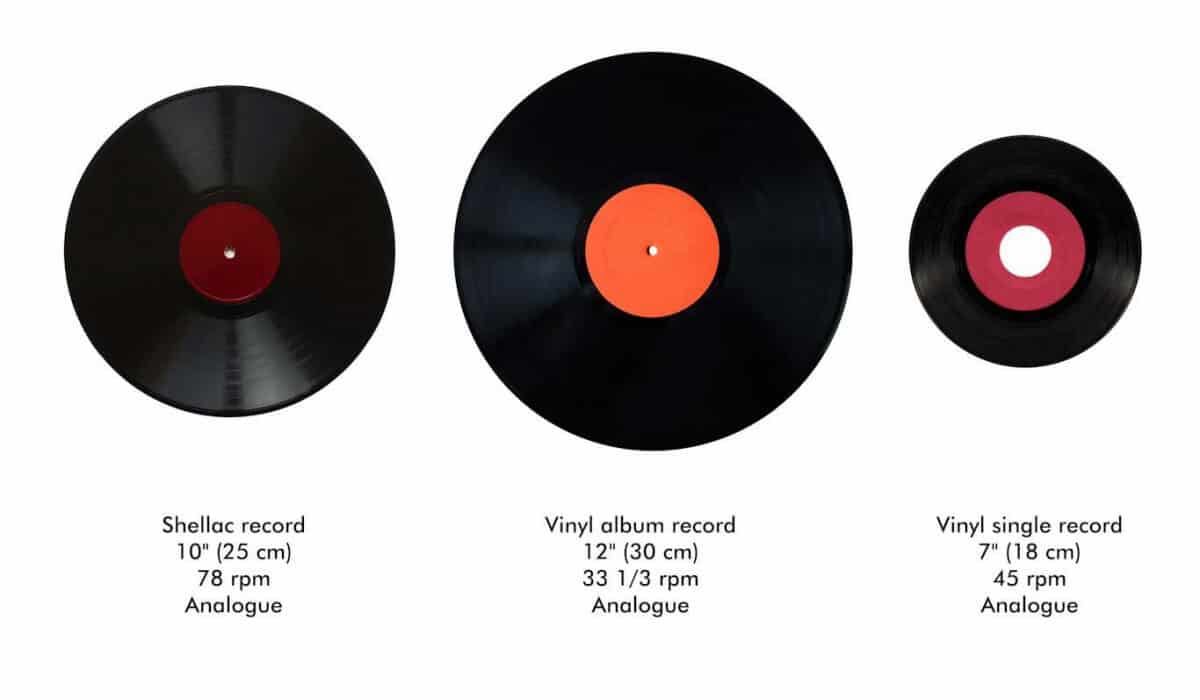
    There’s a lot of talk about the differences between 33, 45, and 78 records. Any vinyl enthusiast in the making has had this question in mind: How can I recognize which record format fits me best? The answer is the type of record player used and the RPM of the record in question.

    There are several significant things to consider to help differentiate between 33, 45, and 78 records. The first is the size of the record, the second comes down to the material, and the third includes revelations per minute (RPM).

    Vinyl has been making such a comeback in the last decade or so, and it looks like it’s not stopping anytime soon. DJs and music connoisseurs aren’t the only ones thrilled to dust off their worn-out turntables. The younger generations are here for it too, and they’re in need of some vinyl 101.

    It’s not possible to play any type of record on any turntable. There are record players that can play both 33s and 45s. Most of the time, a single turntable only plays one kind of record at a time.

    Vinyl production has reappeared in recent times. This essentially includes 45s, also known as LPs. This format is beloved among record companies, as it can contain a full album. 33s come up in record stores or online sales, but they aren’t in demand as much.

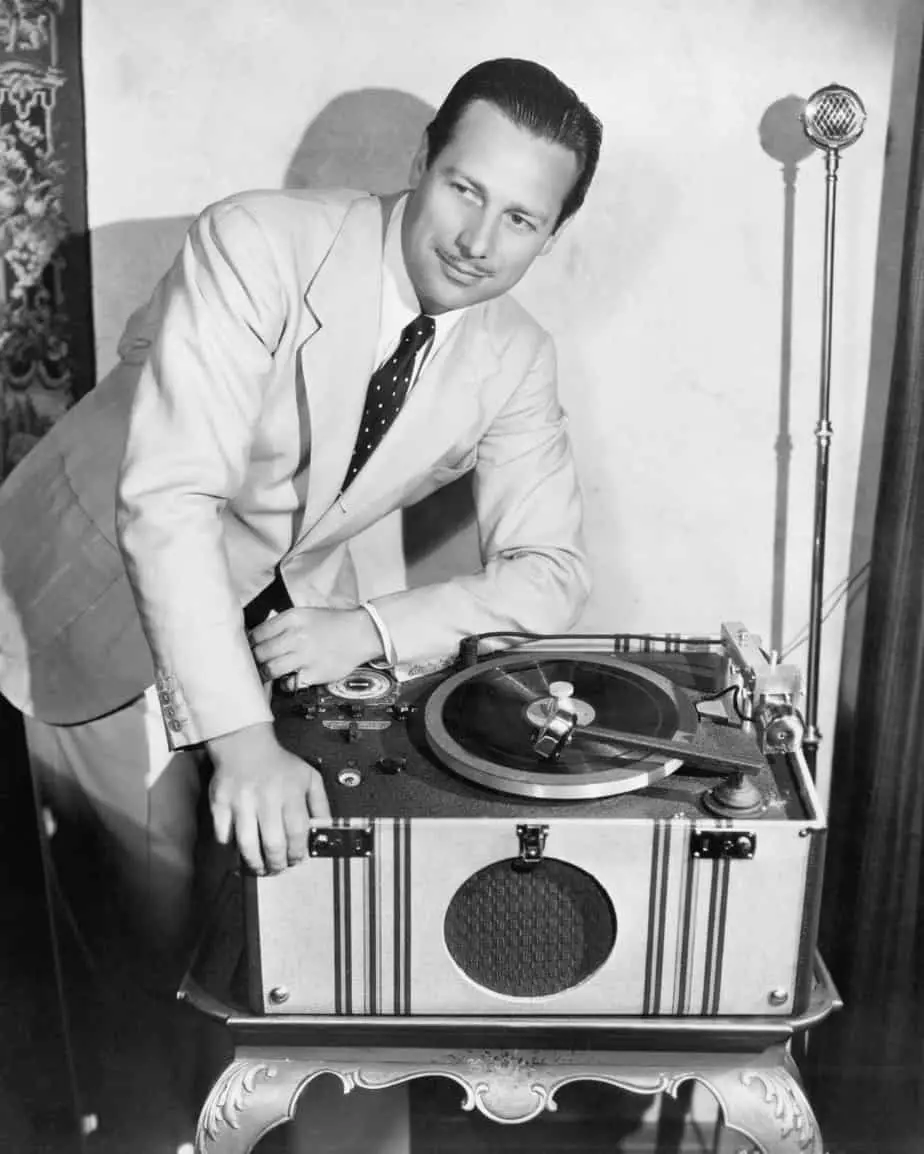
    Since 78s have been out of production for years, the chances are a turntable to play them on won’t be easy to find. Vintage turntables can do the job, but they are hard to come by and even harder to maintain.

    Industry demands have a lot to do with the types of records circulating. The public is less interested in the 78s due to their obscureness and lack of proper use. This wasn’t always the case, though.

    History of 78 Records

    The name ‘78’ comes from the number of revolutions per minute (RPM) this record plays at. It represents how many times it can spin on the record player in a single minute. In the beginning, the speeds varied from 60 to 130 RPM. (1)

    Since 1894, Berliner’s Gramophone Company started selling 70 RPM 7-inch records. Later on, the standard became 78 RPM due to the speed of the manufacturing machines. It then spread throughout the entire record industry. (1)

    Shellac was the material most commonly used to make 78s. It comes from a resin that lac bugs leave on trees. This resin mixes with alcohol, and a new component, shellac, gets made. (2)

    Before this, companies made records from glass and zinc. These materials were too fragile and incapable of being used for mass distribution. Because shellac was sturdier and moisture-resistant, it quickly became the medium of choice. (3)

    The records had grooves carved in that contained the sound info. When a gramophone needle traced the markings, it created vibrations. A speaker transferred them into sound. (3)

    Vintage turntables needed a person to operate them. They were hand-cranked up until the 1910s. That was when Berliner produced the first automatic gramophone, which could play at a higher speed. (3)

    The first 78s could only store about 3 to 5 minutes worth of music. They were single-sided, so the record limit was a song or two max. It wasn’t until after WW2 ended that the industry introduced vinyl records. (2)

    The Invention of Vinyl Records
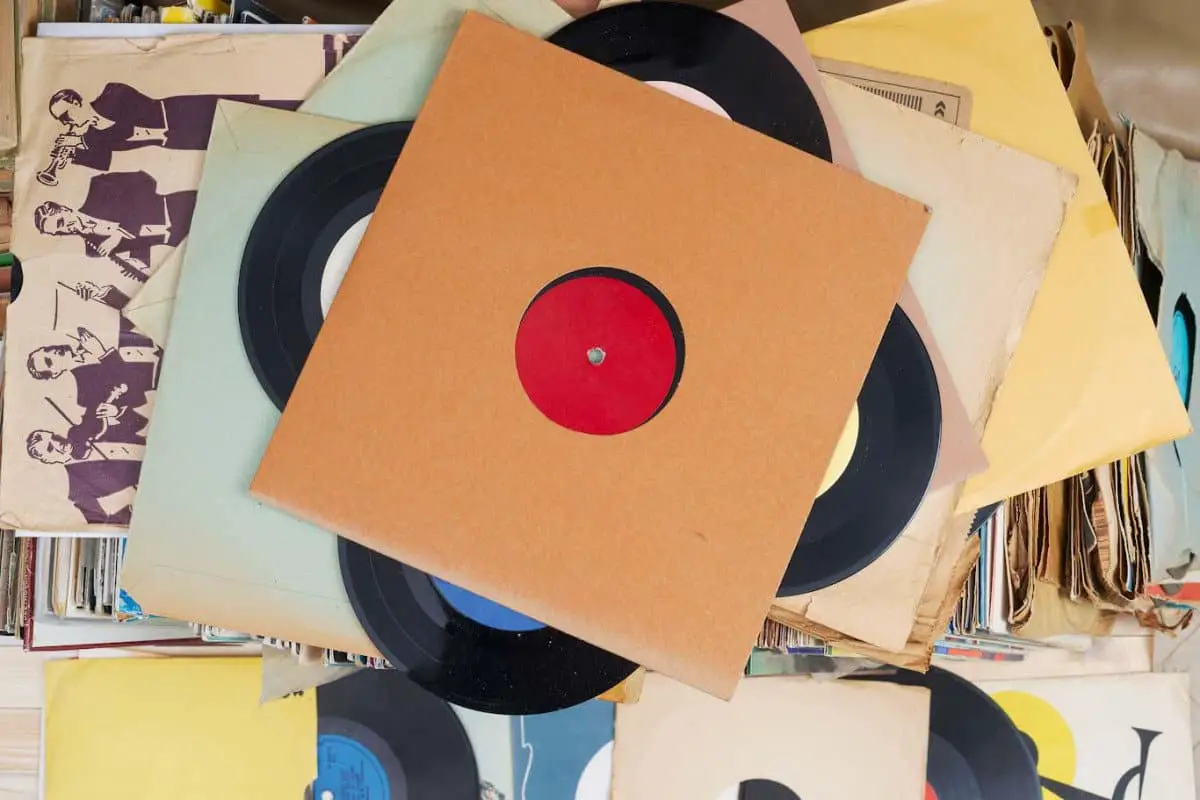
    Because shellac wasn’t the lightest of substances, record companies were looking for other solutions. Polyvinyl chloride appeared to be the next best thing. It didn’t weigh as much, it wasn’t as noisy as shellac, and it broke less easily. (4)

    Records made out of vinyl could also store more sound. The movie industry first introduced them for soundtrack purposes in 1926. The pieces of vinyl were increased to 16 inches and could play 11 minutes of sound. (4)

    Their speed had to go down from 78 to 33 1⁄3 revolutions per minute. They still had the same grooves used in the original 78s. 33s also came in acetate form, which the radio industry was using to tape their shows at the time. (4)

    The sound of the 33s was incomparably better than the one coming out of the 78s. Vinyl didn’t make as much noise when the needle was pressing onto it. Both the public and the music industry loved it, so they researched making even longer playing records. (4)

    The LP (Long Play) came into existence in 1948. It played at 33 RPM, and it appeared in 2 formats: 10 inches and 12 inches. The 45 arrived a year later, as competition to the LP. It was smaller (7-inch), yet the grooves were closer together. (4)

    The record company RCA Victor also released EPs (Extended Play) as 45s. It didn’t catch on at the time – the 45s replaced the 78s for singles only. As music artists gained popularity, their audiences wanted more from them. Fewer singles and more albums turned out to be the recipe for success, and little by little, the 78s lost traction. (4)

    78s Vs. 45s

    The similarities between the 78s and the 45s are apparent: both records play music by having the turntable trace their grooves with its needle. They can also appear in the same size: 10 or 12 inches. Both 45s and 78s come from either shellac or vinyl. However, it’s their dissimilarities that matter here.

    attribute/record type

    78

    45

    size

    10/12 inches

    10/12 inches

    speed

    78 RPM

    45 RPM

    sound

    acoustic, loud

    elegant, full

    max. playing time

    5 minutes

    60 minutes

    sides

    single-sided

    two-sided

    LP/EP

    no

    yes

    channel

    mono

    hi-fi

    Besides the speed, the most notable contrast is the amount of playing time the record holds. The 78 couldn’t hold more than 5 minutes of recorded sound, so it became obsolete. The 45 contained microgrooves with a closer imprint in the vinyl than on a 78.

    The microgrooves ensured more music per side, plus both of the sides were playable, unlike on the 78. It gave rise to a new way of releasing music, so LPs and EPs were born. Artists had more to say, and their fans could enjoy their tunes for longer.

    45s had intricate art on their covers to convey the messages the albums carried. Creatives connected to people from all over the world via this new medium.

    The sonic quality of the 45s was much richer compared to the 78s. Though vinyl scratched more due to its lightness, its surface didn’t create noise. With less room for dissonance, the public embraced the 45s wholeheartedly.

    Turntable companies recognized this movement too. 45s were smaller, so they took up less space than 78 RPM records. A new generation of record players flooded the market. (2)

    It’s tricky to locate a vintage record player that plays 78s. If you stumble upon these types of records, invest in a 78 adaptor that switches the pulleys within the turntable. Only then will the turntable be able to play at 78 revolutions per minute. (2)

    78s Vs. 33s

    Mass manufacture of the 78s didn’t stop until the 1950s. Children’s records seem to be the last types of 78s ever produced back in the 1970s. (5)

    33s and 45s became more and more sought-after. Every home had a record player, and everyone had their genre of choice. From rock and roll to gospel and soul, all recording artists released their new music in this way.

    As opposed to predominantly acoustic 78s, the industry started using new technology to record. Electrical recordings used a microphone to convert vibrations to an electrical signal, which connected to a stylus. A stylus cut through the surface of the record, leaving a groove behind. (5)

    Although the 33s typically don’t hold as much music as the 45s, they helped get rid of the 78s. 33s played for around 20 minutes per side in the beginning. Later on, they could store up to 60 minutes’ worth of music. (1)

    33s and 78s share the same size: they came in 10 or 12-inch formats. They play at opposing speeds, the first at 33 RPM and the latter at 78.

    As far as material is concerned, 78s consisted of shellac. 33s could be vinyl or lacquer-covered recordings. 78s and 33s share a resemblance but have a different feel to them.

    45s Vs. 33s

    The 78 recording was the predecessor to the 45 and the 33. It couldn’t compete with modern times as well as the other two for several reasons. Shellac used to produce the 78 was difficult to work with and even harder to take care of. The records were wide and large, thus incompatible with newer turntables.

    The 45s and the 33s stored more sound information, making them ideal for recording more than just singles. They both contained microgrooves made out of vinyl. It also meant the sound was smoother, as it allowed for high-fidelity. (2)

    The most significant difference between the two was in their size. The 45 was smaller than the 33; it was a 7-inch record, while the 33 was 10 or 12. They also varied in speed – the 33 was slower than the 45.

    45 records were more popular than the 33s because of LPs. They allowed for full album versions instead of more individual songs per side. Because 45s played faster, they sold better.

    Record companies competed using 33 and 45 RPM records. Marketing strategies tried to distinguish between the two, though the similarities were unmistakable. Over time, 33s fell into obscureness.

    45s still sell nowadays. They aren’t reserved for vinyl collectors only; they appear across all genres of popular music. Their recent comeback was unexpected.

    Revival of Vinyl Records
    Ever since the 1990s, records of all kinds started coming back into fashion. Music lovers couldn’t get enough of old recordings of late artists, vintage special editions, 80s records, etc. What nobody saw coming was the value vinyl has created for new listeners.

    We’re all fond of nostalgic items that bring us back to happier times. Ticket stubs from a great movie or worn-out letters from dear friends make us feel emotions we haven’t felt in a while. Vinyl records touch that same spot with their retro charm.

    Record companies stopped making vinyl because of the emergence of the CD in the late 1980s. Records didn’t sell as well as they used to, and the audiences were more interested in digital than analog formats. (6)
    It all changed with subcultures and the steady rise of alternative scenes. They embraced what mainstream popular music was trying to shut down. Their roots stemmed from a real place, which included playing records.

    Not all of the records produced throughout history found their way back to modern turntables. 33s were less famous than the LPs. 78s were unplayable except for the selected few who boasted with legitimate equipment.

    45 RPM recordings combined the best of both worlds. They represented a connection to history while holding space for the contemporary to thrive. That’s why the industry still produces them today. It might also be the reason to keep them in their plans for the future, who’s to say?

    In 2020, US-based vinyl lovers bought 27.5 million LPs. It was almost double the number of LPs sold the previous year. It was more than 30 times more compared to 2006 when the vinyl comeback began. (7)

    While 78s didn’t make the cut to this century, 33s and 45s did. Because of their devotion to creativity, 45s hold a special place on crates diggers’ shelves. With their nuanced covers and elaborate narratives, they tell stories other music formats don’t.

    Format Wars

    Before records became such a hit, radio reigned the airwaves. Everybody had a radio receiver back then so they could tune into their favorite stations. It was the prime source of news, music, and entertainment.

    The industry developed 8-tracks and cassettes using magnetic sound recording technology. They could be played via radios, and later on, walkmans. Both 8-tracks and cassettes were well-liked, yet not enough to survive in the 21st century. (8)

    Tapes weren’t enough to please true music enthusiasts who wanted to experience their music. Records came along, first the 78s, then the 33s and 45s. They ruled over the music market for decades.

    Everything changed when digital came into play. In 1982, Sony and Philips released the compact disc or the CD. It enabled digital encoding of sound using laser technology into a small round piece of plastic. (9)

    The CD could store much more audio info than any type of record. Lots of famous artists switched onto releasing CDs only already during the 1980s. There was a side to it that took the recording companies by surprise, and it had to do with its price.

    Who doesn’t remember PCs with CD burners (or friends who owned them)? It was a shortcut to getting an album you’d wanted but didn’t have to pay for it. As soon as the music industry took notice, it was already too late. Record companies lost a lot of money, and artists started suing for copyright infringement. (9)

    MP3s took this on a whole other level. The industry compressed music into this format that was even more digital than CD; it was intangible. MP3s roamed around the internet and its various sharing platforms, such as LimeWire. There was no way to control their fluctuation or the fact that very few people paid for them. (9)

    Digital music formats competed with one another, but they could never replace the feeling of a recording. The emotional attachment was greater than any ease of access. In the long run, analog won. It didn’t even matter if the records in question were 45s, 33s, or 78s, as long as they played.

    How To Play 33/45/78 Records

    To play your favorite 33s and 45s, all you need is a decent record player. Make sure to check the speed setting since 33s play at a slower speed than 45s. As for the rest of the equipment, use what you normally would: your speakers, as well as amps and preamps.

    For 12-inch records, it isn’t necessary to adjust the speed. These are primarily 33s, though a few 45s come in this size as well. If you’re in possession of a 7-inch record, meaning a 45, change the speed setting to 45 RPM. (4)

    This procedure isn’t as simple when it comes to 78 recordings. The first thing you need to take into account is choosing a turntable that ranges between 60 and 90 RPM. Remember, 78s play at a higher speed, but not all of them are set precisely at 78. (10)

    The cartridge needs to be stereo, and the styli needs to have a tip so as to play the 78 records. You’ll also need an amp that has a mono as well as a stereo set. Last but not least, plug in your favorite speakers – just because the record is old, it doesn’t mean the sound will disappoint. (10)

    It’s also possible to use adaptors which insert into the records to play them. It’s probably not any day that you’re able to play a vintage record, so take all the steps to ensure a quality experience.

    There are certain things to bear in mind when choosing between 45s, 33s, and 78s. Each of these has its advantages and disadvantages upon playing and handling.

    Pros and Cons of 33s/45s/78s

    33 and 45 recordings share a lot of the same benefits. They’re usually made of vinyl, have more playing time than the 78s, and are compatible with most turntables. On the other side, they shatter and scratch more easily.

    Pros of 33 Records:

    • Lacquer-based 33s are more resistant to scratches
    • Good sound quality
    • Longer playing time than 78 RPM recordings
    • Vinyl-based 33s have hi-fi sounds
    • Two-sided

    Cons of 33 Records:

    • Larger than 45s – mostly come in sizes of 10 or 12 inches, meaning not all record players can play them
    • 20 minutes of playing time, which is less than the 45s (no possibility of LPs/EPs)
    • Slowest RPM

    45s are in demand for a reason. They stood the test of time because of their many qualities, such as long play time and smaller size.

    Pros of 45 Records:

    • Smallest size out of all the records (7-inch)
    • Made out of vinyl, a lighter material than shellac
    • Good sound quality
    • Long play time (60 minutes), which enabled the release of LPs and EPs
    • High fidelity sounds
    • Two-sided

    Cons of 45 Records:

    • Vinyl scratched easily and wasn’t resistant to moisture
    • Not compatible with all turntables due to small size
    • Alterations to original music due to scratches

    Even though it had its faults, the 78 was a beloved record format for a very long time. It had certain advantages over the 33 and 45 due to its physicality.

    Pros of 78 Records:

    • Shellac didn’t allow records to warp
    • Moisture-resistant
    • Scratch-resistant due to the hard exterior
    • Unaltered original music
    • Quickest RPM

    Cons of 78 Records:

    • Limited playing time – 3 to 5 minutes, only singles could be released on 78s
    • Large in size – 10 to 12 inches
    • Single-sided only
    • Larger grooves collected more dust within the records
    • Easily shattered
    • Compromised sound quality
    • Mono sound only

    33s, 45s, and 78s each had their own time when they were the record of choice. A hundred years ago, nobody could imagine spending their every day without playing a 78 on a jukebox. Genres such as jazz wouldn’t have the platform as they had with the 78 on its side.

    Due to their nature, the 78s didn’t have a long shelf life. They were only good for releasing singles, and their primary substance, shellac, wasn’t sustainable.

    33s and 45s stepped in the recordings game in the 1940s and are still going strong. They have gone from unnecessary to nostalgic to acceptable anywhere. Without LPs, many music artists would never have the chance to communicate their message to the world.

    33 recordings weren’t as well-loved as 45s because of their limited playing time. They still had credit with their audience and continue to be valued collector’s items today.

    45 RPM records have more pros than cons in regards to the trace they’ve left on music. Without them, there wouldn’t be as much attachment to vinyl as we know it today. They’re an integral part of the culture of not only music but art as a whole.

    Significance of 33/45/78 Records

    Shellac and vinyl records combined have made an impact on the music industry and the public alike. No other format in the history of music has had such an extent as recordings have.

    There’s something warm about records that isn’t there with other analog options. Records feel like a safe harbor, and playing them is a process. It isn’t always easy, but we need it so we can feel the music.

    33s and 45s outlived 78s, but they also outlived CDs, 8-tracks, and cassette tapes. There was never an interconnectedness with the latter as there is with records. This is especially true for wax records, which still spin today.

    The future of recordings may be uncertain, but it’s there. 45s, in particular, have shown that they’ve got an audience that isn’t going anywhere. Even the younger generations are willing to learn how to play records and keep their story going.

    Artists around the globe are able to take part in this interchange of feelings and memories vinyl brings with it. They don’t have to settle for a medium that doesn’t resonate, nor do their fans. It goes for the content that’s on the record cover, as well as the one that goes within.

    With such attention to detail, it’s no wonder records went through their renaissance. There isn’t a single other format like that in our recent history that got the recognition vinyl has. It was all thanks to the public that wanted more out of their music.

    Markets follow the needs of their consumers. It’s soothing to know that there’s power in the decision-making process behind how we enjoy music. It’s not all about making money; there’s something in expressing the right sentiment. 33, 45, and 78 records can do that and much more.

    Which Record Is Better: 33, 45, or 78

    The answer to the question which record out of these three is the best one comes down to your personal preferences. If you don’t mind playing a single song at a time, go for the 78 record. This is best advised to classical music lovers who don’t have a problem with less-than-perfect sound quality. 78s are difficult to come by and need the proper TLC and an adequate turntable to play them.

    33s and 45s are the record formats to go for if you’re in the mood for an authentic listening experience. Take a walk down memory lane and see for yourself what it was like to immerse yourself in the music of your choice. Accompany either of these with a suitable record player and watch the magic unfold.

  • The Best Guide To Shipping Vinyl Records

    The Best Guide To Shipping Vinyl Records

    Are you a newbie to vinyl records, and you’re wondering how best to ship them? Well, you’re in luck because this article focuses on handling vinyl records. We will talk you through the best ways to send your newly owned vinyl records without damaging them.

    Vinyl records are best shipped in slightly thick papers, for example, cardboard. However, if you do not pay extra attention to packing your vinyl records carefully, it could result in a loss.

    To understand how you can package your vinyl to ship them safely, you first must understand the rudiments of safely sending things. With this information, you will be better equipped to transport sensitive and fragile materials such as a vinyl record.

    Essential Guidelines To Guarantee Safe Shipping of Fragile Vinyl Records

    When shipping, different rules are applicable. These additional rules are fundamental when the goods involved are labeled fragile.

    A vinyl record is a fragile shipment and thus cannot just be wrapped up and posted in the mail. You must follow essential procedures to ensure your vinyl remains in its original state before, during, and after shipping.

    The following guidelines will point you towards some of the best steps to follow when shipping your vinyl record either in bulk or per piece.

    Distance

    The first thing you want to do is calculate how far you’re shipping your vinyl record. Distance helps to determine how long your record spends sealed in a box, bearing in mind that your record can easily face destruction by heat, and we don’t want that.

    Distance also determines how you package your record before shipping and in what storage container it should be shipped.

    Packing Your Vinyl Record

    The most crucial step is to ensure that your vinyl record will be well-protected from external and internal influences that could cause damage. How do you do that?

    It is a quick and straightforward guide on the best way to pack your vinyl for shipping.

    • First, take your record out of the outer jacket.
    • You then take the record out of the inner jacket.
    • Place the vinyl record in a new protective inner jacket. It is sometimes customized or printed. You can order inner vinyl jackets online, so you have a new one for each use.
    • Carefully place the record between both jackets taking care not to touch or scratch the surface.
    • Once that is done, you then tape both jackets together firmly so that the record cannot move around.
    • You can then secure the record from external damage by wrapping it up tightly in bubble wrap or foam sheets and further taping them together.
    • Make sure your bubble wrap does not have wiggle spaces. For bulk packaging, you can purchase some strengthening stiffeners for records.

    Choosing The Right External Container

    Even though you have firmly secured your vinyl record from movements and scratches, a poor shipping container might put your efforts to naught.

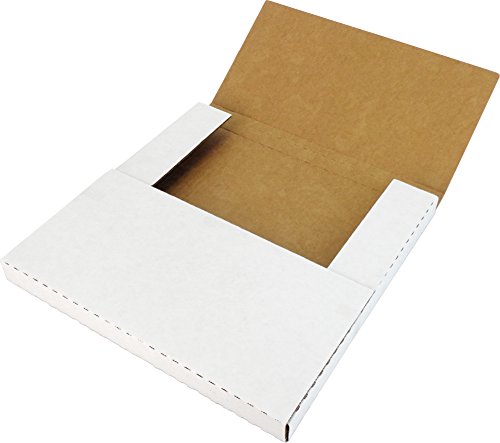
    That’s why it is essential to purchase an LP Mailer. These are available online(Check price on Amazon here) in different sizes and types that are suitable for both single and bulk shipping. (Source)

    (10) White Vinyl Record LP Shipping Mailer Boxes - Holds 1 to 3 12" Records - Adjustable Height - Strong 200# Test Cardboard #12BC01VDWH

    If you are shipping in bulk, do not try to make your record mailers or improvise, as this could affect your record. It might be expensive to purchase several vinyl record mailers, but it will be worth it.

    Sealing

    Once your firmly secured, bubble-wrapped record is placed in the mailing container, you can then seal it up properly. It helps to protect from external damages such as water.

    Labeling

    Now, labeling your package involves two parts:

    First, make sure you check and double-check your addresses and contact number. Write them out clearly. Using water-resistant writing stickers too can be helpful, so the ink doesn’t run out, and the writing becomes illegible.

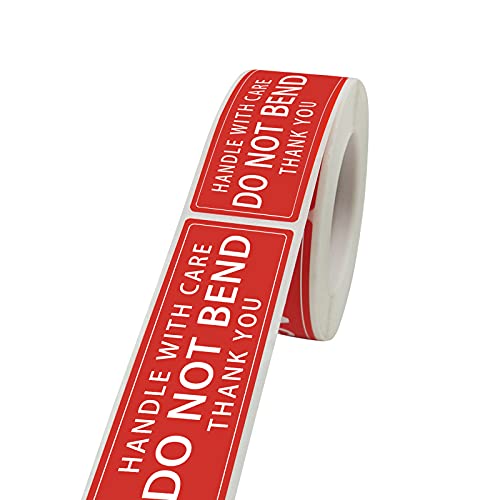
    The second part is to make sure you label your box as “Fragile” or “Vinyl Record, Do Not Bend.” It calls the attention of whoever is handling your shipping to the sensitive content in the parcel. You can also find Handle with Care – Do Not Bend – Thank You Shipping Stickers Labels on Amazon here.

    3" X 1.5" Handle with Care - Do Not Bend - Thank You Shipping Stickers Labels, 250PCS Per Roll

    Insurance

    It isn’t necessary but might come in handy. You just might have to ship a vinyl record that is old or rare.

    Insurance protects you in cases of unforeseen damages or the event of not-so-common instances of property loss. That’s why it’s crucial to choose a suitable carrier for your shipment.

    Weight And Shipping Costs

    Depending on the number of records you are shipping, the weight differs. The final weight of your vinyl records shipment, all packaging inclusive, determines the shipping price.

    Now, most shipping companies charge extra for fragile shipments. The delivery period can also affect your shipping cost, i.e., how fast you want your order delivered.

    Shipping Company/Period

    It is advisable to use shipping companies that handle fragile products for vinyl record shipping. It assures you that your package gets handled with extra care.

    As earlier explained, distance is a determinant when calculating the shipping period. However, there are shipping companies that prioritize prompt delivery at affordable rates.

    Tracking Your Shipment

    Your order has been successfully packaged and shipped, but it doesn’t end there. You have to keep up with your package in transit constantly.

    It keeps you apprised of the delivery period and also notifies you immediately if something goes wrong.

    How Many Ounces Is A Vinyl Record?

    Vinyl records come in different sizes, with the most common being the “7”, “10”, and “12” inches. A 7-inch Vinyl record could weigh as low as 1.4 -1.7 ounces, while a 12-inch record could go as high as 4.2 – 6.3 ounces.

    Now since the music or sound is stored on the surface of the Vinyl record, its overall size and weight are determined by factors such as the following:

    • RPM – Revolution Per Minute (the speed at which the record turns during play)
    • Average minute per side (record length)
    • Diameter
    • Quality
    • Durability

    The material density and record thickness will inherently determine the record’s actual weight and the thickness and material of the record sleeve.

    How Do I Care For My Vinyl Record?

    Your vinyl record is an analog music disk. What this means is that your record is vulnerable to dust, water, heat, and scratches. It, in turn, compromises not only the quality but also the audio sound of your vinyl record.

    Some tips for caring for your vinyl record include:

    Storage

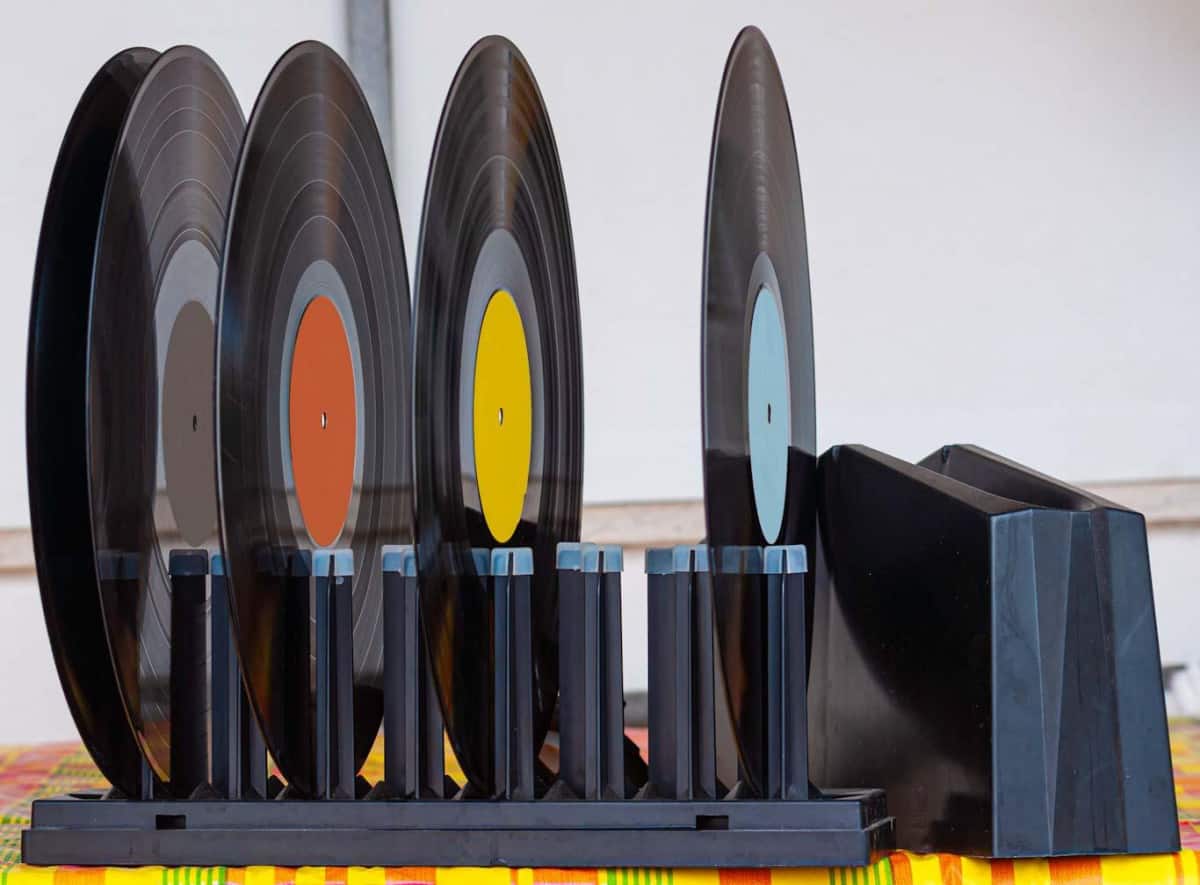
    Always store your vinyl records vertically. It helps to avoid pressure on them that might result in bending.

    Always store your vinyl records in a dry and cool place. Water or heat will easily damage your collection. Be careful not to store different sizes of vinyl records together.

    You can find more about storing vinyl records in these articles that I wrote.

    Cleaning

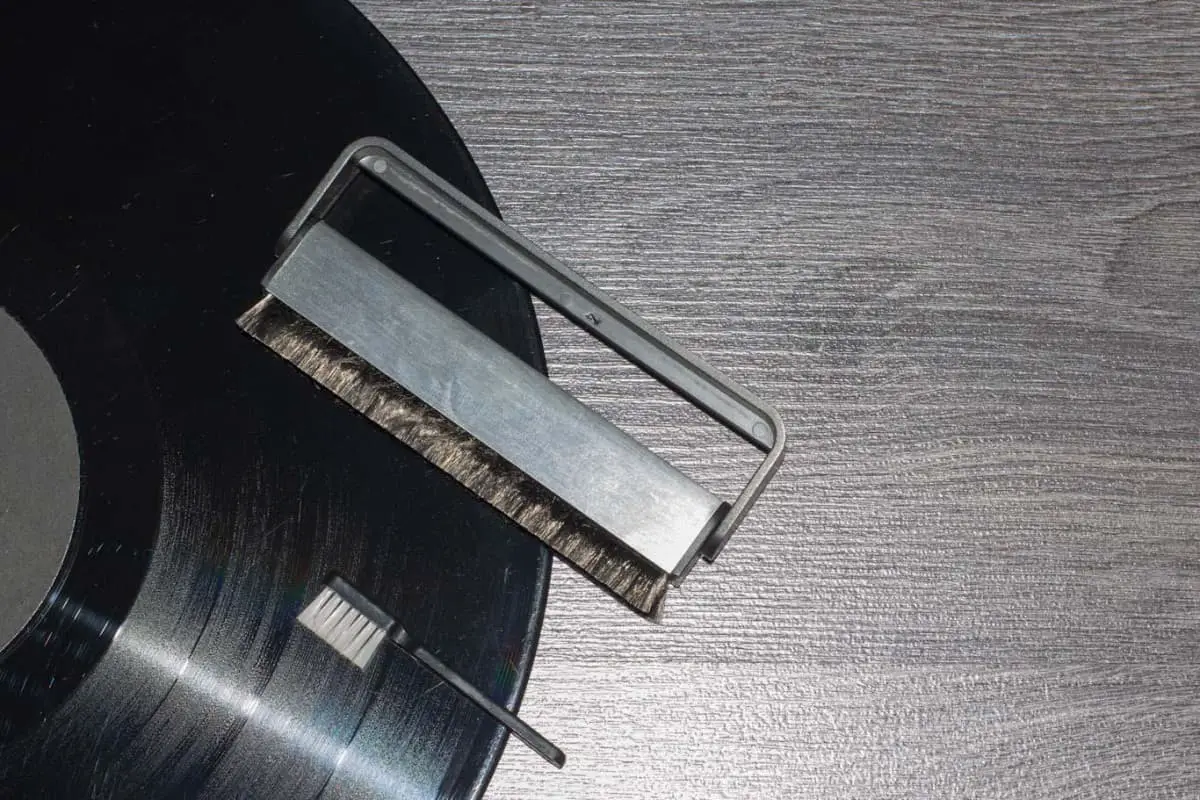
    You can purchase an anti-static carbon fiber brush online that is suitable for cleaning a vinyl record.

    You can also purchase a vinyl record cleaning fluid alongside a microfiber cloth. You get to wipe off fingerprints or dust prints in a non-abrasive way.

    Touching

    Pay extra attention to holding your vinyl records around the edge with clean hands; even the slightest touch can negatively impact the quality of sound from a vinyl record. (Source)

    Final Thoughts

    Are you worried about having to ship a rare collection? Are you anxious about making your first delivery? This article is a detailed and comprehensive guide on the best ways to ship your vinyl collection.

    This guide gives insight into a few things that might not cross your mind and all you need to know about vinyl records.

    Sources

    1. Vinyl for Miles, “How To Pack And Ship Vinyl LP Records like a Pro,” YouTube video 17:53, posted by “Vinyl for Miles,” November 18, 2020, https://www.youtube.com/watch?v=Hl9SEjr0Eys

    2. Anna Merkl, “How Technology Changed the Rhythm of the Music Industry,” (Undergraduate honors thesis Louisiana State University & Agricultural and Mechanical College, Baton Rouge, Louisiana 2020)

    3. Walter L. Welch. 1972. “Preservation and Restoration of Authenticity in Sound Recordings,” Library Trends (1972) 21(1):83–100.

  • Turntables Vs. DJ Controller: A Comparison

    Turntables Vs. DJ Controller: A Comparison

    Do you want to know the differences between turntables Vs. DJ controllers? You are in the right place. This article compares both equipment types, weighing their pros and cons, so you have a clear idea of which is beneficial to you.

    Turntables and DJ controllers are tools that allow DJs to mix and play music. However, there are many differences between both that make either of them a preferable option. Some of these differences include their setup and required skills.

    To explore the differences between both types of DJ’ing equipment, we first need to break down each one and the components that make them unique. Without further ado, let’s get right into it.

    What Are Turntables?

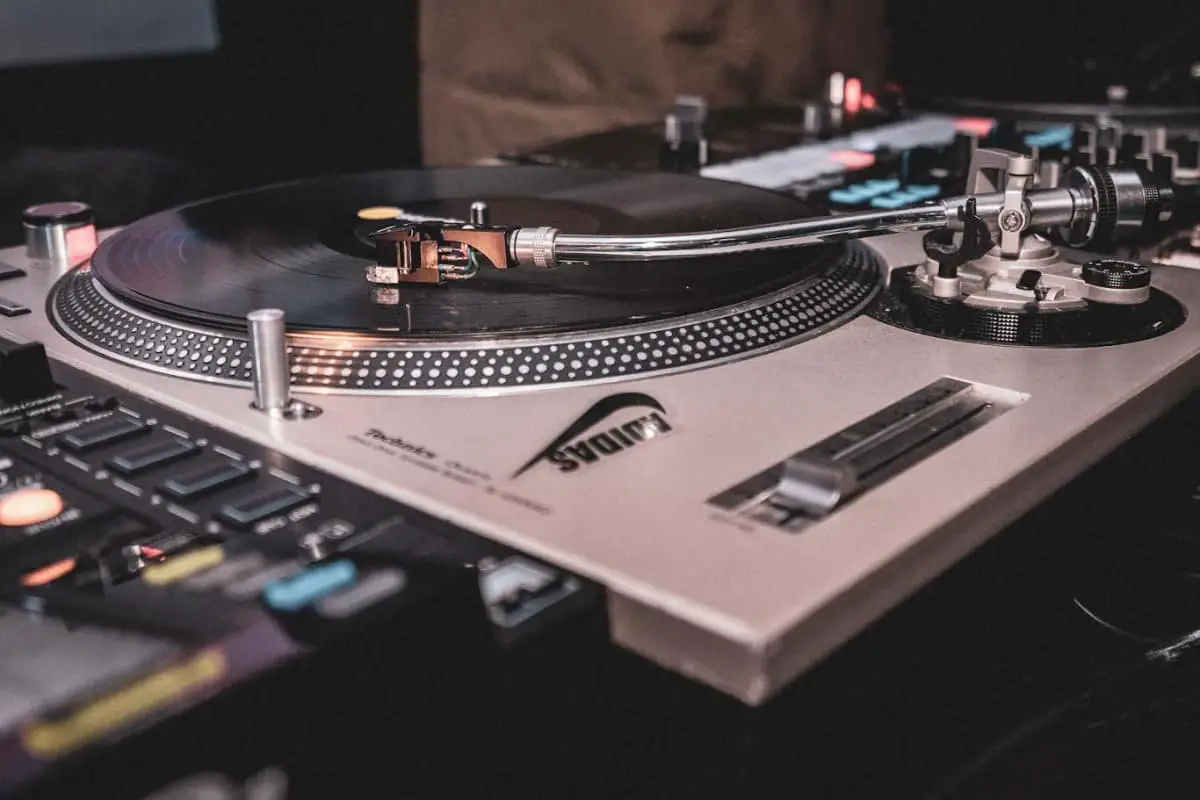
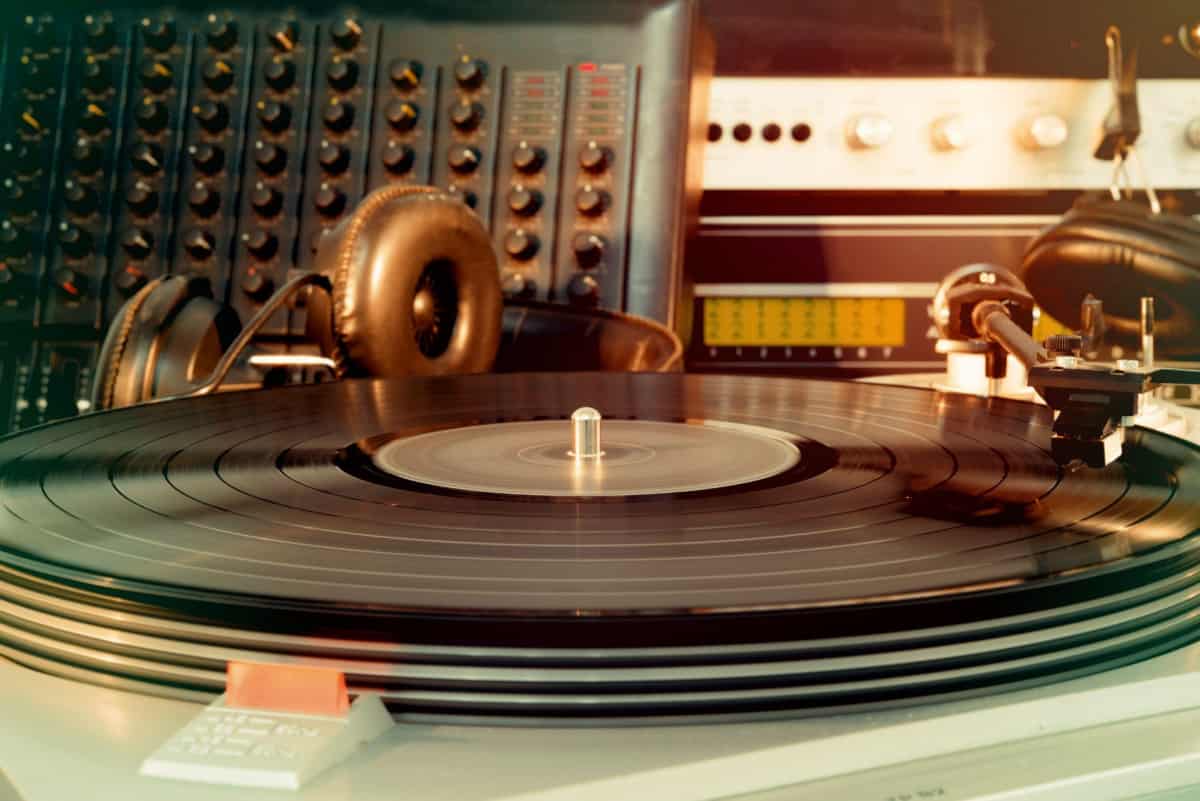
    A turntable is a playback machine used by DJs to play pre-recorded music. The terms “turntable” and “record player” are sometimes used interchangeably, especially when vinyl records are involved, which could confuse newbies.

    Although both are record players with a lot of similarities, they are also very different. For one, a record player is designed solely for listening to music, while you can use a DJ turntable for mixing, beat matching, and scratching music.

    A DJ turntable uses a needle (attached to the cartridge) to pick up music carved into the grooves of vinyl, then transmits this sound as an audio signal to an external preamp, amplifier, and speakers to play the music out loud.

    In the mid-’90s, the use of DJ turntables evolved to include scratching, where the DJ quickly moved the vinyl record backward and forward. This series of sound effects became known as turntablism and was created by hip-hop DJs. (source)

    Since the invention of more digital methods for listening to music, turntables have evolved to become more digital. Digital turntables can emulate this spinning and even produce more sound effects.

    The Different Features of A Turntable

    A turntable has different key features that give it a wide range of functionality. These additional features include:

    1. Platter And Tonearm

    The platter and tonearm are essential for a turntable to function. Without them, music playback would not be possible.

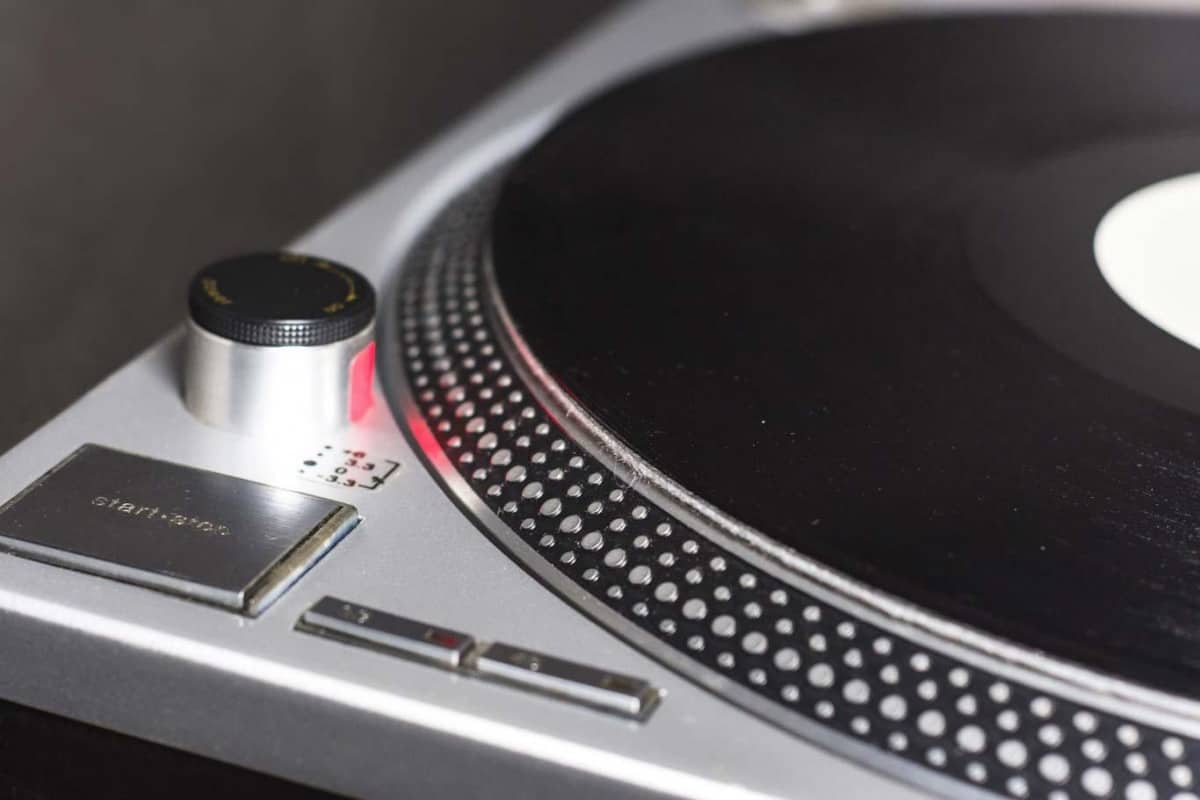
    A large percentage of the turntable’s surface consists of the platter, which can be driven by a motor directly or indirectly, using a belt.

    To use a turntable, place the vinyl record on the platter, then delicately place the cartridge (attached to the tonearm) on the vinyl surface. The platter spins the vinyl at constant speeds while the cartridge reads and plays back music.

    Depending on the preference of the DJ, there are several types of cartridges available for use on the turntable.

    2. Motor And Torque

    A turntable’s torque is the power with which the platter turns, and it is controlled by the efficiency and strength of the motor. As mentioned earlier, there are two types of motors – belt-driven and direct-driven.

    Belt-driven motors are indirectly connected to the platter via a belt and have a lower torque than direct-drive motors (which are directly connected to the platter).

    However, direct-drive turntables are more expensive and the preferred option for professional DJs.

    Differences Between Belt-Drive and Direct-Drive Turntables

    Belt-Drive

    Direct-Drive

    It uses a belt-driven motor that you can separate from the platter.

    It uses a direct-drive motor that is attached to the platter

    Has a torque of <1 kg/cm

    Torque can reach up to 5 kg/cm

    Susceptible to external interference, such as humidity and temperature

    Less susceptible to external interference

    The belt needs regular replacement due to wear and tear

    Low exposure to wear and tear. Thus it doesn’t need regular replacement

    Best for private use

    Best for professional use and live performances

    3. Signal Transmission

    Since a turntable needs an external, supplementary device to play music out loud, it transmits signals to those devices. Depending on the type of turntable, there are three methods to transmit signals.

    Traditional analog turntables use a needle that is housed in a cartridge to transmit signals. Another method, the digital vinyl system (DVS), uses a cartridge but ads a DJ software and an audio interface that converts analog information to digital data.

    A DVS doesn’t play regular analog vinyl but time code records that contain a continuous tone that the DJ software can pick up and respond to. (Source)

    The third method is PHASE, which eliminates the need for a tonearm and cartridge by using wireless transmission devices to play music from the DJ software.

    Differences Between Analog, Digital, and PHASE Vinyl Systems

    Analog

    Digital

    PHASE

    It has a characteristically rich analog sound

    Has all the benefits of digital audio while retaining the fee of analog turntables

    Has all the benefits of digital audio while retaining the fee of analog turntables

    Despite wear and tear, it has high emotional and collector’s value

    Fewer chances of wear and tear

    No risk of wear and tear

    Requires the purchase of physical music

    Digital music that you can carry around with you

    Digital music that you can carry around with you

    Has limited functionality

    Advanced functionality, including effects, performance modes, and MIDI technology

    Advanced functionality, including effects, performance modes, and MIDI technology

    Other features that a turntable has include: Ultrapitch (wider pitch ranges), reverse function, and MIDI-compatible control sections that add a creative feel to your DJing.

    All of these features depend on your style of djing and your needs. For instance, if you use a DVS, you may also wish to include an additional MIDI control section to control your performance modes in your software.

    It is because it adds more dimensions to your live performance, such as looping, cue point, and key shifting.

    Pros Of Using Turntables

    1. Scratching

    Although controllers allow you to scratch (to an extent), they cannot match turntables. After all, the art of scratching was formed and perfected on traditional turntables.

    2. Unique Choices

    Turntables afford you the flexibility to build a unique record collection that no one has. There is a lot of vintage music that never got released on digital, the only place you can get those songs is from a vinyl store.

    3. Best Sound

    It is an ongoing argument within the DJing community. Many believe that the analog sounds from a vinyl record are authentic and unbeatable. They claim that no other digital controller can reproduce them.

    4. Build

    Turntables cost a lot of money, but their durability more than makes up for it. If you treat your turntable well, it could last you for several decades.

    Cons Of Using Turntables

    1. Limited Music Selection

    Record labels nowadays do not bother making vinyl records of new releases. Most new-age songs only have digital releases available. Unless you’re using digital turntables, your music selection is pretty limited.

    2. Prone to Damage

    Turntables have very delicate parts, like tonearms and needles, and these can quickly get damaged if you don’t exercise caution and care. Turntables that are used regularly for parties and events are more prone to damage.

    3. Heavy and Bulky

    Turntables are bulky and heavy, which can make transporting them around a burden. Most of them contain clamps and weights that add extra load to the unit. The average weight of most vinyl players is around 17lbs.

    4. Challenging to Use

    Turntables are hard to use, especially for beginners that have never used them before, or worse, never even played a vinyl record before.

    5. Pricey

    Turntables are expensive to set up and maintain because each component is usually sold separately. Not to mention the high cost of buying the vinyl record itself!

    What Is A DJ Controller?

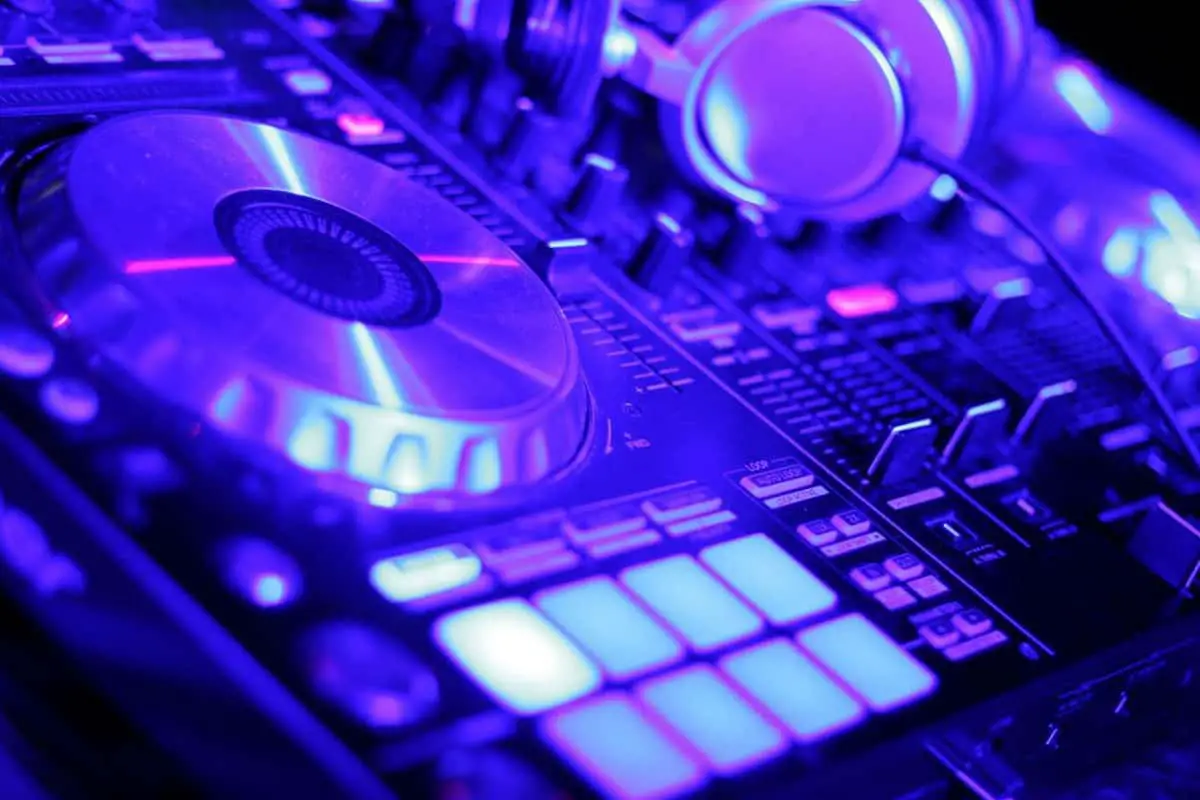
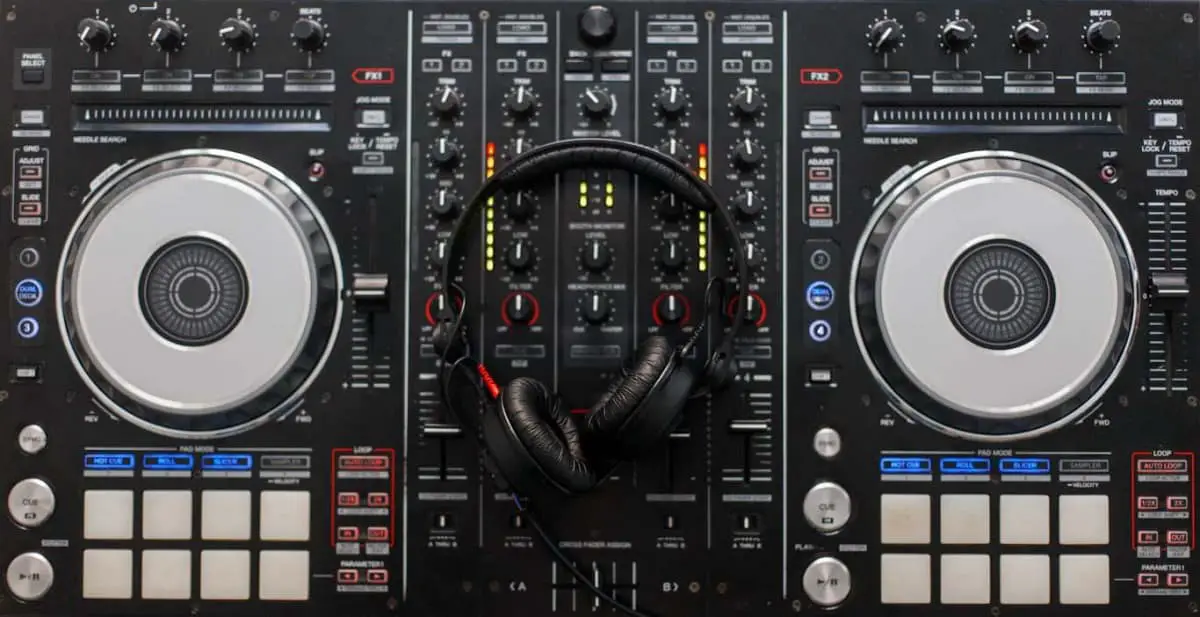
    A DJ controller is a modern, all-in-one device that combines all the elements of a traditional mixer and decks into one piece. Most, but not all, controllers require a laptop and mixing software that gives DJs all the features and controls to mix music easily.

    Compared to traditional turntables, a controller has so many more functions to offer and is typically more affordable.

    Generally, a DJ controller mimics the traditional setup of a mixer and two turntables (asides from a few significant differences) by incorporating them all into one unit. You can scratch, mix tracks, and adjust EQs with a DJ controller, just as you would with a traditional setup.

    Typically, DJ controllers control the DJ software installed on your computer. Then you would need a USB cable to connect your laptop to the controller, which gives you complete control over all the digital music in your library via the DJ software.

    However, standalone DJ controllers allow you to do all of these without the need for a laptop. The DJ software comes pre-installed into the unit, which also has a large screen for navigation.

    Apart from the regular platter and volume functions from the traditional setup, some knobs and controls allow you to switch between songs.

    What Can A DJ Controller Do?

    Apart from the normal function of mixing music, scratching, and listening to music, here are other functions that a DJ controller can perform.

    1. Re-Edit Music

    A DJ controller allows you to re-edit songs without the use of an audio editor. Some of the things you can edit using a DJ controller include switching drops, creating more extended intros, or drumming out new melodies.

    However, all of these depend on the kind of DJ software you use. If you were to edit music using a traditional turntable setup, you would have to use an audio editor.

    2. Video Mixing

    It used to be that to mix a video, you needed to have a specialty visual mixer. However, with a DJ controller and software, you can use the processing power of your laptop to either play the song’s video or create your own synced visuals.

    3. Customize Interface And Control Mapping

    Every DJ has a unique style (or they should have one), so how you use your DJing equipment will differ according to that style.

    The DJ software can allow you to customize your interface so that the functions you regularly use are right there, at your fingertips, and within reach. At the same time, you can hide the ones you rarely use away.

    Although a DJ controller comes with a pre-installed control mapping, some DJ software can allow you to customize your control mapping, so the buttons you use the most are within reach.

    What Features Do Controllers Have?

    Some notable features of a DJ controller include:

    1. Jog Wheels

    These mimic the platter of a traditional turntable that allows you to scratch, nudge tracks, and adjust speeds to keep them in time.

    2. Knobs And Pots

    The knobs and pots on a controller function like those on a traditional mixer and allow you to adjust volume, EQ, and FX.

    3. Software Integration

    Although most decks, mixers, and DVS allow you to connect to software using your laptop, it is not as intuitive and proactive as a DJ controller.

    Controllers are built to work alongside DJ software (and not as an afterthought), so they have much better, deeper, and intuitive integration with the software to access all of the remarkable functions outlined above.

    4. Pads

    A DJ controller also has pads, which are uniquely associated with them, to produce other effects, such as FX, hot cues, and samples.

    5. Faders

    A controller has two different types of faders that control audio volume. The channel fader allows you to control the volume of individual tracks, while the crossfader will enable you to set to instant cut (which is useful when scratching) or fade between songs.

    Other features include the Play/Pause buttons (that allow you to cue, play, and stop songs) and the ports (that will enable you to connect to multiple hardware like speakers, extra decks, or a laptop).

    Pros Of Using A Dj Controller

    1. Affordability

    A DJ controller is very affordable, which is great for beginners trying their hands out at DJing without investing too much into equipment. Some simple controllers cost as little as $50.

    2. Ease Of Use

    It’s easier to learn how to use a DJ controller than a traditional turntable. It has digital features like the sync button that keeps track of song time, so you don’t have to learn how to beat-match.

    3. Compact And Lightweight

    All of the features on a DJ controller are on one unit, so it is compact and easy to transport around without lugging around the extras like mixers, records, and cables.

    Another advantage is that because the songs are digital, you can carry them around with you wherever you go. (Source)

    4. More Functions And Flexibility

    A DJ controller has almost all the different functions you need to perform. From loops to hot cues, touch strips, FX, assignable buttons, and other components, you have the flexibility to wow your audience at every turn.

    5. Cheaper And Better Music Quality

    Digital music has better sound quality, even compared to vinyl records, especially if they’re WAVs. They are also cheaper to buy, and you can easily build an extensive collection of songs for variety.

    Cons Of Using A Dj Controller

    1. Software Oriented

    Most DJ controllers can only work with specific software. Unless you have a playlist you have already synced with your library, you won’t be able to play music using a USB stick or a vinyl record straight from its cuff.

    2. Harder To Connect With The Audience

    It’s harder to connect to the audience and get into the feel of your performance if your eyes are focused on your laptop to keep track of things. It may look to your listeners like you’re uninterested in interacting with them. (Sources)

    3. Prone To Faults

    Several things make a DJ controller prone to faults. For one, you need to use a laptop. The moment your laptop develops a faulHeret or decides to do an update in the middle of your set, you’re in a world of trouble unless you have a backup.

    4. Small Buttons

    The buttons, knobs, faders, jog wheels on the DJ controller are small and can be cumbersome to operate. It is because they have to maximize the space to fit all those features on one unit.

    Comparing Turntables Vs. Dj Controller

    The significant difference between a turntable and a controller is that the latter is a compact unit with all features in one place. At the same time, the former requires supplementary devices to work. There are many things a DJ controller does that a turntable cannot. (Source)

    However, there are similarities between a DVS and a DJ controller because they both play audio devices. With the addition of a few components, a DVS should be able to do what a DJ controller does easily.

    It is a table highlighting the significant differences between turntables and a DJ controller.

    FEATURES

    Turntables

    DJ Controller

    Beat Looping

    YES

    Platters and Needles

    YES

    Hot Cues

    YES

    Performance Effects

    YES

    Jog Wheels

    YES

    Sync

    YES

    LED Display

    YES

    REQUIREMENTS FOR SET UP


    Computer

    YES

    Mixer

    YES

    USB Compatible

    YES

    BEST FOR


    Portability

    YES

    Durability

    YES

    Price

    YES

    Scratching

    YES

    Beginners

    YES

    Conclusion

    Hopefully, this article has given you a better understanding of the differences between turntables vs. DJ controllers.

    In summary, if you are just starting as a new DJ, a controller is a more comfortable, affordable, and more straightforward way to ease yourself into it. In contrast, more experienced DJs have more flexibility to choose between both.

    At the end of the day, whichever one you choose depends on your needs. Once you have carefully weighed the pros and cons and seen which one encompasses your needs the most, then you can go ahead to buy one.

    Sources

    1. Curry, B. (2015). Hip-Hop “Turntablism, Creativity and Collaboration. By Sophy Smith. Farnham: Ashgate,” 2013. 168 pp. ISBN 978-1-409-44337-7. Popular Music, 34(1), 137-140. doi:10.1017/S0261143014000737

    2. Florian Heller and Jan Borchers “Visualizing Song Structure on Timecode Vinyls” (presentation, International Conference on New Interfaces for Musical Expression (NIME’14), Goldsmiths, University of London, UK Jun 30 – Jul 03, 2014)

    3. Takuro Mizuta Lippit “Turntable Music in the Digital Era: Designing Alternative Tools for

    New Turntable Expression” (presentation, International Conference on New Interfaces for Musical Expression (NIME06), Paris, France June 4-8, 2006).

    4. Rietveld, HC (2016). “Authenticity and Liveness in Digital DJ Performance.” in Hytönen-Ng, E and Tsioulakis, I (ed.) Musicians and their Audiences: Performance, Speech and Mediation New York (USA) and London Routledge, Dec 08, 2016.

    5. Pri yon Joni, “9 Things You Need To Know Before “Upgrading” To Turntables From A Dj Controller,” YouTube video 23:29, Posted By “Pri yon Joni,” Aug 25, 2021. https://www.youtube.com/watch?v=y6ucRNVzkSU

  • How To Polish Your Plastic Turntable Covers

    How To Polish Your Plastic Turntable Covers

    Do you have a hard time polishing your plastic turntable cover? If you’ve ever tried to clean a dirty turntable cover like you would wipe down any dusty surface, you can hardly attest to how much time and effort you put in to see any immediate changes. This article will address simple and effective methods to get rid of dirt from your turntable covers.

    There are two effective methods to get your turntable cover clean again – using homemade polishers and factory-made polishers. The homemade method uses items you have at home, while the factory-made requires you to buy particular products to polish your turntables.

    Turntables plastic covers are just as essential as turntables themselves. They prevent water, dust particles, and scratches to the turntable. However, after a few years or an extended period of usage, your turntable plastic cover will start to wear out and look dull and scratch-filled. (Source)

    Without further talk, let’s get right into the different ways to polish your plastic turntable covers.

    Different Ways To Polish Your Plastic Turntable Covers

    Polishing your plastic turntable covers can either be really easy or quite demanding. This process entirely depends on how badly damaged the plastic turntable cover is and what method and product you choose to use.

    There are several methods to polishing your plastic turntable covers that revamp your plastic covers immediately and leave them looking shiny and new.

    These methods include making use of homemade products, purchasing and using plastic polish products, or using plastic polishing machines.

    Based on the type of materials used, these methods will be grouped under 2:

    • Homemade plastic turntable cover polishers
    • Factory-made plastic turntable cover polishers

    Using Homemade Plastic Turntable Polishers

    Homemade plastic polishers are DIY methods. These methods involve using cheap and affordable products within the home you never thought would work effectively.

    Let’s get into these products and the best ways to use them.

    First Method

    For the first method, you will need the following items:

    • A Bowl Of Warm Water
    • Liquid Dish Detergent
    • 2 Microfibre towels
    • Plastic Polish

    Once you have gathered these items, follow the following steps to get your turntable covers clean again:

    • Mix some liquid dish detergent into the bowl of warm water and mix it till it foams.
    • Soak your microfiber towel in this soapy water and then wring it out until it is damp.
    • Carefully wipe all dust-covered surfaces with this towel making sure not to scratch or damage anything.
    • Soak in the second towel in plain water and then wipe down your dustcover to remove soapy deposits.
    • Wait for the cover to dry out, and then add some plastic polish to a microfiber towel to polish your plastic cover surface.

    This simple yet effective method will leave your plastic cover looking neat and new.

    Second Method

    It is helpful when you intend to clean your turntable cover and lighten some scratches. For this method, you need:

    • Toothpaste
    • Warm Water
    • Car Wax
    • 2 Microfibre Towels
    • Plastic Polish

    After you have put together all of these materials, follow the following steps for the best results:

    • Soak the towel in a bowl of warm water.
    • Wrong out the towel till it is damp, and then apply some toothpaste to its surface.
    • Wipe your dustcover from top to bottom with this towel.
    • Soak a fresh towel in warm water and wipe off any paste residue on your cover.
    • Apply some car wax and plastic polish to the cover as soon as it’s dry.

    These methods are pretty time-consuming and energy-demanding, but they work just fine if you are on a budget or you love the thrill of revamping and caring for your vinyl records.

    Using Factory Made Plastic Turntable Polisher

    These products are made under strict rules and guidelines and are intended for cleaning, polishing, and restoration purposes.

    This method can either be through the use of plastic polishing chemicals or polishing machines. It is necessary to pay attention to the quantity and follow the instructions on the containers carefully.

    Some of these polishes include:

    Savouryeves Turntable Cover Polisher

    This polisher is a specially formulated chemical for plastic covers. It is a long-lasting product that is easy to use.

    All you need to do is apply the polisher to a buffer pad that comes with the polisher and wipe down your turntable cover. It works instantly to get rid of dust residues, swirls, and scratches.

    This polisher also effectively gets rid of water and oil stains. This paste polisher gives absolute value for money with a shelf life of 3 years.

    Novus Plastic Polish Kit

    This plastic polish was designed especially for dust covers. It helps to get rid of all scratches, debris, and dust.

    Regular use of this polish can help significantly keep your plastic cover neat and shiny and limit future scratches.

    NOVUS 7100 Plastic Polish Kit - 8 Ounce

    This product works instantly, giving you quick and easy value for money and saving your time and energy too. Novus plastic polish works fast to restore faded and discolored plastic covers. (Source)

    Mothers Plastic Polish

    Mother’s plastic polish is excellent for plastic covers that are discolored, smudged, or oxidized. It buffs out stains in one swipe leaving your plastic cover clean and clear.

    This product is formulated with polymer, which means constant usage will protect your plastic from dust debris, water, and heat damage. This plastic polish is easy to apply and highly affordable.

    Mothers 06208 Plastic Polish - 8 oz

    Plastic polish is always a great option because it adds value to your money and saves time and energy. However, the secret is in knowing the best polish suitable for your turntable plastic.

    Several other factory-made plastic polishers are not only practical but affordable too.

    What To Consider When Choosing Plastic Turntable Cover Polish

    When choosing a cleaning polish for your plastic turntable cover, here are some essential tips to follow when selecting a plastic polish.

    • Plastic polish comes in different types and grades, i.e., some are more abrasive than others. Always pick out the best polish suitable for your plastic cover, or you could end up doing further damage to it.
    • Seek professional advice if you are confused about which plastic polish is suitable for your cover. You can always ask the store owner or speak to customer support for clarity.
    • Read customer reviews online about a product and how effective it is before choosing it.
    • Look out for plastic polish that comes with an all you need polish and cleaning kit.
    • Always check products for substances that are choking or might result in allergies.

    Best Ways To Care For Your Plastic Turntable Covers

    Just like every other product, your plastic turntable cover deserves care. Also because it serves as the primary protector for your turntable.

    We have written out for you some of the best ways to care for this plastic cover.

    • Keep out of direct sunlight. Heat is not a friend of plastic, and there is no greater heat source than the sun.
    • Avoid spillage. Always ensure you keep your turntable away from where you can easily spill coffee or water on it.
    • Always brush your plastic turntable covers with a carbon fiber brush. This brush is gentle and gets the work done without damage to your plastic cover or your turntable.
    • Keep out of the reach of children and pets. Children and pets can damage your plastic cover.

    Summarily

    It would be best if you kept your plastic turntable covers clean at all times and regardless of how often you use your turntable. It is because it serves as a barrier between your turntable and external damages. (Source)

    Keeping a clean plastic turntable cover also means keeping a clean turntable. Dirt or dust debris on the turntable’s needle can affect the quality of sound it produces. Also, handling dust and germ-free plastic turntable cover is beneficial to your health.

    Related articles

    Sources

    1. “Audio Solutions Question of the Week: How do I Clean My Audio-Technica Turntable’s Dust Cover Without Scratching It?” Audio Technica, Accessed October 28, 2021,

    https://www.audio-technica.com/en-us/support/audio-solutions-question-of-the-week-how-do-i-clean-my-audio-technica-turntables-dust-cover-without-scratching-it/

    2. Tap Plastics, “How to Polish and Repair Scratched Plastic,” YouTube Video 5:33, posted by “Tap Plastics,” March 19, 2009, https://www.youtube.com/watch?v=4yp-kumgpoM

    3. “How to Buy a Turntable,” Wikihow, Accessed October 28, 2021, https://www.wikihow.com/Buy-a-Turntable

  • The Best Record Players With Integrated Speakers

    The Best Record Players With Integrated Speakers

    Record players are a fun, novel way to play your favorite music. Music fanatics have said that vinyl records have a much better sound than digital music players, so it’s important to buy a quality record player with high-quality integrated speakers. There are a lot of great options out there, so it can be difficult to find the one that is best for you.

    We have gathered a list of the best record players on the market. Some have the best speakers, some are the highest rated by customers, and some look the best, so keep reading to find the best record player for you!

    Victrola Portable Suitcase Record Player

    This record player is arguable the best one with integrated speakers out there, and for good reason. Every aspect of it is well made and there are few complaints from customers. It is one of the highest rated record players on Amazon, it has a great sound, it looks vintage and classy, and it is one of the cheaper options! It is almost too good to be true! While we can say a lot about this record player, lets dive deeper into its capabilities and features.

    Victrola Vintage 3-Speed Bluetooth Portable Suitcase Record Player with Built-in Speakers | Upgraded Turntable Audio Sound| Includes Extra Stylus | Black, Model Number: VSC-550BT-BK

    The very first thing you notice when looking at this record player is the beautiful vintage design and how it is made to look like a suitcase! This is a very cool design that looks great open or closed and makes it easy to take on the go. They come in a huge variety of colors and patterns as well. It has vintage detailing that fanatics are raving about, but it is clearly a sleek, classy, and clean record player that will look good anywhere.

    The next major detail of this record player is the speakers, which are such an important when it comes to playing music on any device. The speakers have a great “stereo” sound and play the sound clearly and loudly. This record player also features three speed options so you can listen to records that are 33 1/2, 45, and 78 rpm, giving you endless listening options!

    Victrola Vintage 3-Speed Bluetooth Portable Suitcase Record Player with Built-in Speakers | Upgraded Turntable Audio Sound| Includes Extra Stylus | Black, Model Number: VSC-550BT-BK

    In addition to the sound and technology being modern and high-quality, the Victrola Suitcase Record Player has several connectivity options if you are tired of only playing vinyls that you own. This player features Bluetooth, AUX, RCA, headphone jack, and external speaker connection options. You can connect music from your phone and play it through the high quality speakers on this player, giving you a lot more music to listen to without needing to buy more vinyls!

    Finally, this record player has over 40,000 reviews on Amazon, and it sits comfortably at four and a half stars! That is an amazing amount of praise for this record player and customers are very happy with it. One of the best parts is that it only costs about $50 on Amazon, making it one of the best deals for a record player you can get! Check the product here!

    WOCKODER Wireless Record Player Turntable

    If you are not a fan of the suitcase look and you want something a bit more classic, the WOCKODER Wireless Record Player Turntable is a great option. It is a standalone turntable that has a more classic look than the Victrola Suitcase Record Player. While it has a more classic look, it does not skip out on the modern benefits of record players nowadays and it features great speakers, several playing speeds, Bluetooth, and more!

    Record Player Turntable Wireless Portable LP Phonograph with Built in Stereo Speakers 3-Speed Belt-Drive Turntable Vinyl Record Player with Speakers

    The first thing to cover is the appearance of this record player. It comes in a few wood tones to add to the vintage, classic look and they are all beautiful. This player is a standalone record player, meaning it is mainly meant to be placed somewhere and is not meant for travel. However, that is only the appearance. It is actually a very portable record player and it has a simple, clear, acrylic lid to make traveling with it easier without losing its vintage charm.

    The WOCKODER Wireless Record Player has high-quality stereo speakers integrated in it and they sound great. They play any vinyl clearly and loudly so that it fills the room with sound. In addition to the great speakers, this record player also features three speed options so you can play any seven inch, ten inch, and twelve inch vinyls.

    Finally, this record player has a lot of connectivity options, making it easy to connect a phone to the speakers, or to connect different speakers to the record player. These options are RCA, AUX, headphone jack, and Bluetooth so no matter what device you need to connect, the player is able to do it. The WOCKODER record player is pretty cheap as well, selling for about $60 on Amazon, and with a four star rating from over 6,000 reviews, it is definitely one to seriously consider. You can check out this record player here.

    ION Audio-Ford Record Player

    This record player has quite a different style to it than the other ones, but its unique look is part of what makes it such a cool piece of decor that also serves a purpose. The reason this record player is so unique is because it is designed to look like the radio on the interior of an old Ford Mustang! This record player is definitely different from the rest, but it still captures that vintage look that so many enthusiasts are looking for.

    In addition to the appearance of this record player, it has a lot of great features and does not leave out anything important that you might miss otherwise. The sound is great, the connectivity options are all there, and it is enjoyed my most people who have purchased it.

    ION Audio-Ford LP-4-in-1 Classic Car Styled Music Center, Black (Mustang LP

    The speakers on this player have a good sound quality and it plays any record clearly and accurately. This player also includes three speed options so you can play any size vinyl, which is essential for a good record player. The connectivity options for this record player are all there so you can connect with RCA, AUX, headphones, USB, and radio. In addition to connecting to a USB, it can also convert a vinyl into digital through a USB.

    All of the features on this record player make it well worth looking at when shopping around for a new record player. If you like Mustang, or know someone who does, this could be the perfect gift for them or for yourself! It has 422 reviews on Amazon, but its rating is four and a half stars which is high praise for this record player. It is about $100 on Amazon but it can be up to $120 depending on the color you get. You can look at your options for this record player here.

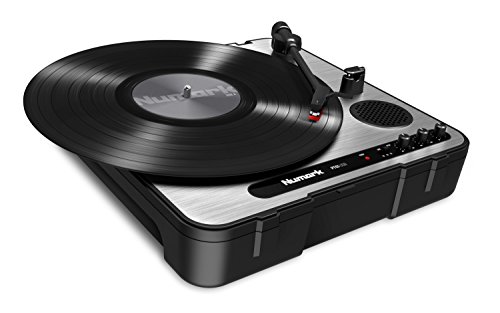
    Numark PT01USB Turntable

    While this record player is quite the jump in price from the other options we have explored, it is important to include for those that want a more modern looking record player to display. This player is more of a turntable, meaning that it is flat and looks more simplistic. However, this is not to say that it does not come with amazing features, and it can be the perfect look for your new record player.

    The sleek, black design of this record player is something that would look great in any modern home. sits flat and is not too showy while still being an interesting piece of functional decor. While it looks great in any home, it is also a more durable record player, so it is easy to take it on the go with you! The sleek design is not the only thing that this record player offers though.

    Numark PT01USB | Portable Vinyl-Archiving Turntable for 33 1/3, 45, & 78 RPM Records

    When it comes to function, this record player has it all. It includes a USB connection option in addition to RCA line outputs, headphone outputs, and a stereo input. You can play music to and from this record player in a variety of ways, giving you a lot of listening options. It also includes three speed playing options like many of the other record players do, so you don’t have to worry about not being able to play a smaller or larger record.

    There are clearly a lot of great aspects of this record player when it comes to sound, and the speakers are nothing to laugh at either. The build in speaker is great for putting a vinyl on quickly, and they have a great sound to them. Because of all of the inputs, you can connect to any other speaker for an even better sound if you want to.

    The Numark PT01USB Turntable is a great option for a record player, and while it only has 179 reviews on Amazon so far, the ratings are ones of high praise and it stands at four and a half stars! It is about $130, but the extra cost can be totally worth it if it is the style of record player you are looking for. You can check out the Numark PT01USB Turntable here!

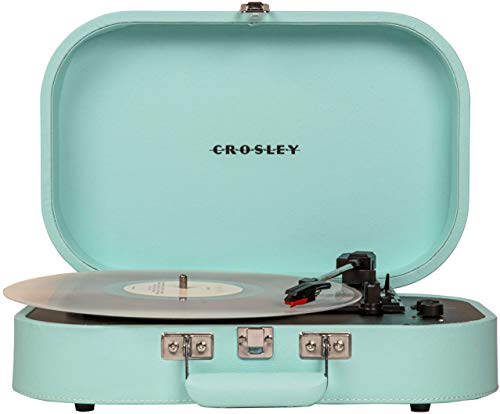
    Crosley CR8009A-GLC Suitcase Turntable

    The Crosley CR8009A-GLC record player is another great option if you love the suitcase look, but want something has a bit softer of an appearance than the Victrola suitcase record player. This record player is a nice, oval shape and it is made with a soft leather material on the outside to really give it that 50’s look. It is a clearly vintage option that is great for any home, whether it is more modern or not.

    It is a suitcase record player, so it is easily portable with its lid that closes and latches, and a handle for easy carrying. In addition to its beautiful, vintage appearance, the Crosley CR8009A-GLC has a lot of the necessary features for any high-quality record player. The sound quality and features are up to par with a lot of the other record players we have talked about.

    Crosley CR8009A-TU Discovery Vintage Bluetooth 3-Speed Belt-Driven Suitcase Turntable, Turquoise

    This record player has built in stereo speakers so it is ready to play right out of the box with crisp, clear sound. It also has all of the RCA, AUX, and headphone ports that you need to connect to nearly any device. One of the most beneficial features of this record player is that it has Bluetooth so you can use those stereo speakers to play music from your phone as well, so you’re not limited to just the vinyls that you own.

    This record player does not leave you hanging if you have different sizes of vinyls either. Like the rest of the record players we have covered, the Crosley has three speeds that you can play your records on. It allows for all sizes of vinyls to be played, seven inch, ten inch, and twelve inch vinyls alike.

    This record player receives great reviews for its soft, vintage appearance and modern technology. It has nearly 600 reviews and they ultimately average out to four and a half stars. This is a great deal for such a high quality record player as well because it is only $60-$70 depending on which color you choose. You can check out this product on Amazon here.

    Victrola 8-in-1 Bluetooth Record Player & Multimedia Center

    The last record player we will look at is the Victrola 8-in-1 Record Player. This is meant for people who want that very old, vintage look instead of a modernized, vintage look. It is quite large, but contains a lot of great features that many of the other record players do not have.

    Victrola 8-in-1 Bluetooth Record Player & Multimedia Center, Built-in Stereo Speakers - Turntable, Wireless Music Streaming | Espresso

    This record player has a three speed turntable, Bluetooth connectivity, FM radio, USB, cassette, CD player, RCA output, and a headphone jack. It is meant to play any music from anywhere. All of these features make this one of the best record players for those that really love that large, vintage look. It even comes with a remote control so you can change settings from a distance.

    The speakers on this record player are very clear and very high quality so that anything you play will fill the room with clean sound. It has over 10,000 reviews on Amazon and is another four and a half star record player. It is quite pricey though, at $130 to $150 depending on the color of wood it is made out of. You can look at this record player here!

  • A Complete Guide To Properly Cleaning Your Vinyl Records

    A Complete Guide To Properly Cleaning Your Vinyl Records

    Vinyl records are increasingly becoming popular. Both collectors and turntable DJs are playing them regularly. However, they need proper care to ensure that these artistic pieces last longer and provide quality sound. In this article, we will provide a detailed guide on how to clean vinyl records.

    Vinyl records need dry and wet cleaning with anti-static record brushes and vacuum record cleaners. Dry cleaning removes the more significant dirt and dust particles, while wet cleaning ensures permanent dirt is removed.

    Besides covering the comprehensive cleaning methods, we will also examine why it’s crucial to clean vinyl records. Read on to find out more.

    Do Vinyl Records Need To Be Cleaned?

    Over the years, vinyl records have evolved. Initially, these analog sound-storing mediums were referred to as phonographic disc records. Manufacturers made these phonographic records from shellac. With time, however, records made from polyvinyl chloride (PVC) became more common.

    These records were then coined ‘vinyl’ records from the material they were made of. With time, all types of records were referred to as vinyl records, regardless of what they were made of.

    As much as new formats were introduced (e.g., compact cassette), vinyl records retained a significant market share. However, in 1991, once the market share of compact disks rose, vinyl disappeared from the mainstream.

    It was not the end of vinyl records as they made a comeback in the 21st century. This time, they were common in particular niches such as rock bands and with DJs. Over time, collectors have also increased with these pieces considered to be of historical and artistic interest.

    Taking proper care of records, therefore, becomes necessary, no matter who owns them. One of the ways to do this is through preservation. To prevent gradual degradation of the audio, most collectors transfer the audio to other media. Preservation also involves playing the records once in a while (1).

    Proper care for the vinyl also involves cleaning them regularly. In turn, owners are rewarded with the tremendous and lush sounds that they have to offer. The cleaning applies to both new and old records. Below are the reasons why cleaning records is essential.

    Static Charge on Records

    Playing records is fun, but with static, the process can be tedious. The static charge has no exception whether the record is new or old. In fact, before adding a vinyl record to your collection, it is already exposed to static (2).

    Static electricity is a result of an electric charge building up in non-conducting materials. The moment two non-conductors are rubbed against each other, static is created. The vinyl itself is made of non-conductive material.

    Vinyl comes into contact with other non-conductors during their production process. The records’ sleeves are also non-conductors, and the friction between the two also creates charge (3).

    In order to ensure higher quality, lower noise floor, and better pressings, vinyl records are made purer and thicker. But unfortunately, this also means the concern with static electricity becomes worse.

    Facts have presented themselves by comparing recent pressings and those from the 80s. Thinner records from the 80s are affected less with the static charge when compared to the latest pressings (4).

    While it’s not possible for the static charge on the records to shock the users, it’s still detrimental. First, the sound from the record will be tampered with. Instead of the lush sound, one will get poor-quality audio.

    Also, the records will be susceptible to dirt and, in turn, they will require thorough cleaning. The electric charge attracts dust meaning the vinyl surfaces will allow dust build-up. In this case, the vinyl records will act as literal dust magnets. Unfortunately, the static charge also threatens the lifespan of the needle.

    You can find more info on removing static from vinyl records in this article: Best Way to Remove Static from Vinyl Records: 7 Easy Tips

    Increase Record’s Lifespan

    For a vinyl record to last long, it’s necessary to take the required measures. It applies to common records or rare records that are difficult to find. While records made from vinyl are known to be less prone to damage when compared to those made from shellac and acetate, they still require attention (5).

    Proper storage and handling prevent slow degradation. Storage practices that you should carry out include storing the records on metal shelves instead of wood. It is to keep them from the contraction and expansion of the wood. Also, the vinyl shouldn’t hang over the sleeve’s edge.

    Also, immediately after the records have been used, they should be placed in their jackets. Again, it would be best if you avoid unnecessary exposure to light and air. Keep in mind that the only places that should be touched when holding it are the label areas and the edge.

    By operating a clean vinyl, one is also assured of an increased lifespan. Dirty and dusty records, on the other hand, may result in permanent damage to the vinyl. The increased friction may also damage the stylus (needle), and in turn, the tonal response may be affected (6).

    As mentioned above, static electricity is generated when non-conductors are rubbed against each other. Therefore, the increased friction between dirty records and stylus only results in more dirt.

    According to an analysis conducted, the dust removed on stylus tips included; 35% diamond dust, 12% jagged silica, and 40% miscellaneous particles (grit, soot). The rest consisted of lint and fibers (7).

    Stay Free From Surface Noise.

    First, it’s vital to understand that occasional surface noise on records is normal. This noise is expected when the music is sliding into existence. It also occurs between tracks.

    However, there may be a problem when the hisses, clicks, and pop sound out of place. There are various reasons to consider. They include; excessive dirt or debris on the vinyl, excessive dust build-up on the stylus, or playing ancient records that require a deep clean.

    Loud pops that prevent enjoyment of the track are caused by actual contamination. At times, one can identify the piece of dirt on the record. Other times, it’s safer to do a quick sweep on both sides of the record. Prior cleaning before use also results in minimal surface noise (8).

    Clean Vinyl Records With Alcohol? We Find Out.

    In order to ensure effectiveness, cleaning vinyl records requires caution and consciousness. Failure to do so may result in damage to the records. Scratches, for example, may form on the record if abrasive agents are used to clean them.

    For vinyl enthusiasts, damage to their rare collection is a real fear. Using alcohol for cleaning, in particular, has been a debated issue over the years. For the most part, however, using it has been discouraged.

    Adequate precaution is necessary when considering alcohol as a surface cleaner. It is because pure alcohol isn’t safe, and you should never use pure alcohol on records. However, there are commercially sold record cleaning agents that contain alcohol in them.

    In an interview, Steve Chase, the founder of Groove Washer, stated why Dr. Bruce Maier (1970s Disc washer creator) steered clear of iso alcohol (high amounts). He mentioned that iso alcohol could remove plasticizers from the records and make the groove brittle.

    He also mentioned that while other experts took pride in using high amounts of iso alcohol, its effectiveness was questionable. Mainly since the alcohol dried up too quickly, leaving no time for the contaminants to be removed (9).

    One may still choose to use alcohol for cleaning their vinyl. However, there are two things they should be aware of. One, the alcohol used should be carefully selected and properly diluted. Also, it is not possible to guarantee that nothing will happen to the records.

    Polyvinyl chloride has properties that make it resistant to solvents. It means that the base material of the records created from PVC is not affected by alcohol. The risk, however, comes in with the additives in the Polyvinyl chloride, e.g., plasticizers.

    As mentioned before, one of the things alcohol could remove is plasticizers. Plasticizers, together with extenders and stabilizers, ensure the vinyl record has flexibility. Unfortunately, once these additives react to the alcohol, their bonding to the record’s surface is compromised. Therefore, this makes alcohol a less desirable cleaning choice for Vinyl records (10).

    The decision to use isopropyl alcohol, therefore, would require usage in small quantities. Failure to control this solution can cause it to turn into an abrasive quickly. The risk is much higher when it comes into contact with acetic acids (such as vinegar).

    Using distilled water to rinse vinyl records cleaned with isopropyl alcohol is recommended. However, due to their delicate nature, you shouldn’t clean shellac records with any kind of alcohol.

    Since some vinyl cleaning agents contain alcohol, going through the ingredients before purchase or use is necessary. Types of alcohol to look out for include ethyl alcohol, pure alcohol, and methyl alcohol. Isopropyl should also be in small quantities.

    How to Deep Clean Vinyl Records

    There are two primary cleaning methods, dry cleaning, and wet cleaning. As the name suggests, dry cleaning does not involve any solutions, while wet cleaning involves a cleaning solution.

    Record owners should conduct dry cleaning every time they take out a record to play. You should do cleaning both before and after the record is played. It keeps the record in great shape. It is because you will remove superficial dirt regularly. Therefore, the chances of the dirt permanently sticking onto the grooves are minimal.

    The best tool to use is an anti-static record brush. These brushes tend to have two bristle rows. While one row removes dirt and dust on the record, the other row is meant to de-stat. By minimizing the static build-up, the chances of dust clinging on the record are also reduced.

    You should start by brushing the record’s surface gently. It should be done in a circular motion while following the grooves. You should apply only light pressure in this case since the aim is to remove large dirt and dust particles. Using too much pressure may destroy the grooves.

    However, there are scenarios where different cleaning methods need to be incorporated. Deep cleaning will offer a thorough clean by using specific solutions.

    The first scenario is when you’re playing a record (regardless of whether it’s brand new or second-hand). The second scenario is with visibly dirty records, they don’t sound good, and they don’t respond to dry cleaning.

    Below is a detailed guide on how to deep clean vinyl records.

    Prepare The Cleaning Solution.

    Deep cleaning vinyl records requires a wet method. That is, incorporating a solution to ensure thorough removal of dirt. Once you decide to use a homemade solution, it is essential to prepare it correctly.

    The necessary ingredients include isopropyl alcohol, a rinse agent, and distilled water. Dishwasher fluid can serve as the rinse agent. However, it should be both fragrance and color-free.

    The dishwasher fluid is essential as it breaks the vinyl’s surface tension. It then allows the solution to reach the deeper parts of the record’s grooves.

    Take a few drops of the rinse agent, three parts of the distilled water, and one part of the iso alcohol. Distilled water is preferred as it does not contain impurities when compared to tap water. You can use a bowl to combine the ingredients and then gently stir. Alternatively, you may opt to use a spray bottle, provided you shake well before use.

    There are homemade solution recipes that recommend using ‘Free Clear’ laundry detergent instead of iso alcohol. In order to avoid damage to the vinyl, it is required that the detergent is free of fragrances, phosphates, or color agents (11).

    Keep in mind, however, that using homemade solutions is taking a chance. Therefore, proper dilution of the alcohol is necessary.

    Using Pre-Packaged Solutions

    Pre-packaged solutions are a bit costly when compared to homemade solutions. Also, the ease of availability of home solutions makes for a strong argument against pre-packaged stuff. However, they go a long way in ensuring the records are clean, safe, and protected. Therefore, they are a much-needed investment if you truly want your vinyl for the long haul.

    Both record stores and music stores sell these solutions. Before making any purchases, you should ensure the ingredients used will be favorable on your vinyl. Most of these solutions come with detailed instructions for proper application.

    Pre-packaged solutions are highly effective whether cleaning by hand or using a machine. However, using cleaning solutions designed for cleaning devices is recommended. Fortunately, there are plenty of cleaning solutions one can choose from.

    There are cleaning solutions packaged individually, while there are those packaged in kits. Cleaning solutions packaged individually tend to be enough for an entire record collection. Especially since they only require a few drops. Solution kits come with cleaning fluid, microfiber cloths, and soft brushes, which are convenient.

    A pre-packaged solution is suitable for absolute purists and collectors with hundreds of dirty records (12).

    Put The Vinyl Record On A Cleaning Mat.

    Finding a suitable surface before cleaning is vital. Cleaning mats are a good option. These mats are made of soft material that will be gentle on the records. It offers an excellent solution for those fearful the solution would seep into the turntable. The attached spindle would ensure the vinyl is secure.

    However, there are mats meant for dry cleaning. Therefore, they cannot handle the solution. Prior confirmation would prevent unnecessary accidents.

    Instead of the turntable, you may opt for other flat and stable surfaces, such as a table or a desk. In cases where a record cleaning mat is unavailable, a micro-fiber towel should suffice. The main aim is for the surface to be non-abrasive and can handle the solution.

    Apply Cleaning Solution On Record

    There are two main ways to apply the cleaning solutions on the record. The first is by spraying a few drops on the vinyl surface. For this, the solution needs to have a spray function.

    In order to completely cover the vinyl’s surface, five mist sprays should be enough. First, spray the solution at a distance of about 15cm. After spraying, give the cleaning solution a few seconds to seep into the grooves.

    If you mix your cleaning solution in a bowl, you may choose to transfer it to a new receptacle, such as a dry spray gun. Alternatively, you may work on it as it is. Using a microfiber cloth, dab the solution onto the vinyl record. The aim is to make the record slightly damp, not to drench it. Therefore, you should avoid overdoing it.

    Caution should be exercised when applying the solution. It is to prevent the label from getting wet. The solution may discolor the label or cause the label glue to loosen. Both incidents will be detrimental to the record’s label and destroy its aesthetic aspect. You may choose to purchase a record label protector disc to keep the fluid from getting to the label.

    Wipe Solution With A Microfiber Towel

    Take hold of your clean microfiber towel and wipe the solution. Start at the center of the record and wipe in a clockwise direction. Avoid wiping across the grooves; instead, move along them. Apply gentle pressure so that the microfiber towel gets into contact with the inner parts of the groove. It will wipe off any visible and invisible blemishes as you continue.

    Once you get to the record’s outer edge, begin the rubbing process in a counterclockwise direction. The same way the needle does when the vinyl is playing. As you do this, ensure your fingers are flat. It is to avoid scratching the record with fingernails.

    Once done with one side of the record, flip it and work on the lower surface. Soak a towel in distilled water and rinse both sides. Once cleaning is over, you should let the record dry.

    There are several ways of letting this happen. Some prefer to let the vinyl air dry. Placing it on a rack for this to happen is advisable. However, by air drying the record, it runs the risk of dirt settling on it again. Instead, you should use a dry microfiber cloth to speed up the process.

    Before tucking the records away again, they need to be entirely dry to prevent mold from growing. It especially applies if the cleaning solutions used contained alcohol.

    Want more details? Check out this guide I wrote about cleaning vinyl records with microfiber: A Step By Step Guide To Cleaning Vinyl Records With Microfiber

    Use A Cleaning Machine

    As seen above, there are several ways that one can clean a vinyl record. For those who don’t wish to use their hands, they can use a machine to clean. These machines allow one to save both time and effort. However, before purchase, you may be required to save up as the devices can get costly. In fact, they can go as high as $500 (13).

    When it comes to record cleaning machines, both manually operated and power operated devices exist. Finding one that suits your cleaning needs will require adequate research. When on a budget, however, machines that use a brush to clean are preferable.

    Purchasing cleaning machines particularly applies to those with extensive record collections. These machines give the vinyl an actual bath. They incorporate both distilled water and cleaning solution. You’re required to spin the vinyl record through the solution for about a minute. The built-in brushes get rid of the dirt.

    What Can You Use to Clean Vinyl Records?

    Vacuum Vinyl Record Cleaners

    Despite their costly nature, vacuum vinyl record cleaners offer several benefits that hand cleaning cannot. Not only do they minimize pressure used, but they also reduce the amount of physical contact on the delicate vinyl. Additionally, they suck up the dust and dirt found on the grooves.

    The vacuum cleaners contain motors that rotate the vinyl as the suction arm does the cleaning. It makes cleaning thousands of records easier without worrying about fatigue, time spent or changing micro-fiber cloths regularly.

    The cleaning solution is applied manually, and the motor rotates the vinyl. Once the entire surface is covered, the suction arm is put over the record, and the dirt and solution are removed. Within seconds, the vinyl record is clean and ready to be played.

    However, allowing the suction arm to rotate for too long with the record already dry may damage the record and wear out of the felt pads.

    Wood Glue

    Unconventional as it may seem, many collectors vouch for wood glue as a record cleaner. In theory, both the wood glue and the vinyl’s materials are made chemically similar. So much so, the glue can’t stick to the record. However, it will stick to all the dirt and dust on the vinyl (14).

    An experiment was conducted to test the truth concerning wood glue’s effectiveness on vinyl records (15). The result was remarkable effectiveness on heavy-duty stain removal. In one application, you should have eliminated most of the excessive grime on the disc used.

    However, this process is not without its disadvantages. The process is complicated since wood glue is not easy to work with. Major requirements include a surface that you will discard afterward and gloves to keep hands protected.

    The amount of glue needed on one surface is too much, meaning the total cost on many records would be expensive. The process also takes too long. It is because you have to wait for the glue to dry, peel it off, rinse the disc and dry it again.

    FAQs

    How To Clean Vinyl Records With Windex?

    You should avoid household cleaning products like Windex completely. It is because they are very abrasive cleaners and pose threats to vinyl records. Instead, collectors should utilize three parts distilled water, dishwasher fluid, and one part isopropyl alcohol to save up on cleaning solution costs.

    I wrote a specific article about why you never should use Windex to clean your vinyl records.

    What’s The Best Way To Clean Vinyl Records?

    You should clean vinyl records every time before and after playing using an anti-static record brush. It goes a long way in increasing their lifespan and minimizes the chance of permanent dirt and dust.

    For extraordinarily soiled or old vinyl records, a deep clean is recommended. This deep clean will incorporate a cleaning solution. Depending on the number of records, one may clean by hand or with a machine.

    How Do You Clean Vinyl Records Without Damaging Them?

    When purchasing cleaning solutions, be sure to check on the ingredients that make up the solution. It is because some ingredients, such as pure alcohol, may end up damaging the vinyl records.

    Also, in situations where isopropyl alcohol is used, you should use it sparingly. Using microfiber cloths will also prevent the records from scratches.

    Sources

    1. Phonograph Record, Wikipedia, https://en.wikipedia.org/wiki/Phonograph_record, Accessed 24th October 2021
    1. The Importance of Cleaning Your Records, The Vinyl Revivers, https://thevinylrevivers.com/the-importance-of-cleaning-your-records/, Accessed 24th October 2021
    1. Ed Selley, How to Deal With Electricity And Your Records, Vinyl Me Please, https://magazine.vinylmeplease.com/magazine/how-to-deal-with-static-electricity-and-your-records/, Accessed 24th October 2021
    1. Static & Your Record Collection, Planet Of Sound, https://www.planetofsoundonline.com/pages/static-your-record-collection,Accessed 24th October 2021
    1. Conservation and restoration of vinyl disks, Wikipedia, https://en.wikipedia.org/wiki/Conservation_and_restoration_of_vinyl_discs#Storing Accessed 24th October 2021
    2. Steve Guttenberg, Do vinyl LPs wear out? The Audiophiliac takes on that myth, cnet, https://www.cnet.com/tech/home-entertainment/do-vinyl-lps-wear-out-well-bust-that-myth/, Accessed 24th October 2021
    1. The Wear and Tear of Records and Styli, Shure, https://service.shure.com/s/article/stylus-wear-and-record-wear?language=en_US, Accessed 25th October 2021
    1. What is Surface Noise? -How Much is Too Much? Sonic Elevation, https://sonic-elevation.com/what-is-surface-noise-how-much-is-too-much/, Accessed 25th October 2021
    2. Marc Henshall, Is it Safe to Slean Vinyl Records with Alcohol? Sound Matters, https://www.yoursoundmatters.com/is-it-safe-to-clean-vinyl-records-with-alcohol/, Accessed 25th October 2021
    1. Joe, Cleaning Vinyl Records with Alcohol: Is it Safe? Vinyl Record Life, https://www.vinylrecordlife.com/cleaning-vinyl-records-with-alcohol-is-it-safe/, Accessed 25th October 2021
    1. LP Record Cleaners vs Homemade Solutions, Spin Clean, https://spinclean.com/lp-record-cleaners-vs-homemade-solutions/, Accessed 25th October 2021
    1. Steven Williams, A Side-by-Side Test of Vinyl Record Cleaning Solutions, Discogs Labs, https://blog.discogs.com/en/side-by-side-test-vinyl-record-cleaning-solutions/, Accessed 25th October 2021
    1. Wiki How Staff, How to Clean Vinyl Records, Wiki How, https://www.wikihow.com/Clean-Vinyl-Records, Accessed 26th October 2021
    1. How to Clean Vinyl Records, Colored Vinyl Records, https://coloredvinylrecords.com/blog/how-to-clean-vinyl-records/, Accessed 26th October 2021
    1. Steven Williams, A Side-by-Side Test of Vinyl Record Cleaning Solutions, Discogs Labs, https://blog.discogs.com/en/side-by-side-test-vinyl-record-cleaning-solutions/, Accessed 25th October 2021
  • Vintage Turntables Vs Modern: Which Sounds Better?

    Vintage Turntables Vs Modern: Which Sounds Better?

    Records sound the same whether you play them on a vintage turntable or a modern one. Or is that so? The answer comes down to the brand of the turntable, your sound system, and the general state and size of your vinyl.

    Vintage turntables differ from modern turntables in terms of ease of use and maintenance. Although many vintage turntable brands still exist, it can be a nuisance to repair them. Limited access to restoring parts may lead to compromising sound quality.

    Vintage turntables have appeal to them, as they are full of stories, memories, and emotions connected to them. Modern turntables compensate by being more suitable for this day and age. The sound coming out of them is almost the same. However, the contrast between the two is clear.

    Modern Versus Vintage Connections

    You can connect modern turntables to all sorts of audio outputs. Speakers that connect via USB or Bluetooth are the most popular choice, as they are accessible via any device. They’re also easy to buy and replace if necessary.

    Vintage turntables don’t always have so many speaker options available to them. Historically manufacturers built record players to connect manually with wires to heavy speakers that can take up a lot of space. One thing they do enable is excellent sound quality.

    As visually appealing as vintage turntables might be, they can mean a lot of work. Having a specialized repair shop that knows how to fix any broken parts is essential. Although built to last without proper care, these types of turntables could pose more of a problem than enjoyment.

    Vintage Turntables

    Is there anything more nostalgia-inducing than putting the needle down to a record? Yes, if the turntable playing it has seen more history than you have.

    Vintage turntables are steadily growing in popularity. It’s because of the quality of sound these devices emit when they play your most beloved vinyl. It’s also due to their elusiveness and clever marketing strategies.

    No matter which category you fall into, you’re bound to have your favorites. The Garrard, the Linn Sondek LP12, the Technics SL-1700 are all examples of fine vintage turntables in fashion in the latter half of the last century. (1)

    Companies such as Yamaha, Thorens, and Dual have been making turntables for more than half a century. Mass production and high demand have led them to develop new models over time. This rise paused with the emergence of CDs and the commercialization of popular music.

    Music videos gained so much popularity that it seemed as if they’d take over the entire listening experience. Suddenly what’s on the screen became more essential than what comes out of the speaker.

    Luckily, real music lovers never stopped digging through crates in search of good tunes. The feeling of putting the vinyl to play is like nothing else.

    Vintage turntables are making such a comeback in recent years for a reason. Wax is re-gaining on value, and record shops are popping up in cities all over the world. But how did turntables come into existence in the first place?

    History of Turntables

    Turntables have been around longer than any of the devices we use to play music. It all started with Edison’s invention of the phonograph back in the 19th century. He managed to find a way to document the vibrations produced by his voice onto tin foil. (2)

    This foil was the predecessor of records – manufacturers engraved the sound into its surface in various grooves. Later designs contained different materials, such as wax, which was easier to handle, and the sound came out cleaner. (2)

    The introduction of the first gramophone by a German company called Berliner occurred not long after. Two people-powered it manually: one person cranked the lever, and the other held the machine for stability. The disc could be pressed into many copies after it was treated with acid. (2)

    The introduction of the turntable as a household item got sidetracked with the popularity of the radio. It was simpler to use, it broadcasted both the music and the news, and its price was more affordable.

    Those who still wanted immersion in their music would gather to play records. Turning the knobs to tune into a radio station doesn’t play the next song you want. No matter how much you try.

    Spending evenings surrounded by friends with the perfect soundtrack came to be an art in itself. Not everyone could figure out how to manage a record player and produce the desired sound.

    Turntables became even more sought-after during the 1970s with the rise of new music genres, playing styles, and trends. Records started getting sampled, DJing turned into an art, and hip-hop was born.

    You can read more about the history of turntables and vinyl in the following article that I wrote.

    Turntablism

    The turntablist is one of the three distinguished types of turntable artists. The other two are the DJ and the turntable materialist. They differ from one another based on the number of hours spent practicing mixing, sampling, and scratching. (3)

    Scratching as we know it today was first discovered by accident by Theodore Livingston (Grand Wizzard Theodore) back in 1977. The record is moved back and forth in a specific spot in this technique. The turntables back then (which we consider vintage nowadays) had strong motors, which made for easy record movement. (4)

    The sound that comes out is broken and re-broken. There’s a danger of damaging the vinyl if incorrect scratching techniques are employed. Some artists thrive to attain the hiss that a damaged record produces. Best to avoid these performances if just reading these words had you wincing.

    Turntablists prefer using the Technics SL-1200 more than any other turntable because of the strength of its motor. They tend to spend hours getting to know the machine they’re working with to manipulate their sound as they choose to. (3)

    Other techniques, such as crossfading and mixing, were also invented during this period. A crossfader connected two turntables, so switching between them was seamless. DJ battles became a fad too, and the audience wanted more out of turntables. (4)

    Jazz musicians like Herbie Hancock started using turntables, as well as disco artists. This movement gave way to a whole new array of experimenting with music genres such as house, electro, or metal. Turntables became a sort of bridge between classic and contemporary forms of music. (4)

    Live music stopped meaning seeing a band playing or hearing a singer singing. The traditional elements intertwined with growing expectations the audience was having. These new trends gave rise to the production of brand-new kinds of turntables.

    Modern Turntables

    Modern turntables came together with the high demand for this way of playing music. Once forgotten in a sea of iPods, walkmans, and CDs, turntables have made quite a comeback in the last decade or so.

    Depending on your intentions with your vinyl collections, there’s a myriad of options to choose from for playback. If you want to embark on a sonic adventure, you might be interested in brands such as Pro-Ject or Rega Planar. Though pricey, these turntables offer the best sound quality there is.

    Yet, if your goal is to digitize your 45s, look into what Sony has to offer. You can have their record player connected to almost any kind of speaker you’ve got on your hands. Don’t expect to be blown away by the sound – its primary function is to bring your records to the 21st century.

    Forget about wires that connect your turntable to the speakers and the amps. Turn Bluetooth on your smart speakers and allow yourself to feel the music. Remember: the better the speakers, the better the sound.

    The critical thing to take away from here is that modern turntables will deliver that caliber of sound, as vintage turntables do. They will take you there using a different route, as they vary in production methodology and sizes.

    If there’s an issue with your turntable’s sound output, chances are the solution isn’t far away. Try replacing the cartridge instead of buying it all anew. A hand-me-down cartridge can wear out your records, even if your turntable isn’t low grade.

    If you’ve wanted to grow your connection to vinyl, but you’re not sure where to start from, look no further. Choose a modern turntable to get yourself re-acquainted with your most precious memories.

    Best Modern Turntables for Beginners in 2021

    According to Wired.com (5), here’s a list of beginner-friendly turntables, ranked from least to most expensive:

    Audio-Technica AT-LP60XBT

    Audio-Technica’s LP-60 pairs with any speaker via Bluetooth or plugs into a stereo. It’s reasonably priced, making it ideal for entry-level turntable enthusiasts to-be.

    Audio-Technica AT-LP60XBT-BK Fully Automatic Wireless Belt-Drive Turntable (Black) (ATLP60XBTBK)

    Sony PS-LX310BT

    Inexpensive doesn’t have to mean inadequate. Sony’s turntable proves so with its USB and Bluetooth plugins. Rip your favorite records to your PC with this great piece of technology.

    Sony PS-LX310BT Belt Drive Turntable: Fully Automatic Wireless Vinyl Record Player with Bluetooth and USB Output Black

    Fluance RT81 Turntable

    A turntable Don Draper would approve of comes with a built-in preamp at a pretty reasonable price. Its pleasing wooden exterior makes for a great addition to any living or lounging area.

    Fluance RT81 Elite High Fidelity Vinyl Turntable Record Player with Audio Technica AT95E Cartridge, Belt Drive, Built-in Preamp, Adjustable Counterweight, Solid Wood Plinth - Walnut

    Audio-Technica AT-LP120XUSB

    This model offers a USB port to allow you to convert your music from analog to digital on your own. The pricing is fair at Amazon, and it comes with a preamp. It’s easy to have it upgraded, and the quality of sound is impressive.

    Audio-Technica AT-LP120XUSB-BK Direct-Drive Turntable (Analog & USB), Fully Manual, Hi-Fi, 3 Speed, Convert Vinyl to Digital, Anti-Skate and Variable Pitch Control Black

    U-Turn Orbit Plus

    With a look reminiscent of The Jetsons, the Orbit Plus will be sure to take you on a journey. It’s not necessarily a long one; you’ll have to switch between your 33s and 45s by moving its belt manually.

    U-Turn Audio - Orbit Plus Turntable (Black)

    Rega Planar 1

    The sleek look of this turntable matches the enjoyable vibrations coming out of it. It has a unique motor that guarantees a pure sound, making it well worth every penny.

    Rega - Planar 1 (Black)

    Pro-Ject Audio Debut Carbon Evo

    One of the few models from this list that doesn’t come with a built-in preamp is the Carbon Evo. It has top-notch parts; the tonearm construction is carbon fiber, and the platter is thermoplastic. The attention to detail results in superb sound, and its cost for said sound quality seems pretty reasonable.

    Pro-Ject Debut Carbon EVO, Audiophile Turntable with Carbon Fiber tonearm, Electronic Speed Selection and pre-Mounted Sumiko Rainier Phono Cartridge (High Gloss Black)

    Pro-Ject Audio Debut Pro

    The latter model’s big brother brings in the sound without bringing in the noise. It does so due to its hand-crafted Rainier phono cartridge by Sumiko in addition to the carbon tonearm. It sounds as sharp as it looks, in this case, you definitely get what you pay for.

    McIntosh MTI100

    An all-encompassing turntable, to say the least; McIntosh’s MTI100 comes with a price. The price is fairly high, although if you look at the brand it might be an indication of why the cost seems inflated. There is no need for any extra purchases though as it comes with a tube preamp and a power amp ready to blast your socks off. At the time of writing you cant buy McIntosh online, but you can find your local dealer here.

    All of the modern turntables from this list will have you enjoying your all-time favorite musicians in a brand new way. Get ready to be re-acquainted with some albums by hearing sounds you might have missed. The crispness of sound these turntables produce is a force to be reckoned with, for sure.

    Just because a turntable doesn’t cost a fortune, it doesn’t mean that it won’t do its job. But is there an alternative that gets you that little extra for just a few extra bucks?

    Does a More Expensive Turntable Guarantee a Better Sound?

    There are so many turntables to choose from; it can be tricky to figure out which one is for you. They come in different sizes, some weigh more than others, and some cost way more than others. But are they worth it?

    The short answer is yes, they are. A high-quality sound system consists of many things, including the (pre)amps, speakers, turntables, tonearms, and cartridges. (6)

    A set that doesn’t have good parts can damage the records you’re playing. It’s essential to invest in a sound system or build it little by little. It’s better to get used to simpler turntables than to use a more complex and pricier one in the wrong way. (6)

    Speakers

    Don’t be afraid to experiment with the speakers you connect to your turntable. Invest in speakers that don’t cost a fortune but go the extra mile. Make sure that the turntable communicates with them accordingly.

    It’s needless to say that there are turntables on the market that cost a few thousand dollars. And they do the job they’re supposed to – the sound that they produce is unforgettable. They are an investment on their own and require regular care.

    If you cannot afford this at the minute, don’t fret. There are plenty of reasonable solutions out there. And they come in style.

    Top 5 Vintage Turntables That Won’t Break the Bank

    It’s not that likely you’ll find the perfect old turntable just waiting for you in a yard sale or on the internet. Let’s also forget about cheap turntables that double as tiny suitcases for a second here. Here’s a selection by Ecoustics of great vintage turntables that don’t cost as much as the rent. (7)

    1. Technics SL-1700 – a classic among the classics, you can assemble this model in no time. Even if you’re not a pro turntablist, you can replace parts, and the amazing sound is guaranteed. The other turntables from this line cost around $900+, but you can find a used SL-1700 for double the price. Who knows, you might find yourself getting an extra table so that you can play the part.
    2. Thorens TD-125 – built to last, the Thorens TD-125 is famous for more reasons. It’s affordable, looks like a million dollars, and has electronic speed control. Thorens sold more than 100,000 copies of this turntable in 1975, and it’s becoming more sought-after today too. Give it a spin to enjoy its pleasing sound for yourself. 
    3. Dual 701 – a vintage turntable with a straight tonearm, this one is for fans of powerful, rugged tones. It weighs more than 20 lbs and has a motor running at low speed at all times. The Dual 701 is the quintessential vintage turntable with its woody feel. It costs about $600. 
    4. VPI HW-19 – when you first see this record player, you might mistake it for a modern turntable. Don’t be fooled; this model has been around since the 1980s. It’s not easy to find it for under $800, but the unmistakable sound coming out of it is well worth the search.
    5. Yamaha YP-701 – Yamaha is fond of building large turntables, and the YP-701 is no exception. Unlike its looks, use it when playing softer records due to its elegant tone. Pair it with music that has a lot to say without shouting it out. 

    Why Vinyl Came Back

    There’s been a lot of discussion as to why vinyl came back in style. Music in digital form is easier to use both for listening and playing purposes. DJs playing all sorts of music don’t require training in handling vintage turntables in order to be successful. 

    Having an extraordinary record in your hands, removing it from its cover, and placing it on the table has something tangible to it. It’s like a ritual, and you find yourself repeating it with another record. And another. Even though you can’t put your finger on a good tune, you can feel like you’re closer to it. 

    Vintage turntables have made us reminisce and slow down. Music shouldn’t be consumed; it should be experienced. It isn’t passive; it’s an active exchange of emotions and vibrations.

    Culture is contradictory by default, as it wants what it cannot have. It yearns for the past while keeping an eye out for the future. Exploring the roots of these needs gives solutions on how to better deal with what is right now. 

    Cultural Approach To Turntables

    Can you imagine your parents dancing with air pods in their ears, jamming to their favorite beats? Or do you see them hanging out with their friends with an unsuspecting turntable in their midst? Stereo sound has made it possible for us to share the music we like with those we love.

    Vinyl is unique because of the grooves we feel on its surface. These same grooves are then met by a needle when placed in a turntable. It’s this bond that we sense when our favorite song is playing.

    Cassettes could’ve never made it to this century. Not for long, anyway. They were lifeless, complicated, and unattractive. Nobody misses their Walkman these days.

    The same goes for CDs. They had an actual use, but we didn’t feel that connected to them. They were a part of the globalized necessity for mass production of music instantaneously. But that’s about it.

    Not to mention mp3s, mp4s, iTunes, and all kinds of streaming services where we devote our attention (and money). We know they’re here, at the touch of our fingerprints, but we cannot see them. There’s no intercommunication going on.

    It is just the opposite with vinyl. Turntables could never go out of fashion. They were and are a real thing that we cannot help but feel drawn to and intrigued by their operation. We’re fascinated by them, and the more stories they tell, the better.

    Modern turntables use this to their advantage. They combine the best out of both worlds. They allow us to explore our sonic curiosities when and how we want to. They even helped create a whole new way of conceptualizing tunes.

    Digilog

    After the commercialization of CD culture, there was a halt in the alternative music industry. Artists such as Shellac were struggling to get to where they wanted to be. They felt they were missing out, and they were planning on doing something about it. (8)

    They were the first band to release their new album both on vinyl and digitally. This move pleased the more modern audience members, as the loyal fans of records sighed with relief. They were able to treat their forgotten turntables with some fresh wax. (8)

    More artists came to follow in their tracks, and vinyl sales rose. The cultural exchange between musicians and their most loyal fans could continue. Nobody expected it to go this far, but it did.

    Vintage turntables have been dusted off and repaired or sold for a pretty price. Record labels keep pressing records and aren’t stopping doing so anytime soon.

    It goes for all genres of music, but mainly electronic and experimental music. Vintage is becoming mainstream, while digital isn’t going away either. The fusion of the two is shaping up as an exciting process everyone can participate in and enjoy.

    If you want to buy a ticket to join this voyage, join anytime you want to. Be prepared to know what’s available to you and where you would like to go. It’s an individual choice, after all, and your stance on the subject matters.

    There’s a lot to look out for when selecting the best turntable for yourself. It depends on what kind of music you like and expect from your designated music player. There’s one thing you shouldn’t compromise on, though: the quality of sound.

    Sound Quality of Vintage vs Modern Turntables

    Turntable/Component

    Loudness

    Consistency

    Transition

    Recognition

    Smoothness

    Vintage

    high

    high

    high

    high

    medium

    Modern

    high

    medium

    high

    high

    high

    The best way to see which turntable provides you with the sound you want to hear is to test them out side by side. Drop by a well-equipped record store and listen to the same record on vintage and a modern turntable.

    Check for the following components: how loud is the record playing? Is the turntable motor spinning at the same consistency for both of these types of turntables? What about the transition between the songs? Can you recognize each of the sounds with no problems whatsoever? How smoothly is the record being played?

    These are just some of the things you should keep in mind before deciding on a turntable. If you know someone who owns a vintage turntable, why not take your favorite record along with you and give it a spin. The same goes for the modern version.

    Alternatively, stop by a specialized shop and ask for some guidance. There’s no correct answer here; choose based on what you feel is the best fit for your listening needs.

    Breakdown of Modern Turntable Vs Vintage Turntable Sound

    It’s safe to say that turntables are not a thing of the past. Demand for vinyl has kept them close to our hearts and ears.

    There are many companies still producing turntables. They are user-friendly and offer lots of replacement parts. Combined with today’s tech equipment, you can have the best sound system there is.

    It isn’t even that expensive to own a great-sounding system. A modern turntable will be sure to provide you with a grade-A experience if you choose wisely. On the other hand, vintage turntables have a charm you can’t resist.

    They can be robust and trickier to handle, but they last. Their sound output depends on the brand, but also the type of music you’re playing.

    You cannot go wrong either with a modern or a vintage turntable. You will find rewards with the most authentic sound money you can buy.

    Sources

    1. https://thevinylfactory.com/features/the-8-best-vintage-turntables-and-what-to-look-out-for-when-buying-second-hand/

    2. Todd Souvignier: “The World of DJs and the Turntable Culture,” p.28

    3. Takuro Mizuta Lippit: “Turntable Music in the Digital Era: Designing Alternative Tools for New Turntable Expression”

    4. Kjetil Falkenberg Hansen: “Turntable Music”, p.4-7

    5. https://www.wired.com/gallery/best-turntables/

    6. Corpsman, Volume 7, Issue 22, Job Corps., 1971

    7. https://www.ecoustics.com/articles/best-vintage-turntables/

  • A Guide To Storing Your Vinyl Records

    A Guide To Storing Your Vinyl Records

    When you’re an audiophile, or even just want to keep your music in great condition, understanding the requirements for storing your vinyl records is essential. After all, you’re collecting them for a reason, just as I do. After years of storing vinyl in various conditions (not all of which were my choice), I’ve found the best ways to store your vinyl records for the optimal condition of your records.

    Vinyl records, like other fabricated physical forms of music storage, have specific conditions which offer optimal results. Optimal conditions will benefit your collection by increasing the longevity of your vinyl records. Best conditions include low humidity, stable temperature, and vertical placement.

    Let’s dive into the different things that affect vinyl record storage to give you the best chance of maintaining your collection for the longest possible time, in the best possible condition.

    How Things Affect Vinyl Record Storage

    We know that vinyl records construction is that of polyvinyl chloride. Commonly known as PVC, we use this same sort of plastic for all kinds of things, from water pipes to our audio record recordings. Given that PVC is a type of plastic, it can last a long time – but it is by no means invincible. (source)

    There are things that can negatively affect PVC. I mean, you can take a PVC pipe and shatter it if you drop the temperature enough. Similarly, PVC will also melt at higher temperatures. The melting point of PVC is between 212 and 500 degrees Fahrenheit. (source)

    What Determines A Record Is Well-Kept?

    A paper on changing perceptions to what good sounding (good quality) vinyl records are to collectors notes how our perceptions have changed. The paper points out how in 1979, a Rolling Stones reader complained about vinyl records ‘the snap, crackle and pop on undulating vinyl’ (Di Gianvittorio, 1979: 6). (source)

    Current culture (at the time of writing) is such that we yearn to hear those familiar sounds that define vinyl, albeit not during the actual music playback, but maybe in between tracks, right? It’s one of the things we all love about our vinyl.

    Although our perceptions of a good condition of vinyl record recording have changed over the years, collectors today still want our records to maintain their familiar-sounding personality and warmth only achievable with a good turntable and vinyl record.

    Let’s look now at what things affect vinyl so we know how to best store it for the best condition over time.

    Placement

    PVC plastic is a relatively malleable plastic, so it is so versatile and used for so many different purposes. As the plastic is somewhat pliable, vinyl records can bend and warp. Knowing this, we can define some rules for vinyl record placement for optimal storage results.

    Horizontal Placement

    Horizontally storing vinyl records is ideal. However, some stipulations make it likely less suitable for practicality. Let me explain.

    Vinyl records stored horizontally on a flat and level surface will be ideally protected in terms of a stable base to rest without fear of warping. However, they must not be stored horizontally with any weight on top. Given that most people who collect vinyl records have more than a few records in their collection. Well, imagine you had hundreds of vinyl records. If you were to store them horizontally and not pile them on top of each other, you would need an awful lot of floor space. Totally impractical in reality and therefore not recommended.

    Vertical Placement

    Vertical storage of vinyl records solves the issue of impractical floor space used for storage purposes. However, we now must introduce several other variables that can affect the record negatively when stored horizontally.

    First, if a record is stored vertically without proper support (like leaning against something on a slight angle), your record will warp over time. So, optimal storage of vinyl records requires stable support to maintain a true vertical storage position without leaning or horizontal pressures. An ideal piece of furniture for such a purpose is a record storage box utilizing rigid foam inserts to hold records upright; if the box isn’t full of records, that is.

    Light

    One of the most deadly adversaries of your record collection is sunlight. Have you ever felt something that is black and left in the sun? It gets pretty hot! With that said, your records will be destroyed by sunlight. Do not store your records anywhere that direct sunlight will find them.

    Sunlight is a significant contributor to vinyl decay. And vinyl decay is a primary source for audio degradation, so again, it’s best to avoid it if you like your records. (source)

    Temperature

    Temperature plays a significant role in degrading PVC. Keep in mind that the audio recorded into the record is done so within tiny microscopic grooves with even smaller cuts and notches. These tiny cuts into the record grooves are what give the record the ability to record audio. Can you imagine how easy it is to melt a tiny groove enough to affect the audio quality negatively? As the melting point of PVC can be as low as 212 Fahrenheit (boiling water temperature), depending on additives to the plastic, you can understand that leaving a record on a radiator could leave you with a very soft and useless clump of vinyl.

    Cold temperatures at extremes will also damage or increase the risk of damage to your records. For example, say you were living in Michigan and get some pretty nasty winter weather. You wouldn’t want any of your vinyl stored in an unheated garage. Extreme cold makes PVC extremely brittle.

    If you’ve ever seen a video of something dipped in freezing nitrogen and then shattered, that’s the same as what happens to records when cold and dropped. And you don’t need liquid nitrogen to do that to a record, just some nasty winter weather below zero. So, it isn’t just heat that can hurt your records.

    Similarly, as mentioned with sunlight, just leaving a record out in the sun for a short time can heat the plastic enough to cause audio degradation in mere minutes of exposure. And if you leave a record in a hot area or in the sun and it isn’t on a level surface, you can expect a lovely warp in your vinyl record.

    Humidity

    Humidity does not generally affect PVC on its own. However, if we add a few things to moisture, then it can be very detrimental.

    First, we have to consider that most record sleeves are made of cardboard. Well, cardboard in a moist environment makes mushy paper mache-like stuff, doesn’t it? You can imagine what high humidity will do to your collector record sleeves holding your precious musical recordings. For this fact alone, it is best to store vinyl in a low humidity environment.

    Second, if we add temperature change to high humidity, we get another set of issues. Fast temperature changes with high humidity levels induce condensation. Think of a cold drink in a glass on a hot day. The cold glass will ‘sweat’ as the humidity in the air condenses on the cold surface. Similarly, if your records are cooler than the atmosphere around them, condensation will occur that could damage your cardboard vinyl record sleeves.

    Long-term storage of vinyl records in a moist environment may also encourage mold or bacterial growth, so again, high humidity should be avoided for best results storing your records.

    Atmosphere

    As we were just discussing the nature of high humidity, let’s take a moment to consider the atmosphere itself and neglect the moisture content for a moment.

    Have you heard of rust? Of course, you have (not like you’ve been living under a rock, right?). Rust is basically the oxidation of iron. However, it brings about a good point – oxygen likes to oxidize stuff. Fire is another form of oxidation, which can be a handful to stop once it gets started.

    Oxygen reacts with many things. You could say it is reactive. PVC also degrades from oxygen overtime via oxidation. However, it’s not like the rusting of iron; it’s much more subtle.

    The air we breathe is about 21 percent oxygen. So this is the sort of benchmark we want to use when thinking of the best atmosphere to store records. (source)

    Indeed storing them near any type of possible harmful vapor is a bad idea. For example, I wouldn’t keep my records anywhere near where I might get acidic vapor trapped in their storage box. In other words, I don’t use bleach spray cleaner or similar things near my records that could affect them via vapor exposure. Not something I typically worry about nearly as much as potential chemical exposure.

    Chemicals

    One of the last serious considerations for storing vinyl records is ensuring that they are not exposed to chemicals. Now, I don’t generally concern myself with spraying cleaners and whatnot in the room where my vinyl is in storage. Due to keeping my vinyl in a storage box, there is little chance I will expose them to chemicals.

    The main problem that some face with chemical exposure and storage damage is cleaning vinyl records with inappropriate chemicals and leaving a residue that damages the records while in storage. Similarly, some substances can seep into the cardboard sleeves holding your records, causing long-term exposure to potentially various harmful substances.

    Similarly, chemicals might damage your record sleeves also. Therefore, knowing how to clean your records properly is vital to their long-term storage success. Take a look at an article I wrote on proper cleaning for the vinyl records here.

    Many manufacturers have perfected the chemical composition of vinyl to best suit the audio recording process. However, it does not necessarily mean they use the chemical additives the PVC needs to reduce oxidation or reactivity to radiation like ultra-violet.

    Studies have shown that using additive chemicals like dibutyltin maleate (DBTM) and dioctyltin bis(isooctyl thioglycollate) (DOTG) both help to stabilize the PVC further and reduce its reactivity to both oxygen and ultra-violet radiation. (source)

    Try to say those chemical names three times fast; I dare you! Seriously though, unless you are a genius chemical engineer, understanding how cleaners or other chemicals might react with these sorts of additives to PVC is a bit of a mystery. So, to err on the side of caution and attempt to prevent a reaction between chemicals, it’s best to steer clear of using any chemicals to clean your vinyl records.

    Summary Of Best Storage Practices For Storing Vinyl Records

    • Keep your vinyl stored vertically but well-supported to avoid warping over time.
    • Keep your records out of direct sunlight.
    • Try to maintain a consistent room temperature for storage without swings in temperature.
    • Keep records stored in a low humidity environment.
    • Maintain storage of records at a safe distance from hazardous chemical vapors
    • Keep records clean with a carbon fiber brush and avoid using harsh chemicals that could leave residues that cause damage over time.

    My Favorite Type Of Record Storage Box

    I’ll be honest – I love my records. I’ve also had my eye on the music business for years. I just find it so fascinating. Well, my taste in record storage boxes reflects not only my desire to have outstanding quality records kept in excellent condition, but it also reflects my love for concerts and the industry.

    My favorite record storage box is a sturdy aluminum (road case style) vinyl record box like this one I bought from Amazon.

    CheckOutStore (1) Aluminum Heavy Duty 12" LP Vinyl Record Album Storage Box (Black/Holds 125 Records)

    This record storage case holds up to 125 records, although about 120 is best. It has soft padding on the inside and rigid heavy-duty protection on the outside. A sturdy handle and two latches keep your storage box closed, locked, and secure. The handle makes it easy to carry, but still, you need to consider that a full crate of vinyl is still going to be pretty hefty (don’t throw your back out!).

    As you can see from the style, it’s a very concert road case styled with a definite appeal to those like me who value function over appearance (but still want it to look cool).

    CheckOutStore (1) Aluminum Heavy Duty 12" LP Vinyl Record Album Storage Box (Black/Holds 125 Records)

    I also like that the case has a locking lid. Not that I need to lock my records up at home, but it helps to keep them dust-free by having the lid shut. I’ve seen a lot of record storage shelves and similar, but all keep your records exposed to the elements, and many will warp your records unless they are completely full. This storage box is, in my experience, the best option for storing records at home. And you can travel with it, given its great road-case robust construction.

    Sources

  • How To Tell If A Record Is Warped

    How To Tell If A Record Is Warped

    How to tell if a record is warped — if you are new to collecting vinyl records, this is important for you to know. Vinyl records are delicate items, so proper care is essential. But before you can do that, you need to know how to check if there is warping on your record.

    The simplest way to know if warping on a record is to hold it flat at eye level. This way, you will see even the smallest warping on the vinyl. Sound distortion when you play the vinyl will also be present if there is enough warping on it. (source)

    Vinyl records are sensitive, so you need to know what factors can cause them to warp and get damaged. Apart from that, you also need to understand how to care for them to keep them in good condition.

    Vinyl 101: How To Tell If A Record Is Warped

    Regardless of the modern advancements that happened to the music industry, there is no denying that vinyl is here to stay. The reason is that there is no replacement for the warm, high-quality sound that a vinyl record can provide.

    Unfortunately, audiophiles who are new to vinyl may accidentally purchase a warped record, preventing them from enjoying the crispness of the vinyl experience. Some of the vinyl problems caused by warps are:

    • changes in tracking force
    • mistracking
    • harmonic and pitch fluctuation
    • vertical tracking angle

    That said, you need to learn how to tell if a record is warped.

    The easiest way to see warping on your record is by holding it flat at eye level. A perfect vinyl record will look utterly flat on your vision. But if it is not, you will see even the slightest apparent warping.

    Variations in the wow and flutter are also indicators of warping.

    On the other hand, you can also play the vinyl record to inspect if it is warped. A warped vinyl will have a distortion of the audio and a skipping sound.

    Fortunately, most vinyl record sellers will check their items for damage before selling them to the public. If you want to avoid buying a warped record, choose a shop that has a good reputation or reviews from other buyers. (source)

    The Causes of Vinyl Warping

    In most cases, the cause of warping on vinyl records is improper storage. Considering how sensitive vinyl records are, warping can be a cause of various factors.

    That said, it is not enough that you know how to tell if a record is warped. Instead, you also need to know the possible causes of warping so that you can avoid them.

    Improper storage

    Not knowing how to store vinyl records properly can cause warping. For instance, stacking your records on top of each other can cause pressure, negatively affecting their shape.

    You might think that horizontally laying your records will keep them flat. But in reality, this method of storing can lead to warping and damage.

    For this reason, it is essential to store your records vertically. You should also not cram too many vinyl records together in storage space as it will also expose them to pressure.

    If you are keeping your records in a box, do not pack them too tightly. The container needs to be a perfect fit for your records as too big boxes will cause the records to move too much.

    Exposure to extreme temperatures

    Vinyl records become soft when you expose them to high temperatures. Since they are already soft, any amount of pressure will cause them to warp.

    A vinyl record starts warping at approximately 140 degrees Fahrenheit. Then, it will begin to melt at 212 degrees Fahrenheit. For this reason, it is ideal to get a wooden shelf for your records.

    Wood does not heat up quickly, so it is the safest material for you to store your record. Plastic storage materials trap heat, so it is not ideal for vinyl records. On the other hand, metal storage moistens when the temperature changes, so it can also damage your records.

    Moreover, do not place your vinyl records near a place where it has direct contact with sunlight, such as windows.

    If you know how to tell if a record is warped and you know are aware of the causes of warping, you will be able to take better care of your vinyl record. (source)

    How To Fix A Warped Vinyl Record

    Record warping is one of the most dreaded problems of vinyl collectors. Unfortunately, there may come the point where you have to face this problem, so it is a good thing that you know how to fix a warped vinyl record.

    However, it is essential to note that the remedies to warping will not fix your record perfectly. TO simply put it, a vinyl record will rarely become perfect again after it is warped.

    Still, it is a good thing that you know how to fix them.

    Sandwich the vinyl record between two heavy objects

    Get two objects that are heavy enough to apply pressure to the record without causing it to break. The objects need to be wide enough to cover the entire record. If you have two large books, they will work perfectly for this process.

    Before starting with the process, make sure that everything you will use is clean.

    Place the first object on a flat surface where there will be no disturbance. Before placing the record, it is ideal to cover it with a soft cloth on both sides to prevent scratching.

    Next, place the vinyl record on top of the first object and cover it with the second heavy object. This method will not show immediate results. It may take up to work, so make sure that you place it somewhere undisturbed.

    While this method can be time-consuming, it is also the easiest and most effective one. Still, it is essential to note that it will not always work.

    Apply heat and pressure

    After knowing how to tell if a record is warped, the next thing you need to know is all the possible methods to fix it. On

    This process requires you to have:

    • two glass panes.
    • your warped vinyl record
    • an oven
    • hot pads or oven mitts

    Preheat your oven to approximately 175 degrees Fahrenheit. The preheating time can take about 5 to 10 minutes, depending on your oven.

    While the oven is preheating, place the record between the glass panels, ensuring it is in the center. Take note that those two panes need to cover the entire vinyl record. Once the oven reaches the right temperature, you can place the vinyl record and glass panes stack onto the oven rack.

    Make sure that you are not pushing the record and glass pane combination too far to be easy to remove later on. The record should sit in the oven for less than three minutes.

    You need to keep your eyes on the oven while doing this method. If you smell anything or hear noise from it, take the vinyl record out immediately.

    After less than three minutes, get a hot pad or oven mitts and remove the vinyl and glass panes from the oven. Put them on a table or any flat surface, and place a heavy object above it until the glass cools. After that, you can remove the vinyl record from the glass panes to see if the warping is gone.

    You already know how to tell if a record is warped. So, you can repeat this process if you cannot fix the warping on the first try. (source)

    Call for a professional’s help.

    If you are unsure if you can do the two methods mentioned above correctly, hiring a professional to help you can be your last resort. Calling a professional is always the most excellent option. Not only do they know how to tell if a record is warped, but they also know what they should do to fix your warped vinyl record.

    Many record shops have a heat and press machine that will bring your record back to its flat shape.

    How To Take Care Of A Vinyl Record To Avoid Warping

    A vinyl record requires more care than CDs and digital music files. And if you know how to tell if a vinyl record is warped, you should also know how to take care of it properly. This way, you will be able to avoid problems in the long run.

    In addition, taking care of your vinyl will help you make it last a lifetime.

    Dry clean your vinyl record

    When dry cleaning a vinyl record, a carbon fiber anti-static brush is the best tool, such a brush allows you to get into the grooves of your record and remove dust and dirt without scratching it. In addition, an anti-static brush will help you clean your record without ruining its audio quality.

    To clean the record correctly, spin it on a turntable and rest the brush lightly on top. After spinning the record for a few seconds, slowly and carefully drag the brush off of the record.

    Be careful with wet cleaning.

    You will need a mild cleaning agent when wet cleaning your vinyl record. Make sure that the cleaner you will use does not have any harsh chemicals that can damage the surface of your record. If you damage your record surface, it will not be enough that you know how to tell if a record is warped. Instead, you will also need to find out how to fix a scratched record.

    You will also need a microfiber cloth to help you remove any dirt, dust, and fingerprint from your vinyl record. The cloth will also give your record a more thorough cleaning.

    For this method, simply spray your cleaning solution directly on the record and let it sit for a few seconds so it can seep into the grooves. Next, wipe the record with a microfiber cloth, following the grooves around.

    Keep your vinyl record in a cool and dry place.

    Vinyl is a type of plastic. For this reason, heat can quickly soften it and cause it to be out of shape. Such is the reason why you need to know how to tell if a record is warped. But apart from that, you need to know the factors that can warp your record so that you can avoid them.

    In addition, keeping your record cool and dry will help you preserve it for a long time. The reason is that storing your record in an area that is too hot or humid will make it prone to bending, warping, and surface damage.

    Avoid touching the surface of your record.

    All the musical information in a vinyl record is stored in the grooves. So, anything that touches the surface of your record can ruin its audio quality. Meaning even your hands can affect the sound quality of a vinyl record.

    If you want your vinyl record to have the best possible audio quality, the right way of handling your record is by touching only the inner label and outside edges.

    Place the vinyl record inside the record jacket right after using it

    Every vinyl record has a jacket where you need to place it after using it. Leaving your record out of its cover for a long time will allow dust, dirt, and other particles to stick into its surface. These buildups can damage the surface of your vinyl record as well as its grooves in the long run.

    If that happens, the audio quality of your record will decrease significantly. (source)

    Avoid Warping: The Do’s And Don’ts Of Vinyl Records

    New vinyl record collectors might not know what they should and should not do with their vinyl records. They may think that learning how to tell if a record is warped is enough to keep vinyl in an excellent state. However, that is not the case.

    As mentioned, vinyl records are sensitive. For this reason, there are a lot of things that you need to avoid doing if you want your collection to last a lifetime. Similarly, there are things that you can do to keep them in good shape.

    Do clean your records before playing them.

    If you know how to tell if a record is warped, you will be able to fix your vinyl records when they acquire damage. However, preventing the records from getting damaged is always better than fixing them. That said, knowing when to clean your records is one of the best ways to keep them in good shape.

    You need to clean your record before using it. While it may sound a little pedantic, cleaning your vinyl record is essential. Such can be as simple as wiping the surface of the record before putting it on a turntable.

    Don’t let the damaged stylus touch the record grooves

    Your stylus will acquire damage in the long run. If you have poor upkeep of your stylus and play your record on the turntable, the record will obtain scratches, which is irreversible damage.

    For that reason, it is not enough that you know how to tell if a record is warped. It is also vital that you take care of your record player and change the stylus once it gets damaged.

    One method to keep your stylus in excellent condition is to reduce the static charge of the records before playing them. Vinyl records consist of PVC, which is prone to static electricity buildup. So, using an anti-static brush will help you prevent any damage to the stylus.

    Don’t lift the vinyl record from the turntable before it stops.

    It is essential to wait for your turntable to stop completely before taking off the record. If you remove the record while the turntable is still spinning, you will scratch its underside and ruin the grooves. Scratches are far different from warping, so you will not be able to use your knowledge about how to tell if a record is warped once your vinyl record obtains scratches.

    Don’t wipe your record using a towel or a shirt.

    Never use a towel or a shirt as a record cleaner regardless of how soft or clean it is. These materials can easily scratch the surface and damage its ridges if you put too much pressure on it.

    If you want to dry clean your vinyl record, you should instead use an anti-static brush and microfiber cloth.

    Don’t use shaky hands when cueing up a record.

    When skipping a song from the record, make sure that you are not using shaky hands. Your hands should be as stable as possible when you cue up the lever and lower the needle to your record. The reason is that cueing the lever with shaky hands and abruptly picking up the needle will cause your vinyl to make popping and ticking sounds in the future.

    If your record player does not have a cueing lever, make sure that you are resting the base of your hand on a steady surface. Next, use two of your fingers to carefully lift the tonearm without gouging the grooves of your record.

    Make sure that you are carefully cueing your tonearm as your knowledge about how to tell if a record is warped will not help you once you scratched it. (source)

  • Are Old Record Players Valuable? Everything You Need To Know

    Are Old Record Players Valuable? Everything You Need To Know

    Are old record players valuable? Suppose you plan to collect vinyl records and turntables. In that case, you may have already asked this question or searched for the answer on the internet. Considering how old record players are, what value can they offer?

    Old record players vary in sound qualities, yet many audiophiles treasure them. But several factors determine how valuable your vintage player is:

    • Brand
    • Condition
    • Model
    • Design
    • Rarity

    Apart from that, record players are also valuable on a sentimental level. (source)

    Moreover, you also need to know the factors that make a vintage record player valuable. 

    Are Old Record Players Valuable? Why?

    Record players were trendy back then. They were the top music-playing device for many music enthusiasts, so it’s no surprise that they provide an unmatched music experience. 

    Right now, the music industry experienced a surge in sales of vintage record players. The reason is that collectors and audiophiles flocked to the vintage appeal of old record players.

    As a result, old record players are worth something nowadays. 

    So, why are old record players valuable? 

    The sound

    One of the essential reasons why old record players are valuable is the way it plays music. Generally, record players have an analog sound that reverberates way better than their digital counterparts. In record players, especially the old ones, the vocals, and music are closer to the real deal than those produced by digital audio formats. 

    In digital audio, such as iTunes, Spotify, and MP3, the sound quality of a song reduces. The reason is the compression of the files to fit into the memory of your device. 

    On the other hand, old record players offer excellent audio quality. If your old record player is still in good physical condition, it will still be valuable despite its age.

    Manufacturing

    To answer the question, “are old record players valuable,” you also need to look at how brands manufactured the turntable. Vintage record players have small yet complex internal components, making their manufacturing process so complicated. Manufacturers need to meet certain adjustments and requirements when producing record players. 

    For instance, one of the most challenging parts of the manufacturing process is ensuring that you will not hear too many vibrations and resonance while a vinyl record is playing. 

    It is also essential to note that manufacturers created vintage turntables for them to last a long time. So apart from precision in manufacturing, they also ensure that they use high-end components. For this reason, old record players are still valuable today. (source)

    Vintage Record Player Components That Make Them More Valuable

    One of the things that answer “are old record players valuable” is their parts. Vintage record players contain intricate pieces that are highly sensitive and follow exact standards when produced. These parts need to work together for the record player to convert the sound picked up by the stylus. 

    Are old record players valuable? That depends on the condition of their intricate parts. 

    1. Cartridge or stylus

    The stylus is the part that tracks the grooves. It is the needle that you put on the surface of a vinyl record to produce sound. The stylus should be appropriately aligned and have an exact weight to avoid damaging the vinyl record. 

    Additionally, the stylus connects to the cartridge, which allows it to move without any disturbance and do its job correctly. 

    The cartridge and stylus are two of the essential parts of the record player. The reason is that they have the most significant impact on the sound quality produced by your turntable. 

    Moreover, the quality of cartridges varies depending on their prices. However, you need to note that the cheaper ones can easily damage your vinyl records.

    2. Bearing

    The bearing is responsible for ensuring that the turntable’s platter will rotate consistently and stay level. It also ensures that the stylus will track the record correctly. For this reason, manufacturers need to produce bearings precisely as a bit of deviation can significantly affect the turntable’s performance. 

    3. Platter

    This part is where you place your vinyl record. A platter usually has a rubber mat or felt as its top component, which prevents the record from resonating too much. The platter’s top mat also ensures that the record will not slip around while on the play. 

    4. Motor

    Another component that answers “are old record players valuable” is the motor. It is the heart of the record player as it is responsible for making the platter and vinyl record turn. If the motor is in bad condition, a vintage turntable will not be that valuable. 

    An essential aspect of the turntable motor that needs to be precise is its speed. The motor must be speed consistent, so the type of drive that connects it to the platter is also a crucial factor. The drive should either be a belt drive or a direct drive.

    5. Tonearm

    The tonearm is the pivotal or radial arm that holds the cartridge. It is generally adjustable when it comes to height. The tonearm also has a counterweight that balances the cartridge at the right height, allowing it to put just enough pressure on the record. 

    With enough pressure and counterweight, a record player’s tonearm can provide you with optimal tracking. It can also prevent your vinyl record and cartridge from getting any damage. 

    Are old record players valuable? The answer depends on the condition of its individual parts. The components mentioned above need to work together despite how old the record is. This way, it will still be able to produce high-quality audio. 

    If the components of your old turntable are in excellent condition, they may have a high market value. (source)

    How To Determine The Value Of A Record Player

    People experience music differently depending on the system that they are using. Right now, the most convenient form of music is the digital format, which you can access through different music streaming platforms. 

    However, such a format involves compressing the music files into smaller sizes. While digital music is utterly convenient, this convenience often outweighs the quality of music for reduced quality. But for audiophiles who want to get the best out of their music experience. 

    Such is the reason why record players are still valuable regardless of how old they are. But how exactly do you find the answer to “are old record players valuable?”

    Brand

    A lot of manufacturers produced record players in the 90s. But it is essential to note that some brands are better than others in terms of the quality and look of their record player. 

    Moreover, the most valuable record players in the 90s are created by:

    • Micro Seiki
    • Dual
    • Thorens 
    • Linn
    • Technics 
    • Rega
    • Kenwood
    • Marantz
    • Garrard 
    • Denon

    In addition, Bang & Olufsen were also popular for making exceptional record players. If you have a record player made by any of these brands, chances are you own a high-value device. 

    Condition

    The brand is not the sole thing that answers “are old record players valuable.” No matter how popular the brand that created your record players is, its value will decrease if it is in poor condition. 

    The condition of your device is highly essential when you are determining its value. A record that physically looks good but is no longer working might be a good vintage decoration. However, it will not have the same value as a record player that is working perfectly. 

    A record player that is already in bad shape will ruin a delicate vinyl record.

    So, how are old record players valuable? If your player has a flat base, turns freely, and the arm moves without friction, then it has a high value. 

    Additionally, the cartridge and stylus of your record platter should also be in good condition. This way, you will be able to touch them without causing any damage. 

    Model

    Are old record players valuable? Well, some record player models have an extremely high value. For instance, the Linn Sondek LP12 is an invaluable record player among collectors. Another iconic model is the Garrard 301/401 was also a record player of choice among audiophiles. The reason? Their features.

    Record PlayerWhy it is valuable
    Linn Sondek LP12launched in 1972has a wooden exterior that’s is aesthetic and valuable among the most expensive record players launched in the market the price, which is more or less $800, can increase with modifications and adding parts
    Garrard 301/401ranked among the best vintage Hi-Fi record players still popular up until today can sell for more than $2340

    Moreover, old record players sold by exclusive brands can sell for over $11,670. 

    Design

    Damaged record players and the ones that no longer work may not be as valuable as those that play perfectly. But that does not mean they do not have any value at all. However, it is essential to note that there are marketplaces that will not accept broken records. 

    Moreover, some old record players still hold value due to how they look. Record players created in the 60s and early 70s focused primarily on sound quality. Manufacturers did this by producing high-quality speakers and amplifiers. 

    On the other hand, the focus of record players shifted in the late 60s and 70s. Instead of focusing on the sound, brands put their emphasis on the designs of their players. 

    So, are old record players valuable in terms of design? Yes.

    Moreover, some examples of old record players with rare designs are:

    • Michell Transcriptors
    • Audio Research XA
    • Dieter Rams Design

    The Audio Research XA is among the most straightforward and best turntables in history in terms of design. On the other hand, the other two were famous for their high-quality construction and minimalistic design. If you have any of these record players, you may have a highly collectible piece. (source)

    Top 6 High Valued Vintage Record Player and Brands

    Even before the resurgence of record players, many audiophiles are already collecting vintage turntables. The primary reason is that vintage turntables are very reliable despite how old they are. They have an excellent sound quality and robust construction, which define their value in the market. 

    Record players were trendy in the mid-90s. So, the industry had a lot to offer, and each of those models competed for dominance. For this reason, finding a valuable vintage record player today can be a challenge.

    That said, check out the turntables below to find out why our old record players are valuable:

    1. Linn

    Linn Products is popular for its Linn Sondek LP12 record player. This vintage turntable was popular due to its chassis design. Linn created a single-bearing suspended sub-chassis, which offered excellent performance.

    Additionally, the brand created the said bearing precisely, which allowed it to deliver smooth operation. 

    On the practical side, the Linn Sondek LP12 was popular as people recognized its quality very quickly. Up until now, this vintage record player still holds a place in the list of popular turntables.

    Apart from quality, the LP12 appeals to audiophiles because you can purchase it for approximately $700 – $800 in its basic configuration. But this record player possesses an impressive potential in terms of an upgrade. That means you can spend how much you want for it to have a better power supply, tonearm, as well as other components. (source)

    2. Technics

    If you want a record player with vintage gear yet can support a modern upgrade, you should go for Technics turntables. This brand is developing some of its legendary record players into impressive current models. 

    For instance, the vintage Technics SL-1200 now has a modern counterpart, the Technics SL2-1200 MK7. 

    The MK7 maintains the classic look of its vintage predecessor. However, the difference lies in the fact that it features a coreless direct-drive motor. This feature offers better torque. It even comes with the classic S-shaped tonearm, which made the SL-1200 popular back then.

    Similarly, the Technics SP-10 was also popular back in its days. The turntable industry debated about belt drive versus direct drive, causing it to become polarized. While both sides showed strong arguments, belt drive slowly took the lead.

    But when Technics launched the SP-10, it was able to lay down the law simply. Another proof of why are old record players valuable is the pure engineering excellence of this vintage turntable. 

    The SP-10 has a direct drive system that even the best belt-driven record players found difficult to counter. Today, a decent Technics SP-10 costs around $2000, highly valuable considering its unattractive format. (source)

    3. Garrard

    Garrard is one of the record players that has classic and timeless designs. The company was first seen in the market in 1915 and closed in 1992. Within this timespan, Garrard produced one of the most iconic record players that we know today.

    That record player is the famous Garrard 301/401. 

    The two designations were the representations of two nearly identical models. In addition, they were also the embodiment of elite Hi-Fi, making them two of the most sought-after Garrard turntables up until today. 

    Moreover, the Garrard 301/401 costs more than $5000. So, if you ask, “are old record players valuable,” this vintage turntable is a perfect answer. (source)

    4. Thorens

    Thorens is also another legendary vintage turntable brand. It is a Swiss-based manufacturer known to deliver impressive record players equipped with high quality and excellent performance. 

    One of the most sought-after turntables by this brand is the Thorens TD-124. This model, launched in the mid-’50s, has a belt drive that gives it high-definition audio. There are also several torques connected to its heavy platter, allowing it to provide fantastic performance. 

    The TD-124 is a bit outdated today, but it can still keep up with other younger turntables. This vintage icon costs approximately $1000. (source)

    5. Kenwood

    Kenwood is no longer a stranger to vinyl enthusiasts who have already experienced music in various ways, shapes, and forms. This manufacturer is still among the top authorities in the industry today and is producing various audio equipment apart from turntables. 

    But before this brand produced fantastic audio devices, it was manufacturing excellent record players. For instance, the Kenwood L-07D is a model that received a lot of praises back then. 

    For people asking, “are old record players valuable,” the L-07D proves that they do. Its performance can even go against some of the modern record player giants available today. The L-07D features a direct drive and a triple layer platter, ensuring that you can get high-quality audio without too much vibration. 

    Moreover, the popularity of this vintage Kenwood turntable will require you to spend $2000 at the very least. (source)

    6. Marantz

    This record player manufacturer was behind some of the most legendary record players that the world has seen. For instance, the Marantz Tt 1000 is one of the most iconic turntables the brand has ever produced. This brand is another manufacturer that answers, “are old record players valuable.”

    The Tt 1000 is a direct drive model that conquered the industry from about 1980 to 1990. Up until this day, this record player is one of the most popular vintage turntables. The older the unit, the more valuable it will be. 

    Audiophiles who want to purchase a decent Marantz Tt 1000 will need to spend at least $4000. But it is essential to note that you need luck in tracking one down. (source)

    How to Maintain Your Vintage Record Player

    Are old record players valuable? The answer not only depends on their brand and model. Instead, the condition of the equipment is also a factor to consider. 

    Record players, particularly the vintage ones, require care and maintenance. The reason is that even the most minor damage can affect how your turntable delivers sound. Fortunately, these devices are created with precision, making them durable.

    But regardless of how high-quality your vintage record player is, you need to know how to take care of it properly. The reason is that proper maintenance will allow you to keep your vintage record player valuable. 

    Use a table that can adequately support your turntable

    If you want to maintain the value of your record player, the first way to do it is to place it on the right platform. 

    Without the right platform, record players tend to have a jarring effect of your footsteps when suspended. This jarring effect can lead to your turntable producing distorted audio. For this reason, you need to place it somewhere that prevents it from vibrating.

    In addition, you need to place your vintage turntable somewhere where nothing can interfere with its signal. You need to keep any unwanted force away from your equipment unless it is good enough to absorb vibration even before it gets to the needle and the vinyl record. 

    Calibrate the anti-skate, tracking force, and height settings correctly

    Are old record players valuable? Well, a vintage turntable must not have any visible sign of wear and tear for it to be valuable. In order to achieve this, proper calibration is essential. 

    Your record player’s tracking force, anti-skate, and you must set the height adjustment correctly to prevent the needle from skipping. 

    Additionally, you should always check the tonearm of your vintage record player to ensure that it puts enough pressure on a vinyl record when in use. 

    Clean the stylus using a carbon fiber brush

    A record player is prone to distortion and skipping once the stylus has accumulated dirt and dust deposits. For this reason, you must have a high-quality stylus brush that can remove the buildup without damaging the stylus. 

    A carbon fiber brush is the best choice for cleaning a stylus. You can also use mild liquid cleaners to keep it in excellent condition. In addition, it is ideal for replacing the stylus every 3,000 hours to ensure that the record player will have a fantastic audio quality. 

    The stylus is one of the most critical parts of your turntable. So, making sure that it is well-kept will answer yes to “are old record players valuable.”

    Align your anti-skate counterweight correctly.

    The anti-skate counterweight is a part of a record player that is responsible for positioning your stylus correctly in the center of the groove. Proper alignment is crucial as it can significantly affect how your stylus sits in the groove of a vinyl record while it is spinning. Therefore, it can also affect the quality of sound that your record player produces. 

    Replace the record player’s belt every few years

    If you own a vintage belt-drive record player, one way of keeping it in good shape is to replace its belt once every few years. Once you start seeing it slip on its pulley lower than the usual, that is an indication that it needs a new one. 

    Another sign that you need a new belt for your turntable is when you hear it slip every time you turn your record player to the on position.

    Clean the surface of your record player

    Cleaning your record player will help you keep it in good shape. But to ensure that you will not cause any scratches or damage when you are cleaning your turntable, you have to use a clean, lint-free cloth.

    If there are fingerprints, alcohol is the best cleaning material. You should never use cleaners with harsh chemicals as they can ruin the surface of your record player. 

    Once completed with removing any dust, dirt, and fingerprints, rub the surface of the turntable with a dry, antistatic cloth once again. 

    Moreover, it is essential to note that you should never use your bare fingers to clean the turntable.

    Make sure that the insides of the record player are clean

    As mentioned, turntables have complex parts on the inside. If those parts are kept clean, you will have a positive answer to “are old record players valuable.” For this reason, you need to clean the insides of your turntable every once in a while. 

    Cleaning the internal parts of your record player will help it sound better and have a longer lifespan. Such is especially true if you have a belt-drive record player. 

    To clean your turntable on the inside, the first thing you need to do is to remove the rubber mat and platter. To ensure that you are doing this step correctly, make sure that you look for your unit’s operating instructions online. Once you successfully remove the platter, take off the belt carefully and clean it with a cloth and alcohol. 

    Next, wipe the underside of the platter to remove any dust and deposits. Once done, wait until each part is completely dry before assembling the record player again.

    This process can seem complicated. Fortunately, you only need to do it once or twice a year to keep your record player in its perfect shape. It is also ideal to use a dust cover to protect your device. (source)