Blog

  • The Costs Of Repairing A Record Player

    The Costs Of Repairing A Record Player

    When your favorite record player stops working so well, it’s time to take it in for a repair. Knowing the costs of repairing a record player is vital before spending any money to ensure the player is worth repairing. In some circumstances, it might be wise to replace the unit merely. But don’t fret; we’ll go over all of this here today to make your life easier.

    The costs of repairing a record player vary based on the make, model, parts needed, and labor required to repair. Most repairs are simple, but others that involve high-precision soldering or other specialized repairs can turn out expensive.

    Understanding the repairs that record players most commonly require is a fundamental aspect of understanding the associated costs. I’ll take you through the most common of these turntable repairs and some of the costs you can expect. It’s going to help you decide whether to do a repair, upgrade, or replace the turntable altogether, so stick around and let’s go for a spin, shall we?

    The Cost Of Repairing A Record Player Explained
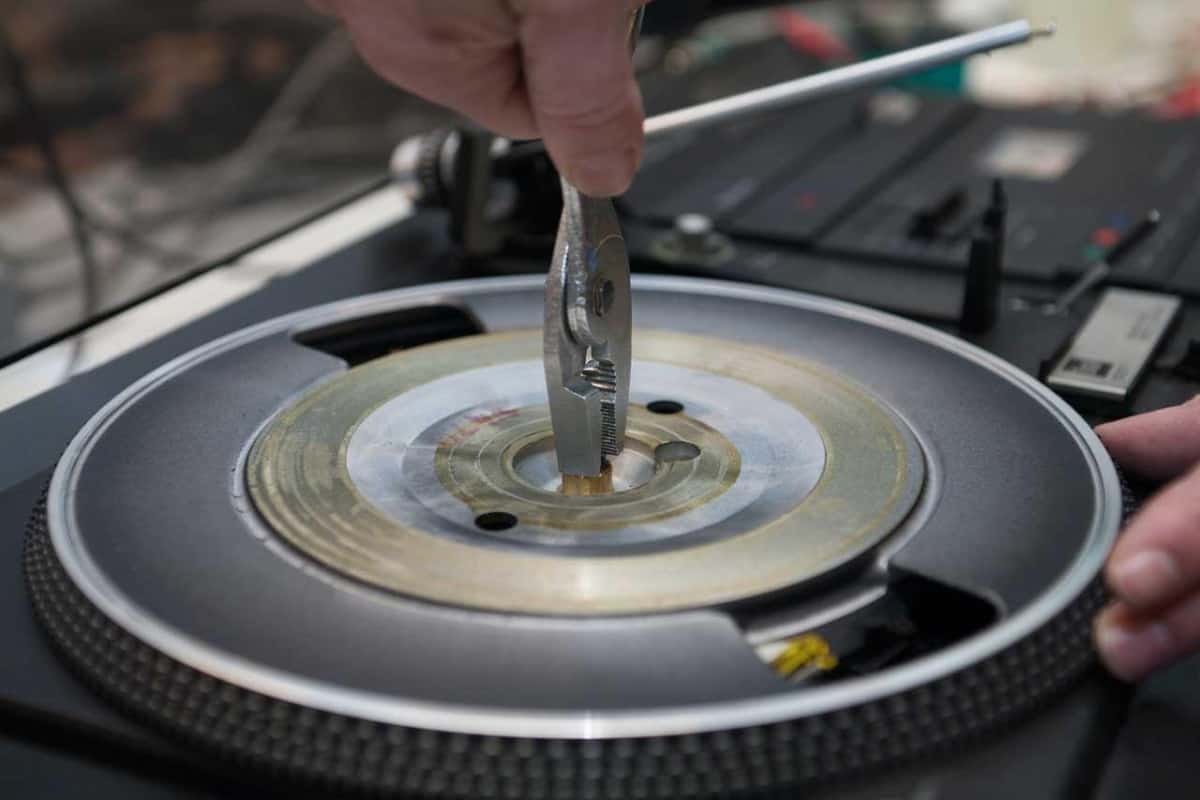
    As mentioned, and evident as it may be, I’ll mention that the type of turntable will dictate whether or not a repair is worth doing. If a record player is a budget one, you may not even have the option to get parts. Therefore, it’s advised that you have a rough formula to figure out if it’s worth the repair in the first place.

    Here are the formulas I use to determine if I should repair a turntable:

    • Value of Turntable < Cost of Repair = Don’t Repair
    • ¼ Value of Turntable = Cost of Repair = Repair Turntable or Upgrade/Repair
    • ½ Value of Turntable = Cost of Repair = Consider Upgrade

    When I use these rules, I take my love for the turntable into account. For example, if you have a solid Technic 1200 base, you may want to keep it forever and upgrade minor components as they break. You have to consider how you use the machine and how comfortable you are with it.

    Let’s take a quick look through some of the more common repairs required and what you can expect to pay for them.

    Common Record Player Repairs, Descriptions, And Costs

    Repair Estimate

    Many record player repair services will charge a nominal equipment troubleshooting/repair estimate fee. Some shops will do a preliminary investigation for free, but anything over a minute or two and you are likely looking at the cost of between $50 and $95, depending on the shop. (source)

    Broken, Stretched, Or Worn Drive Belt

    This repair never happens on direct-drive turntables, but it’s an inevitable repair on a belt drive. Most people don’t bother taking the record player into the shop for this, it’s usually a very straightforward repair. That and the fact that many repair shops carry a 2 to 3 week wait time for turntable repairs, so it usually isn’t worth paying someone to replace the belt when you can likely do the work yourself. (source)

    Drive belts for record players start at as little as a few dollars. However, you get what you pay for in the end. Here are a few examples of standard OEM replacement belt costs for standard models:

    • Audio Technica $17-$35
    • Clearaudio $29-$49
    • Crosley $10-$25
    • Emerson $10-$25
    • Harman Kardon $17-$35
    • Magnavox $17-$20
    • Pioneer $17-$20
    • Technics $17-$30

    Drive belts for record players are typically repaired by the owner of the record player. It’s relatively straightforward to replace and is often not worth the price of labor to replace.

    If you decide to get someone to replace the belt, you can expect to pay about $60 plus the cost of the belt. This service usually includes a complimentary tune-up and cleaning for the cost as a way of justifying a two-minute repair. (source)

    Tip: If your record player is worth less than $100, you may want to consider buying an upgraded turntable instead of replacing the belt.

    Cartridge Replacement

    Replacing a cartridge is something that all record player owners will need to do at some point or another. Audiophiles who enjoy their records must replace their cartridges more than others, as the greater the use, the greater the wear.

    Cartridge replacement can vary widely in cost. Here are two manufacturer examples of the extensive range in cost that a cartridge might cost you:

    • Audio Technica
      • AT-XP5 DJ Cartridge $79
      • AT-F2 MC Phono Cartridge $189
      • AT-ART9 Phono Cartridge $990
      • AT-ART1000 Cartridge $4,999
    • Clear Audio
      • Concept V2 MM Phono Cartridge $250
      • Performer V2 Ebony Phono Cartridge $450
      • Maestro V2 Ebony Phono Cartridge $1,300
      • Da Vinci V2 Phono Cartridge $7,000
      • Goldfinger Statement Phono Cartridge $16,000

    As you can see, you can get cheaper yet name-brand products at relatively low costs. However, you can also get 24-carat gold components with embedded diamonds. I’m not kidding; the Goldfinger cartridge is literally machined from gold and has a ½ carat diamond embedded. (source)

    So, what kind of record table repair do you need?

    The cartridge replacement is likely the most common repair amongst all record players despite make or model. Different cartridge mounting types exist, so if you do decide to upgrade to a non-OEM model, you may require an adapter plate of sorts to accommodate a different mounting arrangement.

    Tune-Up And Cleaning

    A common repair required for record players is the basic tune-up and cleaning service. This repair service usually costs in the neighborhood of $60 to $75 for most turntable brands. The repair usually includes calibration of the tonearm counterbalance and detailed and delicate cleaning of all components. Turntables with built-in brakes, like those used for DJing, may also include having the brakes adjusted. Some service repair shops include a new drive belt in the tune-up service if the turntable is a belt-drive type.

    Tonearm Issues

    There are several issues that a tonearm might have that may include:

    • Lowering too fast – counterbalance adjustment most likely cause
    • Wandering to one side – check if the record player is on a level surface
    • Won’t lower completely – check counterbalance adjustment or limit screw

    Most issues involving the tonearm are easy to repair, and thus you shouldn’t have to pay anything for most of these minor issues. Usually, an adjustment is all that is required. However, if you aren’t sure and frustrated, you could bring the turntable into a general cleaning and tune-up shop. Usually, service shops will include a minor adjustment like that of tonearm counterbalance or similar in a tune-up/cleaning cost. Typically you will be looking at anywhere from $60 to $75 for this service.

    Another not-so-common issue with the tonearm is the failure of the cables. Sometimes a cable just has a bad spot on it and needs replacement. The cables will be very fine and easy to damage, so extreme caution is required.

    Many tonearm cables are plug and play, but some models will require skill with soldering. You will need to remove the cartridge and possibly part of the unit’s underbelly to expose where the cables need to be fed through the tonearm and counterbalance assembly.

    Replacing tonearm cables is a repair usually best left to a repair shop. The part is typical at $10 to $45 for most models and makes of the turntable; however, the higher-end models like Clearaudio will cost considerably more, depending on the model the cable set is made to suit.

    Power Source Repairs

    One of the less common issues that turntables may face is a failed power source. Typically a transformer, this repair can be more involved than you may want to take on yourself. For starters, you’ll likely need some experience with soldering electronics.

    Typically, when an internal component of a record player such as a transformer goes, I recommend taking it into the shop. Here’s where you need to look at whether or not it’s worth it.

    Most repair shops will charge between $60 and $150 in labor to replace an internal component like a transformer. Likely, the cost of the part will be in addition. Depending on the make/model, the part can range from $25 to $400 or more. Use the formula for this to decide if it’s worth paying for the repair.
  • Where Does The Needle Go On A Record? (We’ve Got The Answer)

    Where Does The Needle Go On A Record? (We’ve Got The Answer)

    Understanding how records work is vital to placing the needle on the record in the correct place. So, how do you know where the correct place on the record is? Well, don’t worry, I won’t let you scratch up your records by dropping the needle in the wrong spot.

    If you are playing a record from the beginning, there is a narrow band around the outside edge of the vinyl record called the lead-in; place the needle here to begin playback. If you look at the record from an angle, you’ll see a slightly darker band.

    If you are playing the record from a particular track, you’ll need to use a different method of finding the location, which I’ll detail below. I’ll also explain why the lead-in is essential to use, rather than just dropping the needle into a groove, so stick with me to the end. Let’s get this spinning, shall we?

    Where Does The Needle Go On A Record? It Depends Where You Want To Play.

    The longest vinyl record in standard production is the twelve-inch 33 ⅓ rpm recording. This size of the record can store about 22 minutes of music per side for a total of about 44 minutes. These records are used for albums and LPs.(source)

    The record is divided up by the music recorded on it. Regardless of the music, whether it’s an album of songs or a symphony, there will be a lead-in and lead-out on either end of the recording, on both sides of the record.

    Placing the needle in the lead-in zone of the record is ideal when starting from the beginning.

    Placing the needle on the lead-in ring segment separating tracks on a vinyl record is possible but not advised for the new turntable apprentice. I’ll get into why in a moment.

    Needle Safe Zones

    There are three ‘needle safe zones on a vinyl record:

    1. Lead-In Zone
    2. Mid Lead-In/Out Zones
    3. Lead-Out Zone

    A quick explanation of each, and we’ll get to why these are fundamentally essential areas to release the needle onto the vinyl.

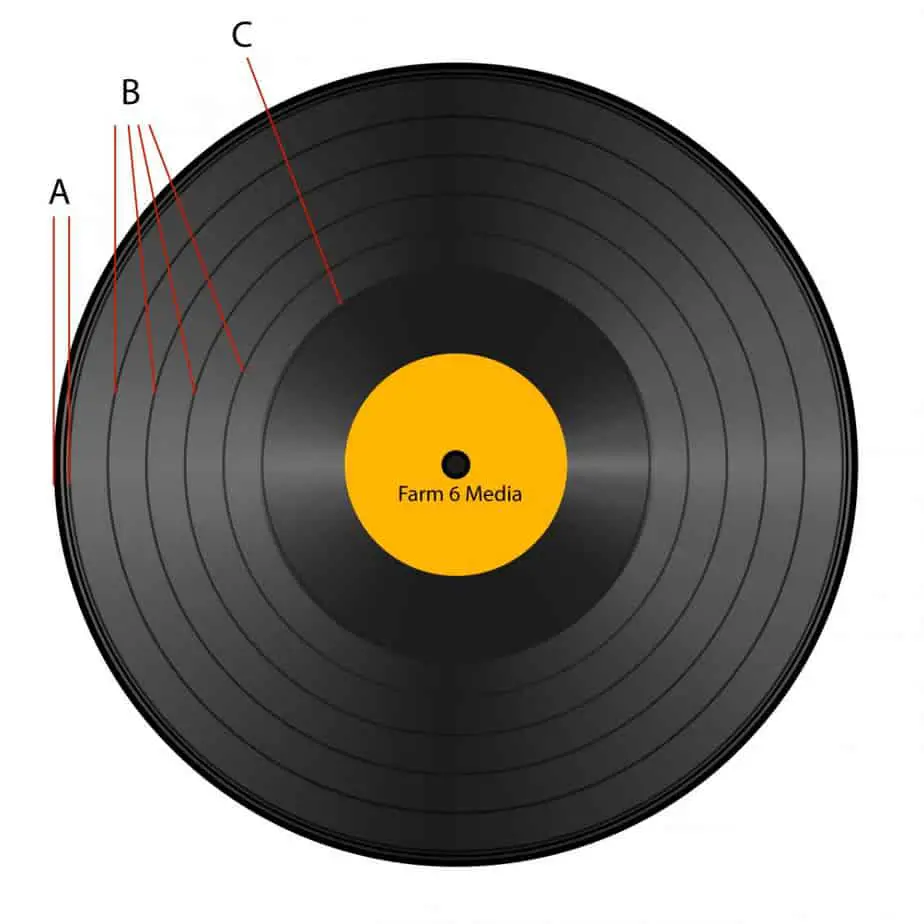
    Following, you will find the explanations of each of the needle dropping-safe zones. The image below the three-zone descriptions shows each area on the record for easy reference.

    A – Lead-In Zone

    The intended area where the needle should meet the vinyl record. Audiophiles will tell you that you should play a record from beginning to end without disturbance. It means starting in the lead-in zone and nowhere else.

    The lead-in zone is the wider of the dark circles around the record. The lead-in zone is on the outermost edge of the record. The position of the lead-in zone is dependent upon the fact that the record is designed for play, starting at the outer edge and working inward.

    B – Mid-Lead-In/Out Zones

    The mid-lead-out or mid-lead-in zones are the darker rings that appear on a record. These zones are in between tracks on the record.

    The number of mid-lead-in/out zones depends on the number of tracks on the record. You can count these rings to find the place to drop the needle to start at a particular track on the album rather than the beginning.

    How To Find A Track On A Record By Counting Lead-In/Out Zones

    1. Start at the outer edge of the record. Often the sleeve or label will state a side A or side B and which tracks are on each side. The outer edge of the record has the main lead-in area. This area is off-color compared to the bulk of the record, making it fairly easy to discern. Count this area as one because it leads into track 1 of the record.
    2. The next small ‘line’ that shows on the record, closer to the center label, is the lead-out zone for track 1 and also the lead-in zone for track 2. Therefore, we can call this area the track 2 lead-in zone.
    3. Count subsequent ‘lines’ on the record, counting up from the first (1) on the outer edge of the record until you find the ‘line’ or lead-in zone for the appropriate track you are looking for.
    4. That’s it! Now use extreme caution to set the needle in place. Caution aids in preventing damage to your record, or the needle for that matter.

    C – Lead-Out Zone

    Although the lead-out zone and final locking grooves are acceptable to drop the needle, I can’t imagine why anyone would bother. There are no tracks after the final lead-out zone near the center of the record. This zone leads to a locking groove that is designed to skip to hold the needle from meandering into the record label section.

    Why Not Drop The Needle Anywhere On The Record?

    Take a good, long look at your record. The tiny lines are grooves that are cut, near microscopically, into the vinyl record. Can you see the tiny nuances within a cut groove that show the sounds of a track? Not likely!

    The grooves on a vinyl record are only about 0.0015 to 0.00314 inches wide; that’s 0.04 to 0.08 mm wide for those of you using metric. The last time I checked, that was very small and near impossible for normal humans to see the detail. (source)

    Now, consider the enormous clumsy hands of a human compared to that microscopic-like world where one could see the nuances of the cut groove.

    With that in mind, drop the needle on this fine-cut groove, and you’re likely to cause permanent damage. Likewise, if you drop the needle regularly on a place on the record, you will invariably cause damage.

    How Tracking Force Is Involved

    The downward pressure applied to the stylus, and thus the needle, will invariably play a role in how your needle interacts with your records. And it doesn’t just affect regular play; it affects dropping the needle as well. (source)

    The tracking force pushes down on the needle to hold it in place in the record groove. However, some novice DJs tend to set their tracking force high to let them get away with more when it comes to scratching.

    A greater tracking force equates to a heavier needle. When dropped on the lead-in zone, the needle can score the record, causing an annoying and possibly loud blip in the silence before or after a track starts.

    The Best Way To Drop The Needle

    Before playing any records, you should ensure your record player is tuned correctly.

    Proper turntable tuning involves balancing the tonearm with the cartridge in place.

    Balancing the tonearm is essential for the proper tracking force application to the record. However, as mentioned earlier, one can damage a record if the force is too great.

    After balancing the tonearm assembly and placing the record on the platter, start up the spin.

    Gently lift the tonearm out of the holding cradle. Most record needle cartridges have a built-in handle for moving the tonearm assembly. I like to use mine by holding a finger under the lever arm, letting the weight of the tonearm hold it in place on my finger while I maneuver it to the lead-in zone.

    By lowering the needle by holding your finger under the cartridge handle, you ensure you put zero extra pressure on the record via the needle. You simply lower the needle, and that’s it; no downward force applied.

    FAQ

    Do records start in the middle or outside?

    Records start around the outer edge of the record. As the record plays, the needle and tonearm will gradually wander towards the center of the record.

    Does dropping the needle on the record damage it?

    If by ‘it’ we are referring to the needle, the answer is that it will not likely damage the needle. However, if we refer to the record made of PVC plastic compared to the rigid diamond needle, then the answer is yes; dropping the needle can damage it (the record).

    Can you stop a record with the needle down?

    Technically, you can stop a record with the needle down, but it isn’t advised for the sake of the record.

    The best practice is to lift the needle off the record gently, but only when the needle has reached a lead-in or lead-out zone. That way, you don’t risk damaging where the audio is recorded on the vinyl record.

  • 9 Of The Worst Record Players To Avoid

    9 Of The Worst Record Players To Avoid

    Everyone will try to tell you which are the best record players to buy. And they are likely based on a mixture of real-life reviews and the amount of money the blog is making from convincing you to purchase. But, whoever warns you NOT to buy something?

    Wasting money on products with poor reviews is something I try to avoid. So, I’ve compiled a list of the worst record players (in my opinion) that you should avoid purchasing at all costs.

    Top X lists are enormous. I say let’s take a look at what to avoid for once, rather than just show what’s hot and selling. After all, some of the best gear is just off the main playing field. Let’s just try to avoid the lousy gear while we navigate the turntable market, shall we?

    My Top 9 Worst Record Players To Avoid At All Costs

    In the following table, I’ve collected data from Google on the worst-rated turntables being offered currently. These were all the way at the end of page 16, and Google was not offering a page 17, so I’m assuming these are the worst that Google is willing to show.

    These models are assumed to be the worst available, based on the reviews of actual buyers. If you do your research in the forums, you’ll find a correlation between what people say is not good and the brands listed in the table below. Or at least, I found a correlation at the time of researching this information.

    Record Player

    Rating On Google

    Price On Google

    RPM

    Crosley T200A

    3.3

    $ 129.00

    33.3, 45

    Crosley Turntable McQueen

    3.2

    $ 109.99

    33.3, 45, 78

    Crosley C3

    3.1

    $ 69.25

    33.3, 45

    Jensen JTA 470 Professional

    3.0

    $ 74.55

    33.3, 45, 78

    Victrola Hawthorne 7 in 1

    3.0

    $ 149.99

    33.3, 45, 78

    Victrola Acrylic Bluetooth Turntable

    2.9

    $ 149.99

    33.3, 45

    Crosley Journey Turntable

    2.7

    $ 49.99

    33.3, 45, 78

    Victrola 3-in-1 Bluetooth Suitcase Turntable

    2.6

    $ 49.99

    33.3, 45, 78

    Victrola Brighton Turntable

    2.4

    $ 99.99

    33.3, 45, 78

    As you can see in the table above, the worst record players are dominated by Crosley and Victrola, with only a Jensen also making the list.

    Assuming that user ratings and reviews correlate to the worst record players for sale, it’s safe to say that Victrola is the worst, having all four positions within the bottom half of the ratings. Crosley comes in as the second-worst brand of the turntable, with a review rating correlation showing the four Crosleys all reside in the top half of the worst nine.

    Jensen sneaks its way into the list with an underperforming JTA 470 Professional turntable. Far from what I call professional, this record player is not on my wish list, that’s for sure.

    My advice is to buy yourself something decent. If you’re buying for a five-year-old, then maybe one of these. Nah, even a five-year-old deserves better, in my opinion.

    Are Cheap Turntables Any Good

    The bottom line is that any turntable will play a record as long as the RPM of the turntable coincides with that of the record. However, this says nothing about the quality of the audio. Not to mention, really cheap cartridges with cheap needles might harm your records. So, if you like your records, you should use a half-decent cartridge and needle at the bare minimum.

    There are two primary considerations when looking at purchasing a cheap turntable. Answering these two questions before spending any money can help save you from making a wrong purchase.

    1. What is the purpose of this turntable?
    2. What is a good quality sound worth to me?

    What is the purpose of this turntable?

    When you’re on a tight budget, determining the purpose of a turntable purchase is an excellent way to figure out what you should buy.

    For example, if you are buying a turntable for a kid, and it’s likely they won’t respect it, or perhaps it’s just a fad, then a cheap turntable might be the best solution.

    If you are heading off to college and there is a high likelihood that your record player will get borrowed a lot, then perhaps a cheaper one is a better idea.

    However, if you intend to guard your turntable along with your valued vinyl collection, then a cheap turntable is not for you.

    If you enjoy listening to music, you might want to reconsider and get a better turntable.

    That leads me right into the second point:

    What Is Good Quality Sound Worth To Me?

    When you consider the stereo system, that is something that plays music either out loud or through headphones or other speakers; there are many links in the chain. I am referring to these links: the amplifier, the record, the record player, the speakers, the wiring or cables, and so forth. You get the idea.

    Each of these components creates a chain that outputs music in your chosen way (speakers, headphones, etc.). That chain is only as good as the weakest link. I’m sure you’ve heard that expression before.

    The rule I always use is never to purchase a “link” of equal or lesser value. Or rather, in this case, never purchase a turntable of equal or lesser value. Now keep in mind here that I say the word value. I did not use the word cost. My definition of value is a quality manufactured product intended to last. Sometimes you find a used Technics 1200 at a garage sale for $20, and it works perfectly. That’s value.

    Now that we’ve established value let’s consider the quality of sound for a moment. If we only look for value, quality manufacture intended to last, then we consider quality sound over mediocre sound. What are you willing to pay to upgrade from mediocrity to a pleasurable existence? That is while listening to vinyl records, of course.

    Other Brands To Avoid

    I find that there are altogether too many brands of turntable now. Call me old-fashioned, but in my experience, it’s best to go with the tried, tested, and authentic brands. So, if it’s a weirdly named brand you’ve never heard of, your best bet is to carry on not knowing it and leave it behind.

    However, you can’t judge a record player by whether or not you’ve heard of the name. For example, many people have heard of Crosley and Victrola. But I wouldn’t touch these brands with a ten-foot pole.

    Perhaps I am just old-fashioned, but I’m still a Technics guy. Don’t get me wrong; there are some other great brands out there like Audio Technica, for example.

    Sometimes It’s The Model, Not The Brand

    I’ve found that out of the name brands that don’t catch my eye, I have one rule for turntables: Never buy a portable or ‘suitcase-style record player. They never seem to be any good, and many models have shown to prematurely wear records from cheap needles, improper tracking pressure, and similar issues. Not to mention the atrocious sound quality you get from the small and inadequate built-in speakers in many of these models.

    Sometimes I also notice that a brand might have a flawed model, but some other great ones. For example, you can debate which Technics record player is the best and which is the worst. It’s a matter of perspective, but who is to say the worst Technic model is not equivalent to the best model of another brand?

    Either way, the cheap portable types of record players are usually the bad ones. Turntables intended for single location use are the ones you want to look at if you want any kind of quality at all.

    And if budget is an issue, take a look at hock shops and used electronics stores. You can often find a great deal on a great record player worth much more than a suitcase-style in terms of quality, but often for less money. I once found a Technic 1200 at a garage sale for only $20. I still have that turntable twenty years later. What does that tell you about the value of the $20 I spent?

    Do yourself a favor and buy a decent turntable right from the start; it doesn’t have to be expensive if you shop for a bargain or a used unit. You’ll be glad you did.

  • The Differences Between Technics 1200 and 1210

    The Differences Between Technics 1200 and 1210

    Technics 1200’s are known as some of the best direct-drive turntables in the industry. The record player has dominated the industry for decades, leading as a benchmark to follow for competition. But what is the difference between the SL-1200 and the slightly more expensive SL-1210 models? Let’s find out.

    The Technics SL-1200 and the SL-1210 are both acclaimed models of record players. Highly similar in many features, the SL-1200 has more features a DJ will like than the 1210, geared to the audiophile.

    Being such a versatile and respected base platform, the Technics 12xx lines of turntables have garnered the respect of DJs and audiophiles alike. Technic has done its best to distinguish two versions of the classic 1200, each suited to an individual audience.

    I’ll go through all the features and point out the similarities between the new Technic turntable models available on the market. That way, you’ll have all the information you need to know, so let’s just dive right in and get this record spinning.

    Current Models of Technics 12xx

    It’s easy to get misled by the denizens of net experts, especially in forums. Everyone loves company, so everyone thinks they know, and everyone thinks their model is the best. But, I’ve got some news for you – there are many models in the Technic 12__ series, four to be exact.

    There are more if we’re talking historically, but in terms of new equipment, this is what the current lineup of the 1200s (including 1210s) that you can get from Technic.

    • SL-1200G – The standard model 1200 direct drive record player.
    • SL-1200GR – 1200G with upgraded motor, motor control, platter, and tonearm.
    • SL-1200MK7 – The DJ’s choice model with reverse play function.
    • SL-1210GR – 1200G with upgraded motor, motor control, platter, and tonearm (black).

    As you can see from the list I put together above, the four current Technic 12xx series of turntables are slightly different.

    When we compare all the specifications, the two turntables, the SL-1200GR and the SL-1210GR, are indeed the same, save for the color of the body. That and a typically hefty price difference at the cash register also.

    The components are the same, but when we compare the other 1200 models, we see that there are indeed some pretty significant differences between a 1200 and 1210. Let’s look at those features that differentiate the models.

    Features Comparison Between The Technics SL-12xx Models

    If you were trying to distinguish between the models of Technic turntable, you likely happen upon several forums where everyone with an answer seems to say that the 1200 and 1210 are the same. That would be inaccurate. I’m going to clear this up.

    When laid out side by side, the features and differences of models show the clear and distinct differences of turntable models. Take a look at the table below.


    Technics SL-1200G

    Technics SL-1200GR

    Technics SL-1200MK7

    Technics SL-1210GR

    Speeds

    33 ⅓, 45, 78

    33 ⅓, 45, 78

    33 ⅓, 45, 78

    33 ⅓, 45, 78

    Reverse Play Function


    Yes


    Platter Weight

    7 15/16 lbs (3.6 kg, incl. Rubber mat)

    5.51 lbs (2.5 kg, incl. Rubber mat)

    4 lbs (1.8 kg)

    5.51 lbs (2.5 kg, incl. Rubber mat)

    Platter Characteristics

    Brass and Aluminum diecast combined

    Aluminum diecast

    Aluminum diecast

    Aluminum diecast

    Starting Torque

    2.2 kg x cm

    2.2 kg x cm

    1.8 kg x cm

    2.2 kg x cm

    Start-Up Time @ 33 ⅓ RPM

    0.7s

    0.7s

    0.7s

    0.7s

    Overall Weight

    39.7 lbs (18 kg)

    25.35 lbs (11.5 kg)

    21.2 lbs (9.6 kg)

    25.35 lbs (11.5 kg)

    Available Colors

    Silver

    Gunmetal Grey

    Silver, Black

    Black

    Power Consumption

    14 Watts

    11 Watts

    8 Watts

    11 Watts

    The features comparison takeaway is that the G and MK7 models are quite different, even on the same base platform. The GR models are identical save for color and likely price.

    Given the GR models are the same, let’s look at what makes the G and the MK7 stand out in the crowd.

    Aside from the apparent feature allowing one to reverse the direction of the platter, there are some other unique differences between the models of Technic record player that are noteworthy.

    Starting Torch And Platter Weight

    Two more distinct differences between the Technic 1200 models are the weight of the platter and the initial torque.

    I find it quite interesting that the initial torque of the DJ version of 1200 is the least powerful of the bunch. However, it is relative to the decrease in weight. A more substantial torque might cause records to slip on the slipmat making for weird and broken beginnings.

    Although it might be an idea to attempt upgrading to a higher torque motor, you might have to consider adding weight to the platter to counter any slip from over-torque.

    Weight

    The most significant difference between Technic 12xx models is the overall weight. The G model comes in at a lofty 39.7 lbs. Let’s just call it 40 pounds; it’s a beast. It’s solid. It’s not going anywhere in a hurricane-force wind. It’s a monster of stability.

    Now compare the large beast G model to the MK7 DJing rig that comes in at just over half the weight of the G at 21.2 pounds. It’s literally near half the weight. The unit sacrifices some of the stability that comes with weight in exchange for the portability factor taking weight in as a primary make or breakpoint.

    Power Consumption

    I found this to be particularly interesting, although not unexpected. The power required to maintain the stable momentum of the platter is relative to the weight of the platter and the speed of rotation. Assuming a rotational speed symmetry, different power requirements to maintain velocity are understandable with different weight platters. The heavier the platter, the more energy is required to maintain velocity.

    Everyday Prices Of Technic 12xx Turntables Online

    The prices of models seem a little out of whack with reality. It’s more accurate than not when comparing the prices of the SL-1200GR and the SL-1210GR. It’s virtually the same machine in every way but base color.

    • Technics 1200MK7 is commonly sold for $999.00 to $1550.00, depending on where you purchase.
    • Technics 1210GR $1699.99 is a standard price to find the 1210GR retailing.

    Bottom Line: What’s The Difference?

    The difference between the iterations of Technic 12xx turntable varies in weight of both platter and overall unit. This platter weight difference explains the difference in power requirements. The only model with a reverse direction feature is the lightest of the turntables, the SL-1200MK7.

    The other difference between these models is the price.

    Which Model Of Technic Turntable Should I Get?

    Deciding which model is pretty straightforward. First, if you are going to scratch or DJ with it, you should likely consider the MK7. The feature to reverse with the flick of a switch is pretty cool. It offers the ability to include many special effects moments that would be pretty difficult to accomplish otherwise.

    The trade-off for the MK7 is the lightweight platter and overall weight. The heavier the player, the more stable, so the MK7 is the lightest of the bunch.

    If the clear sound is what you’re after, I’d recommend the GR model. It’s upgraded from the G but has a lot of great features built-in. However, you just can’t beat the stability of pitch with a heavier platter like that of the G model.

    Other Options For The Technic 12xx Series Of Turntables

    Do you remember the muscle car fad of the 90s and the street racing fad of the 2000s? Whether you do or not, the point is that when a fad gets popular, and a brand or a few brands are at the center, then aftermarket parts become readily accessible.

    The world of the Technic 1200 is no different from the muscle cars of old in that there is no shortage of aftermarket upgrades.

    You could find a great deal on an older Technic 1200GR and upgrade the motor or the cartridge. Many upgrade the tonearm, and most people have their favorite slipmat if DJing is your interest.

    The long and short of it is that upgrades are plentiful, so you could grab a $1000 turntable, add $500 in upgrades and have a turntable that would rival any or most $3000 models.

    Sources

  • My Turntable Smell Like It’s Burning: 5 Issues And Easy Fix Tips

    My Turntable Smell Like It’s Burning: 5 Issues And Easy Fix Tips

    Relaxing to some classic vinyl and a funny smell like burning starts to meander across the room. It’s subtle but makes you wonder why the turntable smell like it’s burning has entered your nose. Before your house burns down, it would be best if you unplugged the device and kept reading to find out more.

    Several things may cause your turntable to smell like it’s burning from a short to a bad belt. You need to discern the exact smell and place where the smell originates from knowing how to fix the problem. Use our handy troubleshooting guide below to find out why your turntable smells like it’s burning.

    We’ll explore the five primary causes of a turntable smell like it’s burning and help you troubleshoot to figure out which cause affects your turntable. Stick with me for the repair tips for each as well, so your turntable will be back up and spinning in no time.

    Why Does My Turntable Smell Like It’s Burning?

    As I mentioned, a few different things might cause a turntable to start giving off an odor of burning suddenly. However, five things are usually the culprit:

    1. Electrical Short – Smells like burning plastic or chemicals.
    2. A Belt Is Loose Or Brittle – Smells like burning rubber.
    3. Motor Failing – Smells like metal or chemicals burning.
    4. Dust Buildup – Smells like paper or waste burning.
    5. Bearing Failing – High pitch squeaks accompanied by smell like burning oil or chemicals.

    Each of these common issues can make an older (or even a new) turntable smell like it’s burning. A smell like burning often happens with brand new turntables out of the box. However, it should not be taken for granted because there could be a potential fire hazard. Here’s more information you need to know (keep reading).

    Electrical Short

    A common cause of a smell of burning with many small appliances, not just turntables, is the electrical short.

    Turntables are known for their reactions to and creation of static electricity. Although not a huge threat, a small short can weaken electrical insulation over time and cause a short to occur more and more often at a particular location.

    How To Diagnose An Electrical Short On A Turntable

    Sometimes, a turntable component, like the wiring or a switch/control knob, starts to fail and starts shorting out.

    Suppose the short is in a circuit that directly affects operation. In that case, the source of the failure should be evident from either a failure of the turntable to produce sound or some other failure in the operation that makes a short obvious.

    Suppose the short is in a circuit that does not directly affect the operation but still has power, like that of an led lighting up part of the turntable or some other similar subsequent circuit. In that case, there is the possibility of a short, without operation being affected.

    Unplug your turntable and give it a thorough inspection. Remove any protective covers to expose the wiring. Trace the wiring from the plug to each end of the circuits and look for:

    • Scorched wiring
    • Loose wiring/connections

    If you find a loose connection, do your best to tighten it or even solder it if you have experience. Otherwise, you may want to bring the unit in for repair, especially if you see anything burnt.

    If you find scorched wiring, do not plug the device back in until professionally repaired.

    A Belt Is Loose Or Brittle

    Turntables that are not direct drive are notorious for burning out drive belts. Commonly the older the turntable or, the more it is used will cause the belt to wear faster.

    Once a belt is aged, it will become loose or brittle. In both cases, it case cause the belt to slip.

    How To Diagnose A Loose Or Brittle Belt On A Turntable

    Usually, when a belt slips, you’ll notice a stop or slow-down in the tempo of the record. However, if the record hasn’t started yet, or the slip wasn’t noticed, you may notice a faint burning rubber smell.

    Unplug your turntable and carefully flip it over (without placing the weight onto the tonearm).

    Inspect the belt for damage. Feel the belt with your fingers to determine if it is still pliable and if there are any brittle spots.

    Inspect that the belt is tight but not over-tightened. The turntable should spin freely and without much discernable friction. The belt should hold firm without slipping.

    Motor Failing

    Whether your record player is a belt-drive or a direct-drive, both use an electrically powered motor. The motor is not indestructible, nor do they last forever. That is, they don’t last if they are ill-maintained or in poor conditions.

    I once kept an old turntable in my garage. An exceptionally wet spring came and went, and I found that the platter had all but seized due to a seized motor.

    When I took the belt-driven turntable inside and opened up the case, I found that the moisture from the air outside had rotted away the motor, bearing, and other metal components. The rusty tonearm was the first dead giveaway. In my experience, it’s best to keep these indoors.

    How To Diagnose A Failing Motor

    Usually, when a motor fails, it either stops working altogether, or you’ll find it ‘steps’ by stopping for very brief pauses and then picking up again.

    The motor is often quite warm to the touch, sometimes even hot enough to burn, so be cautious. Always unplug first.

    If you have a belt-drive, remove the belt and turn the wheel pulley by hand. It should spin freely and without any noticeable friction.

    The motor shaft should not have much, if any, play in the shaft. The pulley and shaft should neither wobble side to side nor extend and retract at all. If they do seem to be loose, then it is likely the inner bearings of the motor are gone.

    If the motor simply stops working, you can test the circuit using a voltmeter if you are experienced with such things. If you aren’t experienced, don’t try to test any electrical circuits and bring the turntable professionally repaired.

    If your motor seems okay but has never had oiling, try oiling it. All record players should have the motor and spindle bearing oiled every 2000 hours or so of use.

    Dust Buildup

    Just because your record player has a dust cover doesn’t mean that dust can’t build up inside the unit. Any record player that has any holes exposing the inner workings may get dust building inside the machine.

    Record players that are used often will gain more dust between the platter and the turntable body.

    Record players that don’t have a dust cover will be highly susceptible to dust buildup issues.

    How To Diagnose A Turntable with too much dust buildup

    If you can see dust at all, there’s too much. One issue that can occur is the use of carbon fiber brushes.

    We are taught to slowly glide the carbon fiber brush, working it from the center spindle outward along with the record as the record spins.

    The motion is similar to plowing snow off the road. In this case, we are plowing dust off the record.

    The problem is that fine carbon brush fibers and dust are being swept off the edge of the record. Over time, this fine dust can build up between the platter and the turntable body.

    When enough dust builds up, and the record player finds use, the friction can heat the dust to the point where a burning smell can emanate from the turntable.

    Use a compressed air can (purchase in a computer maintenance area of stores that sell computers) typically used to blow out keyboards. Focus the air around the platter’s outer edge to remove any dust trapped between the platter and the body of the record player.

    Bearing Failing

    Record players don’t often have a bearing go, but it can happen on turntables used heavily. Smelling the smell of burning plastic (the housing around a hot bearing) is rare but not impossible. Often the turntable is used for scratch djing as this provided adequate pressure on the table bearings to cause premature wear.

    How To Diagnose A Bearing Failure In My Turntable

    The most common noticeable fact when a bearing goes is the sound. True, a blown bearing may start to smell like burning, but it is usually the plastic around the bearing that is starting to heat up due to a hot and worn bearing that would smell. Furthermore, by the time this happens, you’d likely already know due to a noticeable change in turntable operation.

    The most common way to diagnose a blown bearing is the sound. Most bearings start to squeal when they wear. The smell is much less common.

    You might also be intersted in these articles:

  • Why You Should Never Buy A Crosley Record Player

    Why You Should Never Buy A Crosley Record Player

    A lot of people really dislike the Crosley brand. Famous for their cheap, low-end, all-in-one portable record players, Crosley appeals to many people not interested in a high-end record player for its sound generating abilities. However, even for a cheap turntable, there are a lot of reasons you should never buy a Crosley record player, in my opinion.

    Crosley record players are known for their low price and their low quality. Touted on many forums as the bane of the true audiophile, Crosley record players are some of the cheapest and cheapest quality portable record players on the market.

    However, if you are in the neighborhood for a budget-friendly option, you don’t have to break the bank to get a better sound than a Crosley. If their low price is still luring you in that direction, take heed – I’m not the only one with an opinion on these cheap record-turning devices (I don’t even want to call them turntables).

    Let’s take a look at what some people have said about the Crosley and why you’re likely better off without one. Stick with me to the end, and I’ll share my not-so-secret alternative to a cheap turntable you’ll regret.

    Why Shouldn’t You Buy A Crosley?

    As mentioned, I’m not the only one with an opinion about the cheap Crosley players. Mawnck of the Reddit community had this to say about Crosley:

    “…the main problem with the Crosley/Skywin stylus is its plastic cantilever.”

    Okay, so we can see from this statement that if true, these record players would produce inferior sound. Or so it would lead me to believe. However, Mawnck doesn’t stop there. The user goes on to lacerate the brand further.

    I don’t take some random forum person’s opinions for the gospel. I know to take everything I read with a grain of salt. With that in mind, I decided to go hunting for more reliable sources of information.

    Who Has Some Authority To Talk About Crosley?

    My journey to find out all I could to back up my experience and opinion with Crosley record players led me to more professional opinions. I left the forums behind and went to see what some real audiophiles had to say about these budget record players (again, I want to call them record-turning devices, not turntables).

    The next place I stopped was an article by the respected Brent Butterworth of Wirecutter. Here’s what Brent had to say about the Crosley:

    “With all the records I played on it, the sound was thin and blaring. I heard little else but vocals and guitars when I played albums from Bob Dylan, R.E.M., and Yes.”

    This sentiment sounds like a broken record after reading all the user reviews about the Crosley record players. In particular, the Cruiser and other portable, cheap models.

    Brent went on to tell us more about his experience with the Crosley, and I can say that it mirrors my own experiences,

    “I was sure the album included a bassist but I couldn’t easily hear him.”

    The final point Brent nails right on the head, and I agree wholeheartedly.

    “Noise from the turntable’s motor leaked into the stylus and was audible through the speakers.”

    The very same experience I had with the Crosley I tested. I turned on a record to listen to the silence between tracks and could hear the motor coming out the speakers. The speakers are of inferior quality as well, in my opinion, and from my experience. They sounded kind of like tin cans were mounted as horns. I felt it wasn’t worth wasting money on their product.

    Here’s what Brent says about the speakers, again mirroring my sentiment:

    “I hadn’t expected much from the Cruiser’s two 2½-by-1¼-inch oval speakers; even so, I couldn’t lower those expectations enough to enjoy listening to it.”

    With Crosley, It’s Not Just The Speakers, Stylus, Or…

    You may think that I just had a flawed model, and so did all these other people. So, I found another person who distinctly did not use the Cruiser model that many of us dislike. Here’s what I found from Justin Channell on Steve Hoffman Music Forums:

    “So, for years I used a Crosley turntable/CD combo cabinet, until I got sick of it’s poor tracking ability.”

    Let me see if I’ve got this straight. Aside from my experience with the Cruiser that sounded like cheap cans and was all over the place in terms of tracking, other users have said a few things. Let’s sum up the top three complaints:

    • Poor tracking quality
    • Poor speaker quality
    • Poor build materials

    A few other ‘rumors’ are floating about the forums, stating that the Crosley product wears out records prematurely. I have yet to see the evidence to support this claim. However, I can tell you from experience that the three issues above are, in my opinion, critical issues and cannot be ignored.

    Why People Buy Crosley And Other Budget Brands

    The truth is that not everyone has the passionate desire to hear perfect sounds. Not everyone is an audiophile. However, there has to be some sort of reasons why a person ignores what so many tell them about the quality of these record players.

    The primary reason people buy units like the Crosley is that they are cheap and all-in-one, meaning you don’t need a separate amplifier and speakers – The Crosley has them built-in.

    To be honest, if you’ve had a few drinks, or if you don’t care so much about missing half the bass (or all of it) then, it might not be the worst option. I mean, there might be a worse record player out there; I hear the Victrola’s have equal quality as the Crosleys do. Though, you should look at other options.

    Other Options To A Cheap Product Selection

    When it comes to electronics or most music equipment for that matter, I usually prefer to purchase brand new, so I can take advantage of any warranties and use a new flashy product. However, I can appreciate used equipment and the next person; and when it comes to turntables, used is an excellent option for a cheap alternative.

    Here are my top two favorite ways to find an excellent turntable for dirt cheap.

    Take A Saturday Morning Drive

    One of the best things I did when I was in college did a Saturday morning drive. I had ten dollars in my pocket and just received my box of records from my parent’s house – with no turntable!

    To make a long story of youth chasing deals shorter, let me just say that I found my first turntable – a Technic SL-1200 in the driveway of a charming Jamaican woman selling a few things on a Saturday morning. After chatting with her about her garden for several minutes, I asked her how much the record player was missing its plastic cover, but the rest looked intact. She sold it to me for $10.

    I brought it home and plugged it into my stereo, and it worked great. I still have that direct-drive turntable in my basement.

    Hock Shops, Buy And Sell Shops, Second Hand Stores

    You might be surprised to see what brands people will part with at used product stores. Some areas call them Hock Shops. You know the stores, they are notorious for buying stolen goods in the movies. In real life, you can find some fantastic deals on turntables that people are getting rid of because they have an iPod now or some other digital means of playing music. The same thing happened to tape cassettes, except vinyl has a vintage sound many of us, myself included, refuse to let go of in exchange for digital source.

    Drive around, look for garage sales and used equipment stores, and I bet you’ll find a sweet deal before you know it. Just be prepared to buy a new cartridge. It’s often required when buying a used record player. Good luck and happy turntable hunting!

  • 3 Reasons Why Records Pop (And What To Do About It)

    3 Reasons Why Records Pop (And What To Do About It)

    I was sitting with my friend in the living room of my apartment listening to vinyl 33’s, and then I heard it in the middle of one of my favorite tracks – the dreaded pop. It led me to wonder what causes the pop sound that can sometimes happen with vinyl records.

    Vinyl records will make a popping noise for three reasons I call the 3-D’s: Dirt, Debris, and Damage. Dirt and debris are similar, but I think of debris as a more severe particulate residue, dirt, and debris repairable. Damage is irreparable in most cases.

    If you’ve had a record start popping, there might be something you can do. However, the first thing you need to do is to diagnose the pop – what caused it. I’ll walk you through how to diagnose and fix the pop in many cases quickly. I’ll also explain the alternative when you can’t repair the issue. Let’s get this spinning on the table, shall we?

    Why Records Pop – The 3-D’s Explained

    Dirt, debris, and damage are the three ‘D’s’ that are the typical culprits of the classic record pop sound. However, the sound can also be generated by wiring shorts, which I’ll explain after; the three D’s are the most common culprits, so we’ll get them sorted out first.

    Dirt

    I suppose I could have said Dust instead of dirt, but you get the idea. The concept here is that any dry foreign material may get lodged into the grooves of your record. The material will need to be small enough to enter the grooves, and the most common culprit of this is dust.

    Dirt may also include food (if you drop crumbs on a record or other such foolishness). The concept is again that it is foreign material. I classify anything dry into this category because as long as the record isn’t physically damaged, you have a hope of correcting the issue. The correction is often cheap and easy, often as simple as using a carbon brush and taking decent care of your records.

    Keeping a carbon brush and needle cleaner are great ways of avoiding pops by maintaining clean records and equipment. It’s always a wise choice in my experience.

    Prevention Tip: Never leave a record on your record player unless you’re listening to it. Even a covered player will allow dust particles in the air to settle on the vinyl record. Always store your records in the sleeve they came in, and don’t forget them on your turntable.

    Dirt and dust may not be on your record at all, either. The dirt might stick it to your needle and stylus. Sometimes dust will loosely collect on the needle as it scrapes its way along the record groove. Just like rolling sprinkles onto a fresh donut or rolling snowballs to make a snowman, the dust rolls and builds until the needle catches it and ‘drives’ over it, causing a momentary pop noise as the needle jumps over the dust ball.

    Keeping a carbon brush and needle cleaner are great ways of avoiding pops by maintaining clean records and equipment. It’s always a wise choice in my experience.

    Debris

    When I’m talking about debris, I’m referring to the more difficult foreign objects and materials entering a groove in a record, causing a pop sound. More challenging foreign materials include things like oil from your fingers, liquid-like a sneeze over your record, or even spilling liquid nearby that can send tiny droplets flying onto your vinyl.

    Aside from oils and liquids, debris may also include particles that have semi-merged into the vinyl either by chemical reaction or by the needle forcing micro-particulates hard into the soft vinyl surface. These particulates may even cause damage. Think little salt or sand-like particles that are extremely small but hard; much harder than the soft vinyl. The diamond or sapphire record needle is tough. It can act as a hammer of sorts to force tiny hard particles into the surface of the vinyl, causing microscopic damage (our third reason for the popping noise coming up next). (source)

    Damage

    The culprit, none of us, want making a pop noise playing our vinyl records is damage. Various reasons may cause damage, but the outcome is typically the same; the record is irreparable.

    I hope it isn’t your favorite record that’s suddenly making popping noises, but if it is, there might be hope. Not that I want to get your hopes up if the record is physically damaged, but if it’s any of the other reasons, then you might be in luck. Let’s take a look at a couple of other causes before we write off your record. We should also look at proper diagnosis to determine once and for all why your record popped.

    Other Possible Pop Causes

    • Electrical shorts – Check your cables and ground. If the ground wire isn’t properly hooked up, static charge can build and cause audio interference that might sound like a popping noise as the electricity builds and discharges.
    • Player damage – Damage to your stylus or needle might also cause popping or other audio interference. Check your needle and stylus with a high-power magnifying glass to see if you can observe any damage. Maybe you need a new cartridge, and that record you love is okay.
    • Poor quality recordings – Sometimes, it’s just a poorly made record. GuildX700 from Steve Hoffman Music Forums says, “…some vinyl is just crap, I’ve got dead quiet ones and ones that pop and click even though they are clean.” (source)

    How To Diagnose Why A Record Pops

    Diagnosis of your turntable creating a popping noise during record playback is not difficult (if you have the right tools). Ideally, you will have a high-power magnifying glass, but even if you don’t, there are a few things that you can do. Try these steps that I found helped me figure out what the cause of the popping noise is.

    1. Check the connections. Record players are notorious for having issues with things like static electricity. If you’re using old wires like some old RCA cables you found in the garage, check the cabling. If there is a short or damaged cable, it can produce a crackle or popping sound during playback.
    2. Check your needle and stylus. If there is damage to the needle, then it could cause a popping sound. Also, there might be dust on the needle, so try using a needle brush or cleaning dabber to ensure your needle is clean and free of debris.
    3. Clean your record. The easiest fix to the most common issue that causes popping is to clean the record itself. The most common cause of audio interference being a dirty record. This popping noise happens a lot when records aren’t handled properly, and there are oily fingerprints on the vinyl surface.

    Try using a good quality carbon brush and clean your record according to the directions provided with the brush. There are also unique cleaning solutions you can purchase to aid in removing oils and other contaminants that a carbon brush may not remove on a light pass over the record.

    If your record is clean, the needle is clean, and the connections are all good, you likely have a damaged record. I’m sorry, but damaged records usually cannot be repaired.

    How Do You Stop Vinyl Popping?

    If you have proceeded through each of the three steps mentioned above to diagnose a popping noise, then you have likely determined that it is fixed, improved, or your record is damaged, and there’s no hope.

    If you happen to run into the scenario where the record is suddenly worse, or if the record is mildly better, you will likely face a dirt and debris issue. Damage is not likely to worsen if you are using appropriate cleaning tools and agents designed solely for vinyl records.

    The best thing you can do is keep your records stored in a case while leaving them in their sleeves. Don’t leave your records lying out and about. Try always to use a carbon brush on your record before playback to remove any dust before the needle drives it into the soft vinyl.

    If you’re desperate and have some money to burn, you can pick up a legitimate record cleaning machine. The quality machines do a great job, but you pay for it. If you have a record collection that’s seemingly more important than life itself, you may want to pick up one of these machines and give your records the five-star cleaning treatment.

  • 7 Reasons Your Record Is Repeating (And How To Fix It)

    7 Reasons Your Record Is Repeating (And How To Fix It)

    Listening to your favorite record can be a magical experience. The experience loses its magic the moment your record starts repeating, though. Why do records do that, anyway? If you were just listening to the record and it never skipped or repeated before, it can seem all the more bizarre. Before you rush to smite anyone who may have touched the record, let’s first look at the reasons why a record may start repeating.

    Record players skip or repeat for the following reasons:

    1. Dust
    2. Dirt
    3. Warped record
    4. Scratched record
    5. Unbalanced tonearm and counterweight
    6. Unsecure location
    7. Damaged vibration dampener

    I’ll take you through my experience fixing each of these situations when you find your record repeating. I use a quick method to test and find out which one of these is the culprit, and I’ll share that as well. Let’s get things spinning and dive right in.

    Why A Record Repeats And How To Fix A Looping Record

    You’ll find a handy guide here to quickly diagnose, fix and prevent from recurring each of the seven ailments I’ve mentioned to your record playing enjoyment. If you find your record is skipping, looping, repeating, or generally misbehaving, check out each of these items and hopefully get it fixed fast.

    Dust

    If you haven’t had a chance to dig into the delicate parts of a record cartridge, check out my article on why turntable cartridges are so expensive for an explanation of their parts. Needless to say, the stylus, cantilever, and rubber suspension components of the record player cartridge are all tiny and delicate.

    It doesn’t take much dust to get caught on the record groove to form a tiny lump of dust within individual grooves. With a diamond or ruby stylus bearing down on the dust as the record turns, it can easily catch things up and cause your record to repeat, loop, or even skip.

    How To Fix A Dusty Record

    Maintaining a good quality carbon fiber brush with your record player is a wise concept to battling the dust bunnies. Before you drop the needle, turn on the table and let your record spin a few times. Gently lower the brush onto the record, holding the brush so it brushes the record without slowing it down (not being too abrasive here, or you might damage your record).

    Holding the brush perpendicular to the motion of the record, gently slide the brush outwards from the center of the record to, and off, the outer edge. Ensure you make this motion slowly and without pressing too hard. Be gentle and make sure your motion takes several rotations of the record to complete. This way, you leave no dust behind.

    Check your stylus to ensure no dust has caught on the tip. Sometimes you’ll clean a record, but the dust was stuck to the stylus all along, so ensure you check this.

    If there is dust on the stylus, turn off the player before cleaning it. The ideal tool to clean your stylus is a stylus brush. You can cheat with some cleaning products. I used to use a very fine dish cloth moistened with warm water. Make sure it’s just on the edge of being moist, nothing wet.

    Raise and lower the stylus gently and repeatedly onto the brush or cloth, which usually removes dust. Do not scrape the stylus, or you could deform the tip. Only gently ‘dab’ the stylus on soft material.

    Dirt

    Talking about dust and dirt, you might assume we’re talking about the same thing, but we aren’t. Let’s say a friend of yours came over and was eating some cheese-flavored potato chips. Do you know the kind that leaves the sticky orange flavoring all over your fingers?

    Let’s say when you aren’t looking, your grubby friend picks up one of your favorite records and gets a sticky finger on it. They put it back in the sleeve, and no one is the wiser. Until you play it and it skips on the leftover chip flavoring your friend so kindly left behind unnoticed. This scenario is one that happened to me, by the way.

    How To Fix A Dirty Record

    Cleaning the dirt off the record can be tricky if it’s stuck on there good. The best solution is using warm water and a very soft cloth. Never use hot water as it will deform the record.

    Moisten the cloth with warm water and gently rub the cloth in the direction of the grooves. NEVER rub the cloth against the direction of the grooves.

    I like to do what I call the feather approach: touch it lightly, like a feather, to clean it. Repeat. Sometimes repeat a lot for double cheese flavored dirt. But gentle action with a moist, soft cloth will work most of the time without damaging the record.

    Warped record

    Warped records are painful to see and hear when they cause things like skips, repeats, looping, or other such audio destructions of enjoyment. If you have a record warp bad enough to cause the record to skip, then you’ll want to check the record to ensure it isn’t scratched.

    How To Fix A Warped Record

    I wrote another article talking about playing warped records, and it’s got some great ideas to fix them, in case you’re in need. The process might take some time, but it’s worth it if the record is salvageable. You can read more about it here: Is It Okay To Play A Warped Record?

    Scratched record

    If you’ve got a record with a scratch that’s bad enough to cause a loop or skip, then there’s only one thing left to do: Check your record’s pockets for loose change. Seriously though, there’s not much you can do to fix a scratch on a record. Vinyl is pretty soft, but turning it back in time after the damage is next to impossible with records. (source)

    How To Fix A Scratched Record

    Unfortunately, in my experience, there is no fix for a badly scratched record. I had one that was minor but would repeat at this one spot. I used a high-power magnifying glass and a chemically sharpened knife from a specialty set for model making. I was able to cut the groove, so the scratch causes a blip instead of a loop or repeat. But The scratch damaged, either way, that part of the track, and I bought a replacement record.

    Unbalanced tonearm and counterweight

    Every decent record player worth its salt has a finely adjustable tonearm and a counterweight. Typical adjustment is via a dial at the rear of the tonearm assembly, on the opposite side of where the tonearm pivoting attachment to the record player resides.

    If a tonearm is out of balance, the arm and stylus can bounce quickly off the groove that’s being played. When a heavy bass part of the song comes, it may be enough vibration to cause the arm to bounce up and out of its current groove.

    How To Fix An Unbalanced Tonearm And Counterweight

    Balancing your tonearm isn’t tricky, but it can be frustrating if you don’t have patience.

    First, test how you need to adjust the counterweight by zeroing things out. Zero out both the anti-skate and the counterweight tracking adjustment. Set the counterweight, so the arm floats horizontally without you touching it. The counterweight adjustment is usually at the back of the weighted end of the tonearm assembly.

    You need to set the tracking adjustment after you have zeroed your counterweight, so the tonearm floats horizontally. I like to set this around 3.5, but you can set it as low as two if the record player is on a very secure surface. The dial adjustment is usually labeled and closer to the tonearm’s pivot by the rear counterweight. (source)

    Next, set your anti-skate adjustment to match your tracking adjustment number. Remember to consult your stylus manufacturer’s guide to optimal stylus tracking settings.

    Unsecure location

    If you’ve ever acted as DJ at an event, you know this is a huge concern – unsecure record player location. I once played a party that the guy throwing the shin-dig decided to set some wood on top of the bass bins and put the turntables and mixer on top. It worked great until we turned the volume up past small room volume (outside in a field).

    An unsecure location can cause your record to skip from something as simple as a person walking past.

    How To Fix An Unsecure Location

    A solid base is the only fix for this issue. Using a heavy and firm piece of furniture is excellent; the heavier, the better. Counters work great, but no one plays records in the kitchen, so use a desk, a solid record stand, or other firm and secure furniture pieces.

    The other way to ‘fix’ a location that tends to vibrate your record player is through the addition of turntable vibration isolators. Adding something like a zaZen isolation platform or other available specialty record player mounts is a great, albeit expensive, way to solve a location that vibrates or requires isolation. (source)

    Damaged vibration dampener

    WIth older record players or record players that have been through a move without a good travel case, sometimes the built-in table dampeners can become damaged.

    How To Fix A Damaged Vibration Dampener

    If an internal component such as a vibration dampening spring has broken, your best bet is to find the OEM replacement. Unfortunately, I can’t tell you how to fix this, as every record player model is different. Still, I can tell you that a spring-loaded screw threaded through a compression spring usually attaches to the turntable’s feet.

    There is usually a rubber boot on better models, and this boot can become rigid over time. Turn over your player, carefully holding it up, so you don’t damage or rest it on the tonearm or other components and check the player’s feet. They should move and compress against the player with equal force. If one feels more rigid than the others, it may have a rubber boot gone brittle with time. If one feels too sloppy, it may have a broken compression spring.

    As long as you can find the original parts, both of these components are usually easy to replace on most models.

  • Will New Record Players Play Old Records? (We Find Out)

    Will New Record Players Play Old Records? (We Find Out)

    Collecting vintage vinyl is something that many an audiophile enjoy. However, if you’re new to the world of ancient vinyl, you’ll likely ask, ‘Will new record players play old records?’, and you wouldn’t be wrong for the asking.

    New record players will play both 33 ⅓ and 45 rpm records. 78 rpm records from before 1960 will require a specialized turntable and likely stylus as most new record players cannot play at 78 revolutions per minute.

    Diving into the world of new record players vs. old records, we see some exciting shifts in things within the audio industry. History has shown us different record speeds and sizes, and some that worked well and others that worked better. Join me in this deep dive into older records, newer turntables, and the relationships these two shares.

    Will New Record Players Play Old Records?

    The first record player was invented in 1877. It was called the phonograph, and Thomas Edison was the man responsible for its creation. Little did Thomas know it was to become a mainstay in family homes for generations to come. (source)

    New record players will likely only play old records of the 33 ⅓ and 45 rpm (revolutions per minute) speeds. Some specialty players might provide playback for the even older 78s if equipped with speed controls for that particular rpm.

    If we are to make a rule that says yes or no, we’d better define what is new and old. Let’s take a look at when the different records came to the world to better handle what we should call old.

    What Defines An Old Record From A New Record?

    Records come in two speeds today: 33 ⅓ and 45 rpm. The speed the record plays is consistent with the amount of audio the record can hold and relative to the audio quality. A slower spinning record can hold more audio, yet faster records hold more detailed sound.

    The First “78”

    Way back in 1898, the first 78 rpm (revolutions per minute) records appeared, following the 1877 invention of the phonograph. According to Yale University Library:

    “The materials of which discs were made and with which they were coated were also various; shellac eventually became the commonest material.”

    Enter 33 ⅓ RPM

    The 1940s were a crazy time to be alive. The world war, the devastation across Europe, the financial crisis after the war, and the changing technology of the times made the decade a sort of proverbial train wreck.

    Then in 1948, just as the post-war spending was cooling off and people started to ease their buying (source), the world was handed the 33 – a record capable of containing a full-length album.

    The slower speed meant we could cram more music onto the record.

    What About The 45?

    Singles were in their height in the late 40s, and jukeboxes didn’t work great with 33s. So, in 1949 RCA Victor released the first 45. The 7” single-sized records were perfect because of their small size, ability to fit an entire single song (so great for jukebox use), and they had higher quality sound than the former 78 due to new technologies. (source)

    Due to the increasing popularity of 45s to play singles and 33s to play entire albums, in 1959, the last 78 was produced. The 1960s would see fewer and fewer old 78s in the used record shops as the other speeds quickly dominated the market.

    Do New Record Players Sound The Same As Old?

    New and old record players do not generally sound the same. Newer turntables tend to have a cleaner, crisper sound. Older, even vintage models of record players often sound warmer, even with a thin layer of fuzz gently soothing the music in the faintest background.

    Everyone has heard the classic crackling of a vintage, dated record player. From an old horror movie to a seventies class reunion flick, most people will recognize that crackly static sound that only an old record player may produce with such loving distinction.

    Do New Record Players Sound Better Than Old Record Players?

    Almost all of the time, a new record player will sound better than an old one. However, this is not always the case. (source)

    Let’s look at an example to describe how this rule might not be the case.

    Take the Technics SL-1200 Direct Drive Turntable as an example. This sweet machine premiered in 1972 and was the turntable of choice for DJs for at least two decades. The record player has incredible bass characteristics, and a minor upgrade makes it one of the best performing turntables to have seen mass production.

    Compare the Technics to a Music Public Kingdom, or other ‘no-name’ brand of new turntable sold on the significant internet stores. I would bet dollars to donuts that the cheap player, although brand new, will sound like garbage compared to a vintage player that held its own back in the day.

    The flipside to the above argument becomes relevant when comparing cheaper old turntables like those one might have purchased in the mid-1980s or even ’90s for regular home use compared to a mid to high-end turntable of today.

    The new Audio-Tehnica or Denon turntables even are pretty decent. When compared to older vintage models, you can hear the difference that the new technology makes – or in some cases; you can’t hear it.

    Remember that as technology has progressively improved to existing inventions over the years, the turntable was improving too. Better cartridges, better stylus, better precision-crafted components all came with new technology. But it wasn’t just the parts that create the sound which has improved.

    Other components have improved, like the rubber bushings used to hold the tonearm. Better rubber chemistry has improved that piece. Better motor technology also means quieter turntables, less noise transferring through the system into the sound.

    The result is a much cleaner, crisper sound from the cleaner signals the new record player technology creates. We have effectively done away with the dirty yet warm sounds of our past.

    Do New Records Sound Better Than Old Records?

    Like the debate about record players, many have debated whether or not old records sound better than new records.

    The truth about old records sound versus new records sound is twofold. First, one must consider that vinyl degrades over time.

    You’re probably thinking, ‘but I take excellent care of my records, and plastic lasts forever, right? Well, you aren’t wrong that plastic lasts a long time, and the PVC (polyvinyl chloride) that makes records does last a long time. Some records have survived well over 100 years, so we know that a record can last a very long time with proper care.

    If you intend to play the record regularly, it won’t last as long. The truth is that every time you play a record, the grooves wear just a tiny bit. Remember you’re dragging a diamond or sapphire across a soft vinyl surface.

    Probability dictates that every record will eventually wear, scratch, warp, become damaged, or even just crack and break with enough time and use.

    So, does that old record sound better than a brand new record? Not likely. It might sound a bit warmer or have that familiar soft crackle of vintage recordings, but it won’t sound as crisp or clear as a newly cut vinyl, that’s for sure.

  • Why Vinyl Records Are So Expensive

    Why Vinyl Records Are So Expensive

    Being a connoisseur of classic vinyl, I’ve always set some cash aside to purchase my next favorite record. I wondered why vinyl records are so expensive because it seemed that my budget to buy a record kept needing to grow to buy the same amount of vinyl. I decided to study the subject and share what I found out with you, and it’s pretty fascinating stuff, so stick with me.

    Vinyl records are expensive because demand worldwide has grown consecutively for the last 15 years. Worldwide there are only 341 vinyl pressing companies. Sales of vinyl records leaped from 18.84 million in 2019 to 27.5 million in 2020 in the United States alone.

    That growth of 8.66 million in sales in a single year meant that pressing companies felt the pressure to keep up, and many refused to take further pressing orders just to keep up with the existing demand.

    The supply vs. demand ratio ultimately controls the cost of all products. Add potential material supply chain disruption combined with the sociologist spending effects of the pandemic of 2020, and you have a perfect storm for the rising of vinyl record costs.

    What Makes Vinyl Records Expensive – It’s Just Vinyl Plastic!

    I mention some stats later to support how vinyl records, in my experience, have grown in price over the years. However, the question is why. I mean, we know demand has grown, but with the fantastic technology, the ability to manufacture ludicrous amounts of products, why exactly are vinyl records more expensive?

    The actual cost behind the production of vinyl records lies in three primary factors:

    1. Labor
    2. Materials
    3. Time
    4. Trends

    How Labor Affects Vinyl Record Price

    The process of pressing vinyl records is a labor-intensive one. Despite modern manufacturing technologies, a large number of people are required to complete the manufacture. The cost of labor is always one of a business’s highest expenses. Therefore a labor-intensive manufacturing process will always keep the cost of the product higher than one might have otherwise anticipated.

    While studying the manufacturing process, I learned that you just couldn’t rush the pressing process. The quality of the pressing process has a tremendous impact on the finished record’s quality. A rushed record is one that won’t make it past the waste bin.

    How Materials And Supply Affects Vinyl Record Price

    Worldwide there are only 341 vinyl pressing companies with less than a hundred in the United States alone. Considering the staggering growth from 2019 to 2020 alone, it’s a wonder anyone could keep up. (source)

    The problem deepens with the fact that although there are many companies offering record pressing services, most all use the same 20 or so vinyl pressing plants available in the US. (source)

    There just isn’t enough pressing plants to meet the soaring demand. It is the driving factor behind the supply and demand ratio that drives the price of vinyl records up.

    The manufacture of records is not a cheap process. It’s true; the vinyl itself that makes records is not overly expensive. However, the special lacquers and other materials used in the production are most expensive, pound for pound.

    Include a significant industrial accident in the industry, like the fire that tore apart Apollo – one of the leading manufacturers of the specialty lacquer used in the vinyl record pressing process, and you’ve got a supply shortage to bottleneck the already astounding growth in demand further. (source)

    How Time Affects Vinyl Record Price

    Vinyl record manufacturing is a highly specialized process that typically takes about 30 seconds while inside the press itself. However, most commercial vinyl record press companies that offer small batch record pressing have a typical turnaround time of 7 to 12 weeks.

    Some companies are telling potential clients 20 weeks turnaround. Even more are refusing to take orders for the remainder of the year, having already booked their presses with orders for the duration.

    Given the length of time required merely to press a single record, a single press can only create at best two records per minute. That’s a lifetime in today’s modern manufacturing sphere.

    How Trends Affect Vinyl Record Price

    Do you want to know what drives a record price up? It’s you; it’s me; it’s everyone else who wants to buy that specific hot record this year. Add in a limited supply of a special release from a prominent artist, and we’re talking big money.

    Vinyl records are a niche trend that appeals to audiophiles with an ear for deep and rich sound. You just can’t get a better, warmer, rich sound on any device compared to a turntable, in my experience.

    Given the specialty nature of the trendiness of vinyl records and the astute devotion that you and I and other fans of the media have, it’s no wonder some records will break your credit card wide open.

    Looking at the extent that trends affect vinyl, let’s look at the top-priced vinyl records sold in 2020. According to Discogs, the number one vinyl sold in 2020 was Scaramanga Silk – Choose Your Weapon. The 12” sold for a ludicrous $41,095.00. I just can’t imagine liking a breakbeat enough to spend a car on a single record, but someone apparently thought it was worth it.

    The second most expensive vinyl of 2020 was The Nightriders – St.Loo / Lookin’ For My Baby. This record sold for $4999.00. Not bad for a rhythm and blues record!

    As you can see, trends and popularity have a massive influence on the final price of a vinyl record. The rarity and demand play a dance of pricing entanglement as they spiral vinyl record prices to new heights.

    What Is The Average Cost Of A Vinyl Record?

    Vinyl records have ranged widely in price over the years. Back in 2007, the average cost in the US for a vinyl record was $4.80. You can’t even buy a cheeseburger for that now. In 2017, the average cost rose to $28.40, a 490% increase. (source)

    Keep in mind with the above figures that we’re talking about average costs here. You must realize that if it’s a famous artist’s new album, in my experience, the cost is going to be double or even triple the above-mentioned average prices.

    How Much Should I Pay For Vinyl Records?

    Hunting for bargains is a trend that most vinyl enthusiasts know well. But, how much should you pay for vinyl records? And what are the popular records going for these days? Let’s find out.

    Popular records sold in vinyl format in 2020 include the following:

    • Harry Styles – Fine Line – Sold online at major retailers for approximately $30 when writing for the 12” vinyl.
    • Billie Eilish – When We All Fall Asleep, Where Do We Go? – Sold online for anywhere between $18 and $40, depending on the version collectibility and retailer.
    • The Beatles – Abbey Road Anniversary [LP] – Sold used online from $10 and selling in collectible format for as high as $70 at major retailers.

    Where Can I Buy Vinyl Records Online?

    There are many companies selling vinyl records online, from small retailers to the giant Amazon. However, knowing where to buy vinyl records online means you know where to get the best, latest, and rarest tracks at a reasonable cost. The solution isn’t what you might think.

    What About Buying Vinyl Records From Amazon?

    Amazon is a ludicrously large retailer and has a vast amount of sellers on the platform selling records. From my experience, it can be a minor hit and miss.

    If you purchase a vinyl off Amazon that Amazon themselves fulfills, you’re going to get a half-decent record in terms of quality. Watch out for the non-Amazon sellers on the platform, though. I’ve received used records that were sold as new. I’ve also received warped records. Luckily, I’ve got some tricks to fix a warped record (you can read about how I fix warped records here).

    The basic rule I use for buying vinyl records off Amazon is that you are safe if it’s a mass production record. But rare records, proceed with caution and review the seller information first.